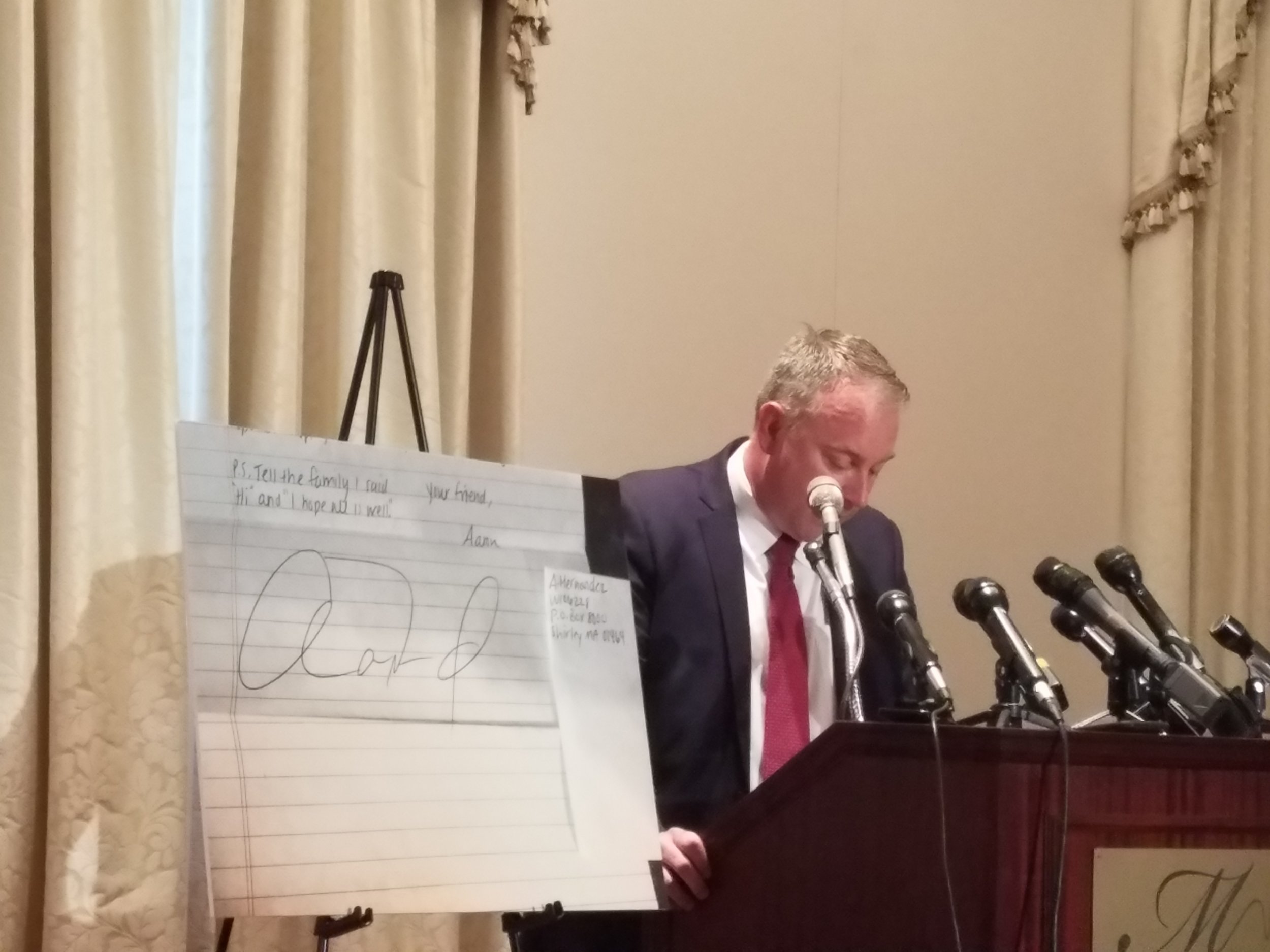
The suicide note left by Aaron Hernandez—the former New England Patriots tight end who died by suicide in his prison cell in April 2017—remains one of the most heavily scrutinized documents in modern sports history. Recovered alongside his Bible and personal effects by investigators at the Souza-Baranowski Correctional Center, the notes were eventually made public by Massachusetts authorities following intense media scrutiny, public records requests, and legal battles pursued by news organizations. The documents shed light on the final mindset of a high-profile athlete whose life descended from professional athletic achievement to criminal conviction for murder and subsequent incarceration.
Background and Context of the Incarceration
To understand the nature and distribution of the writings left behind, it is necessary to examine the legal and institutional circumstances surrounding Aaron Hernandez during his final months. In April 2015, Hernandez was convicted of the first-degree murder of Odin Lloyd, a semi-professional football player who was dating the sister of Hernandez's fiancée. The conviction carried a mandatory sentence of life imprisonment without the possibility of parole, served at the maximum-security Souza-Baranowski Correctional Center in Shirley, Massachusetts.
While serving this sentence, Hernandez faced additional legal jeopardy. In May 2016, he was indicted for a 2012 double homicide in Boston involving Daniel de Abreu and Safiro Furtado. The trial for these charges took place in early 2017 in Suffolk Superior Court. On April 14, 2017, a jury acquitted Hernandez of the double murder charges, convicting him only of unlawful possession of a firearm.
Just days after this acquittal, in the early morning hours of April 19, 2017, correctional officers discovered Hernandez unresponsive in his single cell. He had hanged himself using a bedsheet attached to the window bars. Prison officials and emergency responders attempted life-saving measures, but he was pronounced dead at a nearby hospital. State police and correctional investigators immediately secured the cell, initiating standard protocols for inmate deaths, which included the recovery of handwritten items, personal letters, and religious texts.
Discovery and Official Release of the Writings
Following the discovery of the body, investigators cataloged several handwritten notes left inside the cell. Under Massachusetts public records law, these documents eventually became subject to disclosure, though the process involved significant administrative review, notification of family members, and legal motions.
The Massachusetts State Police and the Worcester County District Attorney's office managed the initial investigation. Officials confirmed that three handwritten notes had been found: one addressed to his fiancée, Shayanna Jenkins-Hernandez; one addressed to his daughter, Avielle; and a third addressed to his legal defense team or an unnamed friend, which later drew intense public interest.
| Document Recipient | Medium / Location | Verified Release Status | Primary Focus of Content |
|---|---|---|---|
| Daughter (Avielle) | Handwritten on paper / Found in cell | Publicly released via official record | Expressions of parental affection, advice, and emotional reassurance. |
| Fiancée (Shayanna Jenkins-Hernandez) | Handwritten on paper / Found in cell | Publicly released via official record | Personal farewells, instructions regarding family matters, and emotional sentiments. |
| Recipient C (Commonly reported as a friend/cellmate) | Handwritten on paper / Found in cell | Publicly released via official record | References to spiritual beliefs, the afterlife, and personal philosophy. |
The release of these documents did not occur instantaneously. Attorneys representing the Hernandez estate, along with family members, initially sought to delay or restrict full public access, citing privacy concerns and the sensitive nature of suicide. However, news organizations, including The Boston Globe and local network affiliates, filed public records requests. By May 2017, the state released redacted versions of the notes, and the content was widely disseminated across national and international media outlets.
Content Analysis of the Recovered Notes
The contents of the recovered writings reflect a mix of personal grief, religious conviction, and final farewells. Handwriting experts and investigators authenticated the notes, matching them against known writing samples from Hernandez during his time in prison and prior legal proceedings.
The Note to His Daughter
The letter addressed to his young daughter focused primarily on paternal love and an attempt to provide comfort from beyond. Reports from investigators and subsequent media reports highlighted that Hernandez urged her to remember him fondly and expressed regret over missing her upbringing. The tone was characterized by emotional appeals and a desire to shield her from the stigma of his actions and death.
The Note to His Fiancée
The communication directed to Shayanna Jenkins-Hernandez addressed their shared history and offered instructions for managing personal affairs. In these lines, Hernandez referenced his belief in an afterlife and expressed a conviction that their separation was temporary in a spiritual sense. The language underscored the emotional strain of long-term incarceration and the isolation he experienced following his conviction.
The Third Note and Spiritual Themes
A third note, which generated significant media discussion, contained references to biblical passages, notably John 3:16 ("For God so loved the world..."). Hernandez had marked passages in the Bible found on his cell floor. The text of the note suggested a preoccupation with redemption, spiritual awakening, and the transition from earthly suffering to a perceived heavenly existence. Investigators noted that Hernandez had exhibited increasing religious engagement during his final months in maximum security.
Legal, Institutional, and Societal Aftermath
The suicide of Aaron Hernandez prompted widespread examination of prison administration, legal doctrine, and the neurological condition of the athlete.
The Legal Doctrine of Abatement
Following his death, Hernandez's legal team invoked a historical Massachusetts legal principle known as *abatement ab initio (from the beginning). Under this doctrine, because Hernandez died while his direct appeal for the Odin Lloyd murder conviction was pending and had not yet been exhausted through the appellate courts, the conviction was formally vacated.
The Worcester County District Attorney and the Massachusetts courts debated the application of this rule. In October 2017, a judge formally vacated the conviction, though legal scholars and victims' advocates heavily criticized the outcome, arguing that it left the legal status of the case unresolved and denied finality to the Lloyd family. The civil lawsuit filed by the Lloyd family against the Hernandez estate, however, proceeded independently of the criminal abatement ruling.
Chronic Traumatic Encephalopathy (CTE) Findings
A significant development following the death of Hernandez involved the examination of his brain tissue. At the request of his family, his brain was donated to Boston University's CTE Center, led by Dr. Ann McKee. In July 2017, researchers announced that Hernandez suffered from Stage 3 chronic traumatic encephalopathy (out of a four-stage scale).
Dr. McKee and her team reported that Hernandez's brain exhibited severe damage, comparable to the pathology observed in much older former NFL players with decades of career exposure. The findings showed extensive accumulation of tau protein in the frontal lobes, which affect decision-making, impulse control, and emotional regulation. While medical and legal experts debated the exact causal relationship between CTE and criminal behavior, the diagnosis became a central point of discussion in subsequent civil litigation filed by Hernandez's estate against the National Football League and the New England Patriots.
Institutional Protocols and Scrutiny
The Souza-Baranowski Correctional Center faced internal and external reviews following the incident. State corrections officials evaluated procedures regarding suicide watch assessments, cell inspections, and the handling of personal property. Investigations confirmed that Hernandez had blocked the door to his cell from the inside with cardboard and other items, a tactic utilized to delay entry by responding officers. Consequently, correctional facilities across the region adjusted protocols regarding cell door visibility, obstruction checks, and monitoring routines for high-profile inmates.
Frequently Asked Questions
Were the Aaron Hernandez suicide notes ever published in full?
Yes. Following public records requests by media organizations and the conclusion of initial state police reviews, redacted versions of the handwritten notes were released to the public in May 2017. Certain personal details involving minor family members were partially redacted to protect privacy, but the substantive text was published by major news outlets.
What did the notes reveal about his motive?
The notes did not provide a single, definitive explanation for his suicide. Instead, they focused on personal farewells, expressions of love for family members, and references to spiritual beliefs and an afterlife. Investigators and psychologists noted that the combination of life imprisonment without parole, ongoing legal battles, and extreme isolation contributed to his state of mind.
How did the legal status of his murder conviction change after his death?
Because Hernandez died while his direct appeal was pending, his legal team successfully petitioned to vacate his 2015 murder conviction under the Massachusetts legal doctrine of abatement ab initio. This ruling meant that, technically, he died an unconvicted man regarding the Odin Lloyd case, though it did not alter the factual findings of the original trial or prevent civil liability.
What was the result of the brain examination performed after his death?
Researchers at Boston University examined his brain tissue and diagnosed him with Stage 3 chronic traumatic encephalopathy (CTE). The condition, associated with repetitive head trauma, showed severe neurodegeneration in areas of the brain controlling impulse control, judgment, and emotion.
Are the original notes accessible to the general public today?
The original physical documents remain part of the closed Massachusetts State Police investigative file. However, authenticated transcripts and photographs of the released pages are widely documented in news archives, court records, and investigative journalism books examining the case.