To calculate quarterly estimated payments using the 2025 estimated tax worksheet (found in IRS Form 1040-ES), project your total expected adjusted gross income, deductions, and credits for the year. Subtract anticipated W-2 withholding, add self-employment tax, apply the applicable safe harbor rule, and divide the final tax liability by four to determine your quarterly payment.
Disclaimer: This guide is provided for educational and informational purposes only and does not constitute formal tax, legal, or accounting advice. Federal tax laws and individual financial circumstances vary; consult a certified public accountant (CPA) or qualified tax professional for personal guidance.
Who Needs to Pay Quarterly Estimated Taxes?
The United States operates on a pay-as-you-go tax system. This means the Internal Revenue Service (IRS) requires income tax to be paid as income is earned throughout the tax year, rather than in a single lump sum when filing an annual tax return.
For traditional employees, employers withhold federal income tax, Social Security, and Medicare directly from each paycheck. However, individuals who receive income not subject to withholding must make estimated tax payments directly to the IRS.
According to IRS guidelines, you generally must pay estimated taxes if both of the following conditions apply:
- You expect to owe at least $1,000 in federal tax for the year after subtracting your federal income tax withholding and refundable credits.
- You expect your withholding and refundable credits to be less than the smaller of:
- 90% of the tax to be shown on your current tax return, or
- 100% of the tax shown on your prior year’s tax return (110% if your prior year's Adjusted Gross Income was over $150,000, or $75,000 if married filing separately).
Common Taxpayers Subject to Estimated Taxes
- Self-Employed Individuals & Sole Proprietors: Freelancers, independent contractors, gig workers, and business owners operating as sole proprietors.
- Partners and S Corporation Shareholders: Business owners who receive pass-through business income reported on Schedule K-1.
- Investors and Retirees: Individuals receiving substantial dividend income, taxable interest, capital gains, passive rental income, or taxable pension and IRA distributions that lack sufficient tax withholding.
- W-2 Employees with Side Income: Full-time employees who earn supplemental self-employment or investment income that exceeds what their standard job withholding covers.
Key Prerequisites and Documents Needed Before You Begin
Before filling out the IRS Form 1040-ES Estimated Tax Worksheet, gather your financial records to ensure your income projections and deduction estimates are as accurate as possible.
Essential Documentation
- Prior Year Tax Return: Your completed Form 1040 from the previous tax year serves as your primary baseline for income, deductions, and tax liability calculations.
- Year-to-Date Accounting Statements: Profit and loss statements, income ledgers, or invoices detailing your gross business earnings and deductible business expenses.
- Form 1099 Records: Previous 1099-NEC, 1099-MISC, 1099-INT, 1099-DIV, or 1099-B tax documents.
- W-2 Pay Stubs (if applicable): Current pay stubs for you or your spouse showing year-to-date income tax withholding.
- Records of Adjustments & Deductions: Statements for health insurance premiums paid, retirement account contributions (Traditional IRA, SEP-IRA, Solo 401(k)), and Health Savings Account (HSA) contributions.
Step-by-Step Guide to the IRS Form 1040-ES Estimated Tax Worksheet
The official worksheet contained within IRS Form 1040-ES breaks down your estimated tax calculation into logical lines. Following these steps sequentially ensures you do not overpay or incur underpayment penalties.
- STEP 1: Estimate Adjusted Gross Income (AGI)
- (Gross Income - Above-the-Line Adjustments)
- STEP 2: Calculate Net Self-Employment Income & SE Tax
- (Net Profit x 92.35% x 15.3% SE Tax Rate)
- STEP 3: Subtract Deductions (Standard/Itemized + QBI Deduction)
- (Yields Taxable Income)
- STEP 4: Compute Total Tax Liability
- (Income Tax + SE Tax + Other Taxes - Tax Credits)
- STEP 5: Apply Safe Harbor & Subtract Anticipated Withholding
- (Smaller of 90% Current Year or 100%/110% Prior Year Tax)
- STEP 6: Divide Remaining Balance by 4
- (Equals Your Quarterly Estimated Payment Amount)
Step 1: Estimating Your Adjusted Gross Income (AGI)
Begin by estimating your total expected gross income for the entire tax year. This includes all forms of taxable income:
- Net profit from self-employment (gross income minus deductible business expenses)
- W-2 wages or salaries
- Taxable interest and dividends
- Capital gains from stock or asset sales
- Rental income and passive enterprise profits
From your total estimated income, subtract expected "above-the-line" adjustments to derive your estimated Adjusted Gross Income (AGI). Common adjustments include:
- Half of your calculated self-employment tax (calculated in Step 2)
- Self-employed health insurance deductions
- Contributions to self-employed retirement plans (SEP-IRA, SIMPLE IRA, or Solo 401(k))
- Contributions to a traditional IRA or Health Savings Account (HSA)
Step 2: Calculating Self-Employment Tax
If you have self-employment income, you must calculate self-employment tax (Social Security and Medicare taxes) alongside regular income tax.
- Determine Net Self-Employment Earnings: Take your total projected self-employment revenue and subtract allowable business expenses. Multiply this net profit figure by 92.35% (0.9235) to establish your net earnings subject to self-employment tax.
- Apply the Self-Employment Tax Rate: The standard self-employment tax rate is 15.3%, which consists of:
- 12.4% for Social Security (up to the annual Social Security wage base limit).
- 2.9% for Medicare (applied to all net self-employment earnings without income limit).
- Account for Additional Medicare Tax: An additional 0.9% Medicare tax applies to self-employment income exceeding threshold amounts ($250,000 for married filing jointly; $200,000 for single filers).
Example: If your projected net business profit is $80,000:
- Net earnings subject to SE tax: $\$80,000 \times 0.9235 = \$73,880$
- Estimated SE Tax: $\$73,880 \times 0.153 = \$11,303.64$
- Deductible portion of SE Tax (50%): $\$11,303.64 \times 0.50 = \$5,651.82$ (subtracted when calculating AGI in Step 1).
Step 3: Deductions and Qualified Business Income (QBI)
Once you have established your estimated AGI, subtract your estimated standard deduction or itemized deductions:
- Standard Deduction vs. Itemized Deductions: Subtract the applicable standard deduction for your filing status (Single, Married Filing Jointly, Head of Household) or your estimated itemized deductions (state taxes, mortgage interest, charitable donations) if they exceed the standard deduction threshold.
- Qualified Business Income (QBI) Deduction (Section 199A): Eligible sole proprietorships, partnerships, and S corporations may deduct up to 20% of net qualified business income, subject to taxable income limitations and phase-outs.
Subtracting these deductions from your estimated AGI leaves you with your Estimated Taxable Income.
Step 4: Determining Income Tax and Total Tax Obligation
Calculate your base regular income tax by applying the official federal income tax brackets to your estimated taxable income. If you have long-term capital gains or qualified dividends, calculate their tax using the lower preferential capital gains tax rates.
Next, combine your individual tax obligations to find your Total Estimated Tax: $$\text{Total Tax} = \text{Regular Income Tax} + \text{Self-Employment Tax} + \text{Alternative Minimum Tax / Other Taxes} - \text{Tax Credits}$$
Subtract nonrefundable tax credits (such as the Child Tax Credit, Credit for Other Dependents, or Foreign Tax Credit) to calculate your final projected tax liability.
Step 5: Applying Safe Harbor Rules to Avoid Penalties
The IRS provides specific legal benchmarks—known as Safe Harbor rules—that protect taxpayers from underpayment penalties, even if their estimated payments fall short of their actual tax bill at the end of the year.
To satisfy the Safe Harbor requirements, your total annual payments (withholding plus quarterly payments) must equal or exceed the lesser of:
- 90% Rule: 90% of the total tax liability shown on your tax return for the current year.
- 100% / 110% Prior-Year Rule:
- 100% of the total tax tax liability shown on your prior year’s tax return (provided the return covered a full 12 months).
- 110% of the prior year's tax liability if your prior year's Adjusted Gross Income exceeded $150,000 ($75,000 if married filing separately).
Using the 100% or 110% prior-year rule is generally the safest strategy for freelancers and business owners with unpredictable or growing income, as your prior-year tax is a known, fixed figure.
Step 6: Calculating Your Final Quarterly Payment Amount
After determining your required annual payment under the safe harbor rule:
- Subtract Anticipated Withholding: Deduct any federal income tax that will be withheld from W-2 paychecks, pensions, or other sources during the tax year.
- Divide by Four: Divide the remaining balance by four to determine your required quarterly estimated tax payment amount.
$$\text{Quarterly Payment} = \frac{\text{Required Annual Safe Harbor Payment} - \text{Total Annual Withholding}}{4}$$
Quarterly Tax Due Dates and Payment Schedule
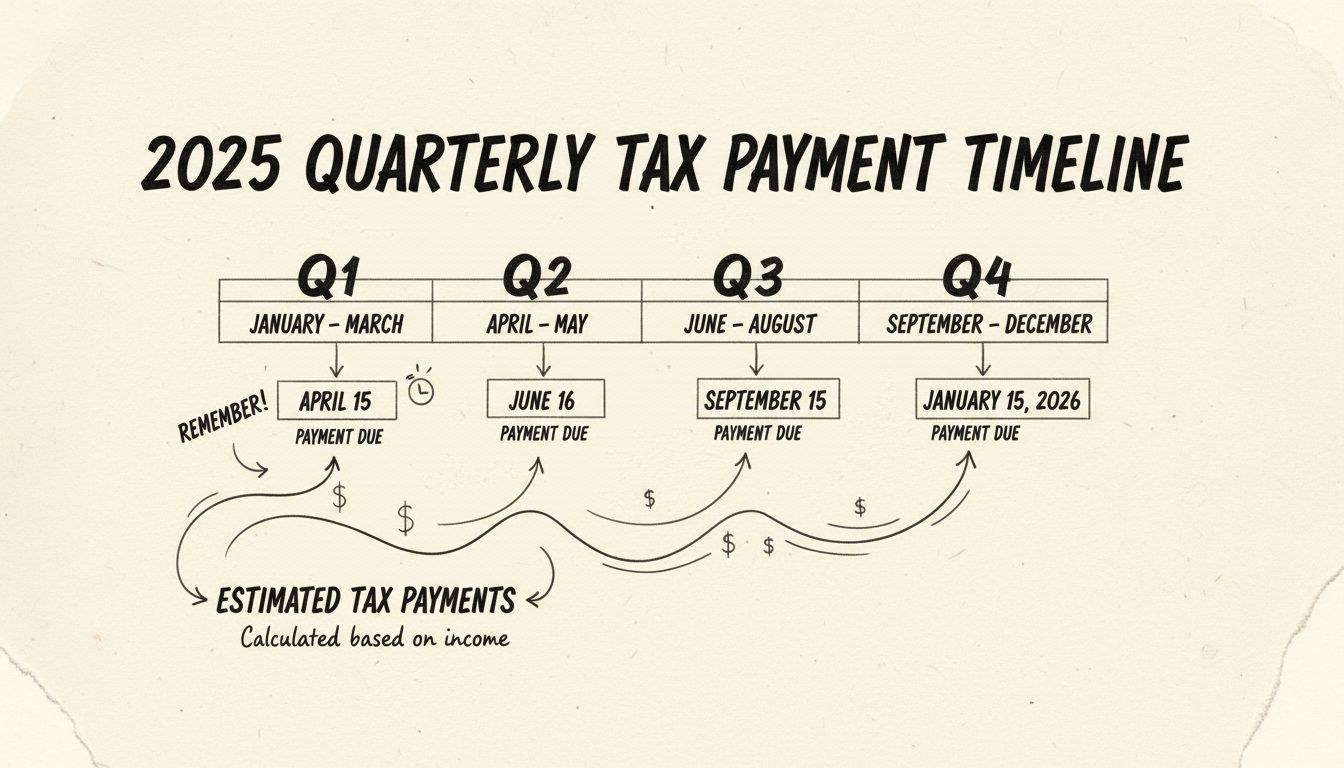
Quarterly estimated tax payments are not spaced evenly across the calendar year. Instead, the payment periods vary in length. Paying on time according to the official schedule prevents interest charges and late penalties.
The standard due dates for calendar-year taxpayers are outlined below:
| Payment Period | Income Earned Window | IRS Quarterly Due Date |
|---|---|---|
| 1st Payment (Q1) | January 1 – March 31 | April 15 |
| 2nd Payment (Q2) | April 1 – May 31 | June 15 |
| 3rd Payment (Q3) | June 1 – August 31 | September 15 |
| 4th Payment (Q4) | September 1 – December 31 | January 15 (of the following year) |
Note: If a payment due date falls on a Saturday, Sunday, or official federal holiday, the deadline is extended to the immediate next business day. Taxpayers residing in designated federal disaster areas may also receive extended payment deadlines published by the IRS.
How to Submit Your Estimated Tax Payments to the IRS
The IRS offers several electronic and physical channels to submit estimated tax payments. Electronic methods are strongly recommended because they provide instant digital confirmation of receipt.
- IRS Payment Submission Methods
- IRS Direct Pay (Bank Account)
- EFTPS (Enrollment)
- Credit / Debit (Third-Party)
1. IRS Direct Pay
IRS Direct Pay allows individual taxpayers to make secure tax payments directly from a checking or savings account without paying any transaction fees. Select "Estimated Tax" as the reason for payment and designate the appropriate tax year when submitting.
2. Electronic Federal Tax Payment System (EFTPS)
The Electronic Federal Tax Payment System (EFTPS) is a free government system suitable for both business and individual tax payments. EFTPS allows users to schedule recurring estimated payments in advance and track complete payment history. Note that new users must complete an online enrollment process to receive a PIN by physical mail before placing their first payment.
3. Credit or Debit Card Payments
Taxpayers can pay using debit or credit cards through authorized payment processors listed on the IRS Payments page. While convenient, third-party payment processors charge processing fees (typically a fixed rate for debit cards or a percentage-based fee around 1.8% to 2.0% for credit cards).
4. Mail via Form 1040-ES Payment Voucher
If paying by check or money order, mail your payment accompanied by the physical paper Payment Voucher found inside Form 1040-ES. Make the check payable to the "United States Treasury" and write your Social Security Number (or ITIN), the tax year, and "Form 1040-ES" in the memo line. Mail the voucher to the specific IRS address designated for your state of residence.
Handling Fluctuating Income: The Annualized Income Installment Method
Calculating quarterly payments by taking a flat 25% of annual estimated earnings works well for taxpayers with consistent monthly income. However, for seasonal workers, commission-based sales representatives, or businesses with highly volatile revenues, equal quarterly payments can cause cash flow strain during low-income quarters.
If your income is earned unevenly throughout the year, you can use the Annualized Income Installment Method.
How the Annualized Method Works
Instead of paying four equal amounts, you calculate your tax liability at the end of each quarterly period based on your actual income and expenses from the beginning of the year through the end of that specific period:
- Q1 Period (Jan 1 – Mar 31): Multiply actual 3-month income by 4 to project annual income.
- Q2 Period (Jan 1 – May 31): Multiply actual 5-month income by 2.4 to project annual income.
- Q3 Period (Jan 1 – Aug 31): Multiply actual 8-month income by 1.5 to project annual income.
- Q4 Period (Jan 1 – Dec 31): Use actual 12-month income.
To use this method, you must complete and attach IRS Form 2210 (Underpayment of Estimated Tax by Individuals, Estates, and Trusts) Schedule AI with your annual tax return. Form 2210 demonstrates to the IRS that your lower quarterly payments corresponded directly to periods of lower earnings, waiving potential underpayment penalties. Detailed guidelines on annualization rules can be reviewed in IRS Publication 505.
Common Pitfalls and How to Avoid Underpayment Penalties
Failing to calculate or pay estimated taxes correctly can result in unnecessary interest penalty charges assessed by the IRS under Section 6654 of the Internal Revenue Code.
| Common Estimated Tax Pitfalls |
|---|
| 1. Forgetting State & Local Quarterly Estimated Taxes |
| 2. Neglecting Self-Employment (Social Security & Medicare) Taxes |
| 3. Skipping Payments After Large One-Time Asset Sales / Capital Gains |
| 4. Missing Quarterly Deadlines (Unequal Period Intervals) |
| 5. Failing to Re-Evaluate Income Mid-Year |
1. Forgetting State Estimated Taxes
Federal tax is only one part of estimated tax obligations. Most states with a state income tax require separate quarterly estimated tax payments. Check with your state department of revenue for local thresholds, filing worksheets, and deadline specifics.
2. Ignoring Self-Employment Tax
A common oversight for new freelancers is estimating payments based solely on federal income tax brackets while failing to account for the 15.3% self-employment tax. Because self-employment tax applies starting at $400 of net earnings, failing to factor it into Form 1040-ES leads to substantial year-end underpayments.
3. Overlooking One-Time Financial Events
If you sell real estate, realize significant capital gains from stock sales, or receive an unexpected inheritance/bonus, your tax liability increases immediately. Re-run the 1040-ES worksheet whenever a significant financial event occurs to adjust your remaining quarterly payments upward.
4. Relying on Incorrect Period Splits
Quarterly payments are not divided into four equal three-month calendar quarters. The second payment period (April 1 to May 31) spans only two months, making Q2 due quickly after Q1. Planning cash flow around these actual IRS calendar intervals prevents missed payments.
5. What to Do If You Calculate an Underpayment Penalty
If you miss a deadline or underpaid estimated taxes during the year, file your annual tax return on time and calculate the penalty using IRS Form 2210, or allow the IRS to calculate the penalty and send you an invoice. You may qualify for a penalty waiver if your underpayment was caused by a casualty, disaster, or unusual circumstance, or if you retired or became disabled during the tax year.
Frequently Asked Questions
What happens if I make a mistake on my estimated tax worksheet?
You do not mail the Form 1040-ES estimated tax worksheet to the IRS; it is designed solely for your personal calculations. If your income or deductions change during the year, simply re-calculate the worksheet for the remaining quarters and adjust your future payment amounts accordingly.
Can I adjust my W-2 withholding instead of making quarterly payments?
Yes. If you or your spouse work a traditional W-2 job while running a side business, you can increase the federal income tax withheld from your employer paychecks by submitting a revised Form W-4. Federal tax withholding is treated by the IRS as if it were paid evenly throughout the year, which can eliminate the need to submit separate quarterly payment vouchers.
Is there a penalty if I pay my estimated taxes late?
Yes. The IRS charges an underpayment penalty based on the interest rate established each quarter for late payments. The penalty is calculated for each specific quarterly period that payments were late or underpaid, even if you are owed a tax refund when filing your final annual return.
Do I need to pay quarterly taxes if this is my first year being self-employed?
If you had zero tax liability in the prior full 12-month tax year (meaning your total tax on Form 1040 line 24 was zero, or you were not required to file), you are exempt from estimated tax penalties for the current year. However, if you owe taxes at year-end, you must pay the balance in full when filing your return, and you will be subject to estimated tax rules in subsequent years.
What is the safest way to avoid an underpayment penalty?
The most reliable method is to satisfy the 100% or 110% prior-year Safe Harbor rule. Calculate your total tax liability from your prior year's tax return, divide that amount by four (or add 10% first if your prior-year AGI was over $150,000), and pay that exact amount across the four quarterly deadlines.
Final Takeaway and Recommended Next Steps
Accurately calculating your quarterly estimated tax payments is essential for keeping your personal and business finances structured while avoiding IRS underpayment penalties.
To maintain compliance and manage cash flow effectively:
- Download IRS Form 1040-ES: Access the latest version directly from the official IRS website.
- Review Prior-Year Tax Figures: Check line 24 (Total Tax) of your prior year Form 1040 to establish your Safe Harbor baseline target.
- Set Aside Funds Monthly: Transfer roughly 25% to 30% of net self-employment earnings into a dedicated tax savings account each month.
- Automate Reminders & Payments: Set calendar alerts for April 15, June 15, September 15, and January 15, or schedule payments in advance using EFTPS or IRS Direct Pay.
- Consult a Licensed Professional: Work with a Certified Public Accountant (CPA) or Enrolled Agent (EA) to review complex tax scenarios, specialized business deductions, and state-specific quarterly obligations.