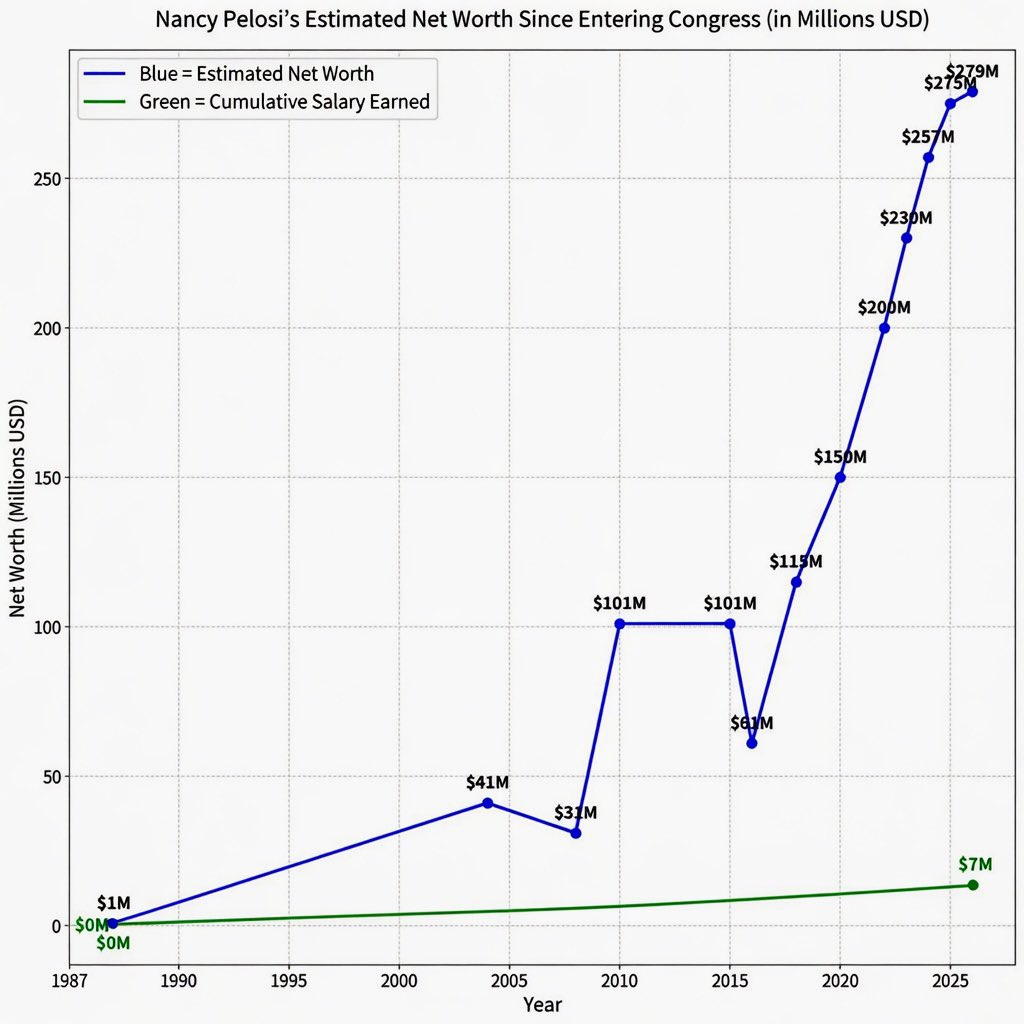
In 2013, Nancy Pelosi’s net worth was estimated at a median of approximately $94,303,502, according to financial disclosure reports filed with the U.S. House of Representatives. Due to the broad reporting ranges required by law, her wealth was officially calculated within a spread ranging from a minimum of $24.7 million to a maximum of $160.2 million.
Congressional wealth is a subject of intense public scrutiny, particularly regarding how high-ranking officials manage personal assets while crafting national policy. Nancy Pelosi, who served as the House Minority Leader in 2013, has consistently ranked among the wealthiest members of Congress. Her financial status is inextricably linked to the professional activities of her husband, Paul Pelosi, a successful venture capitalist and real estate investor.
To understand the nuances of the 2013 valuation, one must examine the specific assets held during that period, the regulatory framework of the Ethics in Government Act, and the broader economic context of the early 2010s.
Understanding Congressional Financial Disclosures
The figures regarding Nancy Pelosi’s 2013 net worth are derived from the annual financial disclosure statements that all members of Congress must file. These reports are mandated by the Ethics in Government Act of 1978 and further refined by the STOCK Act (Stop Trading on Congressional Knowledge Act) of 2012.
It is important to note that these disclosures do not require exact dollar amounts for most assets and liabilities. Instead, they utilize lettered ranges. For example, an asset might be listed in the range of $1,000,001 to $5,000,000. This system creates a significant gap between the "minimum" and "maximum" possible net worth of any representative. Financial analysts typically use the "median" or "average" of these ranges to provide a singular estimate for public consumption.
The Role of the STOCK Act in 2013
The year 2013 was particularly significant for congressional transparency. The STOCK Act, which had been signed into law in April 2012, was fully operational. It prohibited members of Congress from using non-public information for private profit and required more frequent reporting of stock trades (within 45 days of the transaction).
As Minority Leader in 2013, Pelosi’s filings were under a microscope. Critics and watchdogs used these new transparency rules to track her family’s moves in the technology and real estate sectors, which have long been the primary drivers of the Pelosi family fortune.
Breakdown of Nancy Pelosi’s 2013 Net Worth
The 2013 filing revealed a diverse portfolio heavily weighted toward commercial real estate and venture capital through her husband's firm, Financial Leasing Services, Inc. While Nancy Pelosi herself does not technically own many of these assets in her own name, the joint nature of their holdings requires full disclosure of her spouse's interests.
Key Real Estate Holdings
Real estate has historically formed the bedrock of the Pelosis' wealth. In 2013, several high-value properties were central to their financial profile:
- Zinfandel Lane Vineyard, St. Helena: This property in Napa Valley was one of the most prominent assets in the 2013 filing. Valued between $5 million and $25 million, the vineyard produces grapes for sale rather than a private wine label.
- San Francisco Residential Property: The couple’s primary residence in the Pacific Heights neighborhood of San Francisco, while not always fully valued in the same way as income-producing property, represents a significant portion of their equity.
- Commercial Interests in San Francisco and Beyond: The 2013 reports listed interests in various commercial buildings, including a four-story office building on Belden Alley and a partnership interest in a luxury hotel/residential complex.
Investment Portfolio and Stocks
In 2013, the Pelosi family held significant positions in major American corporations. While many of these were held through Paul Pelosi’s investment vehicles, they remained part of the public record. Notable holdings during this period included:
- Apple Inc. (AAPL): Large positions in Apple have been a staple of the Pelosi portfolio for years.
- Walt Disney Co. (DIS): A consistent holding that contributed to the family’s dividend income.
- Comcast Corp. (CMCSA): Reflecting investments in the telecommunications and media sectors.
- Visa Inc. (V): This particular holding was the subject of public debate following a 2011 "60 Minutes" report, though the Pelosis maintained that all trades were legal and ethical.
Comparative Analysis of 2013 Assets and Liabilities
To gain a clear picture of the Pelosi family's financial standing in 2013, it is necessary to balance their massive asset base against their significant liabilities. Like many high-net-worth real estate investors, the Pelosis utilize debt strategically, maintaining several large mortgages.
| Asset/Liability Category | Estimated Minimum (2013) | Estimated Maximum (2013) |
|---|---|---|
| Real Estate Holdings | $18,500,000 | $85,000,000 |
| Stock & Securities | $5,200,000 | $22,000,000 |
| Business/Partnerships | $15,000,000 | $75,000,000 |
| Total Gross Assets | $38,700,000 | $182,000,000 |
| Total Liabilities (Mortgages/Loans) | $14,000,000 | $21,800,000 |
| Estimated Net Worth | $24,700,000 | $160,200,000 |
Note: Data based on 2013 Financial Disclosure Reports and analysis by OpenSecrets.
The Impact of Valuation Ranges on Public Perception
The wide gap between the $24 million floor and the $160 million ceiling in 2013 highlights a common frustration with congressional financial reporting. Because the law allows assets to be reported in such broad increments, it is difficult for the public to determine exactly how much a member of Congress is worth.
For instance, a commercial property worth $6 million and one worth $24 million might both be categorized in the "$5,000,001 to $25,000,000" range. This lack of precision often leads to "worst-case" or "best-case" scenarios being presented by political allies or opponents. In 2013, the median estimate of $94.3 million was the most widely accepted figure among non-partisan financial analysts.
Paul Pelosi’s Professional Influence
It is impossible to analyze Nancy Pelosi’s 2013 net worth without acknowledging the role of Paul Pelosi. As the owner of Financial Leasing Services, he managed the family’s investments in a way that is typical for a private equity and venture capital professional.
In 2013, his investments were centered on the "New Economy," focusing heavily on technology firms in the nearby Silicon Valley. His business acumen allowed the family to see significant capital appreciation during the market recovery that followed the 2008 financial crisis. By 2013, the S&P 500 had seen several years of growth, which directly correlated with the increase in the Pelosis' reported wealth compared to disclosures from 2009 or 2010.
Legislative Scrutiny and Financial Interests
In 2013, as Minority Leader, Pelosi was a central figure in debates over the federal budget, healthcare implementation, and environmental regulations. Critics often pointed to her family’s real estate and tech holdings as potential areas of conflict.
However, the 2013 disclosures did not reveal any violations of House ethics rules. The assets held were largely in broad market leaders or established real estate ventures. The Pelosis have historically argued that their investments are managed independently of Nancy Pelosi’s legislative duties, and that their wealth was largely built before she ascended to the top leadership positions in the House.
Comparative Context: Pelosi vs. Her Peers
In 2013, Nancy Pelosi was not the wealthiest member of Congress, despite her high profile. She typically ranked in the top 15. Other wealthy members at the time included:
- Darrell Issa (R-CA): Often ranked as the wealthiest member, with a net worth estimated over $350 million.
- Michael McCaul (R-TX): Estimated wealth frequently exceeding $100 million.
- Mark Warner (D-VA): A former tech mogul with a net worth often estimated above $200 million.
Pelosi's position as a high-ranking Democrat often made her wealth a more prominent talking point for political commentators than the wealth of her peers, despite several Republicans holding higher net worths in the same period.
Practical Guidance for Researching Historical Net Worth
When analyzing historical financial data for public figures, it is essential to use verified sources. The following steps are recommended for those looking to verify congressional wealth:
- Access Official Filings: Use the House of Representatives’ Office of the Clerk website to search for Financial Disclosure Statements.
- Consult Non-Partisan Watchdogs: Organizations like OpenSecrets (Center for Responsive Politics) provide digitized and analyzed versions of these reports, making the data much easier to interpret.
- Understand Asset Volatility: Remember that net worth in 2013 was a snapshot in time. Stock market fluctuations and real estate market trends in California significantly impact these numbers from year to year.
- Differentiate Between Personal and Joint Assets: Most congressional wealth is reported as "Joint," "Spouse," or "Dependent Child," which is crucial for understanding who actually manages the capital.
Frequently Asked Questions
How much did Nancy Pelosi earn as a salary in 2013?
As the House Minority Leader in 2013, Nancy Pelosi’s annual salary was $193,400. This salary is set by law and is separate from her investment income or the net worth derived from her family’s assets.
Did Nancy Pelosi own any stocks directly in 2013?
The majority of the stocks listed in the 2013 disclosure were held by her husband, Paul Pelosi, or held jointly. Most of these investments were managed through their private investment firm, Financial Leasing Services.
Why is there such a large range in her 2013 net worth estimate?
Congressional disclosure laws only require members to report assets in broad ranges (e.g., $1,000,001–$5,000,000). Because the Pelosis own many high-value assets, the difference between the minimum possible value and the maximum possible value can span over $100 million.
What was the most valuable asset Nancy Pelosi reported in 2013?
The most valuable individual asset was typically the Zinfandel Lane vineyard and residence in St. Helena, California, which was valued at up to $25 million, followed closely by various commercial real estate partnerships in San Francisco.
Did the STOCK Act affect Nancy Pelosi’s 2013 filings?
Yes. The STOCK Act required more rigorous and timely reporting of securities transactions. While it didn't necessarily change her net worth, it increased the transparency of the trades made by her family throughout the year.
Summary of 2013 Financial Standing
The year 2013 represented a period of stability and growth for Nancy Pelosi’s net worth. With a median valuation of $94.3 million, she remained one of the most affluent members of the U.S. government. Her wealth was characterized by a heavy concentration in California real estate and a diverse portfolio of blue-chip technology and service-sector stocks.
While the ranges provided by congressional disclosures offer a broad rather than precise look at her finances, the data confirms that the Pelosi family's wealth was well-positioned to benefit from the post-2008 economic expansion. For those researching this topic in 2026, the 2013 filings serve as a vital historical baseline for understanding the long-term growth of political wealth in the United States.