Navigating workers' compensation requirements for 1099 independent contractors in Hialeah, Florida, requires a careful understanding of Florida’s Division of Workers' Compensation statutes. Generally, independent contractors are not considered employees under Florida law and do not automatically qualify for mandatory workers' compensation coverage, but business owners must pass strict legal tests regarding control, corporate officer exemptions, and construction industry mandates to avoid severe liabilities.
Understanding Florida Workers' Compensation Laws for Independent Contractors
To understand how workers' compensation applies to 1099 workers in Hialeah, Florida, you must first examine how state law defines an employer-employee relationship. The state of Florida—governed primarily by Chapter 440 of the Florida Statutes—does not look merely at the label a business gives to a worker. Giving someone a Form 1099-NEC instead of a Form W-2 does not automatically exempt a hiring business from providing workers' compensation coverage if the actual working relationship resembles that of an employer and employee.
The Florida Division of Workers' Compensation, operating under the Department of Financial Services, uses a multi-factor "right of control" test. If a business dictates every hour of a worker's day, supplies all heavy tools and equipment, provides continuous direct supervision, and prevents the worker from taking on jobs for other clients, the state may reclassify that 1099 contractor as an employee. In the event of a workplace injury, this misclassification can lead to costly stop-work orders, steep administrative fines, and personal liability for the business owner.
In Hialeah—a bustling economic hub within Miami-Dade County known for its heavy concentrations of manufacturing, logistics, construction, and service industries—misclassifying workers is a major compliance risk. Local businesses routinely hire independent contractors for specialized tasks. However, navigating local subcontracting agreements without verifying proper insurance documentation can expose hiring entities to unexpected financial damages.
The Construction Industry Exception and Subcontractor Requirements
While general commercial and service industries afford some flexibility in defining independent contractors, the construction industry in Florida operates under entirely different and much stricter rules. Under Florida Statute Section 440.02, virtually every person performing construction work is presumed to be an employee, regardless of whether they hold an occupational license, possess a federal employer identification number (FEIN), or receive a 1099 tax form.
For businesses operating in Hialeah's active construction and remodeling sectors, hiring a 1099 independent contractor or subcontractor requires strict adherence to statutory compliance:
- Exemptions: Construction industry independent contractors can only be exempt from workers' compensation requirements if they personally hold a valid corporate officer exemption or an official Certificate of Election to be exempt issued by the State of Florida.
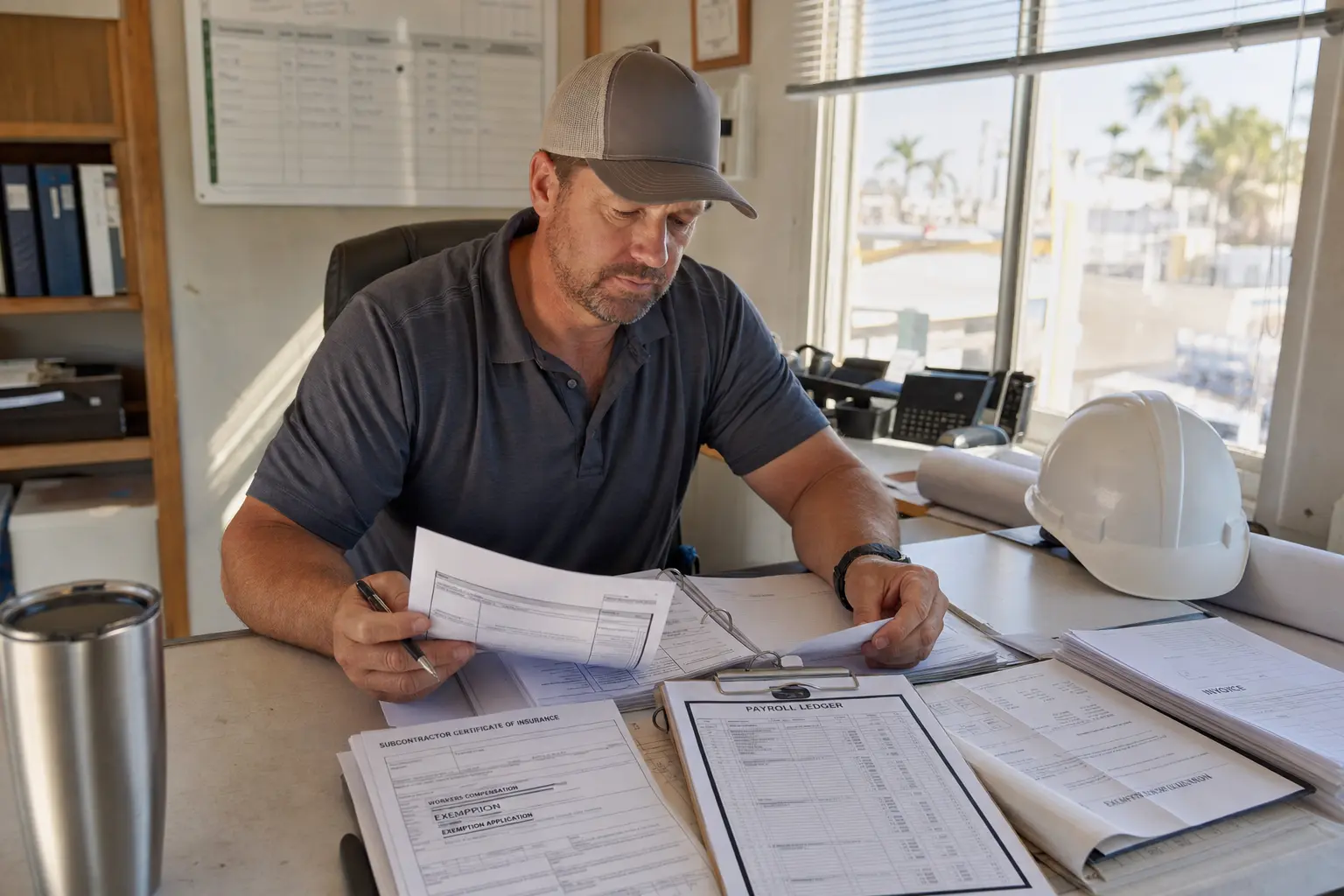
- Certificates of Insurance (COI): Hiring contractors must obtain a valid Certificate of Insurance showing active workers' compensation coverage from every subcontractor they bring onto a job site.
- General Contractor Liability: If a subcontractor's 1099 worker is injured on a Hialeah job site and the subcontractor lacks proper coverage, the general contractor's workers' compensation policy is typically on the hook for the claim. This often results in spiked premium audits and retroactive payment assessments.
Business owners must verify these certificates directly through the Florida Department of Financial Services database rather than relying solely on paper copies handed over by subcontractors, as fraudulent or lapsed certificates are a frequent source of liability.
Corporate Officers, LLC Members, and 1099 Status
The distinction between a sole proprietor operating as a 1099 contractor and a formal corporate entity or Limited Liability Company (LLC) member is vital when examining workers' compensation obligations in Hialeah. Many independent service providers incorporate themselves to project professionalism or limit personal liability, operating as single-member LLCs while still receiving 1099 forms from hiring companies.
In Florida, corporate officers in non-construction industries are automatically included in workers' compensation coverage unless they formally elect to be exempt. For construction industry businesses, up to three officers or LLC members can elect to be exempt from coverage, provided they own at least ten percent of the company. However, if a 1099 contractor is a sole proprietor operating without an LLC or corporation, they cannot file for a state exemption. They are simply an uninsured individual working for your enterprise, which shifts the risk profile significantly.
Summary of Worker Classifications and Coverage Rules in Florida
| Worker Classification | Standard 1099 Status | Non-Construction Coverage Requirement | Construction Coverage Requirement |
|---|---|---|---|
| Sole Proprietor / Independent Subcontractor | Yes | Optional, unless control test establishes an employee-employer relationship. | Mandatory, unless a valid state exemption certificate is held. |
| Single-Member LLC / Corporate Officer | Sometimes | Automatically included unless a formal corporate exemption is filed. | Strictly regulated; maximum of three exemptions allowed for qualifying officers. |
| Traditional W-2 Employee | No | Mandatory if the business employs four or more part-time or full-time workers. | Mandatory if the business has one or more employees (including the owner if corporate). |
Risks and Financial Consequences of Misclassifying 1099 Workers in Hialeah
Misclassifying a worker as a 1099 independent contractor to bypass workers' compensation insurance premiums is a high-stakes gamble that triggers severe regulatory penalties in Florida. The Bureau of Compliance within the Florida Division of Workers' Compensation actively investigates employers suspected of payroll fraud and misclassification.
When an investigator discovers uninsured workers performing tasks under conditions that legally constitute employment, the penalties are swift and severe:
- Stop-Work Orders: The state can immediately shut down operations at all project sites or business locations associated with the offending employer until proof of valid coverage is presented.
- Stop-Work Penalties: Employers can be forced to pay a penalty equal to twice the amount the business would have paid in workers' compensation premiums for the entire period the employees were uninsured, up to a maximum of a preceding three-year period.
- Double Penalties for Construction: In the construction sector, penalties are frequently compounded, and willful evasion can lead to third-degree felony charges for business owners and corporate officers.
Furthermore, if a 1099 worker sustains a catastrophic injury on a Hialeah property and successfully proves in court that they were functionally an employee subject to the business owner's day-to-day direction, the employer faces uninsured tort liabilities, civil lawsuits, and medical expense judgments that can force a company into bankruptcy.
Best Practices for Hialeah Business Owners Hiring 1099 Contractors
To protect your business from legal exposure while utilizing independent contractors, you must implement rigorous compliance protocols. Drafting robust operating agreements and maintaining clear separation between your enterprise and your contractors is essential.
- Establish Written Contracts: Draft clear independent contractor agreements that explicitly state the contractor maintains control over their methods, hours, and means of completing the work. Avoid clauses that dictate mandatory micromanagement or exclusive service hours.
- Require Proof of Insurance: Even if a 1099 contractor claims they do not need workers' compensation, request a Certificate of Insurance or a State of Florida Certificate of Election to be Exempt before letting them step onto a work site in Hialeah.
- Verify Independence: Ensure contractors supply their own specialized tools, market their services to multiple clients, operate under their own business licenses, and assume financial risk for project profitability.
- Consult Insurance Professionals: Partner with a licensed Florida workers' compensation insurance agent or an employment law attorney familiar with Miami-Dade County business practices to review your subcontractor agreements annually.
Disclaimer: Insurance regulations and statutory interpretations change frequently. Business owners in Hialeah, Florida, should consult directly with a qualified Florida workers' compensation attorney or certified insurance professional to address specific corporate compliance scenarios.
Frequently Asked Questions
Can I require my 1099 independent contractors in Hialeah to carry their own workers' compensation insurance?
Yes. You can stipulate in your independent contractor agreement that the worker must maintain an active occupational accident policy or a valid workers' compensation policy. Securing proof of this coverage before starting any project significantly reduces your exposure to vicarious liability.
Does a certificate of liability insurance cover workers' compensation for a 1099 worker?
No. General liability insurance covers property damage and third-party bodily injury, but it explicitly excludes workplace injuries sustained by workers performing duties for your business. You must verify a dedicated workers' compensation policy or a state-issued exemption certificate.
What happens if a 1099 contractor gets hurt on my property in Hialeah?
If the injured contractor is deemed by the state to be a misclassified employee, you could face administrative fines, stop-work orders, and liability for their medical bills and lost wages through your own insurance audit or direct civil litigation. If they are a genuine independent contractor with their own valid exemption or insurance, liability generally remains with them.
Are Florida businesses required to have workers' compensation for all workers?
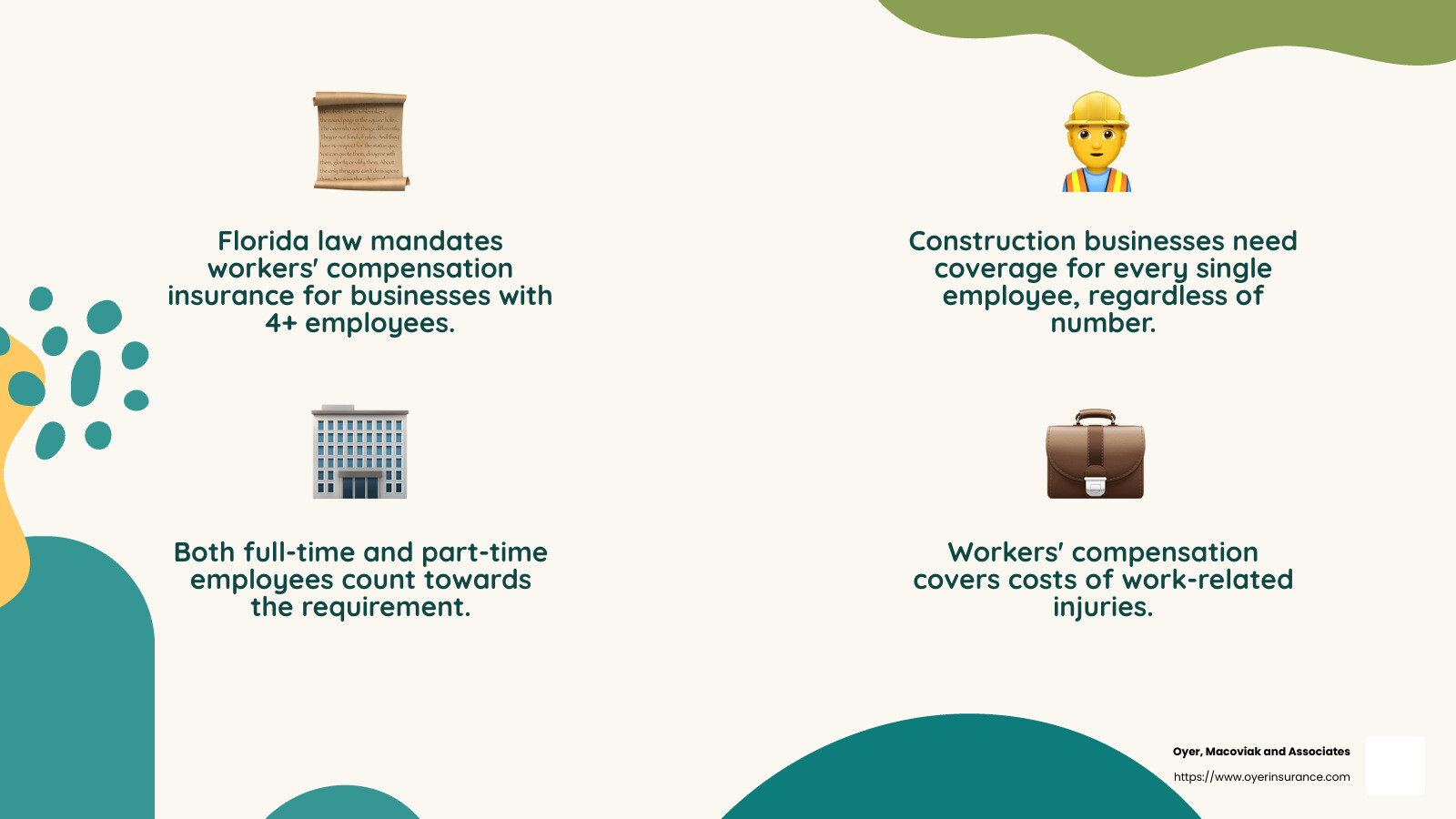
In non-construction industries, mandatory coverage applies once an employer has four or more full-time or part-time employees. In the construction industry, mandatory coverage is required as soon as there is one employee, which includes corporate officers and LLC members unless a formal exemption is approved.
How can I verify if a Hialeah subcontractor's exemption certificate is authentic?
You can verify the status of any Florida workers' compensation exemption or policy directly through the online search tools provided by the Florida Department of Financial Services Division of Workers' Compensation website.
To safeguard your Hialeah enterprise, audit your current roster of 1099 contractors today, verify their corporate exemption status, and consult an insurance specialist to ensure your business operations align fully with Florida statutes.