A $1 million life insurance policy with a disability rider provides a seven-figure death benefit to your beneficiaries while offering essential living benefits if you become seriously injured or ill. Depending on the specific rider, it can waive your premium payments or provide a monthly income, ensuring your coverage remains active and your finances stay stable during a period of total disability.
The Strategic Importance of a $1 Million Death Benefit in 2026
As we navigate the economic landscape of 2026, the $1 million life insurance policy has shifted from being a "luxury" tier of coverage to a standard benchmark for many middle-class families. With the rising costs of higher education, housing, and general cost-of-living adjustments over the last decade, a million-dollar payout is often the minimum required to replace 10 to 15 years of income for a primary breadwinner.
For most policyholders, this amount serves four primary functions:
- Debt Liquidation: Clearing a mortgage, which in many metropolitan areas now averages significantly higher than in previous decades.
- Income Replacement: Providing a capital base that, when invested at a conservative 4% or 5% withdrawal rate, yields $40,000 to $50,000 in annual supplemental income.
- Education Funding: Ensuring that children's college tuition is covered regardless of the parent's presence.
- Final Expenses and Estate Taxes: Covering immediate liquidity needs without forcing the sale of other assets.
However, a death benefit only solves the problem of "dying too soon." It does not address the "living too long with a disability" risk, which is statistically more likely for younger workers. This is where the disability rider becomes an indispensable component of a comprehensive financial plan.
Understanding the Disability Rider: Types and Mechanics
A "rider" is an amendment or add-on to a standard life insurance policy that expands its terms to include additional protections. When attached to a $1 million policy, a disability rider acts as a safeguard for the policy itself or as a secondary source of liquidity. There are three primary types of disability riders available in 2026.
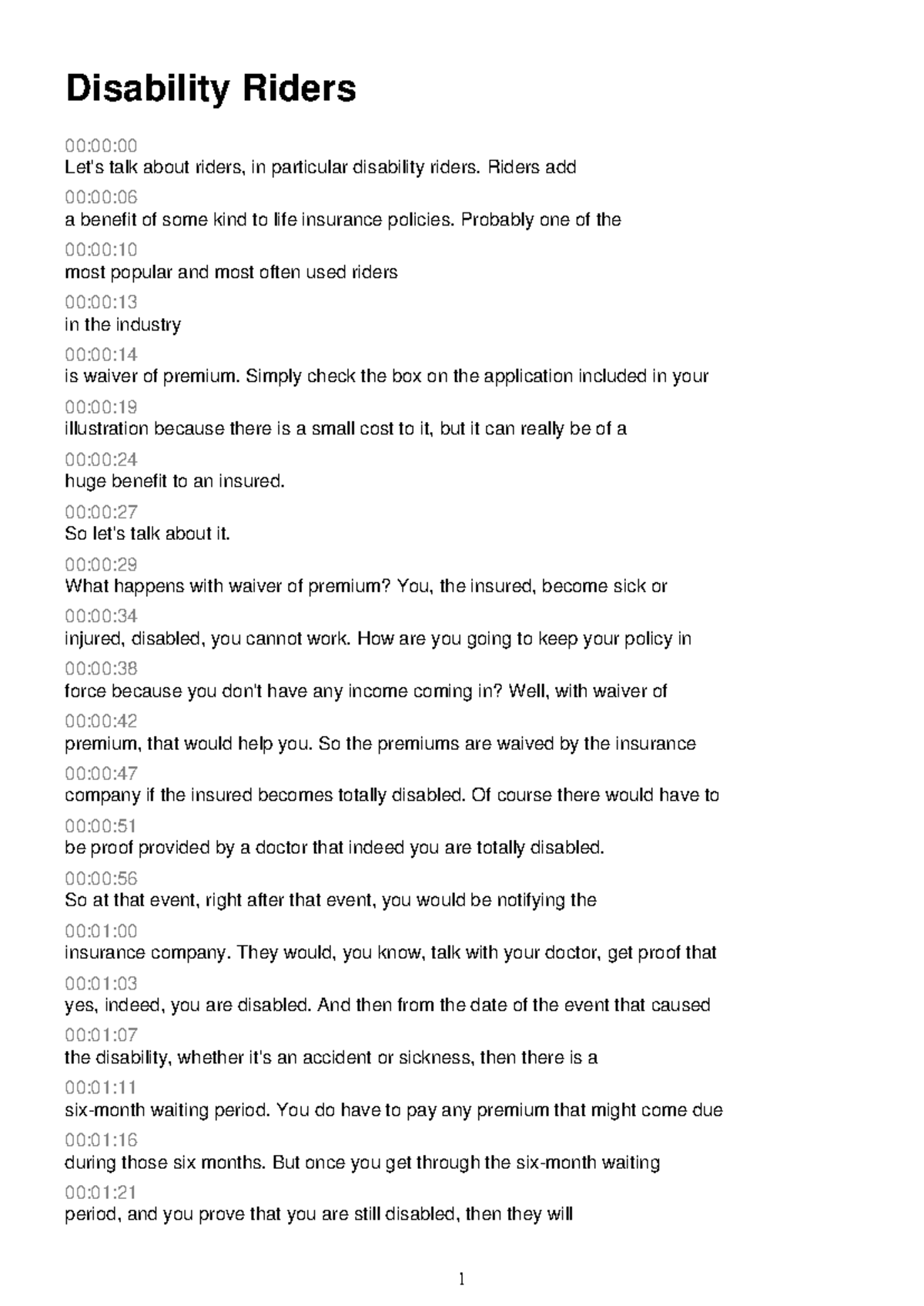
1. Waiver of Premium Rider
The Waiver of Premium rider is the most common and arguably the most vital add-on for a high-value policy. If the insured becomes "totally disabled" as defined by the policy, the insurance company takes over the payment of all future premiums.
- The Benefit: Your $1 million of coverage stays in force even if you can no longer afford the payments because you aren't working.
- The Waiting Period: Most carriers require an "elimination period" (usually six months). If you remain disabled after this period, the company often refunds the premiums paid during those six months and waives all future ones until you return to work or reach age 65.
- Expiration: These riders typically expire between ages 60 and 65, though the waiver continues if the disability occurred before the expiration age.
2. Disability Income (DI) Rider
A Disability Income rider is more robust than a simple waiver. It pays out a monthly stipend to the policyholder if they become disabled.
- The Benefit: Instead of just keeping the policy active, this rider puts cash in your pocket to help with groceries, utilities, and medical bills.
- Calculation: The payout is usually calculated as a percentage of the death benefit—for example, 1% of the face value per month. On a $1 million policy, a 1% rider would yield $10,000 a month, though many companies cap this at a lower flat rate (e.g., $2,000 to $5,000) to manage their risk.
3. Accelerated Death Benefit (ADB) for Chronic Illness
While technically distinct from a "disability income" rider, many 2026 policies use ADB riders to solve the same problem. If a physician certifies that you cannot perform at least two of the six "Activities of Daily Living" (ADLs)—such as bathing, dressing, or eating—you can "accelerate" or withdraw a portion of your $1 million death benefit while you are still alive.
Comparison of Policy Types for $1 Million Coverage
When structuring a $1 million policy with these riders, you must choose between Term and Permanent life insurance. The choice significantly impacts the cost and the long-term utility of the disability rider.
| Feature | Term Life Insurance ($1M) | Permanent Life (Whole/Universal) |
|---|---|---|
| Duration | 10, 20, or 30 years | Lifelong (to age 121) |
| Initial Cost | Low (Affordable for most) | High (5x to 10x more than term) |
| Cash Value | None | Builds equity over time |
| Rider Impact | Simple; usually just Waiver of Premium | Complex; can waive high premiums |
| Best For | Young families; mortgage protection | High-net-worth; estate planning |
| Rider Cost | Nominal (usually a few dollars/mo) | Included or percentage-based |
The Underwriting Process for High-Limit Policies
Applying for $1 million in coverage in 2026 involves more scrutiny than applying for a $250,000 policy. Insurance companies view $1 million as a "jumbo" or "large case" threshold, triggering specific underwriting requirements.
Financial Underwriting
The insurance company must verify "insurable interest." They will not issue a $1 million policy to someone whose income or assets do not justify that amount. Generally, companies allow a death benefit of 15 to 25 times your annual income. For a $1 million policy, an applicant usually needs an annual income of at least $40,000 to $65,000, depending on their age and existing debts.
Medical Underwriting
While "no-exam" policies exist in 2026, they often cap out at $500,000 or $750,000. For a $1 million policy with a disability rider, you should expect:
- A Paramedical Exam: A technician visits your home to record height, weight, blood pressure, and collect blood/urine samples.
- Digital Health Records: The carrier will pull your data from the MIB (formerly Medical Information Bureau) and prescription drug databases.
- Specialty Tests: If you are over age 50, an EKG may be required.
The disability rider adds another layer to this. A company might approve you for the $1 million life insurance but decline the disability rider if you have a history of back pain, depression, or other chronic conditions that don't increase mortality risk but do increase "morbidity" (disability) risk.
The Definition of Disability: The Fine Print Matters
The most common mistake consumers make is assuming that "disabled" means the same thing to every insurance company. In the context of a life insurance rider, the definition of disability is usually stricter than what you might find in a standalone Social Security Disability Insurance (SSDI) claim.
- Own-Occupation: You are considered disabled if you cannot perform the duties of your specific job. This is the gold standard but is rare for riders on life policies.
- Any-Occupation: You are only considered disabled if you cannot perform the duties of any job for which you are reasonably suited by education, training, or experience. Most life insurance disability riders use this definition.
- Presumptive Disability: Most $1 million policies automatically trigger the rider if you suffer total loss of sight, speech, hearing, or the use of two limbs, regardless of your ability to work.
Before signing, you must verify which definition your policy uses. If you are a specialized professional (like a surgeon or engineer), an "any-occupation" rider may not provide the protection you expect if you can still perform sedentary office work.
Cost Considerations for 2026
The cost of a $1 million policy with a disability rider is influenced primarily by age, tobacco use, and health classification. Adding a Waiver of Premium rider typically increases the base premium by 10% to 15%.
For a healthy, non-smoking 35-year-old in 2026, a 20-year term policy for $1 million might cost approximately $45 to $60 per month. Adding a disability waiver might bring that total to $52 to $68 per month. This small incremental cost is often seen as "insurance for your insurance," ensuring that if you lose your income, you don't also lose the $1 million safety net for your family.
Factors that can significantly increase these rates include:
- Body Mass Index (BMI): Falling into "overweight" or "obese" categories can double premiums.
- High-Risk Hobbies: SCUBA diving, private piloting, or rock climbing may lead to "flat extra" charges.
- Family History: Early-onset cardiovascular disease or cancer in parents can move you from a "Preferred Plus" to a "Standard" rating.
Common Pitfalls to Avoid
When purchasing a $1 million life insurance policy with a disability rider, avoid these three frequent errors:
Relying Solely on the Rider
A disability rider on a life insurance policy is a supplement, not a replacement for a standalone Long-Term Disability (LTD) policy. Standalone LTD policies offer better "own-occupation" definitions and higher monthly benefit caps. Use the life insurance rider to protect the policy itself (Waiver of Premium) while maintaining a separate policy for your primary income replacement.
Ignoring the "Waiting Period"
Many policyholders are surprised to find they must pay premiums out-of-pocket for six months after a disabling accident before the waiver kicks in. You should maintain an emergency fund to cover these gap months.
Choosing the Wrong Term Length
If you buy a $1 million, 10-year term policy with a disability rider, and you become disabled in year nine, the waiver will only last for one more year. If you have young children or a 30-year mortgage, align the term length with your longest-running financial obligation.
Step-by-Step Guide to Acquiring Coverage
- Calculate Your Need: Confirm that $1 million is the correct amount by using a DIME (Debt, Income, Mortgage, Education) analysis.
- Compare Multiple Carriers: Use an independent broker who can access several 2026 rate tables. Different companies specialize in different health profiles (e.g., one company may be more lenient on high blood pressure).
- Request a "Waiver of Premium" Quote: Specifically ask to see the premium with and without the rider to understand the cost-benefit ratio.
- Complete the Digital Application: Most 2026 applications are handled via secure online portals with e-signatures.
- Schedule the Exam Early: If a paramedical exam is required, scheduling it for a morning appointment (after fasting) usually yields the best blood pressure and glucose results.
- Review the Delivery Package: Once approved, read the "Exclusions" section of the rider. Most riders will not pay for disabilities resulting from self-inflicted injuries or acts of war.
Frequently Asked Questions
Does the disability rider pay out if I am only partially disabled?
Generally, no. Most disability riders attached to life insurance policies require "total disability," meaning you cannot work at all. This is a key difference from standalone disability insurance, which often includes "residual" or "partial" disability benefits that pay if you can only work part-time.
Are the benefits from a disability income rider taxable?
In the United States, if you pay for the life insurance policy with after-tax dollars (which is the case for most individual policies), the disability income you receive is typically tax-free. However, it is always advisable to consult a tax professional regarding 2026 IRS guidelines or your specific jurisdictional tax codes.
Can I add a disability rider to an existing $1 million policy?
It is often difficult to add a rider after the policy has been issued. Most companies require the rider to be added at the time of the initial application. If you already have a policy and want disability protection, you may need to apply for a new policy or "replace" the existing one, which will involve new medical underwriting at your current age.
What happens to the rider if I convert my term policy to permanent life insurance?
Many 2026 term policies include a "conversion privilege." If you convert your $1 million term policy to a whole life policy, some companies allow you to carry the disability rider over without a new medical exam, but the premium for the rider will increase to match the much higher permanent insurance rates.
Will the rider cover mental health-related disabilities?
This depends heavily on the carrier. Some policies in 2026 have a "Mental and Nervous" limitation, which restricts disability payments for conditions like anxiety or depression to a maximum of 24 months, whereas physical disabilities are covered until age 65.
Final Recommendation
For the majority of breadwinners in 2026, a $1 million term life insurance policy paired with a Waiver of Premium rider represents the most efficient balance of cost and protection. This setup ensures that your family's $1 million safety net is "self-completing"—meaning that even if a catastrophic injury or illness takes away your ability to earn a paycheck, your life insurance remains a guaranteed asset. Before finalizing your coverage, always verify the specific "definition of disability" in your policy documents to ensure it aligns with the physical and cognitive demands of your career.