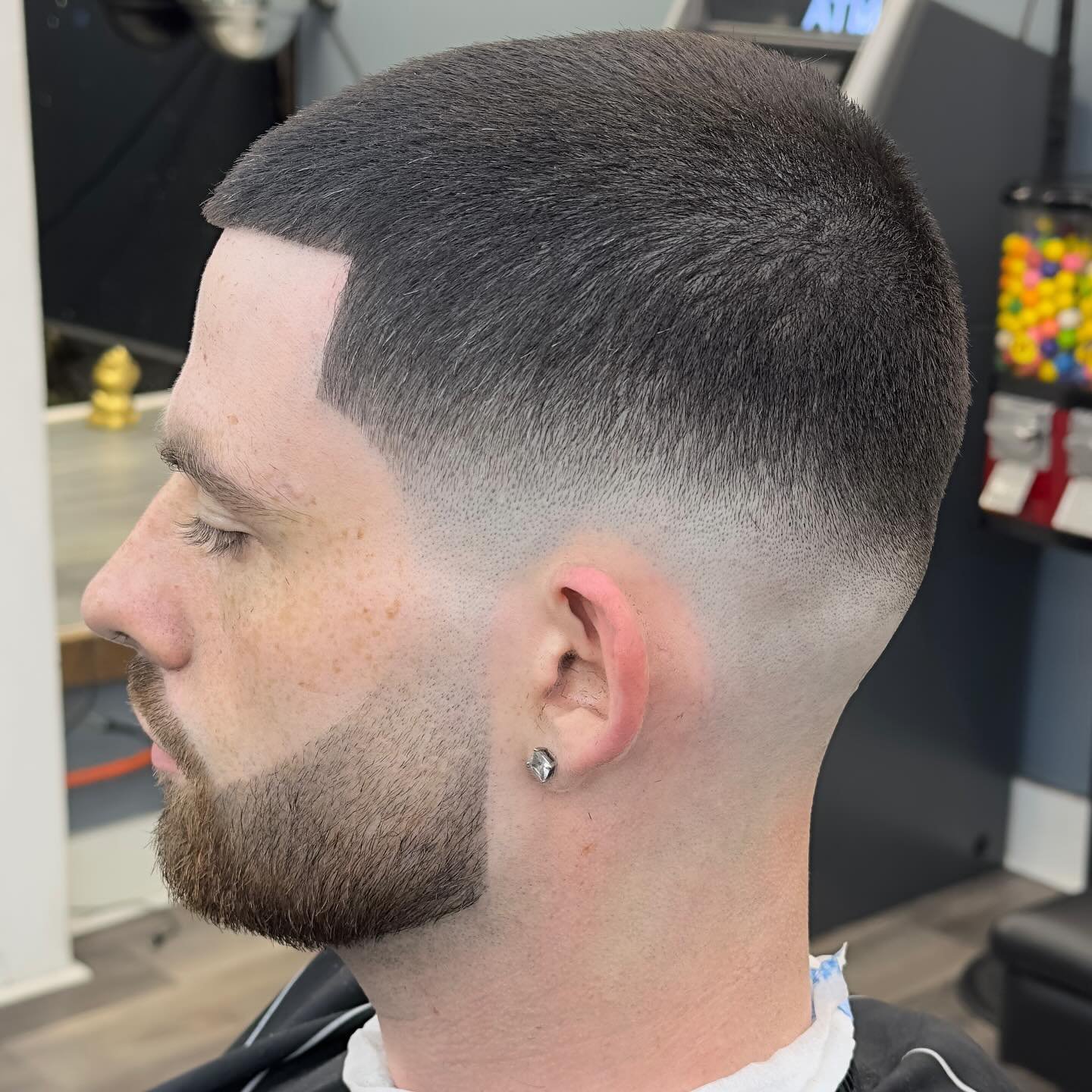
A 1 low fade with short hair on top is a precision-driven men’s haircut where the hair at the bottom of the sides and back is clipped to a length of 1/8 inch (a #1 guard). This taper begins very low, typically just above the ears and neckline, while the hair on top is kept short enough to be low-maintenance but long enough to style.
The popularity of the 1 low fade with short hair on top remains unparalleled in 2026 due to its balance of professional polish and modern edge. Unlike high fades that expose a significant amount of scalp or skin fades that require frequent touch-ups to maintain a "bald" look, the #1 guard provides a soft "shadow" effect. This subtle contrast makes it an ideal choice for men who want a clean-cut appearance without the aggressive transition of higher or shorter fades.
The Technical Anatomy of a Number 1 Low Fade
To understand this haircut, one must first break down the terminology used in modern barbering. The "number 1" refers specifically to the clipper guard size used at the shortest point of the fade. A #1 guard leaves approximately 3 millimeters (1/8 inch) of hair. In the hierarchy of fades, this is a middle-ground choice; it is shorter than a #2 (which looks more like a standard taper) but longer than a #0 or a skin fade, which removes the hair down to the follicle.
The "low" designation refers to the placement of the transition line. In a low fade, the "blur" or the point where the hair begins to get longer starts very close to the ears and the nape of the neck. This keeps the majority of the head's sides covered with a decent amount of hair, which is particularly beneficial for individuals with irregular head shapes or those who prefer a more conservative aesthetic.
When you combine this with "short hair on top," you are typically looking at lengths ranging from a "buzz" (where the top is also done with a clipper) to a "crew cut" or "short crop" (where the top is cut with shears to 1–2 inches). This combination ensures that the entire silhouette of the head remains tight and structured.
Why the 1 Low Fade is a Staple in 2026
In the current grooming landscape of 2026, we see a shift toward "stealth wealth" and "quiet luxury" in personal appearance. The 1 low fade fits this trend perfectly. It doesn't scream for attention like a platinum-blonde mohawk or a high-contrast disconnected undercut. Instead, it offers a refined gradient that suggests a man who takes care of his grooming but isn't obsessed with vanity.
Technologically, clipper precision has improved significantly by 2026. Modern cordless clippers allow barbers to achieve a more seamless blend between the #1 guard and the longer hair on top than was possible a decade ago. Furthermore, the rise of scalp-health awareness has made the #1 fade a favorite because it leaves just enough hair to protect the skin from UV rays while still providing the cooling benefits of a short cut.
Suitability: Analyzing Face Shapes and Hair Textures
Not every haircut suits every individual. The 1 low fade with short hair on top is remarkably versatile, but its execution should be adjusted based on physical characteristics.
Face Shapes
- Oval Faces: This is the ideal face shape for this cut. Since oval faces are naturally balanced, the low fade maintains that symmetry without elongating the head too much.
- Square Faces: The short sides of the #1 fade emphasize a strong jawline. Keeping the hair on top slightly textured can soften the look if desired.
- Round Faces: For those with rounder features, a low fade can sometimes make the face appear wider if the top is too flat. To counter this, many men in 2026 opt for a "short pompadour" or "textured crop" on top to add a bit of height and elongate the face.
- Diamond/Heart Shapes: The low fade is excellent here because it doesn't add bulk to the widest part of the face (the temples), helping to balance a narrower chin.
Hair Textures
- Straight Hair: A #1 fade on straight hair shows the gradient very clearly. It requires a skilled barber to ensure there are no visible "steps" or lines in the transition.
- Wavy or Curly Hair: The low fade is a fantastic way to manage the bulk of curls. By keeping the sides short with a #1, you prevent the "poofing" effect at the ears, while the short top allows the natural texture to show without becoming unruly.
- Thinning Hair: For men experiencing hair loss, a 1 low fade is often a strategic choice. By shortening the sides, the hair on top appears thicker by comparison. The #1 length is short enough to minimize the contrast between the scalp and hair, masking thinning areas more effectively than a longer taper.
Variations of Short Hair on Top
"Short hair on top" is a broad term. Depending on your personal style, you can pair your 1 low fade with several distinct top styles:
- The Buzz Cut (#3 or #4 on top): This is the ultimate low-maintenance version. The sides are a #1, and the top is clipped to a uniform length. It’s rugged, masculine, and requires zero styling product.
- The French Crop: This involves a #1 low fade paired with a short, textured top and a fringe (bangs) pushed forward. It has been a dominant trend in 2026 for its youthful, edgy appearance.
- The Classic Crew Cut: The hair is tapered from the front to the back. It’s slightly longer at the hairline and gets shorter toward the crown. This is the quintessential "professional" look.
- The Textured Quiff: The top is cut to about 2 inches and styled upward and slightly back. This works best for men with thicker hair who want to use a matte clay or wax to create volume.
Comparing Fade Placements with a #1 Guard
| Feature | 1 Low Fade | 1 Mid Fade | 1 High Fade |
|---|---|---|---|
| Start Point | Just above the ears/neckline | Level with the temples | Near the crown/top corners |
| Scalp Visibility | Minimal; mostly at the very bottom | Moderate along the sides | High; most of the sides are short |
| Maintenance | Low to Medium | Medium | High (shows growth quickly) |
| Professionalism | Very High | High | Moderate/Edgy |
| Face Narrowing | Subtle | Moderate | Significant |
The Barber Consultation: How to Request This Cut
Communication is the most common point of failure in a haircut. To ensure you get a 1 low fade with short hair on top, you should be specific about three things: the guard size, the height of the fade, and the texture of the top.
- Specify the Guard: "I want a number 1 on the sides." If you say "short," the barber might use a #2 or #3. A #1 is a very specific length.
- Define the Height: "Keep the fade low." You can even point to where you want the blending to start—usually about half an inch to an inch above the ear.
- Describe the Top: Instead of saying "short on top," specify how you want it to behave. "I want about an inch of length so I can texture it with clay," or "Use a #4 guard on top and blend it into the #1 fade."
- The Nape: Decide if you want a "tapered" nape (where the hair fades into the skin) or a "blocked" nape (a straight line). For a 1 low fade, a tapered nape almost always looks better as it grows out.
Execution and Technical Process
While you won't be cutting your own hair (unless you're an experienced DIYer), understanding the process helps you appreciate the skill involved. A professional barber in 2026 typically follows these steps:
- De-bulking: The barber uses a higher guard (like a #3) to remove the bulk from the sides and back to see the canvas clearly.
- Setting the Baseline: Using the #1 guard, the barber creates the initial "low" line around the ears and neck.
- Blending: This is the most difficult part. Using a "flick-out" motion and the clipper's lever (open/closed positions), the barber bridges the gap between the #1 at the bottom and the longer hair further up. This creates the "fade" or gradient effect.
- Top Work: The top is cut using either shears (for a natural look) or a higher clipper guard. In 2026, many barbers use "point cutting" on the top to add internal texture, which prevents the hair from looking like a solid block.
- Detailing: The lineup or "edge-up" around the temples and neck is done with a trimmer to make the haircut look sharp.
Maintenance, Longevity, and Styling
The beauty of the 1 low fade with short hair on top lies in its easy upkeep, but it does require some attention to keep it looking fresh.
The Growth Cycle: Because hair grows roughly half an inch per month, a #1 fade will look like a #2 after about a week and a half. To maintain the crispness of the fade, most men visit the barber every 2 to 3 weeks. However, because it is a low fade, the grow-out period is more forgiving than a high skin fade. Even after 4 weeks, the haircut will still look like a decent "taper," whereas a high fade might look "shaggy" or unbalanced.
Styling Products for 2026: The trend for 2026 is moving away from high-shine gels and toward natural, matte finishes.
- Matte Clay/Paste: Best for textured looks like the French crop or a messy quiff. It provides hold without making the hair look greasy.
- Sea Salt Spray: Excellent for men with slightly longer "short" hair on top. It adds volume and a "beach" texture that looks effortless.
- Conditioning Oil: Even for short hair, scalp health is vital. A drop of lightweight oil can prevent the "ashy" look that sometimes occurs with short clipper cuts.
Daily Routine: One of the primary reasons men choose this cut is the speed of the morning routine.
- Wash and towel-dry.
- Apply a pea-sized amount of product (if using).
- Run fingers through the top to set the direction.
- Air dry for 5 minutes.
Common Mistakes to Avoid
Even with a simple cut, things can go wrong. Be aware of these pitfalls:
- Going Too High: If the barber starts the #1 guard too high up the head, it becomes a "mid" or "high" fade. This changes the face shape entirely. Ensure the "low" instruction is understood.
- Neglecting the Crown: The hair at the back of the head (the crown) often grows in a circular pattern (a cowlick). If the barber cuts this too short, it may stick straight up. Ensure they leave enough length at the crown to lay flat.
- Skipping Scalp Care: With a #1 fade, your scalp is more exposed to the elements. In 2026, using a moisturizer or a sunscreen specifically for the scalp is recommended if you spend a lot of time outdoors.
FAQs about the 1 Low Fade
How long does a 1 low fade take to grow out? A #1 fade (3mm) will typically transition into a "standard" short taper look within 3 to 4 weeks. By 6 weeks, the distinct "fade" gradient will be mostly gone, and the hair will look uniform.
Is a 1 low fade suitable for professional office environments? Absolutely. In fact, it is one of the most recommended cuts for corporate settings in 2026. Because it is a "low" fade, it remains conservative, while the #1 length provides a clean, groomed appearance that looks much sharper than a standard scissor-all-over cut.
Does a 1 low fade work with a beard? Yes, it is one of the best cuts to pair with facial hair. The barber can "taper" the sideburns so that the #1 fade on the head blends seamlessly into the beard. This prevents a "disjointed" look where the hair and beard don't meet harmoniously.
Can I do a 1 low fade at home? While you can certainly run a #1 guard around your ears, achieving a true "fade" (the smooth gradient) is technically difficult on your own head, especially at the back. It is generally recommended to see a professional for the fade itself, even if you trim the top yourself.
Is the #1 guard too short for people with sensitive skin? For most, a #1 is safe. Unlike a "zero" or "skin" fade, the blades of the clipper do not make direct, constant contact with the skin because the guard provides a 3mm buffer. However, if you are prone to folliculitis, ensure your barber uses sanitized equipment and apply a soothing aftershave balm.
Final Recommendation
If you are looking for a haircut that bridges the gap between "bold" and "boring," the 1 low fade with short hair on top is the definitive choice for 2026. It offers the structural benefits of a fade—slimming the sides of the head and emphasizing the top—without the high-maintenance requirements of shorter or higher variations. To get the best result, pair it with a textured top and a matte styling product. This combination ensures you look sharp in the boardroom, the gym, and everywhere in between.