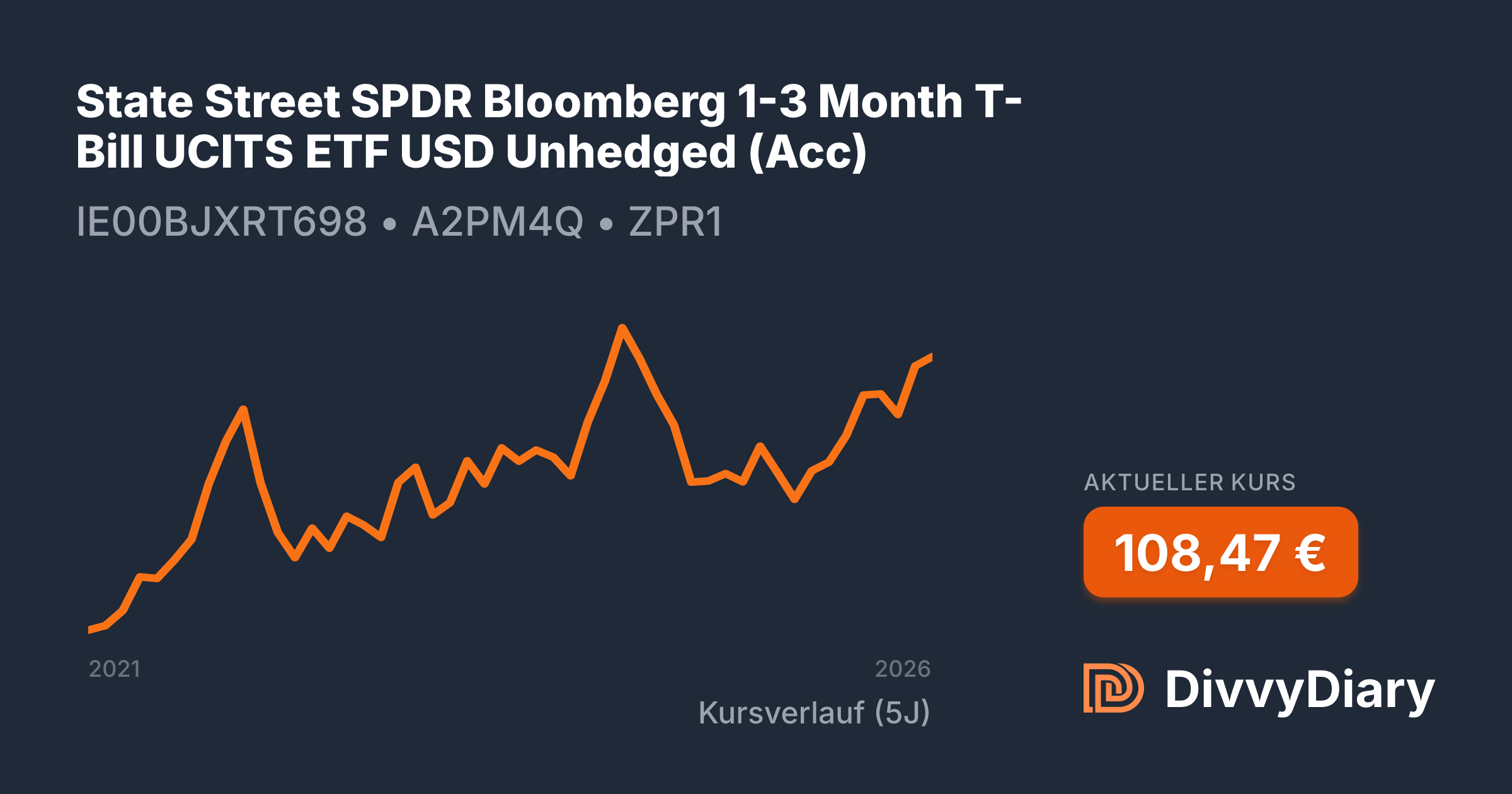
A 1-3 month Treasury Bill (T-Bill) ETF is a liquid, low-risk investment vehicle that holds U.S. government debt obligations with maturities between one and three months. These funds are designed to track the performance of the shortest end of the yield curve, providing investors with a "cash-plus" return that typically mirrors the federal funds rate while maintaining high price stability and state tax advantages.
Understanding the Role of Ultra-Short Treasury ETFs
In the financial landscape of 2026, 1-3 month T-Bill ETFs have solidified their position as the premier alternative to traditional money market funds and high-yield savings accounts (HYSAs). These exchange-traded funds (ETFs) purchase U.S. Treasury Bills, which are short-term debt instruments backed by the full faith and credit of the United States government. Because these bills have such short durations, they are effectively insulated from the significant price volatility that plagues longer-term bonds when interest rates fluctuate.
The "1-3 month" designation refers to the specific segment of the maturity schedule the fund targets. By maintaining a portfolio of bills that mature within 90 days, the fund manager ensures that the portfolio’s weighted average maturity (WAM) stays very low. As bills mature, the manager reinvests the proceeds into new bills at current market rates. This constant "rolling" of debt allows the ETF to capture rising interest rates quickly, making it a defensive powerhouse in inflationary environments.
For the modern investor, these ETFs serve as a sophisticated cash management tool. They offer the intraday liquidity of a stock—allowing you to buy or sell shares throughout the trading day—combined with the safety of government-backed debt. In a 2026 market where market volatility remains a concern, the ability to "park" capital in a vehicle that yields a competitive return without sacrificing principal safety is an essential component of a diversified portfolio.
The Mechanics: How 1-3 Month T-Bill ETFs Generate Returns
To appreciate the value of these ETFs, one must understand how Treasury Bills themselves work. Unlike traditional bonds that pay periodic interest (coupons), T-Bills are "zero-coupon" instruments. They are sold at a discount to their face value. For example, a $1,000 bill might be purchased for $985. The "interest" is the difference between the purchase price and the $1,000 paid at maturity.
A 1-3 month T-Bill ETF aggregates thousands of these individual positions. The fund’s Net Asset Value (NAV) generally stays very stable, often hovering around a specific peg (like $100 or $50), while the interest earned is accrued daily and typically distributed as a monthly dividend.
The Impact of Duration and Interest Rates
Duration is a measure of a bond's sensitivity to interest rate changes. A 1-3 month T-Bill ETF has an extremely low duration, often around 0.08 to 0.15 years. This means that if interest rates were to rise by a full 1%, the value of the fund would theoretically only drop by about 0.10% to 0.15%. This is a negligible fluctuation compared to a 10-year Treasury note, which might drop 8% or 9% under the same circumstances.
In 2026, as the Federal Reserve manages the terminal rate, these ETFs provide a direct pass-through of those rates to the investor. When the Fed holds rates high to combat persistent service-sector inflation, the yields on these ETFs stay elevated. Conversely, if the Fed begins a cutting cycle, the yield on the ETF will move downward in lockstep, but the principal remains protected.
Comparing Leading 1-3 Month T-Bill ETFs
The market for ultra-short Treasury ETFs is dominated by a few massive players. While they all track similar indices—such as the Bloomberg US Treasury Bellwethers: 3 Month Index—there are subtle differences in expense ratios, liquidity, and exact maturity targets.
| ETF Ticker | Fund Name | Primary Focus | Typical Expense Ratio | Primary Benefit |
|---|---|---|---|---|
| BIL | SPDR Bloomberg 1-3 Month T-Bill ETF | 1-3 Month Maturities | 0.135% | Highest liquidity and largest AUM |
| SGOV | iShares 0-3 Month Treasury Bond ETF | 0-3 Month Maturities | 0.05% to 0.12% | Extremely low cost; targets shortest end |
| TBIL | US Treasury 3 Month Bill ETF | Single-Month Rolling | 0.15% | High precision for the 3-month benchmark |
| CLIP | GS Access Treasury 0-1 Year ETF | 0-12 Month Maturities | 0.12% | Slightly higher yield potential via longer bills |
| VGSH | Vanguard Short-Term Treasury ETF | 1-3 Year Maturities | 0.04% | Better for slight rate-drop protection |
BIL vs. SGOV: The 2026 Stand-Off
The competition between State Street’s BIL and BlackRock’s SGOV is the central narrative in this niche. BIL is the veteran of the space, boasting massive daily trading volume that makes it the preferred choice for institutional "whales" who need to move hundreds of millions of dollars without moving the price.
SGOV, however, has become the retail favorite due to its aggressive fee structure. In many periods leading up to 2026, BlackRock has utilized fee waivers to keep the net expense ratio as low as 0.05%. For a retail investor holding $10,000 or $100,000, SGOV often provides a slightly higher net yield simply because it takes a smaller cut of the interest. Furthermore, SGOV includes bills with 0-1 months remaining, making it slightly "shorter" and even less volatile than BIL.
Key Advantages of T-Bill ETFs Over Other Cash Vehicles
Investors often wonder why they should use an ETF when they could simply use a bank savings account or a Money Market Mutual Fund (MMF). There are three primary reasons: safety, tax efficiency, and transparency.
1. Superior Credit Safety
While a bank account is insured by the FDIC up to $250,000, a T-Bill ETF is backed by the U.S. Treasury. For investors with millions in cash, the ETF is often viewed as safer than a bank, as it does not rely on the solvency of a specific private institution. Unlike some Money Market Funds that "broke the buck" during historical financial crises by holding commercial paper (corporate debt), a pure T-Bill ETF holds only government obligations.
2. State and Local Tax Exemptions
This is the "hidden" advantage of 1-3 month T-Bill ETFs. Interest earned on U.S. Treasury obligations is generally exempt from state and local income taxes. In high-tax states like California, New York, or Massachusetts, this can increase the "tax-equivalent yield" significantly.
If a High-Yield Savings Account pays 5% and a T-Bill ETF pays 4.9%, the ETF might actually put more money in your pocket after state taxes are settled. It is important to note that while the interest is state-exempt, any capital gains realized from selling the ETF shares at a profit are still subject to taxation.
3. Immediate Liquidity and Accessibility
A T-Bill ETF can be bought and sold in any standard brokerage account (Schwab, Fidelity, Vanguard, etc.). Unlike TreasuryDirect, which can have a clunky interface and rigid holding periods for certain instruments, an ETF allows you to exit your position at 10:00 AM and have the cash available for another trade immediately.
Risks and Operational Limitations
No investment is entirely without risk. While 1-3 month T-Bill ETFs are among the safest assets on the planet, investors must be aware of specific nuances.
- Inflation Risk: The primary "enemy" of the T-Bill investor is inflation. If the ETF is yielding 4.5% but the Consumer Price Index (CPI) is running at 5%, the investor is losing purchasing power in real terms. These funds are meant for capital preservation, not wealth accumulation.
- Opportunity Cost: In a bull market for equities, holding too much cash in T-Bills can lead to significant underperformance. T-Bills are for the "safe" portion of a portfolio, not the growth engine.
- Brokerage Fees: While most major brokerages have moved to zero-commission trading, some still charge fees for certain types of orders or accounts. Additionally, the "bid-ask spread"—the difference between the price you buy at and the price you sell at—acts as a hidden cost. For highly liquid funds like BIL, this spread is usually just one cent, but it is still a factor for high-frequency movers.
- Reinvestment Risk: If the Federal Reserve aggressively cuts interest rates, the yield on your T-Bill ETF will drop quickly. Unlike a 5-year CD or a 10-year bond, you have no "lock-in" for your yield.
Implementation Strategies for 2026
How should an investor actually use these funds in a 2026 economic environment?
The Emergency Fund Wrapper: Many financial advisors now recommend keeping 3-6 months of expenses in a T-Bill ETF rather than a standard savings account. This ensures the money is working as hard as possible while remaining accessible within 1-2 business days (the standard settlement time for ETF trades).
The Rebalancing Hub: For those who manage a "60/40" or "70/30" portfolio, a 1-3 month T-Bill ETF serves as a perfect volatility damper. When the stock market feels overvalued, an investor can trim equity positions and move the proceeds into BIL or SGOV. This provides a "safe harbor" that earns interest while the investor waits for a better entry point back into the stock market.
Tax-Loss Harvesting Complement: Because the price of these ETFs is so stable, they are excellent "placeholders" during tax-loss harvesting maneuvers. If an investor sells a different bond fund to realize a loss for tax purposes, they can park the cash in SGOV for 30 days to avoid "wash sale" rules before moving into a new permanent position.
Technical Specifications and Verification
When evaluating a specific fund, investors should consult the U.S. Securities and Exchange Commission (SEC) filings or the fund provider's official website. Key metrics to verify include:
- 30-Day SEC Yield: This is the most accurate representation of what the fund is currently earning, as it is a standardized calculation required by the SEC.
- Weighted Average Maturity (WAM): Look for a WAM under 60 days to ensure the fund is truly "ultra-short."
- Net Assets: Ensure the fund has at least $1 billion in assets to guarantee tight bid-ask spreads and high liquidity.
Frequently Asked Questions
Are 1-3 month T-Bill ETFs better than money market funds?
They are often more transparent and offer better tax treatment at the state level. While money market funds aim for a stable $1.00 NAV, T-Bill ETFs fluctuate slightly in price (though usually by only a few cents). For investors in high-tax states, the state-tax exemption of the ETF usually makes it the superior choice.
How often do these ETFs pay dividends?
Almost all 1-3 month T-Bill ETFs pay dividends on a monthly basis. The "ex-dividend" date usually falls near the beginning or end of the month. If you sell the ETF before the ex-dividend date, you don't lose the interest; it is simply "baked into" the share price you receive when you sell.
Can I lose money in a 1-3 month T-Bill ETF?
While theoretically possible, it is extremely unlikely for a diversified 1-3 month Treasury ETF to lose significant principal. The only scenarios where this would occur are a total default by the U.S. government or an unprecedented, instantaneous spike in interest rates that exceeds the yield of the bills. Even in the 2022-2023 rate hike cycle, these funds remained remarkably stable.
Do I need a special account to buy these?
No. Any standard taxable brokerage account, IRA, or 401(k) with brokerage access can purchase these ETFs. They trade exactly like a share of Apple or Amazon stock.
What is the difference between BIL and a 3-month T-Bill bought directly?
The ETF (like BIL) is a rolling ladder of bills. When you buy a single 3-month T-Bill, it eventually matures, and you are left with cash. You then have to manually buy another bill. The ETF automates this process for you, keeping your money perpetually invested in the 1-3 month window.
Practical Next Action
For investors looking to optimize their cash holdings in 2026, the first step is to calculate your "effective yield" in your current savings account after state taxes. If you live in a state with income tax, compare that to the 30-day SEC yield of a fund like SGOV or BIL. If the ETF yield is higher (especially after the tax adjustment), consider moving your non-immediate cash (money not needed for the next 7 days) into one of these ETFs to maximize your passive income with minimal risk.