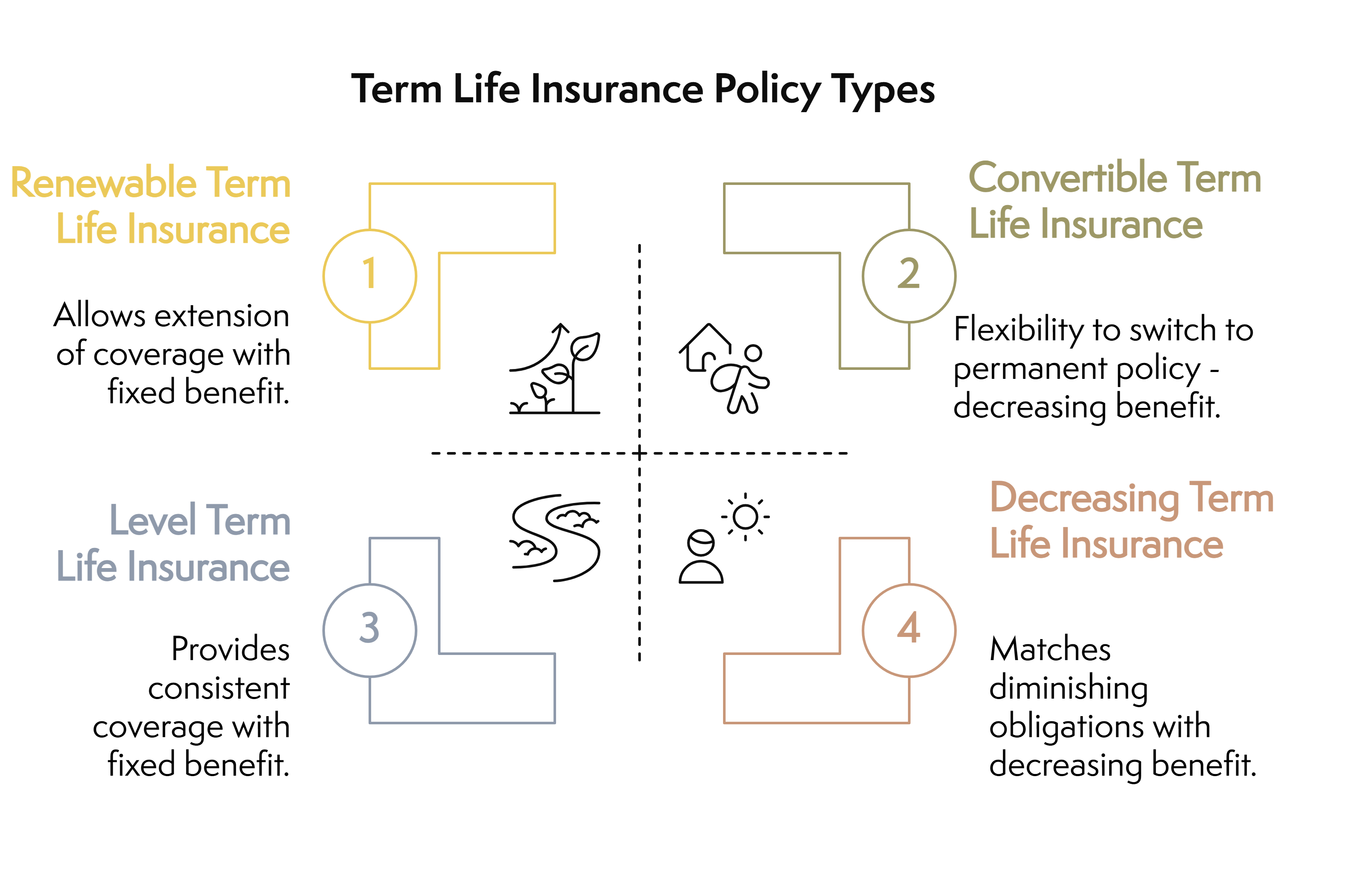
A yearly renewable term life policy is a level term insurance for a term of one year. While the death benefit remains level throughout the duration of the coverage, the policy provides the policyholder the right to renew the contract annually without providing new evidence of insurability, though premiums typically increase with each renewal.
Yearly Renewable Term (YRT) insurance, often referred to in the industry as Annual Renewable Term (ART), represents the purest form of life insurance protection. It is designed to provide a specific death benefit for a 12-month period. As we navigate the financial landscape of 2026, YRT remains a niche but vital tool for individuals and businesses requiring flexible, short-term protection. Unlike level-premium term policies that lock in a rate for 10, 20, or 30 years, YRT resets its pricing annually based on the insured’s attained age.
To fully grasp why a YRT policy is categorized as "level term insurance for a term of one year," one must distinguish between the "level" nature of the death benefit and the "increasing" nature of the cost. This article examines the mechanics, costs, strategic applications, and technical nuances of YRT policies in the current market.
The One-Year Term: Mechanics of Yearly Renewal
The defining characteristic of a YRT policy is its duration. Technically, the contract expires every 365 days. However, the "renewable" clause is what gives the policy its value. In 2026, modern life insurance contracts heavily emphasize consumer protections regarding renewability, ensuring that as long as premiums are paid, the insurer cannot cancel the coverage due to changes in the insured’s health.
The Guaranteed Renewability Clause
When an individual first applies for a YRT policy, they undergo medical underwriting. This process determines their initial risk class (e.g., Preferred Plus, Standard, or Substandard). Once the policy is issued, the "right to renew" becomes a contractual guarantee. Even if the insured develops a chronic illness or suffers a significant health decline during the year, the insurance company must renew the policy for the following year at the pre-determined rate for their age and original risk class.
The "Level" Component vs. The "Variable" Component
The phrase "level term insurance" in the context of YRT can be confusing for those accustomed to "level premium" term insurance. In a YRT policy:
- The Death Benefit is Level: If you purchase a $500,000 YRT policy, your beneficiaries receive $500,000 whether you die in year one or year ten of the policy.
- The Premium is Variable: Because the probability of death increases as a person ages, the cost of the insurance increases. Each year, the "term" starts over, and the premium is recalculated based on the insured’s current age.
Premium Structure and the "Step-Rate" System
In 2026, the pricing of YRT policies follows a "step-rate" or "attained age" premium schedule. This is fundamentally different from a 20-year level term policy, where the insurer overcharges the policyholder in the early years to subsidize the much higher costs of insurance in the later years.
How Premiums are Calculated
The premium for a YRT policy is essentially the "net premium" (the actual cost of the risk of death) plus the insurer’s administrative expenses and profit margin. Actuaries use mortality tables—many of which have been updated recently to reflect post-2020 longevity trends—to determine the likelihood of an individual dying within that specific one-year window.
Because the insurer is only on the hook for one year at a time, the initial premiums for YRT are often the lowest available in the entire life insurance market. For a healthy 30-year-old in 2026, a YRT policy may cost significantly less than a 20-year level term policy. However, this cost advantage disappears over time as the "steps" in the premium schedule become steeper.
The Premium Schedule
Most YRT policies come with a "Schedule of Maximum Premiums." This table outlines exactly what the policy will cost for every year up to a certain age (often 70, 80, or 95). While the insurer may charge a "current" premium that is lower than the maximum, they cannot exceed the rates listed in this schedule. This transparency allows policyholders to forecast exactly when the policy will become too expensive to maintain.
Comparative Analysis: YRT vs. Other Term Products
To understand where YRT fits into a financial plan, it is helpful to compare it against more common insurance structures available in 2026.
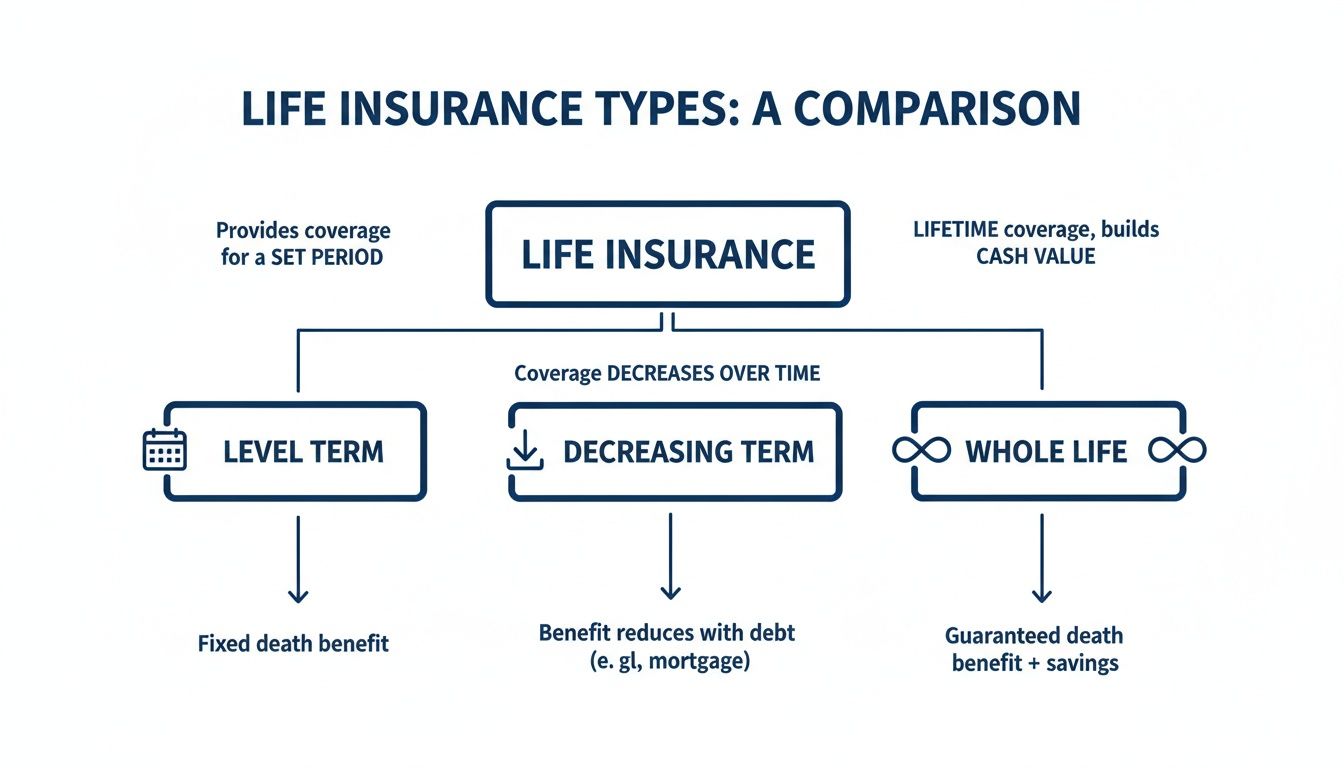
| Feature | Yearly Renewable Term (YRT) | Level Premium Term (10/20/30 Yr) | Whole Life Insurance |
|---|---|---|---|
| Term Length | 1 Year (Renewable) | Fixed (10, 20, or 30 Years) | Permanent (Life) |
| Death Benefit | Level | Level | Level (usually) |
| Premiums | Increases Annually | Guaranteed Level | Guaranteed Level |
| Cash Value | None | None | Accumulates Over Time |
| Initial Cost | Lowest | Moderate | Highest |
| Best Use Case | Short-term/Interim needs | Long-term debt/Family protection | Estate planning/Wealth transfer |
| Medical Exam | Required at inception only | Required at inception only | Required at inception only |
Strategic Use Cases for YRT in 2026
While YRT is not the most popular form of life insurance for the average family, it serves specific, high-value purposes in financial and business planning.
1. Interim Coverage During Career Transitions
Individuals transitioning between jobs or starting a business often face a gap in group life insurance coverage. A YRT policy provides a cost-effective way to maintain a "safety net" for 12 to 24 months without committing to a long-term, higher-premium contract.
2. Business Buy-Sell Agreements and Short-Term Debt
Businesses often use debt to fund specific projects that have a clear expiration date. If a business takes out a five-year loan, a YRT policy can be used to cover the life of a key executive for that specific period. As the loan is paid down, the business can choose to renew the policy or let it lapse without the "surrender charges" or complexities associated with permanent insurance.
3. "Buy Term and Invest the Difference" (BTID)
Some aggressive investors prefer YRT because it minimizes their immediate insurance outflow. By paying the lowest possible price for insurance in their 20s and 30s, they can redirect the savings into high-growth investment vehicles. However, this strategy requires a strict exit plan, as YRT premiums in one’s 50s and 60s can become prohibitively expensive, potentially consuming the investment gains if the policy is kept too long.
4. Insurability Preservation
For individuals who cannot currently afford a large permanent policy or a long-term level term policy but want to "lock in" their insurability while they are healthy, YRT is an excellent entry point. Most YRT policies in 2026 include a conversion rider, allowing the policyholder to switch to a permanent policy without a medical exam at a later date.
Technical Nuances: Convertibility and Limitations
A critical aspect of the YRT policy is the Conversion Privilege. As of 2026, most reputable insurers include a provision that allows the YRT policyholder to convert their "one-year level term" coverage into a permanent policy (like Whole Life or Universal Life).
The Conversion Window
The conversion privilege is usually time-sensitive. A policyholder might be allowed to convert the policy at any time during the first 10 years or before reaching age 65, whichever comes first. This is a powerful tool for someone whose financial situation improves or whose health declines, making them otherwise uninsurable for a new policy.
The Age Limit on Renewals
While "renewable" is in the name, YRT policies do not last forever. Most contracts have a maximum renewal age, typically between 70 and 95. Beyond this point, the mortality risk is so high that the premiums would be nearly equal to the death benefit itself, making the policy economically unfeasible for both the insurer and the insured.
The "Adverse Selection" Risk
Insurers are wary of YRT policies because of "adverse selection." This is the tendency for healthy people to drop their YRT policies as premiums rise, while unhealthy people keep them because they cannot get coverage elsewhere. To mitigate this risk, insurers in 2026 often price YRT policies with a slightly higher margin in the later years to account for the fact that the remaining pool of policyholders may be less healthy than average.
Financial Mathematics of YRT
To truly understand why YRT is a "one-year term," one must look at the mathematical underpinnings. Life insurance is priced based on the Net Amount at Risk (NAR). In a YRT policy, because there is no cash value, the NAR is always equal to the full face amount of the policy.
The formula for the annual premium in a YRT policy is essentially: $$Premium = (Probability\ of\ Death \times Face\ Amount) + Administrative\ Loadings$$
As the "Probability of Death" increases slightly every year, the premium must follow suit. In contrast, in a 20-year level term policy, the insurer calculates the total cost of 20 years of YRT and averages it out, creating a "level" payment. This highlights that all term insurance is essentially built upon a foundation of YRT.
Frequently Asked Questions (FAQ)
Is a YRT policy the same as "Annual Renewable Term"?
Yes. Yearly Renewable Term (YRT) and Annual Renewable Term (ART) are synonymous. Both refer to a life insurance policy that covers the insured for one year and offers the right to renew annually without a medical exam, typically with increasing premiums.
Why is it called "Level Term" if the price goes up every year?
The "level" in "level term insurance for a term of one year" refers to the death benefit. If you buy a $1,000,000 policy, the payout remains $1,000,000 for that year. It is classified as "term" because it covers a specific period (one year) rather than the insured’s entire life.
Can I be denied renewal if I get sick?
No. As long as you have a "guaranteed renewable" clause in your contract and you continue to pay your premiums on time, the insurance company cannot deny your renewal based on changes in your health. Your premium will increase based on your age, but not because of your specific medical condition.
When does a YRT policy stop being a good deal?
YRT is typically a "good deal" when coverage is needed for a short duration (less than 5 years) or when initial cash flow is extremely tight. It stops being a good deal when the cumulative premiums over several years exceed what you would have paid for a fixed-rate level term policy. For most people, the "crossover point" where YRT becomes more expensive than a 20-year level term policy occurs within 7 to 10 years.
Do I need a medical exam every year for a YRT policy?
No. You only undergo a medical exam and full underwriting when you first apply for the policy. The annual renewals are automatic upon payment of the new premium, regardless of changes in your health status.
Final Recommendations
If you are considering a yearly renewable term life policy in 2026, your first step should be to define the duration of your need. If you require protection for a mortgage, a child’s education, or income replacement for a decade or more, a 10-year or 20-year level premium term policy is almost always more cost-effective in the long run.
However, if you are in a "waiting period"—perhaps waiting for a business deal to close, a more permanent insurance plan to be approved, or a temporary debt to be paid off—the YRT policy is an unmatched tool for immediate, low-cost protection. Always ensure the policy you select includes a conversion rider, providing you with an "exit ramp" into permanent coverage should your health or financial goals change in the future.
Before signing, request a full premium illustration from the insurer. This document will show you the "current" and "guaranteed maximum" premiums for every year the policy is in force. This prevents "sticker shock" in later years and allows you to integrate the rising costs into your long-term financial plan.