Whether a star has point symmetry depends entirely on its number of points (vertices) and its geometric construction. A star possesses point symmetry if and only if it has an even number of points that are arranged directly opposite one another across a central origin. While a common five-pointed star lacks point symmetry, stars with six, eight, or ten points frequently exhibit this specific geometric property.
Understanding Point Symmetry in Geometry
Point symmetry, also known as central symmetry or rotational symmetry of order 2, occurs when every part of a figure has a matching part that is the same distance from a central point but in the opposite direction. In a Cartesian coordinate system, if a shape has point symmetry around the origin (0,0), then for every point $(x, y)$ on the shape, there must be a corresponding point $(-x, -y)$ also on the shape.
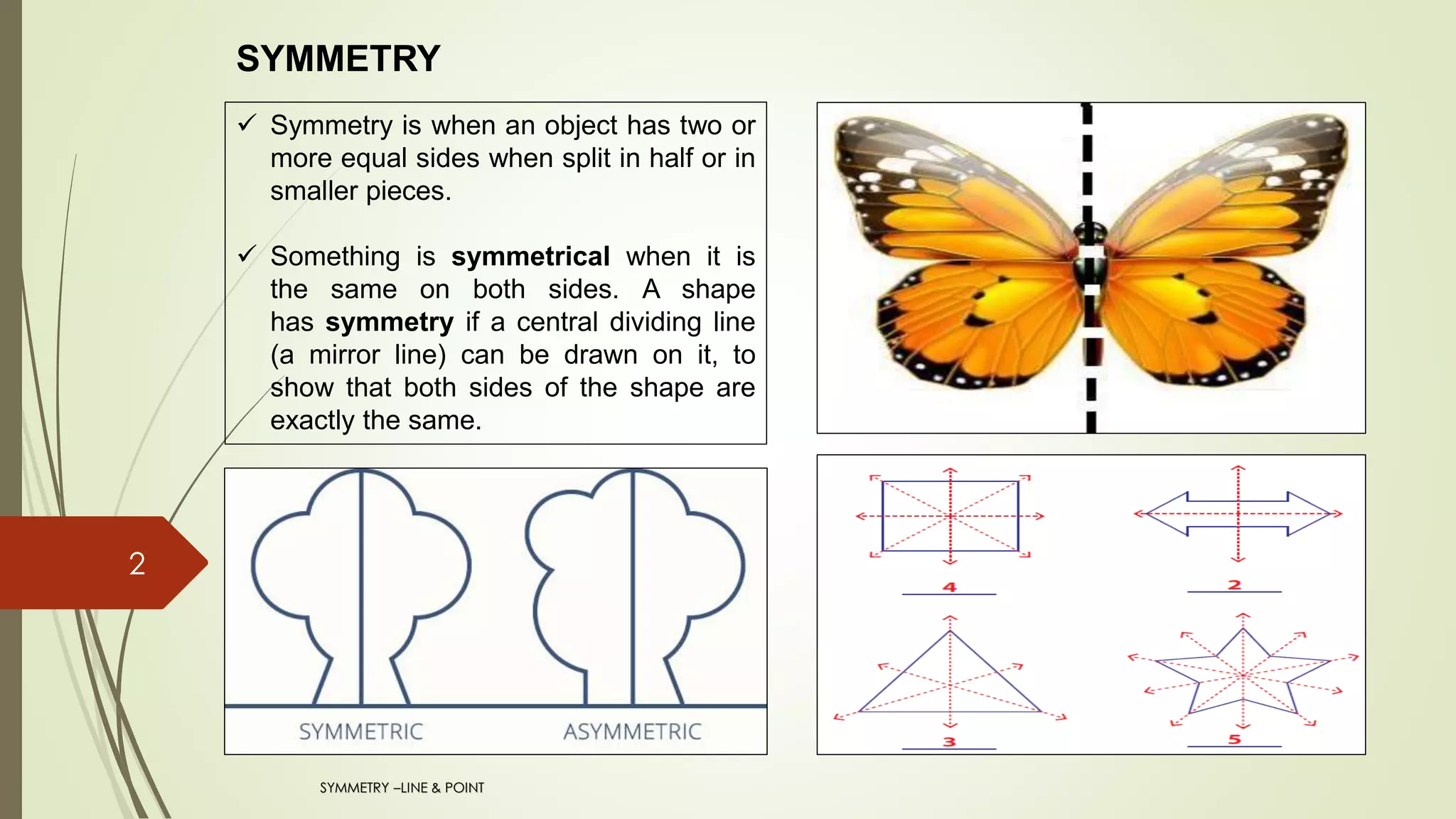
When you rotate a figure with point symmetry 180 degrees around its center, it remains unchanged. This is distinct from line symmetry (reflectional symmetry), where a figure can be folded over an axis to match itself. While many stars have multiple lines of symmetry, point symmetry is a more restrictive condition that requires a balanced "opposite" for every vertex and edge.
As of 2026, the study of symmetry remains a foundational element of both Euclidean geometry and modern computational design. Understanding these properties is essential for fields ranging from architectural planning to the development of crystalline structures in material science.
The Geometry of Star Polygons
To determine if a star has point symmetry, we must first define what a "star" is in a geometric context. Mathematicians refer to these as star polygons, often denoted by Schläfli symbols ${n/k}$, where $n$ represents the number of vertices and $k$ represents the "step" used to connect them.
For example, a standard five-pointed star is a ${5/2}$ star polygon. This means there are five vertices, and each vertex is connected to the second vertex away from it. A six-pointed star, often formed by two overlapping equilateral triangles, is a ${6/2}$ star figure (also called a hexagram).
The symmetry of these polygons is governed by the value of $n$. The symmetry group of a regular star polygon is $D_n$ (dihedral symmetry), which includes both rotational and reflectional symmetries. Point symmetry is specifically the presence of a 180-degree rotation in that symmetry group.
The Rule of Even Vertices: When Point Symmetry Exists
The primary determinant for point symmetry in a regular star is whether the number of points, $n$, is an even number.
Stars with an Even Number of Points
If a star has an even number of points (such as 6, 8, 10, or 12), it is possible for it to have point symmetry. In an even-pointed regular star, every vertex has a "partner" vertex located exactly 180 degrees across the center. For instance:
- 6-Pointed Star (Hexagram): If you pick the top vertex, there is a corresponding bottom vertex. If you rotate the star 180 degrees, the shape looks identical.
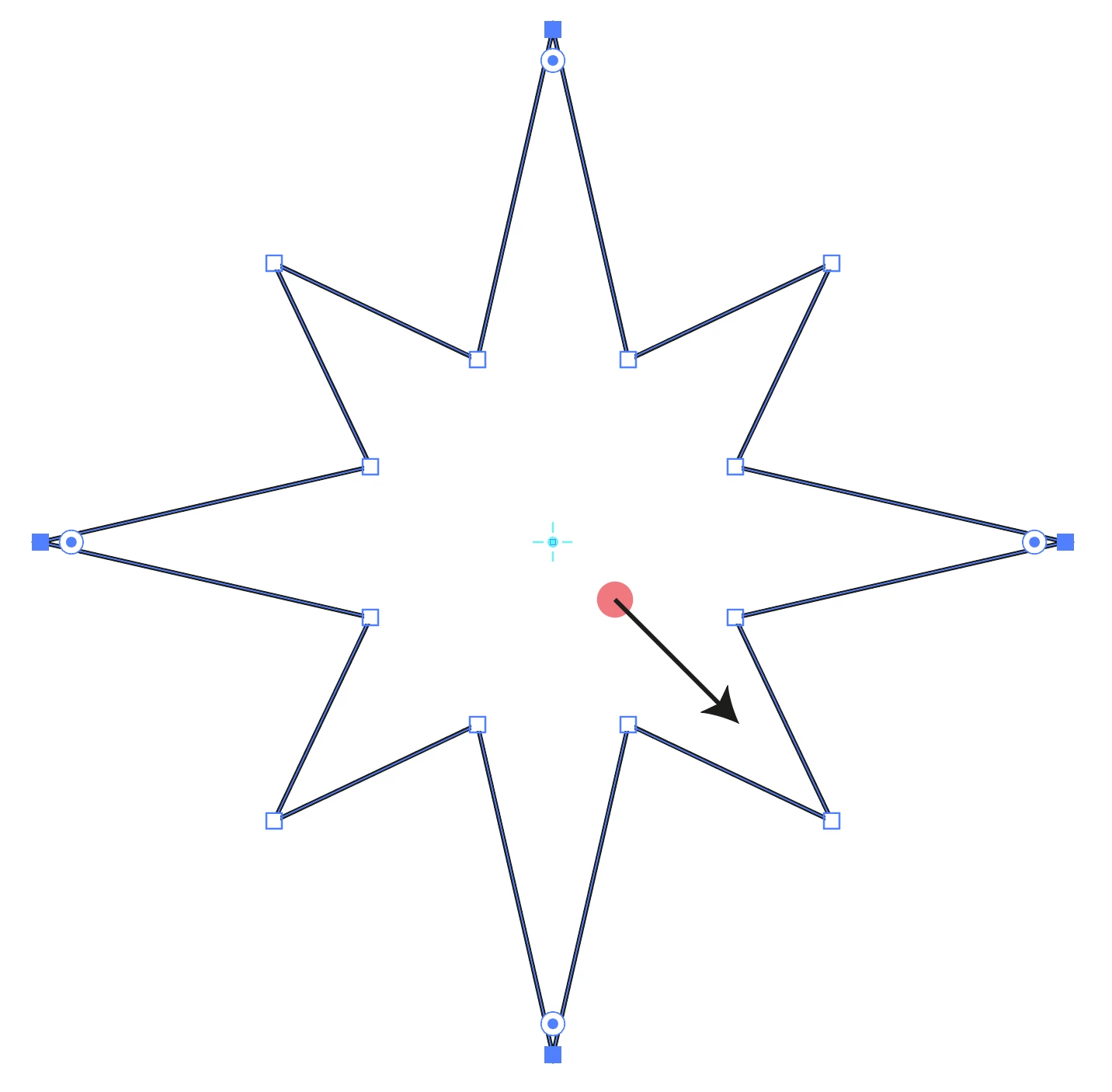
- 8-Pointed Star (Octagram): This shape is often used in tile patterns and religious iconography. Because 8 is even, it possesses point symmetry.
- 12-Pointed Star: Frequently found in complex architectural mosaics, this star also exhibits point symmetry.
Stars with an Odd Number of Points
If a star has an odd number of points (such as 5, 7, or 9), it cannot have point symmetry. In an odd-numbered configuration, if you pick a vertex and look 180 degrees across the center, you will find an edge or a "valley" (indentation) rather than a corresponding vertex.
- 5-Pointed Star (Pentagram): This is the most common star shape. If you rotate it 180 degrees, the single point that was facing "up" is now facing "down," and the two points that were at the bottom are now at the top. The orientation has changed, meaning it does not have point symmetry.
- 7-Pointed Star (Heptagram): Like the pentagram, the odd number of vertices prevents the shape from being identical after a 180-degree rotation.
Distinguishing Between Reflectional and Point Symmetry
A common point of confusion for students and designers is the difference between reflectional (line) symmetry and point (rotational) symmetry.
A five-pointed star has five lines of symmetry. You can draw a line from any tip through the center to the opposite "crotch" of the star, and the two halves will be mirror images. However, having line symmetry does not guarantee point symmetry. In fact, many shapes have line symmetry but lack point symmetry, and vice versa.
Point symmetry is specifically about central inversion. It requires that the shape looks the same when turned upside down. A 6-pointed star has both: it has six lines of reflectional symmetry and it has point symmetry. A 5-pointed star has five lines of reflectional symmetry but zero point symmetry.
Identifying Point Symmetry: The "Upside Down" Test
For those working in graphic design or geometry, a simple practical test can determine if a star (or any shape) has point symmetry:
- Print or draw the star on a piece of paper.
- Mark the center point of the star.
- Rotate the paper 180 degrees (turn it upside down).
- Compare the result to the original orientation.
If the star looks exactly the same—meaning the tips are pointing in the same directions and the overall silhouette is unchanged—it has point symmetry. If the star appears inverted (e.g., a "point up" star becomes a "point down" star), it lacks point symmetry.
Symmetry Properties of Common Star Shapes
The following table summarizes the symmetry characteristics of various regular star polygons based on their vertex count.
| Number of Points ($n$) | Name of Polygon | Point Symmetry? | Rotational Symmetry (Order) | Lines of Reflectional Symmetry |
|---|---|---|---|---|
| 3 | Triangle (Degenerate Star) | No | 3 (120°) | 3 |
| 4 | Tetragram (Cross) | Yes | 4 (90°) | 4 |
| 5 | Pentagram | No | 5 (72°) | 5 |
| 6 | Hexagram | Yes | 6 (60°) | 6 |
| 7 | Heptagram | No | 7 (51.4°) | 7 |
| 8 | Octagram | Yes | 8 (45°) | 8 |
| 9 | Enneagram | No | 9 (40°) | 9 |
| 10 | Decagram | Yes | 10 (36°) | 10 |
Technical Depth: Rotational Order and Point Symmetry
In group theory, symmetry is classified by the "order" of rotation. The order $n$ refers to how many times a shape can be rotated within a full 360-degree circle and still look the same.
- A regular $n$-pointed star has rotational symmetry of order $n$.
- The angle of rotation for each step is $360 / n$.
- Point symmetry is equivalent to rotational symmetry of order 2, or any even order that is a multiple of 2 (where a 180-degree rotation is one of the available steps).
If $n$ is even, then $n/2$ is an integer. This means that rotating the star by $180$ degrees ($n/2$ steps of $360/n$ degrees) is a valid symmetry operation. If $n$ is odd, $n/2$ is not an integer, and no combination of rotations will result in exactly 180 degrees, thus precluding point symmetry.
Applications of Star Symmetry in 2026
The distinction between even and odd star symmetry is not just a mathematical curiosity; it has practical implications in several fields as of 2026.
Architectural and Textile Design
In Islamic geometric patterns and Gothic tracery, the choice between an 8-pointed star and a 5-pointed star dictates how patterns can be tiled. Even-pointed stars with point symmetry allow for different types of "interlocking" and "translational" tiling that are impossible with odd-pointed stars. Designers often use even-pointed stars when they want the pattern to feel more "grounded" or "static" from any orientation.
Crystallography
In the study of crystals, point symmetry is a requirement for certain lattice structures. While "quasicrystals" (discovered by Dan Shechtman) can exhibit 5-fold and 10-fold symmetry, classical crystallography relies heavily on symmetries of order 2, 3, 4, and 6. A 6-pointed star configuration is common in molecular chemistry (such as the benzene ring), where point symmetry influences the molecule's dipole moment and physical properties.
Signal Processing and Optics
In 2026, optical sensors and star-trackers used in satellite navigation often use star-shaped apertures to control light diffraction. The symmetry of these apertures affects the "starburst" effect (diffraction spikes). An even-pointed star aperture produces fewer, more distinct spikes because the spikes from opposite sides overlap due to point symmetry. An odd-pointed star aperture produces twice as many spikes as it has points because there is no overlap.
Common Misconceptions and Troubleshooting
When analyzing "a star does have point symmetry," several common errors can occur:
- Confusing Order with Degrees: A 5-pointed star has "rotational symmetry," but not "point symmetry." Students often hear "rotational symmetry" and assume it means point symmetry. Remember: point symmetry is specifically the 180-degree version.
- Ignoring Irregular Stars: All the rules above apply to regular star polygons (where all sides and angles are equal). If a star is irregular—for example, if one point is longer than the others—it will lose its point symmetry even if it has an even number of points.
- Center of Symmetry: Point symmetry requires a single central point. In some complex overlapping star figures, there may be multiple centers of local symmetry, but for the shape as a whole, there must be one unified origin.
For more technical proofs on star polygons and their symmetry groups, the resources at Wolfram MathWorld provide exhaustive topological data. Additionally, the Britannica entry on Symmetry offers a broader context for how point symmetry fits into the hierarchy of geometric transformations.
FAQs
Does a standard 5-pointed star have point symmetry?
No, a standard 5-pointed star (pentagram) does not have point symmetry. If you rotate it 180 degrees, the orientation of the points changes (the top point moves to the bottom, but the overall shape is inverted). It does, however, have five lines of reflectional symmetry and rotational symmetry of order 5.
What is the minimum number of points a star needs to have point symmetry?
For a regular star polygon, the minimum number of points required for point symmetry is four (a tetragram or a "four-pointed star"). However, many people do not consider a 4-pointed shape a "star" in the traditional sense, often calling it a cross. Therefore, the 6-pointed star (hexagram) is the most common example of point symmetry in star-like figures.
Can an irregular star have point symmetry?
Yes, an irregular star can have point symmetry as long as every point on the star has a corresponding point directly opposite it across the center. For example, a star with four long points and four short points (an 8-pointed compass rose) still has point symmetry, even though it is not a "regular" polygon.
Is point symmetry the same as 180-degree rotation?
Yes, in two-dimensional geometry, point symmetry is identical to rotational symmetry of order 2, which corresponds to a 180-degree rotation. In three-dimensional geometry, point symmetry (central inversion) is slightly different as it involves reflecting points through the origin in all three dimensions $(x, y, z) \to (-x, -y, -z)$.
Why does the number of points have to be even?
The number of points must be even because point symmetry requires vertices to exist in pairs. For every vertex at a specific angle, there must be another vertex exactly 180 degrees away. In an odd-numbered polygon, the space 180 degrees away from a vertex is always the midpoint of the opposite side, not another vertex.
Summary of Actionable Insights
To verify if a specific star has point symmetry:
- Count the points: If the number is odd, it definitely lacks point symmetry.
- Check for regularity: Ensure the points are evenly spaced and of equal length.
- Apply the 180-degree test: Rotate the image mentally or physically. If the "up" direction looks the same as the "down" direction, point symmetry is present.
- Differentiate from lines: Do not assume that having lines of symmetry (reflection) means the shape has point symmetry (rotation).
For those designing logos or patterns in 2026, choosing an even-pointed star is the key to achieving a balanced, point-symmetric aesthetic that maintains its integrity even when inverted.