In Islamic jurisprudence, credit cards are generally considered permissible (Halal) provided they are used in a manner that avoids interest (Riba) and prohibited transactions. While the standard contract includes an interest clause for late payments, most contemporary scholars allow their use if the cardholder remains committed to paying the full balance within the interest-free grace period.
The intersection of modern finance and Islamic law (Sharia) is a complex landscape that requires a nuanced understanding of both contractual obligations and religious principles. As we navigate the financial environment of 2026, credit cards have become nearly indispensable for daily transactions, travel, and building a financial footprint. However, for the Muslim consumer, the question of whether these tools are "Haram" (forbidden) or "Halal" (permissible) remains a primary concern. To answer this, one must look beyond the plastic card and examine the mechanics of the debt, the nature of the contract, and the intention of the user.
Understanding the Fundamental Prohibition: Riba (Usury)
The most significant hurdle regarding credit cards in Islam is Riba, commonly translated as usury or interest. The Quran and Hadith are explicit in their condemnation of Riba, viewing it as an exploitative mechanism that creates wealth from money itself rather than through productive economic activity or risk-sharing. In a conventional credit card setup, the "price" of borrowing money is the interest rate charged on the revolving balance.
There are two primary types of Riba relevant here: Riba al-Nasi'ah and Riba al-Fadl. Riba al-Nasi'ah is the interest charged due to a delay in payment, which is exactly what happens when a credit card balance is carried over to the next month. From a Sharia perspective, if you borrow $1,000, you must return exactly $1,000. Any stipulated excess required by the lender because of the time taken to repay is considered Riba and is strictly prohibited.
Because conventional credit cards are built on the premise of earning interest from consumers who do not pay in full, the entire business model of the issuing bank often stands in direct opposition to Islamic economic ethics. However, the complexity arises because the interest is not triggered immediately. Most cards offer a "grace period" of 21 to 25 days. If the balance is paid within this window, no interest is charged. This "conditional" nature of the interest is where scholarly opinions begin to diverge.
The Controversy of the Contractual Clause
Even if a cardholder is disciplined enough to never pay a cent in interest, a significant ethical and legal question remains: Is it Halal to sign a contract that contains an interest clause? When you apply for a credit card, you sign a legal agreement stating that you agree to pay interest if you are late.
Some conservative scholars argue that the mere act of signing a document that validates Riba is sinful, regardless of whether the interest is actually triggered. They cite the principle that Muslims should not witness or be party to usurious contracts. From this perspective, a conventional credit card is Haram because the contract itself is flawed at its root.
Conversely, many contemporary Sharia councils, including those in the UK, North America, and parts of the Middle East, have adopted a more pragmatic view based on Hajah (need) or Darurah (necessity). In 2026, functioning in a global economy without a credit card is increasingly difficult. Car rentals, hotel bookings, and even some government services require a credit card for security deposits. Consequently, these scholars permit the use of conventional cards under the condition that the user has the firm intention and the financial means to pay the balance in full before any interest accrues.
Conditions for Using a Conventional Credit Card Halal
For those following the permissive view, specific conditions must be met to ensure the card’s usage remains within the bounds of Halal practice. These are not merely suggestions but are considered essential safeguards against falling into major sin.
- Immediate Full Repayment: The cardholder must treat the credit card as a debit card. This means never spending money they do not currently have in their bank account. The goal is to clear the statement balance in full every single month.
- Automated Safeguards: In 2026, most banking apps allow for "Full Balance Auto-Pay." Scholars often recommend setting this up immediately to eliminate the risk of human error or forgetfulness leading to an interest charge.
- Avoiding Cash Advances: Conventional credit cards usually charge interest on cash withdrawals from the very moment the money is taken out, with no grace period. Because this interest is unavoidable, cash advances on conventional cards are universally considered Haram.
- Permissible Purchases: The card must not be used to purchase prohibited items or services, such as alcohol, gambling, or other non-Sharia-compliant activities. Using a Halal tool for a Haram purpose invalidates its permissibility.
- Assessment of Need: One should ask if a debit card or a prepaid card could serve the same purpose. If a debit card suffices, it is often preferred to avoid the "grey area" of credit contracts entirely.
Islamic Credit Cards: The Sharia-Compliant Alternative
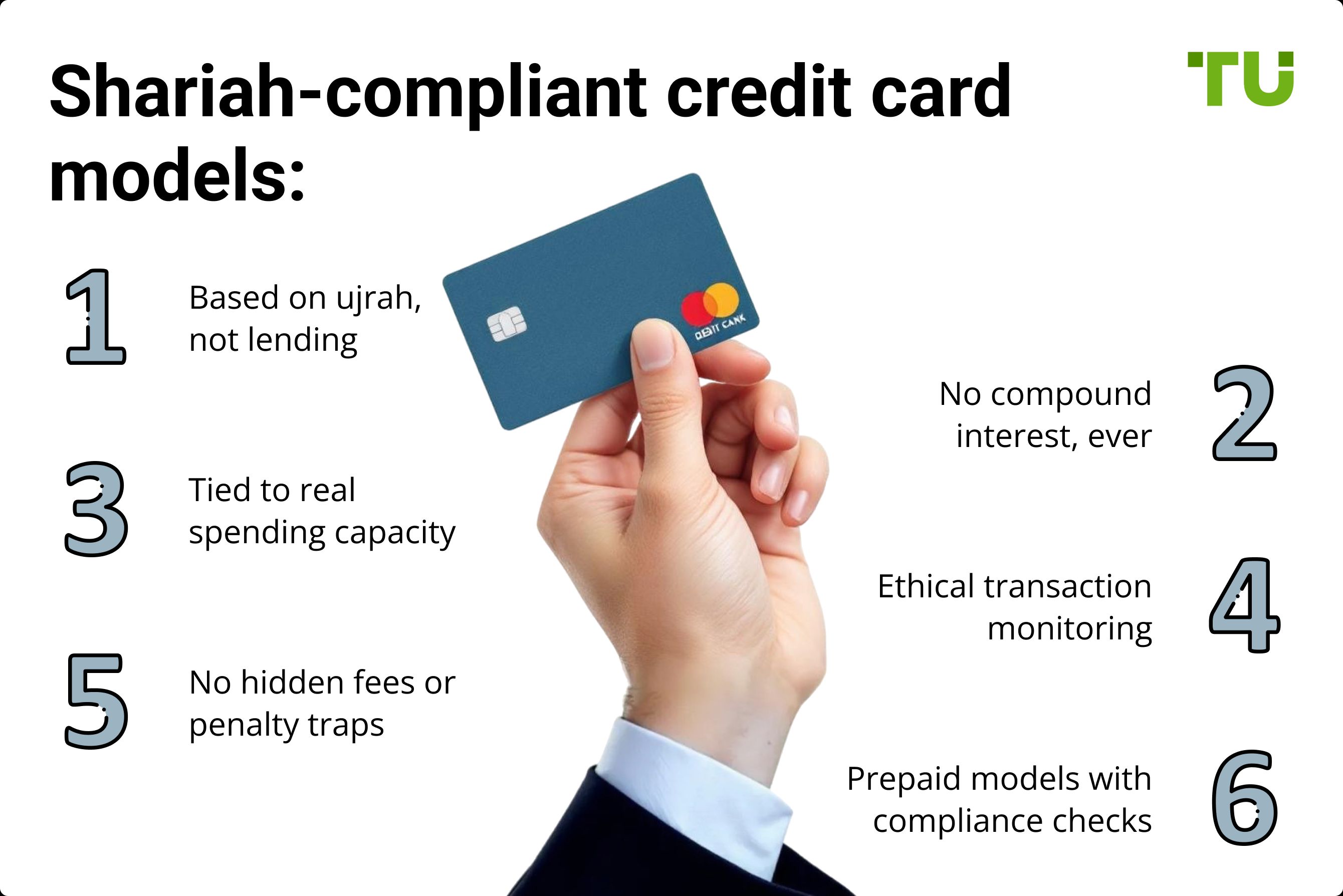
To address the needs of the Muslim community, Islamic banks have developed "Islamic Credit Cards." These products are designed to provide the convenience of a credit card without the Riba-based contract. They are governed by specific Islamic contractual structures that have been vetted by Sharia Supervisory Boards.
The Ujrah Model (Service Fee)
In this model, the bank does not charge interest on the borrowed amount. Instead, it charges a fixed "service fee" (Ujrah) for the benefits provided by the card, such as payment processing, reward programs, and the convenience of the facility. The fee is not linked to the amount of debt but to the service itself.
The Tawarruq Model (Commodity Murabaha)
This is a more complex arrangement where the bank purchases a commodity (like metals or oil) on the customer's behalf and then sells it back to the customer at a profit on a deferred payment basis. The customer then sells the commodity to a third party for cash. This creates a liquid balance for the customer to use, and the "profit" the bank makes replaces the "interest" found in conventional banking.
The Kafalah Model (Guarantorship)
Under Kafalah, the bank acts as a guarantor for the customer’s transactions with merchants. The bank may charge a fee for providing this guarantee. This is often combined with other structures to ensure the bank remains profitable while staying compliant with Sharia.
Comparison: Conventional vs. Islamic Credit Cards (2026)
| Feature | Conventional Credit Card | Islamic Credit Card |
|---|---|---|
| Interest (Riba) | Charged on revolving balances (Haram). | Strictly prohibited. |
| Contract Base | Loan with interest-bearing clause. | Based on Ujrah, Tawarruq, or Ijarah. |
| Late Fees | Usually a percentage or flat fee (often contains Riba). | Fixed administrative fee or donated to charity. |
| Cash Advances | High interest from day one. | Usually permitted via Tawarruq with fixed fees. |
| Merchant Selection | Can be used anywhere. | Some may automatically block Haram merchants (e.g., bars). |
| Rewards/Points | Common. | Permitted if the rewards are from the bank’s own funds. |
The Role of Fees and Penalties
A common point of confusion is the "Late Payment Fee." Many ask: if interest is Haram, isn't a late fee also Haram?
In Islamic finance, a penalty for late payment is a subject of debate. To prevent customers from taking advantage of interest-free credit, Islamic banks are allowed to charge a late fee. However, the bank is generally not allowed to keep this fee as profit, as that would resemble Riba. Instead, Sharia standards, such as those from the Accounting and Auditing Organization for Islamic Financial Institutions (AAOIFI), often require the bank to donate the late fee to a registered charity. This penalizes the late-payer without providing a usurious incentive to the lender.
In 2026, many conventional banks have also moved toward flat-fee structures for late payments, but unless the bank explicitly states it is Sharia-compliant, the assumption remains that these fees may contribute to the bank’s interest-based revenue streams.
Rewards, Cash Back, and Points: Are They Halal?
Most credit cards offer incentives to encourage spending. From an Islamic perspective, these are generally viewed as Hiba (gifts). If the bank gives you a 1% cash back on your purchases, it is considered a gift from the bank to the customer for using their services.
However, there is a caveat. If the rewards are funded directly by the interest paid by other "indebted" customers, some scholars express discomfort. Nevertheless, the prevailing view is that since the merchant fees (which the bank collects from the store) typically fund these rewards, they are permissible for the cardholder to accept and use.
Handling the "Trap" of Modern Credit Culture
The primary danger of credit cards, even if used in a "Halal way," is the psychological trap of debt. Islam emphasizes financial responsibility and the avoidance of debt except in cases of genuine need. The Prophet Muhammad (peace be upon him) frequently sought refuge from debt, noting its potential to lead to lying and broken promises.
In the digital economy of 2026, "Buy Now, Pay Later" (BNPL) schemes and credit cards are designed to encourage impulsive consumption. A cardholder may start with the intention of paying in full but may eventually fail due to an emergency or overspending. At that moment, they fall into the trap of Riba. For this reason, a "Halal" approach to credit cards must include strict personal budgeting and a "contingency fund" to ensure that the credit balance is always covered by liquid assets.
Frequently Asked Questions
Is it Haram to have a credit card if I never pay interest?
Most contemporary scholars say it is permissible (Halal) if you have a genuine need for the card and are certain you can pay the balance in full before interest is charged. However, a minority of scholars still consider it Haram because you are signing a contract that acknowledges the validity of interest.
What should I do if I accidentally get charged interest?
If an accidental interest charge occurs, you should pay it immediately to stop the Riba from compounding. Many scholars recommend calculating the amount of interest paid and giving an equivalent amount to charity (Sadaqah) to "purify" your finances, though this does not undo the sin if it was intentional.
Are Islamic credit cards available in non-Muslim countries?
Yes, as of 2026, several "Fintech" companies and dedicated Islamic banks offer Sharia-compliant credit or "charge" cards in the UK, USA, and Europe. These are often structured as "Gold-backed" or "Asset-backed" cards that avoid traditional Riba mechanisms.
Can I use a credit card to pay for Hajj or Umrah?
Using a credit card for pilgrimage is permissible if you have the funds to pay it off immediately. However, it is disliked (Makruh) or potentially invalid to go into interest-bearing debt to perform a religious obligation that is only required for those who are "financially able."
Is the annual fee on a credit card considered Riba?
No, an annual fee is generally considered a service charge (Ujrah) for the administration of the account and the provision of benefits. As long as the fee is not a percentage of the credit limit used, it is typically viewed as a permissible contractual fee.
What is the difference between a credit card and a charge card?
A charge card (like certain premium American Express cards) requires the balance to be paid in full every month and does not technically offer a revolving "credit" facility with interest. Many scholars find charge cards to be more compliant with Islamic principles because they do not have a Riba-based revolving balance feature.
Practical Recommendations for 2026
If you are a Muslim consumer looking to maintain financial integrity in 2026, the following steps are recommended:
- Prioritize Islamic Banks: If you live in a region with Islamic banking (like the UAE, Malaysia, or Saudi Arabia), always choose a Sharia-compliant credit card over a conventional one.
- Explore Fintech Options: Look for modern Sharia-compliant digital wallets and "Halal Credit" startups that use profit-sharing or service-fee models rather than interest.
- Use a "Buffer" Account: Keep enough money in a separate savings account to cover your entire credit limit. This ensures that even in a bad month, you have the means to clear the debt.
- Read the Fine Print: Even if a card is marketed as "interest-free," check for "admin fees" that might be hidden Riba. Verify the card has an endorsement from a reputable Sharia board.
Ultimately, the goal of the Muslim consumer should be to move toward a debt-free life. While credit cards are a useful tool in the current global financial infrastructure, they should be treated with the caution one would give to any tool that has the potential to cause spiritual and financial harm.