The SCP Foundation uses Object Classes to categorize anomalies based on the difficulty of their containment rather than their inherent danger or lethality. While a world-ending entity might be classified as Safe if it can be easily stored in a locker, a harmless but teleporting cat might be classified as Keter because it is nearly impossible to keep in one place. Understanding these distinctions is fundamental to navigating the SCP database and the wider lore of the Foundation.
The classification system serves as a shorthand for Foundation personnel, primarily researchers and containment specialists, to understand the resource allocation and security protocols required for a specific anomaly. As of 2026, while the standard "Primary Classes" remain the backbone of the database, more complex systems like the Anomaly Classification System (ACS) have become prevalent to provide a more nuanced view of an object's behavior and risk.
The Foundation of Classification: The Box Test
To understand how SCP classes are assigned, the community and in-universe researchers utilize a thought experiment known as the Locked Box Test. This analogy simplifies the complex decision-making process into a series of hypothetical scenarios regarding a physical container.
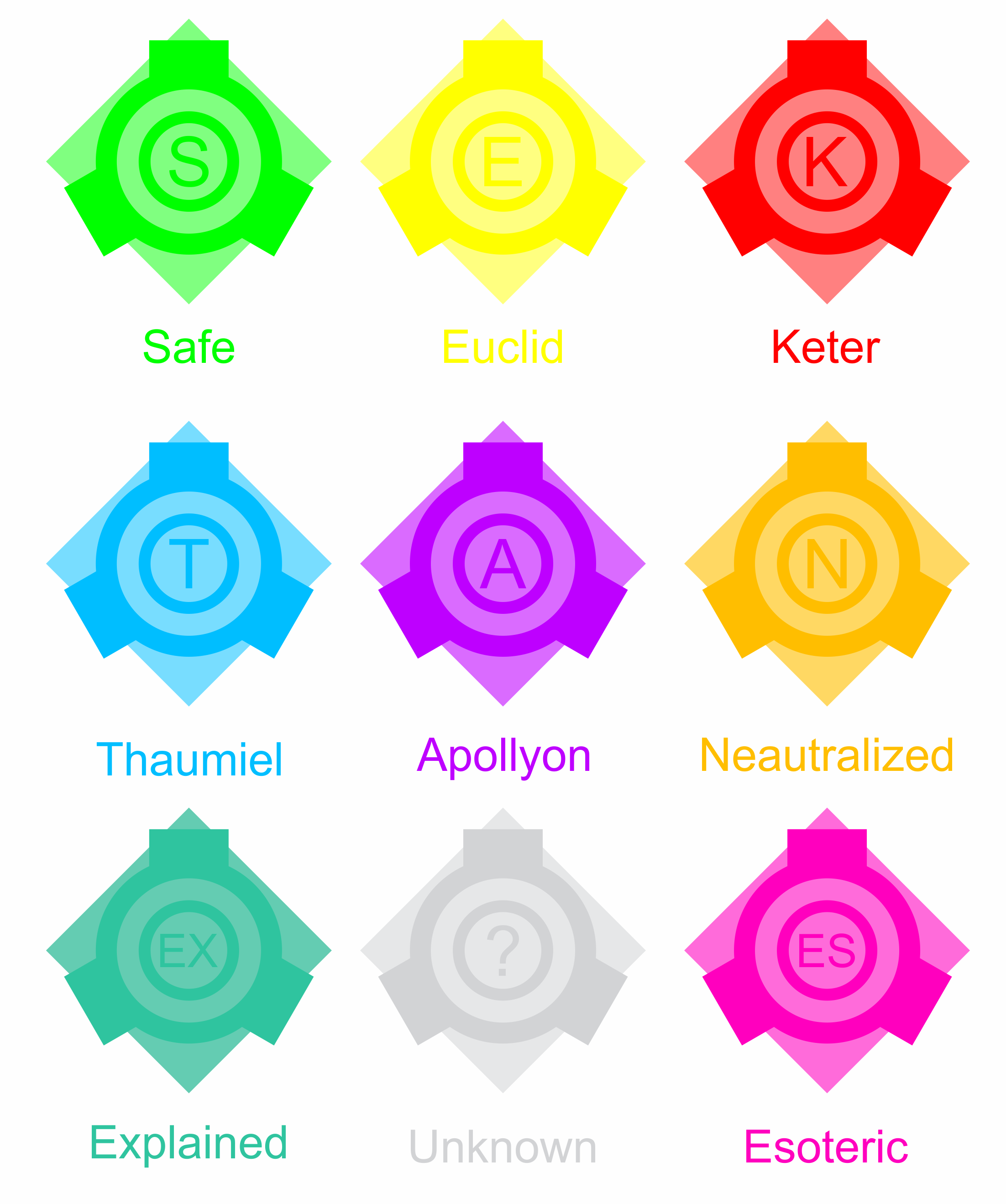
- Safe: If you put it in a box, leave it alone, and nothing bad happens, it is likely Safe.
- Euclid: If you put it in a box, leave it alone, and you are not entirely sure what will happen, it is Euclid.
- Keter: If you put it in a box, leave it alone, and it easily escapes, it is Keter.
- Thaumiel: If the object is the box, it is Thaumiel.
- Apollyon: If the object cannot fit in a box and is actively destroying the world, it is Apollyon.
- Archon: If you could put it in a box but doing so would cause a disaster, so you leave it out, it is Archon.
This test highlights the most common misconception among new readers: class does not equal danger. A button that destroys the universe if pressed is "Safe" if it just sits on a table. A sentient shadow that does nothing but hide in corners is "Keter" if no physical or electromagnetic barrier can hold it.
Primary Containment Classes
The majority of anomalies in the Foundation database fall into these core categories. These designations have been the standard since the early days of the Foundation and remain the most frequently used.
Safe
Safe-class objects are anomalies that are understood well enough to be contained reliably and permanently. This does not mean the object is harmless; rather, it means the object's anomalous properties can only be triggered by external activation. Many Safe-class objects are inanimate items, though some are sentient beings with cooperative temperaments or physical limitations that prevent escape.
Examples of Safe objects include SCP-914 (The Clockworks), which requires manual input to operate, and various "cursed" items that only manifest effects when handled in specific ways.
Euclid
Euclid-class objects are anomalies that require more resources to contain or those whose behavior is not fully predictable. This is the "default" class for many SCPs. If an anomaly is sentient, sapient, or autonomous, it is almost always classified as Euclid because a thinking being has its own will and can act in ways the Foundation cannot fully anticipate.
Euclid containment protocols are often more complex and require frequent monitoring. If the Foundation does not yet understand the "rules" governing an anomaly, it remains Euclid until further research allows for a Safe designation or until repeated escape attempts necessitate an upgrade to Keter.
Keter
Keter-class objects are the most difficult to contain. The designation "Keter" (derived from the Hebrew word for "Crown") signifies anomalies that the Foundation cannot reliably or consistently keep in a box. This may be due to the anomaly's immense power, its ability to bypass physical dimensions, or its active desire to escape and cause harm.
Containing a Keter-class object often involves massive expenditures of resources, specialized containment sites, and high turnover of security personnel. It is important to note that a Keter designation does not mean the Foundation wants to destroy the object—the mission remains "Secure, Contain, Protect"—but it does mean containment is a constant, uphill battle.
Thaumiel
Thaumiel-class objects are highly classified anomalies used by the Foundation to contain or counteract other anomalies. These are "the Foundation's own anomalies." The existence of Thaumiel-class objects is often known only to the O5 Council and senior staff.
A Thaumiel object might be a machine that resets time to prevent a K-Class scenario, or a specific entity whose presence stabilizes reality. Because they are tools of the Foundation, they are kept under the strictest secrecy to prevent them from being neutralized or used against the organization.
Neutralized
Anomalies are classified as Neutralized when they are no longer anomalous. This can occur because the object was accidentally or intentionally destroyed, its anomalous properties ceased to function, or it was "cured." While the object is no longer a threat, its documentation is kept in the database for historical and research purposes.
Explained
Explained-class (SCP-EX) objects are those that were once thought to be anomalous but have since been fully understood by conventional science. This usually happens when the Foundation discovers a new law of physics or when a "supernatural" event is revealed to be a hoax or a natural phenomenon. This class serves as a bridge between the Foundation’s secret world and the public’s scientific understanding.
Comparison of Primary SCP Classes
| Object Class | Containment Difficulty | Predictability | Common Characteristics |
|---|---|---|---|
| Safe | Low | High | Inanimate, requires activation, or fully understood. |
| Euclid | Moderate | Medium | Sentient, sapient, or poorly understood. Default class. |
| Keter | High | Low | Actively hostile, multi-dimensional, or constantly evolving. |
| Thaumiel | Extremely High | High | Used to contain other SCPs; highly secretive. |
| Neutralized | None | N/A | No longer anomalous; destroyed or disabled. |
| Explained | None | High | Accounted for by modern scientific theory. |
The Anomaly Classification System (ACS)
As the Foundation database grew, many authors felt that the three primary classes (Safe, Euclid, Keter) were insufficient to describe the complexity of certain anomalies. This led to the creation of the Anomaly Classification System (ACS), which is now widely used in newer articles as of 2026. The ACS adds two additional layers of classification to the standard Containment Class.
Disruption Class
The Disruption Class measures how quickly an anomaly can spread and how difficult it is for the Foundation to keep it a secret from the general public.
- Dark: The anomaly is localized and does not affect anyone outside of its immediate vicinity.
- Vlam: The anomaly affects a small group of people (e.g., a small town or a neighborhood).
- Keneq: The anomaly could affect a large city or a significant geographical region.
- Ekhi: The anomaly poses a threat to global normalcy and is nearly impossible to hide.
- Amida: The anomaly is actively breaking the veil of secrecy or affecting the entire universe simultaneously.
Risk Class
The Risk Class measures the severity of the anomaly's effects on an individual or the environment if containment is breached.
- Notice: The effects are mild or purely aesthetic.
- Caution: The effects are harmful but not lethal (e.g., pain, minor injury).
- Warning: The effects are severely harmful and likely lethal.
- Danger: The effects are highly lethal and occur rapidly.
- Critical: The anomaly causes immediate, widespread death or total destruction of the soul/consciousness.
Esoteric and Non-Standard Classes
Beyond the primary classes, the Foundation utilizes "Esoteric Classes" for anomalies that fit very specific, niche scenarios. These are less common and often unique to specific storylines or "Canons."
Apollyon
Apollyon-class anomalies are those that cannot be contained and are expected to cause the end of the world (a K-Class Scenario) in the near future. Unlike Keter, where the Foundation tries to maintain containment, Apollyon implies that containment is impossible and the Foundation is merely managing the fallout or preparing for the end.
Archon
Archon-class anomalies are those that could theoretically be contained, but the Foundation chooses not to. Usually, this is because the anomaly is part of the fundamental structure of reality, or containing it would cause more damage than leaving it free. For example, if an entity is responsible for the existence of gravity, containing it would be catastrophic.
Ticonderoga
This class is reserved for anomalies that cannot be contained but also do not need to be. They are typically harmless and do not threaten the "Veil" of secrecy, making the massive expenditure of resources for containment unnecessary.
Maksur
Used primarily in the context of the Church of the Broken God, Maksur-class anomalies are parts of a larger whole that have been separated. They are "broken" anomalies that are Safe or Euclid individually but would become Keter or Apollyon if they were ever allowed to recombine.
How Classification Affects Foundation Operations
The classification of an SCP dictates nearly every aspect of its lifecycle within the Foundation. When an object is first recovered, it is usually given a temporary designation based on initial contact reports. As researchers conduct "D-Class" testing and observation, the class is refined.
Resource Allocation
Keter-class anomalies receive the lion's share of funding and manpower. This includes the construction of specialized sites (like Site-19 or Site-17), the hiring of specialized Containment Architects, and the deployment of Mobile Task Forces (MTFs) dedicated solely to that one object. Safe-class objects, by contrast, are often kept in standard high-security storage lockers with minimal oversight.
Personnel Clearance
Working with higher-class objects requires higher security clearances (Level 3 or 4). While a Level 1 researcher might be allowed to study a Safe-class anomalous coin, only senior staff are permitted to handle Keter-class entities. Thaumiel-class objects are so sensitive that even Level 4 personnel may not know they exist; they are often restricted to Level 5 (O5 Council) and their direct subordinates.
Ethics Committee Oversight
The Foundation's Ethics Committee pays close attention to Euclid and Keter classifications. Because these objects are often sentient and difficult to contain, the protocols for keeping them suppressed often involve morally questionable methods. The Committee must balance the safety of the world against the treatment of the anomaly, a conflict that is a recurring theme in Foundation literature.
Frequently Asked Questions
Is Keter the "worst" class?
Not necessarily. Keter only means the object is hard to keep in a box. A Keter-class object might be a harmless ghost that can walk through walls, while a Safe-class object might be a bomb that destroys the galaxy if someone flips a switch. "Worst" usually refers to the Risk Class or the potential for a K-Class Scenario, not the Containment Class.
Can an SCP's class change?
Yes. Anomaly classes are updated as the Foundation's understanding of the object evolves. If a Keter-class object is rendered inert, it becomes Neutralized. If a Euclid-class object is found to be easily contained with a new technology, it may be downgraded to Safe. Conversely, if a Safe object shows new, aggressive behaviors, it will be upgraded to Euclid or Keter.
What is the difference between Apollyon and Keter?
The difference is the possibility of success. With a Keter-class object, the Foundation believes that containment is difficult but achievable through effort and resources. With an Apollyon-class object, the Foundation has accepted that containment is impossible and the anomaly will eventually (or is currently) causing a total failure of the Foundation's mission.
Why are some classes written in different colors?
This is part of the Anomaly Classification System (ACS). The colors provide a quick visual reference:
- Green: Low threat/disruption.
- Blue/Yellow: Moderate threat/disruption.
- Orange/Red: High threat/disruption.
- Black: Maximum threat/disruption.
Who decides the class of an SCP?
In-universe, the classification is determined by the Research Head of the specific project, with approval from the Site Director and potentially the O5 Council for high-priority objects. Out-of-universe, the author of the SCP article chooses the class that best fits the narrative they are trying to tell.
Conclusion and Next Steps
The SCP classification system is a vital tool for understanding the scale and scope of the Foundation's work. By shifting the focus from "how dangerous is it?" to "how hard is it to contain?", the Foundation emphasizes its primary mission of preservation and secrecy. Whether you are a new reader or a seasoned researcher, keeping the Locked Box Test in mind will help you navigate the thousands of anomalies currently documented in the database.
If you are looking to deepen your knowledge of the SCP universe, your next steps should include:
- Reading the "Top Rated" articles on the SCP Wiki to see how different classes are applied in practice.
- Exploring the ACS Guide to understand the visual headers found on modern articles.
- Reviewing the K-Class Scenario list to understand what happens when containment truly fails.