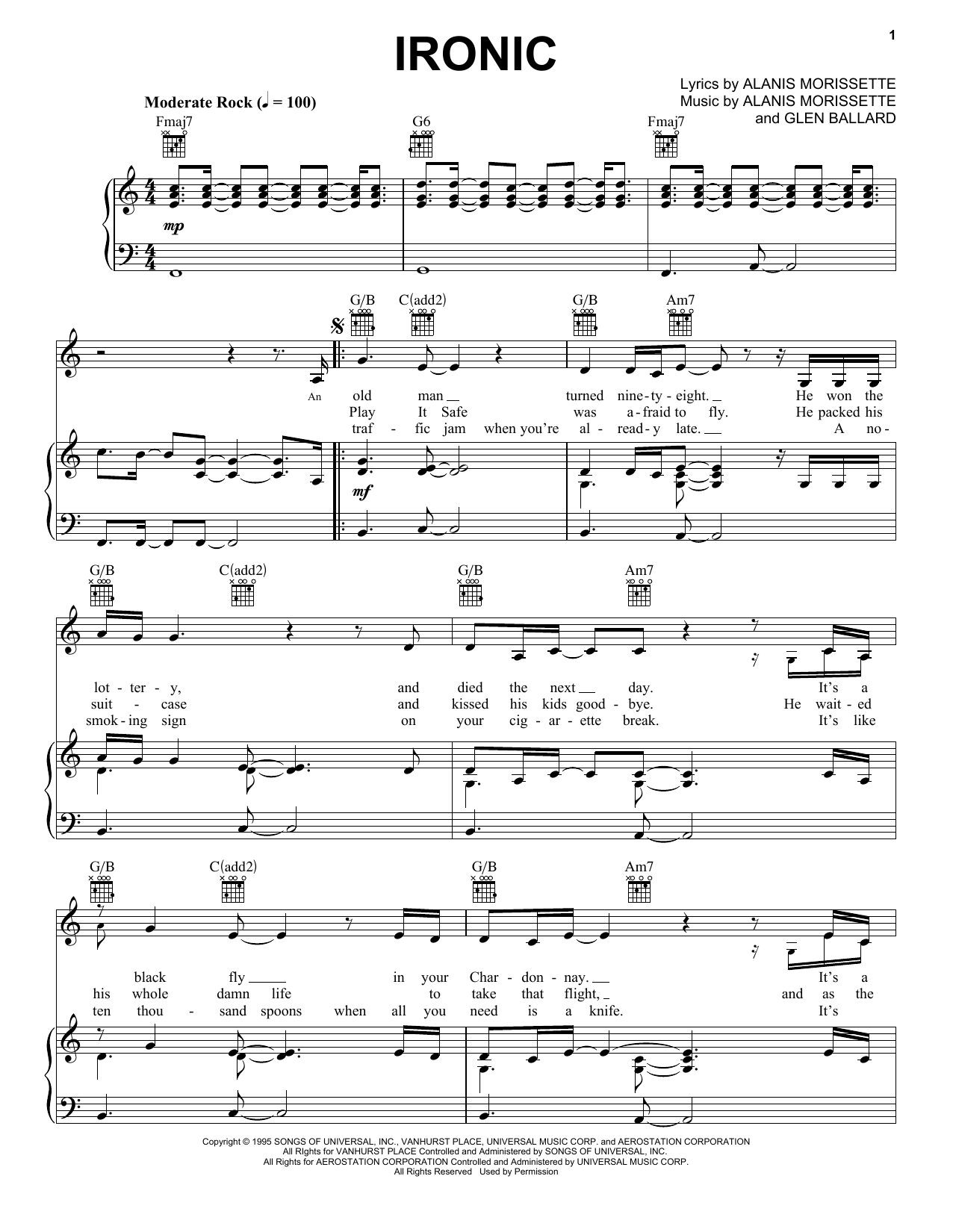
The meaning of Alanis Morissette’s "Ironic" centers on a series of unfortunate coincidences and "bummers" rather than the strict linguistic definition of situational irony. While the lyrics depict life's cruel timing and unexpected frustrations, the song's enduring legacy stems from the meta-irony of a song titled "Ironic" containing almost no examples of actual irony.
Released in 1996 as the third single from the diamond-certified album Jagged Little Pill, "Ironic" became an instant cultural touchstone. However, it also became a lightning rod for English teachers and linguists worldwide. To understand the lyrics, one must look past the dictionary and into the heart of mid-90s alternative rock—a genre defined by angst, observation, and the acknowledgment that the universe often has a twisted sense of humor. In 2026, as we look back on three decades of this track, the discussion has shifted from mocking its "incorrectness" to appreciating its emotional honesty and the "meta" layers Morissette unintentionally (or intentionally) created.
The Verse-by-Verse Breakdown: Analyzing the Scenarios
To understand the meaning of "Ironic," we must examine the specific vignettes Morissette presents. Each verse describes a character facing a sudden, often tragic or annoying, reversal of fortune.
The Old Man and the Lottery
The song opens with a 98-year-old man who wins the lottery and dies the next day. This is perhaps the closest the song gets to situational irony. Situational irony requires a discrepancy between expectation and reality. One expects a lottery win to result in a better life; the reality of immediate death creates a sharp, cruel contrast. The meaning here is a meditation on the fleeting nature of success and the proximity of death to our greatest triumphs.
The Death Row Pardon
Morissette describes a "death row pardon two minutes too late." This is a classic example of "cosmic irony" or "the irony of fate." It suggests that a higher power or the universe itself is playing a cruel joke on the individual. The meaning is rooted in the tragedy of timing—the idea that the solution to our greatest problem exists, but arrives exactly when it can no longer help us.
The Flight and the Fear of Flying
The second verse tells the story of a man who is afraid to fly, waits his whole life to take a flight, and as the plane crashes, thinks, "Well, isn't this nice." This scenario explores the self-fulfilling prophecy or the futility of caution. The character spent a lifetime avoiding a specific catastrophe only for that catastrophe to occur the one time he let his guard down. It speaks to the anxiety of the human condition and the lack of control we have over our ultimate destinies.
The Wedding Day and the "Good Advice"
The chorus brings us the most famous examples: rain on a wedding day, a free ride when you’ve already paid, and "good advice that you just didn't take." These are generally classified as bad luck or unfortunate coincidences. The meaning reflects the "Murphy’s Law" philosophy: if something can go wrong, it will, and usually at the most inconvenient moment possible.
The Linguistic Debate: Irony vs. Coincidence
The primary criticism of "Ironic" for the past thirty years has been that the scenarios described are not actually ironic. In the technical sense, irony is the expression of one's meaning by using language that normally signifies the opposite, or a state of affairs that seems deliberately contrary to what one expects.
Situational Irony vs. Bad Luck
For "rain on your wedding day" to be ironic, the bride would have to be a meteorologist who predicted a sunny day, or the couple would have to have moved the wedding to a desert specifically to avoid rain. Simply having bad weather on a significant day is an unfortunate coincidence, not irony.
Linguists often use "Ironic" as a teaching tool to explain this distinction. The "free ride when you've already paid" is a matter of poor timing. The "black fly in your Chardonnay" is merely a nuisance. However, the song's meaning transcends these technicalities. It captures a specific emotional state—that feeling of being "mocked" by life’s circumstances.
The Evolution of the Word
Language is fluid. Since 1996, the common usage of the word "ironic" has actually drifted closer to Morissette’s definition. While the "prescriptive" definition remains the same in dictionaries, the "descriptive" usage by the general public often equates irony with a "strange or funny coincidence." In this way, Morissette didn't just write a song; she helped redefine a word for an entire generation.
The "Meta-Irony" Theory: The Ultimate Meaning
As we navigate 2026, the most sophisticated interpretation of the song is the "Meta-Irony" theory. This suggests that the song is, in fact, perfectly titled because the true irony is that a song called "Ironic" is filled with non-ironic examples.
Whether Alanis Morissette and co-writer Glen Ballard intended this is a subject of much debate. In various interviews over the years, Morissette has been candid about the writing process. She was only 19 or 20 at the time and has admitted that they weren't obsessing over the Oxford English Dictionary. They were looking for scenarios that felt "ironic" in a colloquial, emotional sense.
The fact that the song has been ridiculed for its lack of irony for decades is, in itself, ironic. The singer is being criticized for a lack of knowledge while the song becomes one of the most successful "irony" lessons in history. This creates a loop of meaning that keeps the track relevant in pop culture discussions.
Comparative Analysis of Scenarios in "Ironic"
To better understand the distinction between what Morissette wrote and what technical irony would look like, consider the following table:
| Scenario in Song | Why it's "Bad Luck" | What would make it "Ironic" |
|---|---|---|
| Rain on your wedding day | It is an uncontrollable weather event that happens to occur on a special day. | A couple getting married in a "Rainmaking" ritual being rained out (or a drought-stricken area getting rain only on a day it ruins a parade). |
| A free ride when you've paid | It is a matter of redundant expenditure and poor timing. | A person who owns a taxi company being forced to pay for a ride in a competitor's car because their own broke down. |
| Black fly in your Chardonnay | It is a minor, annoying contamination of a luxury item. | A pest control expert finding a fly in their glass at a convention for fly-prevention. |
| Death row pardon (too late) | It is a tragic failure of the legal system's bureaucracy. | A judge being sentenced to death by a law they themselves wrote and championed. |
| Winning the lottery and dying | It is a cruel coincidence of health and fortune. | A man who spent his life savings on "How to Live to 100" books winning the lottery and dying the next day. |
The Cultural Significance of the Music Video
The meaning of the song is further expanded by its iconic music video, directed by Stéphane Sednaoui. In the video, Alanis plays four different versions of herself in a single car journey: the driver (serious/focused), the passenger (playful), the one in the back left (moody/contemplative), and the one in the back right (eccentric/free-spirited).
This visual representation suggests that "Ironic" isn't just about external events; it’s about internal perspectives. The different versions of Alanis represent the different ways we react to life's "ironies." We can be frustrated, we can laugh it off, or we can simply observe. The car journey is a metaphor for life—we are moving toward a destination, and while "life has a funny way of sneaking up on you," our various "selves" help us process the absurdity of the ride.
Collaborative Creation: Morissette and Glen Ballard
The lyrics were born out of a highly productive period between Morissette and producer Glen Ballard. Their goal for Jagged Little Pill was honesty above all else. When analyzing the meaning of "Ironic," it is important to remember that it was written as a stream-of-consciousness exercise.
Ballard has noted in retrospectives that they wanted to capture the "spirit" of an observation. The song wasn't meant to be a legal brief; it was meant to be a conversation. This explains why the "ironies" are so domestic and relatable. They are the kinds of things friends complain about over coffee. The "meaning" is found in the shared human experience of feeling like the world is slightly tilted against you.
The Song’s Legacy and "Updated" Meanings
Over the years, the meaning of "Ironic" has been updated to fit new contexts. In 2015, Morissette appeared on The Late Late Show with James Corden to perform a "modern" version of the song. The new lyrics included:
- An iPhone battery dying when you finally get a response to a text.
- A "swiping right" on a person who turns out to be your clone.
- A funny tweet that no one favorites.
These updates reinforce the original meaning: life is full of small, technologically-driven absurdities that feel like "irony" to the person experiencing them. The song has become a vessel for expressing the specific frustrations of any given era.
Frequently Asked Questions
Did Alanis Morissette know the lyrics weren't ironic?
At the time of writing, Morissette and Glen Ballard were more focused on the rhythmic flow and the emotional resonance of the scenarios than on strict linguistic accuracy. In later years, she has embraced the controversy, often joking about it during live performances. She has acknowledged that the "most ironic thing about the song is that it’s not ironic."
Why is "Ironic" considered a staple of 90s music?
It perfectly captured the "post-grunge" transition where alternative music became more melodic but retained a sense of cynicism and introspection. The song’s focus on the "everyday" made it more accessible than the heavy political or dark themes of early 90s grunge.
What is the most "truly ironic" line in the song?
Arguably, the line "It's a free ride when you've already paid" comes closest to irony if interpreted as a comment on the redundancy of effort. However, the "old man/lottery" scenario is the most widely accepted example of situational irony by those who defend the song's title.
Has the song's meaning changed in 2026?
By 2026, the song is viewed through a lens of "Gen X nostalgia." The debate about its grammar has largely settled into an appreciation for its status as a "meta" masterpiece. It is now understood as a song about the feeling of irony rather than the definition of it.
What was the inspiration for the "black fly in your Chardonnay" line?
While not explicitly confirmed as a single event, the line represents the juxtaposition of high-class expectations (Chardonnay) with the grit of reality (a fly). It symbolizes how easily the "perfect moment" can be ruined by a small, uncontrollable factor.
Practical Takeaway: Embracing Life’s "Un-Ironies"
When listening to "Ironic" today, the best approach is to stop acting like a grammarian and start acting like a human. The song’s true meaning is a reminder that we cannot control the weather, the lottery, or the timing of a pardon. We can, however, control our reaction to these events.
The next time "rain on your wedding day" occurs—metaphorically or literally—the takeaway from Alanis Morissette is to recognize the absurdity, acknowledge the "bummer," and keep driving. Life has a "funny, funny way of helping you out" by teaching you that perfection is an illusion and that sometimes, the most memorable parts of our lives are the ones where everything went "wrong."