In 2026, American International Group (AIG) remains a dominant force in the global property and casualty (P&C) sector, primarily competing against elite multi-line insurers such as Chubb, Zurich, Allianz, and AXA. Following its strategic separation from its life and retirement business (Corebridge Financial), AIG’s competitive landscape has shifted toward high-stakes commercial underwriting, specialty lines, and global risk management for multinational corporations.
The Strategic Shift of AIG and its Competitive Context
To understand AIG’s competitors in 2026, one must first recognize the structural evolution the company has undergone. For decades, AIG was a massive, diversified conglomerate. However, the "New AIG" strategy, finalized in the mid-2020s, focused the organization on General Insurance. By deconsolidating its Life and Retirement segments, AIG streamlined its operations to improve its combined ratio—a key insurance metric where a percentage below 100% indicates underwriting profit.
This leaner structure means AIG no longer competes directly with pure-play life insurers in the same capacity. Instead, it battles for market share in complex risk environments, including cyber insurance, directors and officers (D&O) liability, and large-scale industrial property coverage. Its competitors are no longer just "insurance companies" but are global capital managers with sophisticated actuarial capabilities.
Primary Global Commercial Competitors
The most direct competition for AIG comes from a handful of "super-majors" that possess the balance sheet strength and global licensing to match AIG’s international footprint.
1. Chubb Limited
Chubb is frequently cited as AIG’s most formidable rival, particularly in North America and the London market. Since the merger of ACE and Chubb, the company has set the industry benchmark for underwriting discipline.
- Market Position: Chubb excels in the High-Net-Worth (HNW) personal lines and middle-market commercial sectors.
- Competitive Edge: While AIG historically focused on the largest "Fortune 500" accounts, Chubb has successfully captured the tier just below that, while aggressively challenging AIG for the largest global programs.
- 2026 Status: Chubb’s integration of advanced AI for claims processing has given it a slight edge in speed-to-market compared to AIG’s legacy systems, though AIG’s "AIG 200" modernization program has largely closed this gap.
2. Zurich Insurance Group
Zurich is the primary European-based competitor that mirrors AIG’s ability to provide Global Programs. A global program allows a multinational corporation to have a master policy in its home country with local policies issued in every jurisdiction where it operates.
- Market Position: Zurich is exceptionally strong in Europe and has a significant "Farmers" brand presence in the U.S.
- Competitive Edge: Zurich’s focus on sustainability and "Green Insurance" products has allowed it to win contracts with ESG-conscious corporations, a segment where AIG has had to work hard to catch up.
3. Allianz SE
As one of the world's largest financial services groups, German-based Allianz competes with AIG on nearly every continent.
- Market Position: Allianz Global Corporate & Specialty (AGCS) is the specific unit that goes head-to-head with AIG’s commercial arm.
- Competitive Edge: Allianz possesses a massive credit insurance arm (Allianz Trade), providing a holistic financial security package that AIG—now focused strictly on P&C—sometimes lacks in integrated bids.
Domestic United States Rivals
In the U.S. domestic market, AIG faces stiff competition from companies that may not have the same global reach but dominate specific niches or distribution channels.
The Travelers Companies, Inc.
Travelers is a titan in the U.S. domestic market, particularly known for its strong relationships with independent agents.
- The Conflict Zone: Travelers competes fiercely with AIG in Workers' Compensation and Commercial Auto.
- The Difference: Travelers tends to have a lower risk appetite for the "excess and surplus" (E&S) lines where AIG thrives, preferring more predictable, standard-market risks.
Liberty Mutual Insurance
Liberty Mutual’s "Global Risk Solutions" division is a direct competitor to AIG’s specialty units.
- Strategy: Liberty Mutual has grown significantly through acquisitions (such as Ironshore), allowing them to compete in specialized areas like environmental liability and construction, which were traditionally AIG strongholds.
Berkshire Hathaway (General Re and National Indemnity)
Warren Buffett’s insurance operations represent a unique competitive threat. Berkshire Hathaway Specialty Insurance (BHSI) was launched specifically to target the high-level commercial business that AIG and Chubb once dominated.
- Competitive Edge: Berkshire’s "Fortress Balance Sheet" allows them to take on massive, idiosyncratic risks that even AIG might choose to syndicate or reinsure.
Comparison of Key Market Players (2026 Projections)
The following table outlines how AIG stacks up against its primary peers in the commercial and specialty insurance space.
| Competitor | Primary Strength | Geographic Focus | Key Advantage Over AIG |
|---|---|---|---|
| Chubb | Underwriting Margin | Global / North America | Superior High-Net-Worth portfolio |
| Zurich | Multinational Programs | Europe / Global | Stronger "Green" & ESG product suite |
| Allianz | Scale & Diversification | Europe / Asia | Integrated Trade Credit services |
| Travelers | Distribution Network | United States | Dominant middle-market agency loyalty |
| Liberty Mutual | Specialty Acquisitions | Global | Highly aggressive E&S pricing |
| Beazley | Cyber & Specialist Risk | London Market / U.S. | Faster innovation in digital risk |
Specialty and Niche Market Competition
Beyond the giants, AIG faces "precision competition" from Lloyd’s of London syndicates and specialized insurers. These entities do not try to match AIG’s scale but instead try to out-innovate them in specific areas.
- Cyber Insurance: In 2026, the cyber market is highly fragmented. AIG, an early pioneer in cyber coverage, now faces competition from Beazley and Munich Re, who have developed proprietary data sets for modeling systemic cyber collapses.
- Directors & Officers (D&O): This remains a core business for AIG. However, AXA XL (the commercial division of AXA) has become a primary alternative for corporate boards seeking high-limit liability protection.
- Energy and Aerospace: AIG has historically been a leader here. Today, Starr Companies (led by former AIG CEO Maurice "Hank" Greenberg) competes directly for these high-technical-knowledge accounts, often hiring former AIG underwriters.
Financial Performance Metrics: AIG vs. Competitors
To evaluate the competitive standing of AIG in 2026, analysts focus on three primary financial indicators:
- Combined Ratio: AIG has spent years lowering its combined ratio from the high 90s (or over 100) to a more competitive mid-90s range. Competitors like Chubb often post ratios in the high 80s or low 90s, indicating higher underwriting profitability.
- Net Written Premiums (NWP): This measures the volume of business. While AIG's NWP decreased slightly following the Corebridge spinoff, the quality of the premiums in General Insurance has improved.
- Loss Reserves: AIG’s historical challenge was "reserve development"—finding out old claims cost more than expected. In 2026, AIG’s reserves are considered much cleaner, putting them on equal footing with The Travelers Companies and other conservative peers.
The Role of Insurtech and AI in Competition
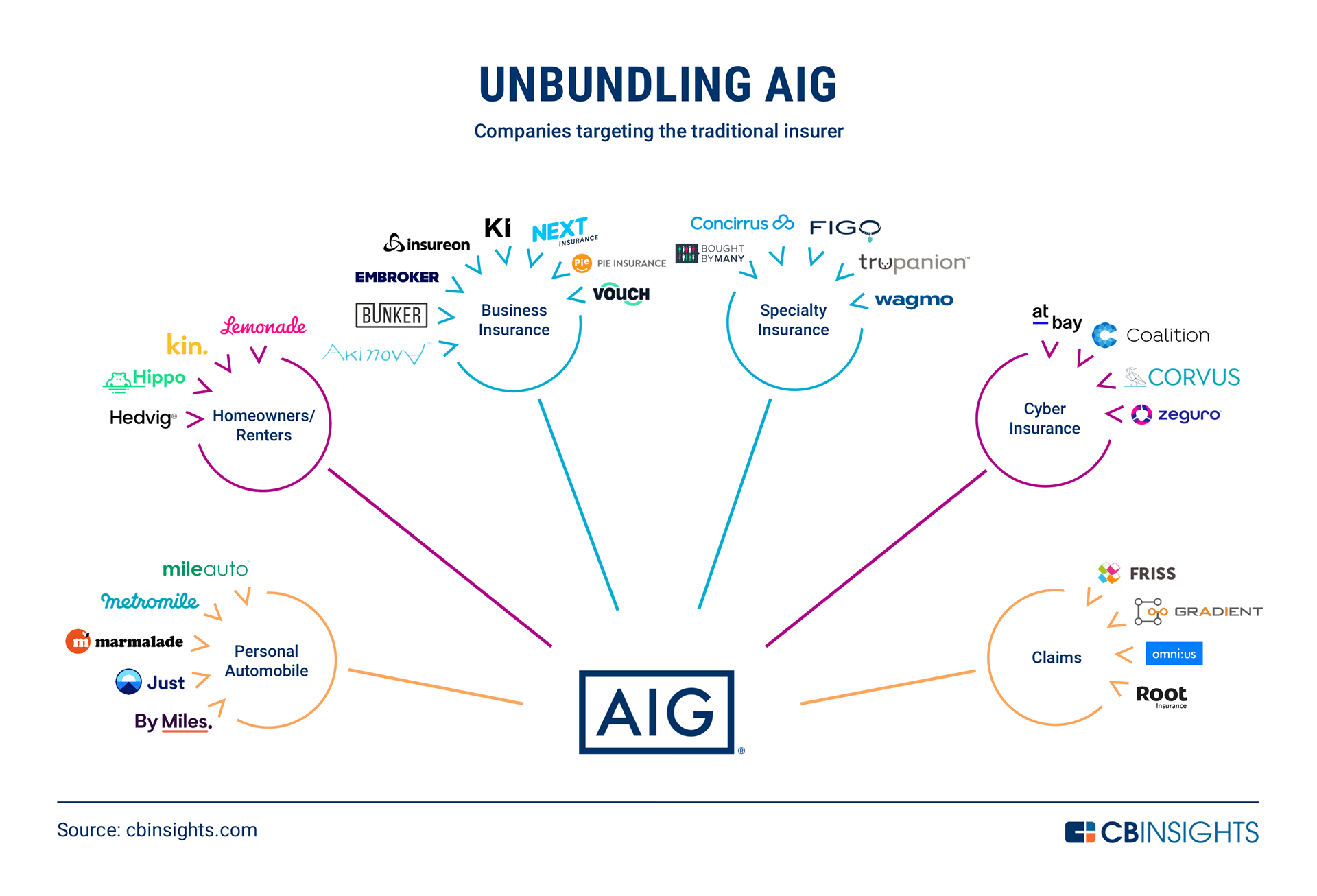
By 2026, the line between "traditional insurer" and "Insurtech" has blurred. AIG’s competitors are increasingly tech-first entities.
- Algorithmic Underwriting: Companies like Lemonade (which expanded into commercial lines) and Next Insurance challenge AIG in the small-business segment by offering instant policy issuance.
- Alternative Capital: AIG also competes with "Insurance-Linked Securities" (ILS). In this model, catastrophe bonds and capital market investors take on risk directly, bypassing traditional insurers like AIG for high-layer property coverage.
Frequently Asked Questions
Who is AIG’s biggest competitor in 2026?
Chubb Limited is widely considered AIG's most direct and significant competitor. Both companies operate globally, focus heavily on commercial and specialty lines, and compete for the same pool of elite underwriting talent and multinational corporate clients.
Did the Corebridge Financial spinoff change AIG’s competitors?
Yes. Before the spinoff, AIG competed heavily with life insurance giants like MetLife and Prudential Financial. In 2026, as a focused P&C company, AIG's primary rivals are now other general insurers like Zurich, AXA, and Travelers.
How does AIG’s global reach compare to its rivals?
AIG remains one of the few insurers with a physical presence and licensing in over 70 countries and the ability to provide claims service in nearly 190. Only Zurich and AXA offer a truly comparable global network for multinational insurance programs.
Is AIG still a leader in Cyber Insurance?
While AIG remains a top-tier player, it faces intense competition in 2026 from specialty insurers like Beazley and Chubb. The competition has moved from simply offering "coverage" to providing "risk resilience services," including 24/7 digital monitoring.
What is the "Combined Ratio" and why does it matter for AIG's competition?
The combined ratio is the sum of an insurer's loss ratio and expense ratio. A ratio of 95% means the company spends $0.95 for every $1.00 it collects in premiums. AIG's goal in 2026 is to keep this ratio consistently lower than its peers to prove its underwriting excellence to investors.
Practical Recommendation for Stakeholders
For risk managers and corporate buyers in 2026, the choice between AIG and its competitors should be driven by the complexity of the risk. If your organization requires a "Global Program" with local policies in emerging markets, AIG, Zurich, and AXA remain the primary shortlist.
For investors, the key is to monitor AIG’s expense ratio. While AIG has significantly improved its underwriting, its administrative costs have historically been higher than those of leaner competitors like Chubb or Travelers. AIG’s ability to maintain its 2026 market share will depend on its continued success in the "AIG 200" digital transformation, ensuring that it can match the operational efficiency of its more agile rivals.