The American Institute of Certified Public Accountants (AICPA) provides the standard framework for personal financial statements, specifically under the Personal Financial Statements Guide (PFS Guide). This framework, known as Generally Accepted Accounting Principles (GAAP) for personal financial statements, dictates how individuals should calculate and report their net worth to ensure consistency, transparency, and reliability for lenders, investors, or personal estate planning.
The Role of the AICPA in Personal Financial Reporting
For most individuals, tracking net worth is a personal exercise—a simple subtraction of total liabilities from total assets. However, when an individual seeks a substantial commercial loan, engages in estate planning, or enters into a complex business partnership, personal wealth reporting requires a higher standard of rigor. The AICPA establishes the professional standards that Certified Public Accountants (CPAs) must follow when preparing or auditing these statements.
The primary objective of the AICPA’s guidance is to shift the focus from a "cost-basis" accounting method, which is standard for corporations, to a "current value" method, which is more relevant to an individual’s true economic position. By using current values, the AICPA ensures that financial statements reflect the actual fair market value of assets—such as real estate, private business interests, and marketable securities—at a specific point in time.
GAAP vs. Tax Basis: Why Standards Matter
It is a common error to conflate an individual’s tax return with their net worth statement. A tax return is designed to fulfill legal obligations to the government; it often uses historical cost or tax-favored valuations that do not necessarily represent the current liquid or market value of an individual's holdings.
The AICPA guidelines require the use of current values because they provide a "snapshot" of solvency. For instance, if you own a home purchased ten years ago, your tax records may carry it at your adjusted cost basis. Under AICPA standards, you would report the property at its estimated fair market value as of the date of the statement. This distinction is critical because lenders and stakeholders are concerned with your ability to meet financial obligations today, rather than what you originally paid for your assets.
Core Components of an AICPA-Compliant Statement
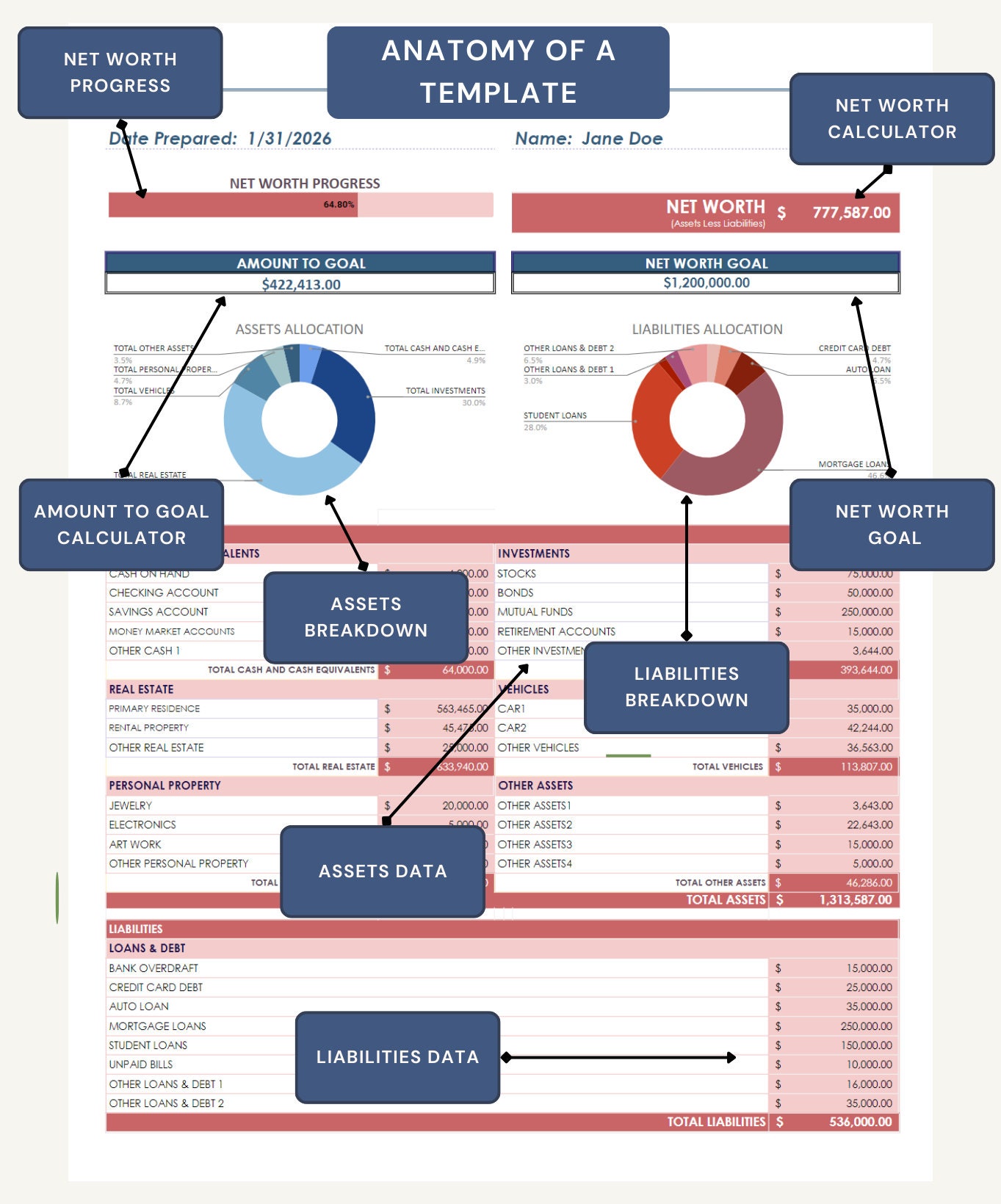
A statement of financial condition prepared under AICPA standards is structured to provide a clear view of an individual's liquidity and net worth. It typically consists of three primary sections:
- Assets: These are categorized by their nature and liquidity. They include cash and cash equivalents, marketable securities, notes receivable, personal effects (such as jewelry or art), and interests in closely held businesses.
- Liabilities: These are debts or obligations, including mortgages, consumer loans, taxes payable, and estimated income taxes on the differences between the estimated current values of assets and their tax bases.
- Net Worth: This is the residual amount—the difference between total assets and total liabilities.
A crucial, often overlooked, requirement in AICPA-compliant reporting is the provision for estimated income taxes. Because many assets, if sold at their current value, would trigger capital gains taxes, the AICPA requires that the potential tax liability associated with the "hypothetical liquidation" of those assets be reflected as a liability. This ensures that the reported net worth is not artificially inflated by ignoring the tax impact of selling those assets.
Methodologies for Valuing Assets
The AICPA emphasizes that the valuation of assets must be professional and justifiable. When a CPA prepares a personal financial statement, they do not simply accept an individual's "best guess." Instead, they look for verifiable evidence.
- Marketable Securities: These are typically valued at the closing price on the date of the financial statement.
- Real Estate: Valuation usually requires independent appraisals or analysis of comparable sales in the local area.
- Closely Held Businesses: This is often the most complex area. CPAs may apply various valuation techniques, such as the income approach (discounted cash flow) or the market approach (comparables), to determine the fair value of private interests.
- Personal Property: Items such as art, collections, or antiques often require appraisal by qualified experts to satisfy the AICPA's demand for objective measurement.
Comparison of Financial Valuation Methods
| Feature | AICPA Personal Financial Statements | Tax Return (IRS) Basis |
|---|---|---|
| Primary Objective | Represent current economic position | Report taxable income and tax liability |
| Asset Valuation | Current Fair Market Value | Historical Cost or Adjusted Basis |
| Tax Liabilities | Includes "deferred" taxes on assets | Only records taxes actually due/paid |
| Intended User | Lenders, partners, estate planners | Government authorities (IRS/State) |
| Standardization | High (AICPA PFS Guide) | High (Tax Code) |
The Accountant’s Responsibility and Reporting Levels
When you engage a CPA to prepare a personal financial statement, there are different levels of service, which carry varying degrees of assurance.
- Compilation: The CPA compiles the information provided by the individual into the format required by the AICPA. The accountant provides no assurance that the statements are free from material misstatement.
- Review: The CPA performs analytical procedures and inquiries. This provides "limited assurance" that no material modifications are necessary for the statements to be in conformity with the AICPA guidelines.
- Audit: This is the highest level of service. The CPA performs extensive testing, external confirmations of assets and liabilities, and rigorous evaluation of valuation methods. An audit provides a high level of assurance that the financial statement represents a fair and accurate picture of net worth.
For many high-net-worth individuals, a "compilation" or "review" is sufficient for banking requirements, but significant estate or partnership matters may necessitate a full audit.
Common Pitfalls in Calculating Personal Net Worth
One of the most frequent mistakes individuals make when attempting to model their own net worth based on AICPA standards is failing to account for "contingent liabilities." For example, if you have signed a personal guarantee for a business loan, that guarantee represents a potential future liability. Even if the business is currently healthy, the AICPA framework suggests that such risks should be disclosed to provide a complete financial picture.
Another error involves the inconsistent valuation of assets. You cannot use the "retail" value for some items and "wholesale" value for others. The consistency principle mandates that all assets of a similar class be treated with the same valuation methodology. If you value your real estate holdings at current market value, you must apply that same logic to your entire portfolio, rather than mixing current market values with cost-basis figures for different properties.
Legal and Professional Considerations
It is important to recognize that financial statements are legal documents. If an individual provides false or misleading information to a CPA to inflate their net worth for a loan application, they may be engaging in bank fraud. The CPA, governed by the AICPA Code of Professional Conduct, is obligated to maintain integrity and objectivity. If an accountant discovers that the information provided is fraudulent or materially misstated, they must withdraw from the engagement if the issues cannot be resolved.
Furthermore, these statements should not be viewed as tax advice. While a CPA prepares the statement, the individual remains responsible for the accuracy of the underlying data. Always consult with legal counsel or a tax advisor regarding the implications of the valuation methods used, especially regarding estate tax planning, as the fair market values determined for financial reporting can sometimes intersect with estate valuation requirements.
Frequently Asked Questions
What is the difference between a balance sheet and a personal financial statement? While both report assets, liabilities, and equity, a personal financial statement under AICPA guidelines specifically focuses on current market values rather than the historical cost-based accounting often used in corporate balance sheets. It also includes specific disclosure of tax liabilities associated with selling assets.
Do I need a CPA to calculate my personal net worth? You do not need a CPA to calculate your net worth for personal budgeting. However, if you are applying for a significant commercial loan or providing documentation for legal/estate proceedings, a CPA-prepared statement is generally required to provide the third-party verification that banks and courts demand.
How often should a personal financial statement be updated? AICPA standards apply to a specific point in time (the "as of" date). Most institutions require that these statements be refreshed at least annually, or more frequently if there has been a material change in your financial condition, such as the sale of a business or a large real estate transaction.
Are personal items like cars or clothing included in AICPA net worth? Yes. Under AICPA guidelines, personal effects are categorized as assets. However, they must be reported at their current estimated value, not the original purchase price. This often requires professional appraisal, especially for high-value items like luxury vehicles, jewelry, or art collections.
Why is "estimated income tax" considered a liability? In accounting theory, your net worth should represent what you would actually walk away with if you liquidated your position. If you have significant unrealized capital gains, you would owe taxes upon sale. Including this as a liability provides a more realistic (and conservative) view of your true net worth.
Next Steps for Financial Documentation
If you are preparing to present your personal financial statement to a bank or financial institution in 2026, the most effective first step is to gather all your current account statements, loan documents, and property appraisals. Organize these into an asset-liability ledger before contacting a CPA.
By having your documentation prepared in advance, you reduce the time and cost associated with the CPA’s engagement. Ensure that you have clear, dated verification for the market value of your real estate and business interests, as these are the areas that will undergo the most scrutiny. Professional preparation not only satisfies the requirements of third-party lenders but also gives you a clearer, more accurate perspective on your financial reality, allowing for better strategic planning in the years to come.