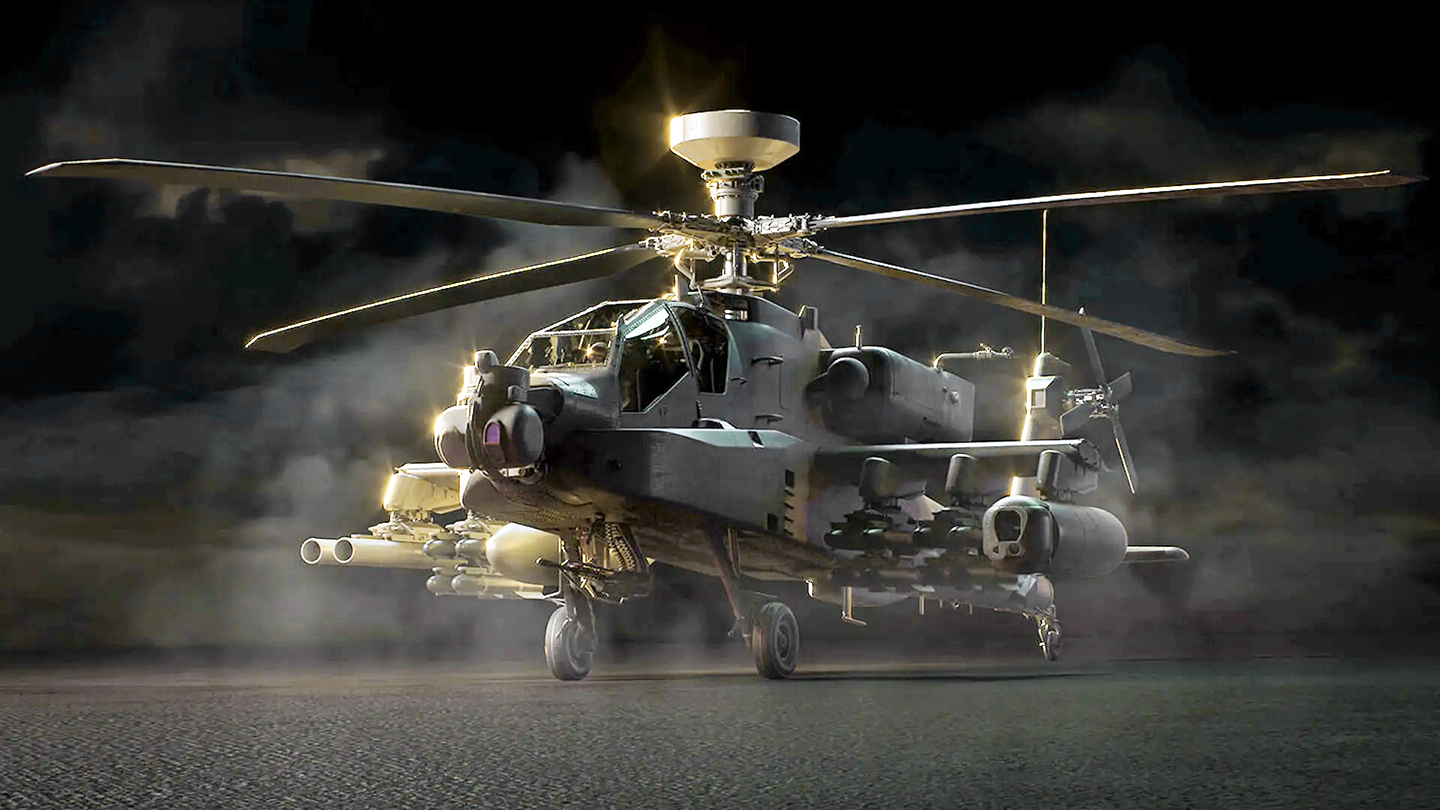
The AH-64 Apache is a twin-turboshaft attack helicopter that serves as the primary heavy-attack platform for the United States Army and numerous international defense forces. Renowned for its advanced sensor suites, devastating armament, and survivability, it remains the global benchmark for rotary-wing lethality, despite its significant acquisition and maintenance costs.
The Evolution of a Dominant Aerial Predator
The journey of the AH-64 Apache began during the Cold War as the Advanced Attack Helicopter (AAH) program, designed to replace the AH-1 Cobra. The primary objective was to create a platform capable of destroying Soviet armor in the event of a conflict in Europe. Hughes Helicopters developed the initial YAH-64, which first took flight in 1975. By the time it entered service in 1986, the Apache had evolved into a sophisticated tank-killer, featuring the innovative Integrated Helmet and Display Sighting System (IHADSS), which allowed pilots to aim the aircraft’s chain gun simply by moving their heads.
In the decades following its debut, the Apache has undergone continuous modernization. The transition from the original AH-64A to the AH-64D Longbow in the late 1990s introduced the distinctive mast-mounted radar dome, revolutionizing battlefield awareness. By 2026, the fleet is dominated by the AH-64E Version 6.5 and early iterations of Version 7. These modern variants integrate Improved Turbine Engine Program (ITEP) hardware and advanced digital backbones, ensuring the airframe remains relevant in an era of peer-to-peer electronic warfare and long-range precision fires.
The Apache's longevity is not merely a result of its initial design but its capacity for modular upgrades. As of 2026, the platform has transitioned from a purely mechanical beast to a digital node within the Joint All-Domain Command and Control (JADC2) architecture. This evolution allows the Apache to act as a scout and coordinator for unmanned aerial systems (UAS), effectively extending its reach far beyond the visual range of its crew.
The Anatomy of Lethality: Systems and Sensors
The AH-64 Apache is often described as a flying tank, but its true power lies in its ability to see before being seen. The heart of its target acquisition is the M-TADS/PNVS (Modernized Target Acquisition and Designation Sight/Pilot Night Vision Sensor). This system, often referred to as the "Arrowhead," provides high-resolution, high-definition infrared and television imagery. It enables the crew to identify and track targets in total darkness or through smoke and obscurants, a capability that was groundbreaking in the 1980s and remains world-class today.
The AN/APG-78 Longbow Fire Control Radar is the Apache’s most recognizable feature. Mounted above the main rotor, it allows the helicopter to hover behind cover (such as a treeline or building) and pop up briefly to scan the battlefield. The radar can classify up to 128 targets and prioritize the 16 most dangerous threats simultaneously. This data can then be transmitted via data link to other aircraft or ground units, making the Apache a force multiplier that enhances the effectiveness of an entire combat team.
In terms of firepower, the Apache utilizes a versatile "triad" of weapons:
- M230 Chain Gun: A 30mm automatic cannon capable of firing 625 rounds per minute. It is slaved to the pilot's helmet, meaning the gun points wherever the pilot looks.
- AGM-114 Hellfire Missiles: Precision-guided munitions designed to destroy heavy armor. Modern "Romeo" and "Longbow" variants use semi-active laser or millimeter-wave radar guidance.
- Hydra-70 Rockets: These 70mm unguided or laser-guided (APKWS) rockets provide area saturation and are effective against light vehicles and personnel.
Why the Apache is Deemed "Costly"
The "costly" moniker attached to the Apache is well-earned, reflecting both the price of the technology and the immense logistical tail required to keep it operational. As of 2026, the flyaway cost for a new AH-64E Guardian ranges between $35 million and $50 million, depending on the specific equipment and sensor configurations. However, the purchase price is only the beginning of the financial commitment.
Maintenance requirements for the AH-64 are notoriously intensive. For every hour the Apache spends in the air, it requires multiple man-hours of maintenance on the ground. The complexity of the transmission, the sensitive avionics, and the high-performance T700 or newer T901 engines demand a constant supply of specialized spare parts and highly trained technicians. This high "operating cost per flight hour" (OCPFH) makes it one of the most expensive assets in the Army's inventory to sustain over a 20-year lifecycle.
Furthermore, the training pipeline for Apache pilots and maintainers is expensive. Pilots must undergo extensive simulation and live-fire training to master the multi-tasking required to operate the sensors while maneuvering in nap-of-the-earth (NOE) environments. When factoring in fuel, ammunition, and the periodic "remanufacturing" of older airframes to modern standards, the total lifecycle cost of an Apache fleet can run into the billions for even medium-sized defense forces.
Comparison of Apache Variants and Capabilities
To understand the platform's progression, it is useful to compare the technical specifications across its major iterations. The following table highlights the leap in performance from the legacy models to the current 2026 standard.
| Feature | AH-64A (Legacy) | AH-64D Longbow | AH-64E Guardian (v6.5/7) |
|---|---|---|---|
| Engines | 2x GE T700-GE-701 | 2x GE T700-GE-701C | 2x GE T901 (ITEP) |
| Max Speed | 158 knots | 153 knots (due to radar drag) | 164+ knots |
| Target Tracking | Optical/Basic IR | Longbow Radar (RF) | Multi-spectral Fusion/MUM-T |
| Connectivity | Voice Radio | Improved Data Link | Link 16 / SatCom / UAS Control |
| Max Gross Weight | 17,650 lbs | 23,000 lbs | 24,250 lbs |
| Key Capability | Anti-armor focus | Networked battlefield | Manned-Unmanned Teaming |
Operational Limitations and Vulnerabilities
Despite its "powerhouse" status, the AH-64 Apache is not invincible. The evolution of modern warfare has introduced new threats that challenge the platform’s dominance. One primary concern is Man-Portable Air Defense Systems (MANPADS) and sophisticated Surface-to-Air Missile (SAM) networks. While the Apache is equipped with advanced electronic warfare (EW) suites and infrared countermeasures (IRCM), the proliferation of cheap, heat-seeking missiles remains a significant threat in contested airspace.
The Apache's size and weight also impose certain limitations. In high-altitude or hot environments—often referred to as "high and hot" conditions—the helicopter's performance can degrade, affecting its lift capacity and maneuverability. While the newer AH-64E with the T901 engine has largely mitigated these issues through increased horsepower and fuel efficiency, physics still dictates limits on how much fuel and ammunition can be carried in extreme climates.
Additionally, the reliance on high-tech sensors makes the Apache vulnerable to electronic interference. In 2026, peer adversaries have invested heavily in GPS jamming and radio frequency (RF) spoofing. If the Apache’s connection to the broader tactical network is severed, or if its Longbow radar is jammed, the crew must revert to older, visual-range combat methods, which significantly increases their exposure to enemy fire.
The Future of the Apache in 2026 and Beyond
As we navigate through 2026, the US Army is in the midst of the Future Vertical Lift (FVL) program. While newer platforms like the V-280 Valor (FLRAA) are set to redefine utility and long-range transport, the Apache is expected to remain the premier attack helicopter for at least another two decades. The Army’s strategy is not to replace the Apache immediately, but to pair it with the Future Attack Reconnaissance Aircraft (FARA) concepts and sophisticated drone swarms.
The 2026 modernization efforts focus heavily on Manned-Unmanned Teaming (MUM-T). In this operational model, an Apache pilot can take control of the sensors and flight paths of nearby drones from the cockpit. This allows the Apache to stay out of the range of enemy air defenses while using the drones to scout targets and even deliver munitions. By acting as a "quarterback" in the sky, the Apache maintains its relevance even as ground-based air defenses become more lethal.
Software-defined radio and AI-assisted target recognition are also being integrated into the AH-64E fleet. These systems help reduce the cognitive load on the two-person crew, allowing them to focus on high-level tactical decisions rather than manually scanning for every possible threat. This integration of artificial intelligence is the key to managing the complexity of modern multi-domain operations.
Frequently Asked Questions
Why does the Apache have two pilots?
The AH-64 uses a tandem seating arrangement to distribute the intense workload of modern combat. The pilot, sitting in the rear seat, focuses primarily on flying the aircraft and maneuvering through terrain. The co-pilot/gunner (CPG), sitting in the front, manages the weapon systems and sensor suites. However, both stations have full flight controls, allowing either crew member to fly the aircraft or engage targets if the other is incapacitated.
Can the AH-64 Apache operate in all weather conditions?
Yes, the Apache is designed for all-weather, day/night operations. Its infrared sensors can "see" heat signatures through rain, light fog, and total darkness. While extreme weather like severe thunderstorms or heavy icing can ground any helicopter, the Apache’s robust avionics suite makes it one of the most capable "all-weather" combat aircraft in existence.
How does the Apache protect its crew from ground fire?
The Apache is built for high survivability. The crew sits in a "Kevlar tub" armored cockpit capable of withstanding hits from 23mm anti-aircraft fire. The rotor blades are designed to survive hits from smaller caliber rounds, and the engines are shielded and separated to ensure that if one is hit, the other can continue to provide power. Furthermore, the fuel system is self-sealing to prevent explosions after ballistic impact.
Is the Apache still the best attack helicopter in 2026?
While platforms like the Russian Ka-52 "Alligator" or the Chinese Z-10 offer significant capabilities, the AH-64E Guardian is widely considered the most advanced due to its sensor integration and combat-proven history. Its ability to integrate into a wider digital battlefield (JADC2) gives it a strategic advantage that few other platforms can match.
How much does it cost to train an Apache pilot?
Training a single AH-64 pilot costs several million dollars. This includes initial flight school, specialized transition training to the Apache airframe, and hundreds of hours in high-fidelity simulators. Even after reaching a unit, pilots must maintain a high number of flight hours annually to remain "combat mission ready," adding to the overall cost of the program.
Strategic Recommendation for Defense Analysts
For those evaluating the role of the AH-64 Apache in modern defense budgets, it is essential to view the platform not just as a helicopter, but as a networked combat system. While the unit cost and maintenance requirements are high, the Apache provides a unique combination of persistence, precision, and psychological deterrent that unmanned systems cannot yet fully replicate.
In 2026, the most effective use of the Apache fleet involves prioritizing the upgrade to Version 6.5/7 and ensuring full integration with UAS assets. Defense forces should focus on maintaining a robust logistics chain for the ITEP engines, as these offer the greatest return on investment in terms of performance and reliability in diverse global environments.