The taiga ecosystem features remarkable physiological, anatomical, and behavioral adaptations that enable flora and fauna to survive extreme sub-zero temperatures, heavy snowfall, and short growing seasons. Organisms overcome these environmental pressures through specialized strategies such as evergreen needle retention, countercurrent heat exchange, seasonal camouflage, and metabolic dormancy.
Introduction to the Taiga Biome
The taiga, also known as the boreal forest, is the world's largest terrestrial biome. Stretching in a vast circumpolar belt across North America, Europe, and Asia, this environment is characterized by harsh, long winters and short, mild summers. Annual temperatures frequently drop below −50°C (−58°F), and the ground often remains frozen as permafrost beneath a shallow active soil layer.
Despite these punishing climatic conditions, the taiga supports a diverse and specialized array of life. Organisms residing in this biome cannot merely endure the elements; they must possess highly evolved traits to secure food, withstand freezing temperatures, and complete reproductive cycles within a severely restricted timeframe. Understanding these adaptations reveals the intricate evolutionary mechanisms that allow complex biological communities to persist in Earth's most demanding northern latitudes.
Climatic Pressures and Environmental Constraints
To understand why specific adaptations are necessary, one must examine the baseline pressures exerted by the taiga environment. The biome experiences extreme seasonality, transitioning rapidly between dark, frozen winters and brief, insect-heavy summers.
| Environmental Stressor | Typical Taiga Condition |
|---|---|
| Thermal Extremes | Winter lows reaching −50°C; short summer spikes |
| Water Availability | Much of the water is locked in ice and snow |
| Nutrient Limitation | Acidic, nutrient-poor podzol soils |
| Solar Radiation | Highly variable daylight (24-hour night/day) |
These factors create a landscape where energy conservation is paramount. Water is physiologically scarce during winter because it is frozen, meaning plants and animals face challenges similar to those in arid deserts. Furthermore, the low angle of incoming solar radiation limits the total thermal energy absorbed by the landscape, dictating strict energetic budgets for every resident species.
Flora Adaptations: Surviving the Boreal Winter
Plant life in the taiga must contend with frozen soils, heavy snow loads, and a growing season that may last for only three months. The dominant vegetation consists of coniferous evergreen trees, such as spruce, fir, and pine, alongside resilient deciduous species like larch and birch.
Conifers and Needle Morphology
Conifers dominate the taiga largely due to the structural design of their leaves. Needles present a small surface area compared to broad leaves, which drastically reduces moisture loss through transpiration during freezing, dry winter winds.
- Waxy Cuticle: Each needle is coated in a thick, waxy layer that seals in moisture and protects internal tissues from ice-crystal puncture.
- Stomatal Crypts: Microscopic pores called stomata are deeply recessed into the needle structure, creating a localized boundary layer of humid air that further prevents desiccation.
- Dark Coloration: The dark green or bluish-green hue of needles absorbs maximum solar radiation, allowing photosynthesis to resume as soon as ambient temperatures rise above freezing, even while snow still covers the ground.
Evergreen vs. Deciduous Strategies
While evergreens retain their photosynthetic apparatus year-round, giving them a head start when spring arrives, the deciduous larch (Larix species) adopts a different approach. Larch trees drop all their needles in autumn, shedding the burden of maintaining foliage through heavy snowfalls and dark winters. By dropping their needles, they eliminate transpiration entirely during months when soil water is inaccessible.
Fauna Adaptations: Physiological and Behavioral Survival
Animals in the taiga face the dual challenge of thermal regulation and food acquisition. Species have evolved three primary survival tactics: migration, hibernation, and year-round active resistance.
Morphological Adaptations for Insulation
For residents that remain active through the winter—such as the moose (Alces alces), snowshoe hare (Lepus americanus), and gray wolf (Canis lupus)—insulation is critical.
- Dense Fur Coats: Mammals develop a multi-layered coat consisting of a dense, trapping underfur and coarse, wind-resistant guard hairs. This traps a layer of air warmed by body heat directly against the skin.
- Compact Body Proportions: Following Allen's Rule, taiga-dwelling mammals often feature shorter limbs, ears, and tails compared to their southern relatives, minimizing surface area-to-volume ratios to reduce heat loss.
- Specialized Appendages: The snowshoe hare possesses exceptionally large, fur-covered hind feet that act as natural snowshoes, distributing its weight and preventing it from sinking into deep drifts while foraging for woody browse.
Physiological Strategies: Torpor and Hibernation
When food becomes scarce and temperatures plummet, many animals conserve energy by lowering their metabolic rates.
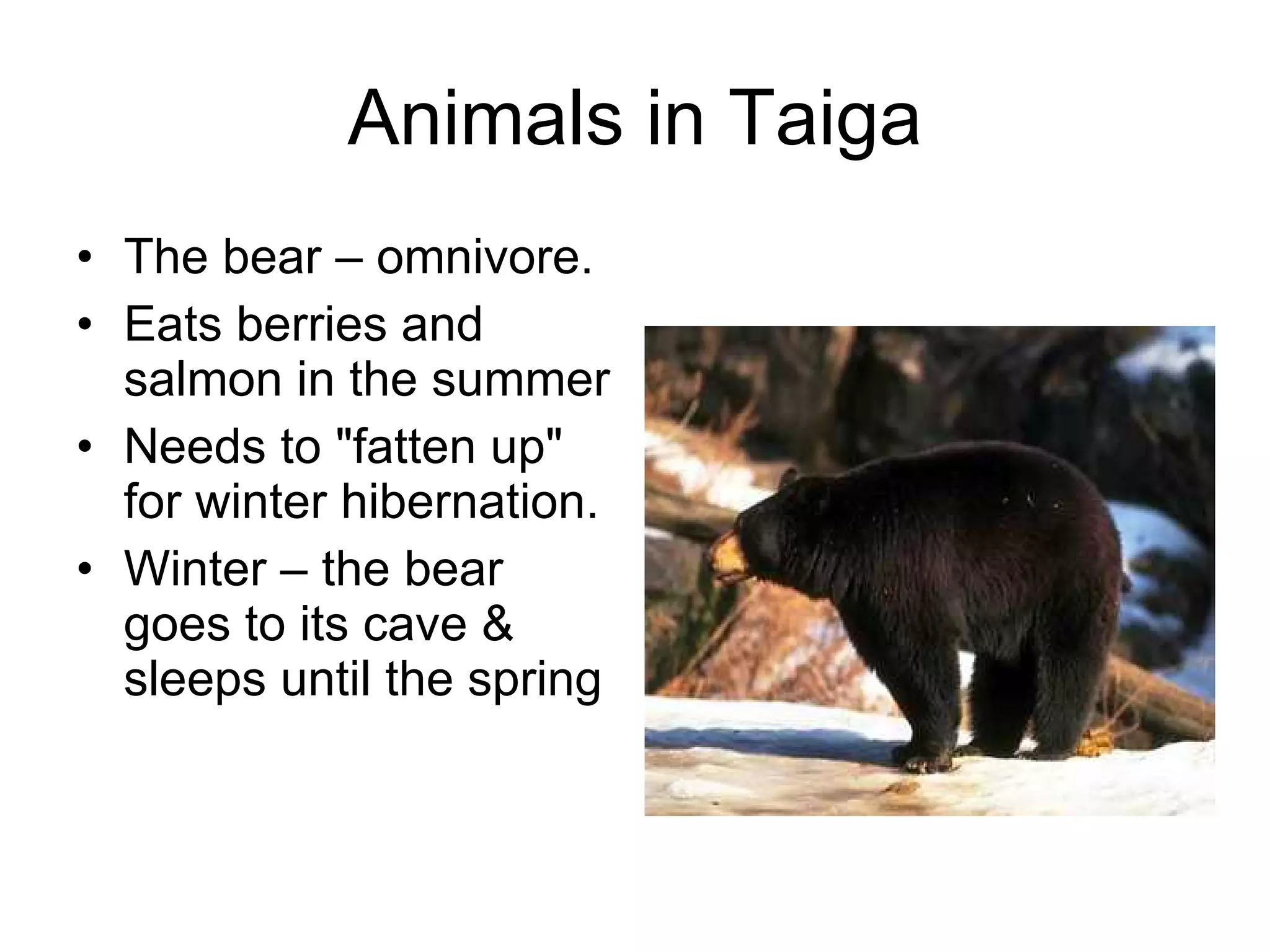
- True Hibernation: Animals like the black bear (Ursus americanus) enter a state of prolonged dormancy. Their heart rate drops to a fraction of its normal rate, and body temperature decreases slightly, allowing them to survive months without eating, drinking, or excreting by metabolizing stored fat reserves.
- Daily Torpor: Smaller mammals, such as certain voles and shrews, utilize short bouts of controlled hypothermia to conserve calories during particularly frigid nights.
Countercurrent Heat Exchange
Aquatic and semi-aquatic mammals, as well as the legs of birds and canids walking on snow, utilize countercurrent heat exchange systems. Arteries carrying warm blood from the heart run parallel to veins returning cold blood from the extremities. Heat is transferred from the warm arterial blood to the cool venous blood before it reaches the extremities, keeping the core warm and preventing tissue freezing in exposed limbs.
Comparative Overview of Taiga Survival Strategies
Different taxonomic groups utilize distinct suites of adaptations to overcome the challenges of the boreal environment.
| Taxonomic Group | Primary Challenge | Key Structural Adaptation | Primary Behavioral Strategy |
|---|---|---|---|
| Conifers | Frozen soil and wind desiccation | Waxy, needle-shaped leaves | Year-round photosynthesis (evergreen) |
| Large Herbivores | Deep snow and low forage quality | Long legs and broad hooves | Migration or winter yarding |
| Small Mammals | Extreme cold and predation | High surface-to-volume ratio / Snowshoes | Sub-nivean burrowing (under snow) |
| Resident Birds | Energy loss and food scarcity | High metabolic rate / Fat storage | Flocking and caching seeds |
Sub-Nivean Ecology: Life Beneath the Snow
The layer of snow blanketing the taiga floor is not merely a barrier; it is a vital microhabitat known as the sub-nivean zone. The temperature at the ground surface beneath deep snowpacks remains relatively stable, hovering near 0°C even when air temperatures drop far below freezing.
Small mammals such as mice, shrews, and voles exploit this sub-nivean space. They construct intricate networks of tunnels along the forest floor, allowing them to access fallen seeds, bark, and insect larvae protected from winter winds and surface predators like raptors and foxes. This behavioral adaptation transforms a hostile snow layer into a thermal blanket that enables small-bodied species to maintain viable winter populations.
Frequently Asked Questions
How do taiga trees avoid freezing to death in winter?
Taiga trees avoid freezing by synthesizing natural antifreezes, such as sugars and amino acids, within their cellular fluids. This solute concentration lowers the freezing point of water inside the plant cells. Additionally, they purge excess water from their cells into intercellular spaces, where controlled freezing causes less structural damage than intracellular ice crystal formation.
Why are evergreen conifers more successful in the taiga than deciduous trees?
Conifers dominate because they do not waste precious energy and short summer periods regrowing leaves every year. Their needle structures minimize water loss and allow them to begin photosynthesizing immediately during brief spring thaws, giving them a competitive edge over deciduous species with shorter growing seasons.
How do snowshoe hares survive winter predation?
Snowshoe hares rely on seasonal camouflage and extreme agility. Their fur transitions from a brown summer coat to a pure white winter coat, providing camouflage against snow. Furthermore, their large, padded hind feet allow them to sprint across soft snowdrifts that trap heavier predators like lynx and foxes.
What is the purpose of migration in the taiga?
Many bird species, such as warblers and thrushes, leave the taiga before winter because the insect populations they rely on disappear. Migration allows these animals to exploit abundant food resources during the brief summer breeding season while avoiding the lethal energy deficits of the boreal winter.
How does permafrost affect plant adaptations in the taiga?
Permafrost restricts root penetration to a shallow active soil layer, preventing trees from developing deep taproots. Consequently, taiga trees develop wide, shallow root systems that often interlock with neighboring trees to maintain structural stability against high winds, despite the thin soil substrate.
Practical Recommendations for Observing Boreal Adaptations
When studying or visiting the taiga ecosystem, researchers, naturalists, and ecotourists should observe established conservation protocols to protect vulnerable wildlife and delicate flora:
- Maintain Safe Distances: Wildlife operating under extreme winter energy budgets must not be disturbed by human presence. Forcing a moose or caribou to flee depletes vital fat reserves needed for survival.
- Respect Sub-Nivean Habitats: Avoid heavy foot traffic or snowmobiling across delicate, uncompacted sub-nivean zones where small mammals nest and forage beneath the snowpack.
- Minimize Soil Compaction: Stay on established trails during summer months to protect the fragile, slow-recovering podzol soils and shallow tree root networks.