AARP Medicare Supplement Insurance Plan F, insured by UnitedHealthcare, offers the most comprehensive coverage among all standardized Medicare Supplement (Medigap) plans. It eliminates out-of-pocket costs for Medicare-approved services by covering all original Medicare deductibles, copayments, and coinsurance. However, federal law restricts Plan F availability to individuals who became eligible for Medicare prior to January 1, 2020.
What Is AARP Medicare Supplement Plan F?
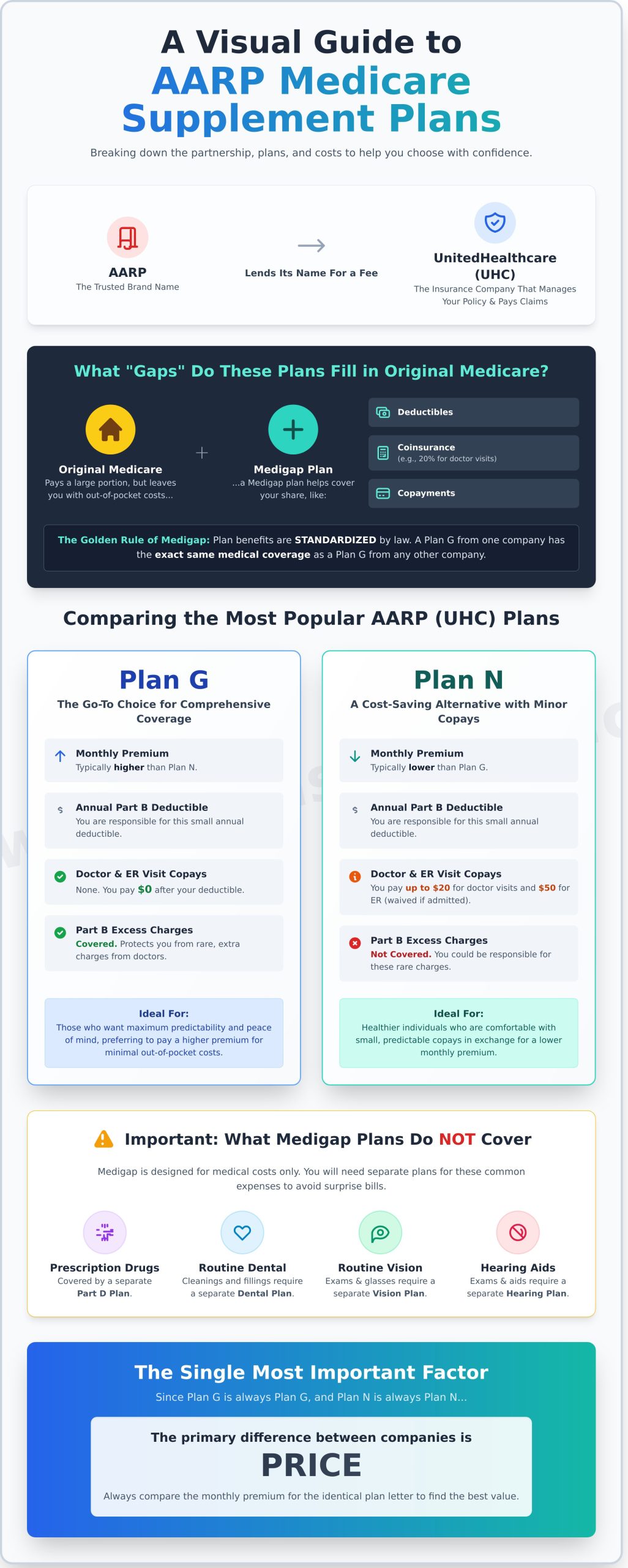
AARP Medicare Supplement Insurance Plans are underwritten by UnitedHealthcare Insurance Company (or its affiliates) and carry the AARP brand through a licensing agreement. Medicare Supplement insurance, commonly referred to as Medigap, is designed to fill the financial gaps left by Original Medicare (Part A and Part B).
Original Medicare pays for a substantial portion of health care expenses, but it does not cover everything. Beneficiaries remain responsible for inpatient hospital deductibles, daily hospital copayments, skilled nursing facility coinsurance, outpatient deductibles, and 20% coinsurance on Part B medical services. Without a Medigap plan or alternative coverage, there is no annual cap on out-of-pocket medical expenses under Original Medicare.
Plan F is standardized by the federal government under the oversight of the Centers for Medicare & Medicaid Services. Standardizing Medigap plans means that the basic benefits of Plan F offered through UnitedHealthcare under the AARP brand are identical to Plan F offered by any other insurance carrier. What sets AARP/UnitedHealthcare apart are customer service, underwriting practices, administrative efficiency, regional pricing structure, and member discount programs.
When enrolled in AARP Plan F, beneficiaries can visit any doctor, specialist, or healthcare provider across the United States that accepts Original Medicare, without needing a referral or stay confined to a network.
Eligibility Rules: The 2020 MACRA Cutoff Explained
The most important aspect of evaluating Plan F is understanding federal eligibility guidelines. Under the Medicare Access and CHIP Reauthorization Act of 2015 (MACRA), Congress passed legislation prohibiting Medigap plans from covering the Medicare Part B deductible for individuals newly eligible for Medicare on or after January 1, 2020.
Because Plan F covers the Part B deductible, federal law restricts sales of Plan F to "first-eligible" beneficiaries who met the criteria before 2020.
- Medicare Eligibility Date
- Before Jan 1, 2020: Eligible for Plan F
- On/After Jan 1, 2020: NOT Eligible for Plan F (Consider Plan G or Plan N)
Who Can Buy AARP Plan F Today?
You are eligible to purchase or switch to an AARP Medicare Supplement Plan F if you meet both of the following criteria:
- You turned 65 before January 1, 2020, or you became eligible for Medicare due to a disability or End-Stage Renal Disease (ESRD) prior to that date.
- You are enrolled in both Medicare Part A and Part B.
If you met the Medicare eligibility requirement before January 1, 2020, you are considered "grandfathered." You maintain the right to buy or remain enrolled in Plan F, even if you did not sign up for Medicare immediately when you turned 65 or if you are shopping for coverage years later.
If you became eligible for Medicare on or after January 1, 2020, you cannot purchase Plan F from AARP or any other insurer. Instead, you must look at alternative standardized options such as Plan G or Plan N.
What Does AARP Medicare Supplement Plan F Cover?
Plan F earned its reputation as the "full coverage" Medigap policy because it pays 100% of the covered out-of-pocket costs that Original Medicare shifts to the patient. Once Original Medicare processes a claim for a covered service, Plan F automatically pays the remaining balance.
- ORIGINAL MEDICARE (Pays covered portions of hospital & outpatient care)
- OUT-OF-POCKET EXPENSES (Part A Deductible, Part B Deductible, Coinsurance, Excess Charges)
- AARP MEDICARE SUPPLEMENT PLAN F (Pays 100% of standard gaps)
Key Covered Benefits:
- Medicare Part A Hospital Coinsurance and Hospital Costs: Covers up to an additional 365 days of hospital care after Original Medicare benefits are exhausted.
- Medicare Part A Deductible: Pays the inpatient hospital deductible required for each benefit period.
- Medicare Part B Deductible: Pays the annual outpatient and medical service deductible.
- Medicare Part B Coinsurance or Copayment: Covers the standard 20% out-of-pocket cost for doctor visits, outpatient surgery, lab work, and medical equipment.
- Medicare Part B Excess Charges: If a doctor or specialist does not accept "Medicare assignment" (meaning they do not agree to accept the Medicare-approved amount as full payment), they can legally bill up to an additional 15% above the approved rate. Plan F pays 100% of these excess charges.
- Skilled Nursing Facility (SNF) Care Coinsurance: Covers the daily copayment for days 21 through 100 of a skilled nursing facility stay.
- Blood Coverage: Pays for the first 3 pints of blood needed annually for a medical procedure.
- Part A Hospice Care Coinsurance or Copayment: Pays for prescription drugs for symptom control and copayments for respite care.
- Foreign Travel Emergency Coverage: Pays 80% of covered emergency healthcare care received outside the United States, up to a lifetime maximum of $50,000 (after a $250 annual deductible).
Because Plan F leaves zero out-of-pocket expenses for Medicare-covered services, policyholders do not receive medical bills for doctor visits, hospitalizations, or diagnostic testing.
Detailed Benefit Comparison: Plan F vs. Plan G vs. Plan N
To understand where Plan F fits among Medigap options, review this side-by-side comparison of standardized benefits available through AARP/UnitedHealthcare.
| Benefit / Coverage Feature | Plan F | Plan G | Plan N |
|---|---|---|---|
| Medicare Part A Deductible | Covered (100%) | Covered (100%) | Covered (100%) |
| Medicare Part A Hospital Coinsurance | Covered (100%) | Covered (100%) | Covered (100%) |
| Medicare Part B Coinsurance | Covered (100%) | Covered (100%) | Covered except copay up to $20 for office visits & $50 for ER |
| Medicare Part B Deductible | Covered (100%) | Not Covered | Not Covered |
| Medicare Part B Excess Charges | Covered (100%) | Covered (100%) | Not Covered |
| Skilled Nursing Facility Coinsurance | Covered (100%) | Covered (100%) | Covered (100%) |
| Foreign Travel Emergency (up to plan limits) | Covered (80%) | Covered (80%) | Covered (80%) |
| Eligible if Medicare-eligible on/after Jan 1, 2020? | No | Yes | Yes |
(Note: Medigap plans do not cover outpatient prescription drugs. Drug coverage requires a standalone Medicare Part D prescription drug plan.)
Pricing Structures and Premium Factors for AARP Medigap Plans
Although benefits are standard across all insurance companies offering Plan F, monthly premiums vary based on location, age, rating structure, and carrier pricing adjustments.
Community-Rated vs. Attained-Age Pricing
UnitedHealthcare pricing for AARP Medicare Supplement plans generally uses community-rated or modified community-rated pricing models depending on state regulations.
- Community-Rated: Everyone who has the plan in a specific geographic area pays the same monthly premium, regardless of age. Premiums may rise over time due to inflation and rising medical costs, but not solely because you grow older.
- Attained-Age Rated: Premiums are based on your current age and automatically increase as you age.
- Issue-Age Rated: Premiums are based on the age you were when you purchased the policy. Rates do not increase simply because you get older, though they may rise due to overall inflation.
In many states, AARP/UnitedHealthcare incorporates multi-tiered discount structures, such as enrollment discounts for younger applicants or household discounts when multiple residents in a household hold active policies.
High-Deductible Plan F Option
In addition to the standard Plan F, a High-Deductible Plan F option exists for grandfathered beneficiaries. Under High-Deductible Plan F, policyholders must pay out-of-pocket costs for Medicare-covered services until reaching an annual deductible threshold set by the federal government each year ($2,870 in 2025). Once the annual deductible is met, the plan pays 100% of covered expenses for the remainder of the calendar year. High-Deductible Plan F carries significantly lower monthly premiums than standard Plan F.
Medical Underwriting and Switching to or from Plan F
If you are grandfathered and currently hold an AARP Plan F policy, or if you want to switch to AARP Plan F from another company, you must navigate health qualification requirements unless you qualify for a protected enrollment period.
- Medigap Application Process
- Is the applicant in an Open Enrollment Period or exercising Guaranteed Issue Rights?
- YES: No Health Questions Guaranteed Approval
- NO: Subject to Medical Underwriting (Can be rated or denied based on medical history)
- Is the applicant in an Open Enrollment Period or exercising Guaranteed Issue Rights?
Medigap Open Enrollment Period
Your initial Medigap Open Enrollment Period is a one-time six-month window that begins the first month you are both age 65 or older and enrolled in Medicare Part B. During this window, federal law grants you guaranteed issue rights:
- Insurers cannot deny you coverage based on pre-existing conditions.
- Insurers cannot charge higher premiums based on your medical history.
Guaranteed Issue Rights outside Open Enrollment
Outside of your initial six-month Medigap Open Enrollment window, you generally need a qualifying event to buy or switch Medigap policies without health screening. Qualifying events include:
- Losing employer-sponsored group health coverage that acts as secondary coverage to Medicare.
- Moving out of your Medicare Advantage plan's service area.
- Leaving a Medicare Advantage plan under official trial rights provisions.
Medical Underwriting
If you apply to switch to AARP Plan F without a guaranteed issue right, UnitedHealthcare will review your medical history through a process called medical underwriting. You will be asked questions about recent hospitalizations, chronic illnesses, prescription treatments, and major diagnoses. Based on your health profile, UnitedHealthcare may:
- Accept your application at the standard base premium rate.
- Accept your application with a higher premium rating based on health risks.
- Decline your application entirely.
In a few states—such as New York, Connecticut, Massachusetts, and Maine—state regulations mandate continuous or annual open enrollment periods that allow policyholders to switch Medigap plans without medical underwriting, regardless of health status. Review local state insurance department guidelines to confirm your state's rules.
Comparing Plan F and Plan G: Financial Analysis
Because Plan F carries higher premiums than most other Medigap plans, many grandfathered beneficiaries evaluate whether keeping Plan F remains financially advantageous compared to switching to Plan G.
The only difference in coverage between Plan F and Plan G is the payment of the annual Medicare Part B deductible. Plan F pays the Part B deductible; Plan G does not.
- Plan F Out-of-Pocket Balance = $0
- Plan G Out-of-Pocket Balance = Annual Medicare Part B Deductible
Calculating the Value Gap
To decide if maintaining or buying AARP Plan F makes financial sense, compare the annual difference in premiums against the cost of the Part B deductible.
- Step 1: Calculate your annual premium for AARP Plan F (Monthly Premium × 12).
- Step 2: Obtain a quote for an AARP Plan G policy (Monthly Premium × 12).
- Step 3: Subtract the Plan G annual cost from the Plan F annual cost to find your annual premium savings.
- Step 4: Compare those annual savings to the annual Medicare Part B deductible ($257 in 2025).
Example Calculation:
If an AARP Plan F policy costs $220 per month ($2,640 per year) and an equivalent AARP Plan G policy costs $170 per month ($2,040 per year), the premium difference is $600 per year.
Under Plan G, you pay the annual Part B deductible out-of-pocket ($257 in 2025).
- Plan F total yearly cost: $2,640
- Plan G total yearly cost: $2,040 (premiums) + $257 (Part B deductible) = $2,297
- Net Annual Savings with Plan G: $343
In this example, keeping Plan F costs $343 more per year than paying the Part B deductible yourself under Plan G. Because Plan F is a closed risk pool (no new Medicare enrollees have entered the pool since 2020), its premiums tend to rise faster over time than Plan G premiums. Beneficiaries who can pass medical underwriting often save money by switching from Plan F to Plan G.
Additional Benefits Offered Through AARP and UnitedHealthcare
While Medigap benefits are standardized by federal law, UnitedHealthcare offers extra non-insurance programs and value-added services to AARP Medicare Supplement policyholders. Availability varies by state, but frequently includes:
- Gym and Fitness Access: Access to participating fitness locations nationwide through programs like Renewable Active or Gym Membership discounts.
- Dental, Vision, and Hearing Discounts: Access to discount networks for routine dental checkups, eyewear, and hearing aids (these are non-insurance discounts, not Medicare-covered benefits).
- 24/7 NurseLine: Direct phone access to registered nurses for non-emergency medical advice and healthcare guidance.
- Driver Safety Courses: Discounts on AARP Smart Driver courses, which may qualify policyholders for auto insurance discounts in participating states.
Step-by-Step Guide: How to Apply or Switch Coverage
If you are eligible for Plan F and decide to apply for or change your AARP Medicare Supplement insurance policy, follow these steps:
Step 1: Confirm Medicare Eligibility Date (Must be prior to Jan 1, 2020)
Step 2: Review Health Status & Check for Guaranteed Issue Rights
Step 3: Compare Monthly Premiums (AARP Plan F vs. AARP Plan G/N)
Step 4: Complete Application (Online, phone, or licensed insurance agent)
Step 5: Maintain Current Coverage Until New Policy Is Approved & Active
Verify Your Original Medicare Date: Check your red, white, and blue Medicare card to confirm your Medicare Part A or Part B effective date was prior to January 1, 2020.
Evaluate Health History: If you are outside your initial Open Enrollment Period and do not have a guaranteed issue event, review the medical health questions on the application. Consult your medical records to ensure accurate disclosures.
Gather Information: Have your Medicare Number (MBI), Medicare Part A and B start dates, current list of medications, and primary care provider details ready.
Submit the Application: You can apply directly through the official AARP/UnitedHealthcare portal, by calling a company representative, or by working with an independent licensed Medicare agent.
Maintain Active Existing Coverage: Never cancel your existing healthcare policy until you receive written approval, your new policy number, and a confirmed start date from UnitedHealthcare. Once confirmed, send formal written notice to cancel your previous carrier policy to avoid gaps or double-billing.
Frequently Asked Questions
Why is AARP Medicare Supplement Plan F unavailable to new Medicare enrollees?
Federal law under the Medicare Access and CHIP Reauthorization Act (MACRA) phased out Medigap plans that cover the Medicare Part B deductible for individuals who became eligible for Medicare on or after January 1, 2020. The law was intended to prevent zero-cost care, encouraging beneficiaries to share in initial outpatient expenses to reduce unnecessary medical utilization.
Is AARP Plan F being discontinued for people who already have it?
No. If you were enrolled in Plan F prior to 2020, or if you became eligible for Medicare before January 1, 2020, you can keep your Plan F policy indefinitely. You cannot be dropped from the plan due to age or health conditions as long as you pay your premiums on time.
Does AARP Plan F cover prescription drugs bought at the pharmacy?
No. Modern Medigap policies, including AARP Plan F, do not cover outpatient retail prescription drugs. To get prescription coverage, you must enroll in a standalone Medicare Part D plan or obtain creditable coverage through an employer or retiree sponsor.
Can UnitedHealthcare cancel my AARP Plan F policy if I develop health issues?
No. All standardized Medigap policies are guaranteed renewable. As long as you pay your monthly premiums on time and made true statements on your original application, UnitedHealthcare cannot cancel your coverage or single you out for a rate increase based on changes in your personal health.
What is the difference between AARP Plan F and a Medicare Advantage plan?
AARP Plan F is a Medicare Supplement policy that works alongside Original Medicare (Part A and Part B). Original Medicare remains your primary insurer, and Plan F pays your out-of-pocket gaps. A Medicare Advantage plan (Part C) replaces Original Medicare as your primary coverage, operating through private HMO or PPO provider networks with its own copayments, deductibles, and authorization rules.
Next Steps and Action Plan
If you met Medicare eligibility rules prior to January 1, 2020, AARP Medicare Supplement Plan F remains an available option for comprehensive out-of-pocket protection. However, because Plan F premiums reflect a closed enrollee population, rate increases can exceed those of open plans.
To determine if keeping or purchasing AARP Plan F fits your budget:
- Contact UnitedHealthcare or a licensed insurance professional to obtain a personalized quote for both Plan F and Plan G in your zip code.
- Calculate whether the annual premium gap between Plan F and Plan G is larger than the annual Medicare Part B deductible.
- If you are healthy enough to pass medical underwriting or qualify for a state-specific open enrollment rule, consider transitioning to Plan G to lower your total yearly health insurance costs while maintaining strong coverage across doctors and hospitals nationwide.