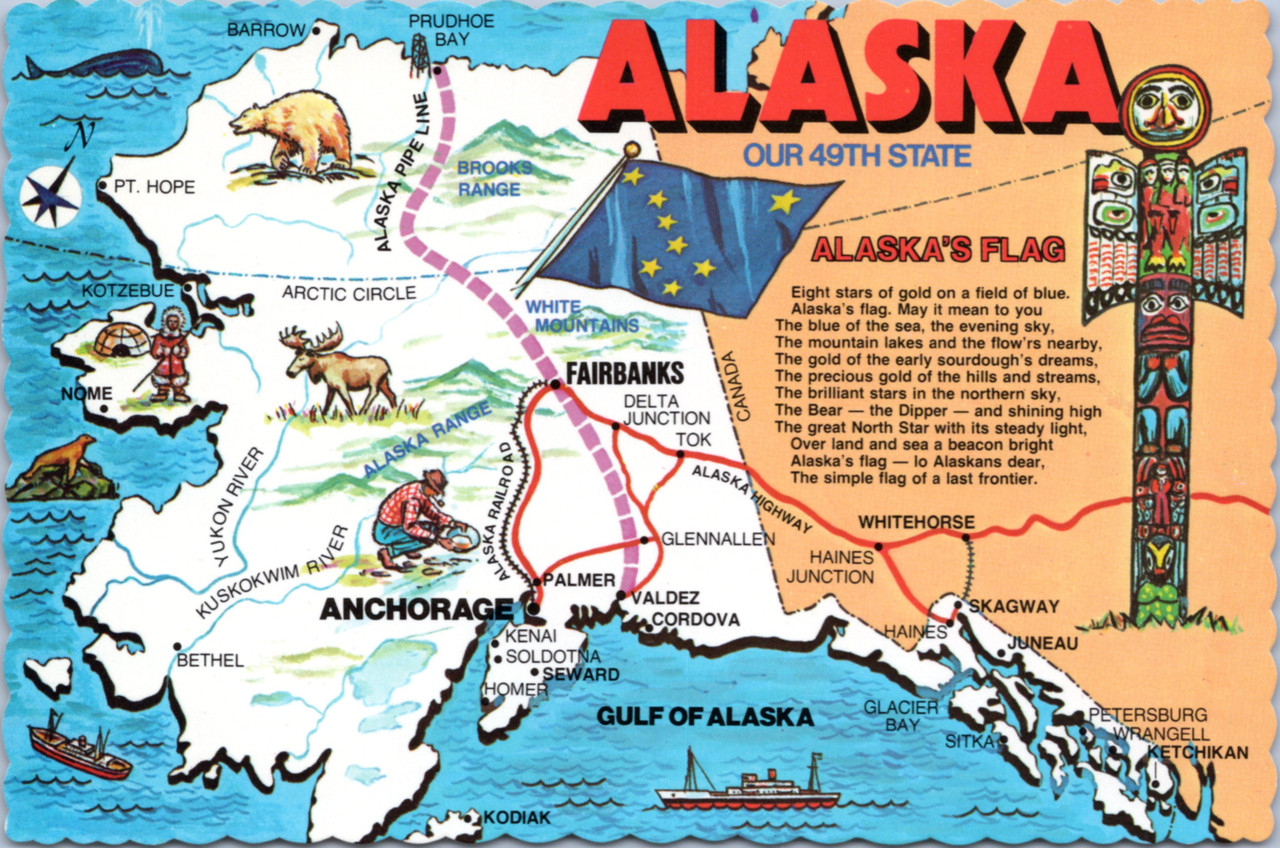
Alaska is officially the 49th state of the United States, having been admitted to the Union on January 3, 1959. This massive northern territory, often called the "Last Frontier," was purchased from Russia in 1867 and remained a territory for nearly a century before achieving full statehood under President Dwight D. Eisenhower.
The admission of Alaska as the 49th state represented a pivotal moment in American history, marking the first time the United States expanded its borders beyond the contiguous "Lower 48" into the non-contiguous Arctic and sub-Arctic regions. This transition from a remote district to a sovereign state fundamentally altered the geopolitical landscape of the Cold War and provided the U.S. with a strategic foothold in the North Pacific. As of 2026, Alaska remains a unique entity within the American fabric, defined by its immense scale, specialized economy, and distinct legal framework.
The Long Road to Statehood: From Purchase to 1959
The journey to becoming the 49th state was neither swift nor certain. It began with the Treaty of Cession in 1867, negotiated by U.S. Secretary of State William H. Seward. At the time, the purchase of 586,412 square miles for $7.2 million—roughly two cents per acre—was widely ridiculed by the press and public as "Seward’s Folly" or "Seward’s Icebox." Many Americans viewed the land as a frozen wasteland with no practical value.
For several decades, Alaska’s status remained ambiguous. It was first managed as a Department under the U.S. Army, then as a District. The discovery of gold in the Klondike and Nome during the late 1890s triggered a massive influx of settlers, which forced the federal government to provide a more robust legal structure. In 1912, the Second Organic Act officially organized Alaska into a U.S. Territory, granting it a local legislature but withholding the right to vote in presidential elections or have voting representation in Congress.
The push for statehood gained momentum during and after World War II. The construction of the Alaska Highway and the establishment of major military bases highlighted the territory's strategic importance. Proponents of statehood argued that Alaskans were paying federal taxes without representation and that the territorial status hindered economic development. However, opposition was fierce; some members of Congress feared the addition of two new senators from a sparsely populated region would upset the political balance, while others argued the territory was too remote and economically dependent on federal subsidies to survive as a state.
Ultimately, the "Tennessee Plan" (electing "shadow" senators and representatives to lobby in Washington) and the tireless efforts of leaders like Ernest Gruening and Bob Bartlett led to the passage of the Alaska Statehood Act. President Eisenhower signed the proclamation on January 3, 1959, officially making Alaska the 49th state.
Geographic Dominance and the "Last Frontier"
Alaska’s inclusion changed the physical identity of the United States. It is more than twice the size of Texas, the second-largest state. If Alaska were superimposed over the contiguous U.S., its borders would stretch from the Atlantic to the Pacific. This vastness encompasses several distinct geographic regions, each presenting its own set of challenges and opportunities.
The Five Primary Regions
- The Inside Passage (Southeast): A labyrinth of islands and fjords, this region is home to the capital, Juneau. It is characterized by temperate rainforests and a maritime climate.
- Southcentral: This is the most populous region, containing Anchorage and the Kenai Peninsula. It serves as the hub for commerce and transportation.
- The Interior: Home to Denali (formerly Mt. McKinley), the highest peak in North America, this region experiences extreme temperature swings, from 90°F in summer to -60°F in winter.
- The Arctic (North Slope): Bound by the Arctic Ocean, this region is the center of Alaska’s oil production and is characterized by permafrost and the "midnight sun."
- Southwest and the Aleutians: A volcanic chain stretching toward Asia, this area contains some of the world’s richest fishing grounds.
The sheer scale of the 49th state means that much of it remains "off the road system." In 2026, many communities are still only accessible by bush plane or boat, creating a unique logistical environment where the cost of goods and services is significantly higher than in the Lower 48.
The 2026 Economic Landscape of the 49th State
The economy of Alaska is fundamentally different from any other U.S. state, relying heavily on natural resource extraction and federal spending. As we look at the state’s profile in 2026, three primary sectors dominate its financial health.
Oil and Gas Production
Since the discovery of oil at Prudhoe Bay in 1968 and the subsequent completion of the Trans-Alaska Pipeline System (TAPS), oil has been the lifeblood of Alaska's state budget. Unlike other states that rely on sales or income taxes, Alaska historically funded the majority of its government operations through severance taxes on oil. However, as production in older fields matures, the state has increasingly looked toward new developments in the Willow project and the National Petroleum Reserve-Alaska (NPR-A) to maintain revenue levels.
The Alaska Permanent Fund
A defining feature of the 49th state is the Alaska Permanent Fund. Established in 1976, the fund captures a portion of oil revenues and invests them in a diversified portfolio. Each year, eligible residents receive a Permanent Fund Dividend (PFD), a direct cash payment that serves as a form of universal basic income. In 2026, the PFD remains a central pillar of the Alaskan household economy, though it continues to be a subject of intense legislative debate regarding its size versus the funding of essential public services.
Tourism and Commercial Fishing
Alaska's wilderness is a global destination. The tourism sector has evolved to include large-scale cruise ship operations in the Southeast and adventure-based tourism in the Interior. Simultaneously, the seafood industry, centered in ports like Dutch Harbor and Kodiak, provides a significant portion of the nation's salmon, halibut, and crab. These industries are highly seasonal, creating a "boom and bust" cycle within the calendar year that residents must navigate.
Alaska vs. The Contiguous United States: A Comparative Analysis
To understand the unique position of the 49th state, it is helpful to compare its metrics against the national average and other large states.
| Feature | Alaska (49th State) | Texas (2nd Largest) | U.S. National Average (2026) |
|---|---|---|---|
| Land Area (Sq. Miles) | 586,412 | 268,597 | ~76,000 (per state avg) |
| Population Density | ~1.3 per sq. mile | ~115 per sq. mile | ~96 per sq. mile |
| State Income Tax | None | None | Varies (3%–13%) |
| State Sales Tax | None | 6.25% | Varies (0%–7%) |
| Highest Point | Denali (20,310 ft) | Guadalupe Peak (8,751 ft) | N/A |
| Primary Transit | Air/Water/Road | Road/Rail | Road/Rail |
Governance and Legal Distinctions
The 49th state operates under a constitution that is often cited as one of the most modern and progressive in terms of individual rights. Most notably, the Alaska Constitution contains an explicit right to privacy, which the state’s Supreme Court has interpreted more broadly than the U.S. Supreme Court interprets the federal Constitution.
The Borough System
Unlike the other 49 states (with the exception of Louisiana’s parishes), Alaska does not have counties. Instead, it is divided into Boroughs. Areas that are not part of an organized borough fall into the "Unorganized Borough," which is administered directly by the state government. This system was designed to prevent the proliferation of small, inefficient local governments in sparsely populated areas.
Alaska Native Corporations (ANCSA)
The legal status of Alaska’s Indigenous people is also distinct. In 1971, the Alaska Native Claims Settlement Act (ANCSA) was signed into law, resolving long-standing land claims. Rather than a reservation system like that found in the Lower 48, ANCSA created 13 regional and over 200 village corporations. These corporations are major economic players in the state, owning millions of acres of land and operating diverse businesses worldwide.
Prerequisites for Residency and Living in Alaska
Living in the 49th state is a significant undertaking that requires careful planning regarding costs and logistics. For those considering relocation or long-term stays in 2026, the following requirements and realities apply:
- Residency for the PFD: To be eligible for the Permanent Fund Dividend, you must be a resident of Alaska for a full calendar year and intend to remain a resident indefinitely.
- The Cost of Living: Goods in Alaska are generally more expensive due to the "Jones Act" and the high cost of shipping. Food and fuel prices in rural "bush" communities can be double or triple the prices in Anchorage or Fairbanks.
- Employment Requirements: Many jobs in the North Slope oil fields or the commercial fishing industry require specific safety certifications, such as the North Slope Training Service (NSTC) card or maritime safety training.
- Climate Preparedness: Winter gear is not a luxury but a survival requirement. Temperatures in the Interior frequently stay below zero for weeks at a time, requiring specialized vehicle maintenance (engine block heaters, oil pan heaters, and battery blankets).
Common Misconceptions About the 49th State
Because of its isolation, several myths persist about Alaska. Addressing these is essential for a factual understanding of the state.
Myth 1: It is dark all winter and light all summer. While the Arctic Circle experiences 24-hour darkness and light, most of the population lives in Southcentral Alaska (Anchorage), which still receives about 5–6 hours of daylight even on the winter solstice.
Myth 2: Alaska is a tax-free haven. While there is no state-level income or sales tax, many local municipalities levy their own sales taxes (often 5%–7%), and property taxes in urban areas can be relatively high to fund local services.
Myth 3: You can live off the land easily. Subsistence living is a reality for many Alaska Native communities and some rural residents, but it is strictly regulated by state and federal fish and game laws. It requires immense skill, physical labor, and upfront investment in equipment.
Frequently Asked Questions
Which state was admitted after Alaska?
Hawaii was admitted as the 50th state on August 21, 1959, just seven months after Alaska. This completed the current 50-state composition of the United States.
Can you drive to the 49th state from the Lower 48?
Yes, you can drive to Alaska via the Alaska Highway (Alcan). The route begins in Dawson Creek, British Columbia, Canada, and ends in Delta Junction, Alaska. Travelers must pass through Canada, which requires a valid passport and adherence to Canadian customs and immigration laws.
Why is Alaska called the 49th state if it's not connected to the others?
The numbering of states is based strictly on the chronological order of their admission to the Union. Since Alaska's statehood bill was signed and its proclamation issued before Hawaii's, it is the 49th state, regardless of its geographic location.
Who owns the land in Alaska?
The land is divided between the federal government (approximately 60%), the state government (28%), Alaska Native Corporations (12%), and a very small percentage of private individual owners (less than 1%). This high percentage of public land is why federal land management policies are a major political issue in the state.
What is the official language of the 49th state?
English is the primary language, but in 2014, Alaska became the first state to officially recognize 20 Indigenous languages alongside English. These include Inupiaq, Yup'ik, Tlingit, and Haida, among others.
Practical Recommendations for Travelers and Newcomers
If you are planning to visit or move to the 49th state in 2026, the most critical action you can take is to verify the current "Real ID" requirements for domestic air travel and ensure your vehicle is "winterized" if you plan to arrive during the colder months. For those interested in the economic benefits of residency, start a documentation file immediately upon arrival to prove your physical presence, as the state requires rigorous evidence (such as utility bills, voter registration, and employment records) to qualify for the Permanent Fund Dividend.
For more information on statehood history, visit the National Archives or the official State of Alaska portal.