The mandatory draft registration age in the United States has not changed to 42. As of 2026, the law remains that almost all male U.S. citizens and male immigrants living in the U.S. between the ages of 18 and 25 must register with the Selective Service System. Confusion regarding the age limit typically arises from recent changes to voluntary enlistment ages in certain military branches.
Understanding the Difference Between Registration and Enlistment
To understand why the number "42" has entered the public conversation regarding the draft, it is essential to distinguish between the Selective Service registration (the "draft") and voluntary military enlistment. These are governed by different sets of regulations and serve different purposes within the Department of Defense (DoD) framework.
The Selective Service System (SSS) is an independent agency of the U.S. government that maintains information on those potentially subject to military conscription. Registration is a legal requirement for men aged 18 through 25. This does not mean these individuals are currently being drafted into service; the U.S. has not utilized a draft since 1973, maintaining an all-volunteer force for over half a century.
Voluntary enlistment, conversely, refers to individuals choosing to join the military. Each branch—Army, Navy, Air Force, Marines, Coast Guard, and Space Force—sets its own maximum age for new recruits based on their current personnel needs and the physical demands of training. In recent years, several branches have adjusted these ages upward to address recruiting shortfalls, which is likely where the "age 42" figure originated.
Why People Think the Draft Age Changed to 42
The misconception that the draft age was raised to 42 is largely rooted in the "Recruiting Crisis" that began in the early 2020s. To expand the pool of eligible applicants, several military branches significantly raised their maximum age for initial entry.
The Air Force and Navy Adjustments
In late 2022 and throughout 2023, the U.S. Navy and the U.S. Air Force both raised their maximum enlistment age to 42. Prior to these changes, the Air Force limit was 39, and the Navy limit was 34 (though it had fluctuated). By allowing individuals up to age 42 to join, the branches aimed to capture "career-ready" individuals or those who may have missed the opportunity to serve earlier in life but still possess the physical and mental aptitude for service.
Misinterpretation of the NDAA
Legislative updates, specifically the National Defense Authorization Act (NDAA) for Fiscal Years 2025 and 2026, have also caused confusion. While these bills included provisions for "automatic registration" to streamline the Selective Service process, they did not expand the age bracket for conscription to 42. Social media rumors often conflate "automatic registration" for 18-to-25-year-olds with an expansion of the age pool itself.
The Current Legal Requirements for Selective Service (2026)
In 2026, the legal framework for the Selective Service remains anchored in the Military Selective Service Act. The requirements are specific and carry significant legal weight for those residing in the United States.
Who Must Register?
- All male U.S. citizens: This includes those living abroad and dual citizens.
- Male immigrants: This includes permanent residents (Green Card holders), refugees, asylees, and even undocumented immigrants living in the U.S.
- Transgender individuals: The Selective Service requirement is based on the gender assigned at birth. Therefore, individuals assigned male at birth must register, while those assigned female at birth are not required to, regardless of their current gender identity.
Exemptions from Registration
There are very few exemptions to the registration requirement. Those who are not required to register include:
- Women (though this remains a point of periodic legislative debate).
- Non-immigrants in the U.S. on valid diplomatic or student visas.
- Individuals on active duty in the U.S. Armed Forces (as they are already in the system).
- Individuals who are continuously confined to a medical institution or incarcerated.
The Registration Window
The "window" for registration begins 30 days before a man’s 18th birthday and ends at his 26th birthday. Once a man reaches age 26, he can no longer register for the Selective Service. This creates a permanent record of non-compliance if the individual failed to register during the eligible window, which can have long-term consequences.
Legislative Changes: Automatic Registration in 2025-2026
One of the most significant shifts in the last two years has been the move toward automatic registration. Previously, men were required to proactively register via the Selective Service website, at a post office, or via a check-box on the FAFSA (Free Application for Federal Student Aid) form.
The Transition to Automation
Starting with the 2025 legislative cycle, Congress moved to automate the registration process. Under these provisions, the Selective Service System utilizes data from other federal agencies—such as the Social Security Administration or the Department of Motor Vehicles—to automatically enroll eligible men.
The goal of this change was twofold:
- Efficiency: It reduces the administrative burden on both the government and the individual.
- Fairness: It ensures that individuals do not accidentally forfeit their eligibility for federal benefits simply because they were unaware of the registration requirement.
It is important to emphasize that this automation does not change the age range. It simply changes how the data is collected for the 18-to-25 demographic.
Comparison of Age Limits by Military Branch (2026)
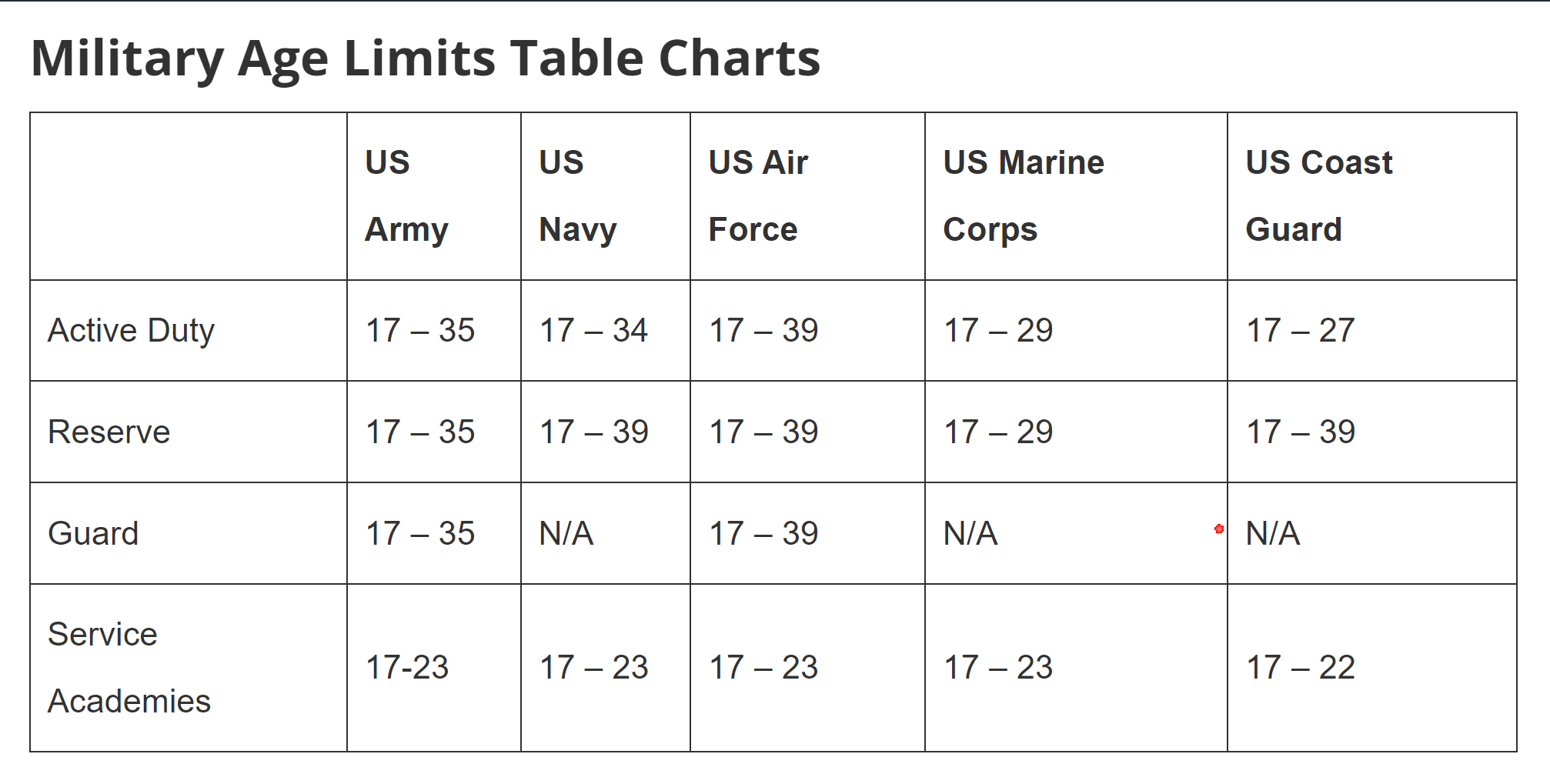
While the draft registration age is fixed at 18–25, the ages for voluntary enlistment vary significantly. The following table outlines the maximum age for new recruits in 2026 without a prior service waiver.
| Service Branch | Minimum Age | Maximum Enlistment Age (Non-Prior Service) |
|---|---|---|
| U.S. Army | 17 (with consent) | 35 |
| U.S. Navy | 17 (with consent) | 42 |
| U.S. Air Force | 17 (with consent) | 42 |
| U.S. Marine Corps | 17 (with consent) | 28 |
| U.S. Coast Guard | 17 (with consent) | 42 |
| U.S. Space Force | 17 (with consent) | 42 |
Note: Individuals with prior military service can often enlist past these ages, as their previous years of service are "subtracted" from their current age for eligibility purposes.
Consequences of Failing to Register Before Age 26
Because the draft registration age has not moved to 42, the cutoff at age 26 remains a "hard" deadline. Failing to register can lead to "permanently closed doors" regarding federal benefits and opportunities.
Federal Employment
Most federal agencies require proof of Selective Service registration as a condition of employment. If a man failed to register and is now over 26, he may be barred from civil service positions, including jobs within the Department of State, the DOJ, or the USPS.
Citizenship for Immigrants
For male immigrants seeking U.S. citizenship, "good moral character" is a requirement. The U.S. Citizenship and Immigration Services (USCIS) views the intentional failure to register for the Selective Service as a negative factor in a citizenship application. Immigrants who lived in the U.S. between ages 18 and 26 but failed to register may find their naturalization process delayed or denied.
State-Level Benefits
Many states have mirrored federal laws. In several jurisdictions, you cannot obtain or renew a driver’s license, receive state-based student financial aid, or qualify for state government jobs without being registered.
The "Special" Draft: Health Care Personnel Delivery System (HCPDS)
There is one specific scenario where someone older than 25 could technically be "drafted," which may contribute to the confusion about the age 42. This is the Health Care Personnel Delivery System (HCPDS).
In a national emergency where the military experiences a severe shortage of medical professionals (doctors, nurses, technicians), Congress has the authority to authorize a specialized draft. Under the current plans for the HCPDS:
- The age range for a medical draft could extend up to age 44.
- This would only apply to individuals with specific, high-demand medical skills.
- This is an entirely separate mechanism from the general draft registration that applies to the 18-25 population.
As of 2026, this system remains inactive, but the existence of these contingency plans for older specialists is often misinterpreted as a general change to the draft age for the public.
The Probability of a Draft in 2026
Despite the headlines and the focus on registration ages, the actual activation of a draft remains highly unlikely. For a draft to occur, several high-threshold events must happen:
- Congress must pass legislation: The President cannot "order" a draft on his own; it requires an Act of Congress.
- Presidential Signature: The President must sign the act into law.
- Lottery System: The Selective Service would then conduct a random lottery based on birthdays.
- Examination: Those called would undergo rigorous physical, mental, and moral evaluations before induction.
The U.S. military leadership continues to favor the all-volunteer force because it results in higher retention rates, better morale, and a more professionalized soldier than a conscripted force.
FAQs About the Draft Age
Did the NDAA for 2025/2026 increase the draft age?
No. The National Defense Authorization Acts for these years focused on implementing automatic registration for men aged 18 to 25 to ensure compliance. It did not expand the age requirement to 42 or any other age beyond the traditional 25-year-old cutoff.
Can I join the military at age 42?
Yes, in specific branches. As of 2026, the Navy, Air Force, Coast Guard, and Space Force have set their maximum enlistment ages at 42. This allows older adults to join as volunteers, but it does not mean they are subject to a mandatory draft.
What happens if I am 27 and never registered?
If you are already 27, you can no longer register. You should contact the Selective Service System to request a "Status Information Letter." This document is often required when applying for federal jobs or benefits to explain why you did not register. You may have to prove that your failure to register was not "knowing and willful."
Are women included in the draft registration as of 2026?
No. While there have been several court challenges and legislative proposals to include women in Selective Service registration to ensure gender equality in service, the law currently only requires those assigned male at birth to register.
Can a draft be called without a war?
Technically, yes, if Congress deems it necessary for national security. However, historically, drafts have only been used during periods of major conflict. In 2026, the Selective Service remains in a "standby" mode.
Final Recommendation: Verify Your Status
If you are a male between the ages of 18 and 25, or the parent of one, the most important action is to verify registration status. Even with the rollout of automatic registration in 2025 and 2026, data lags can occur.
- Check Online: Visit the official Selective Service System website (sss.gov) and use the "Verify" tool.
- Update Information: If you have moved, you are legally required to update your address with the Selective Service until you reach age 26.
- Don't Rely on Rumors: While the voluntary enlistment age of 42 is a reality for several branches, the mandatory draft age remains firmly at 18-25.
For those over age 26 who are interested in serving, the focus should not be on the draft, but on the various "over-30" or "over-40" recruitment programs offered by the Navy and Air Force, which value the maturity and professional experience that older recruits bring to the force.