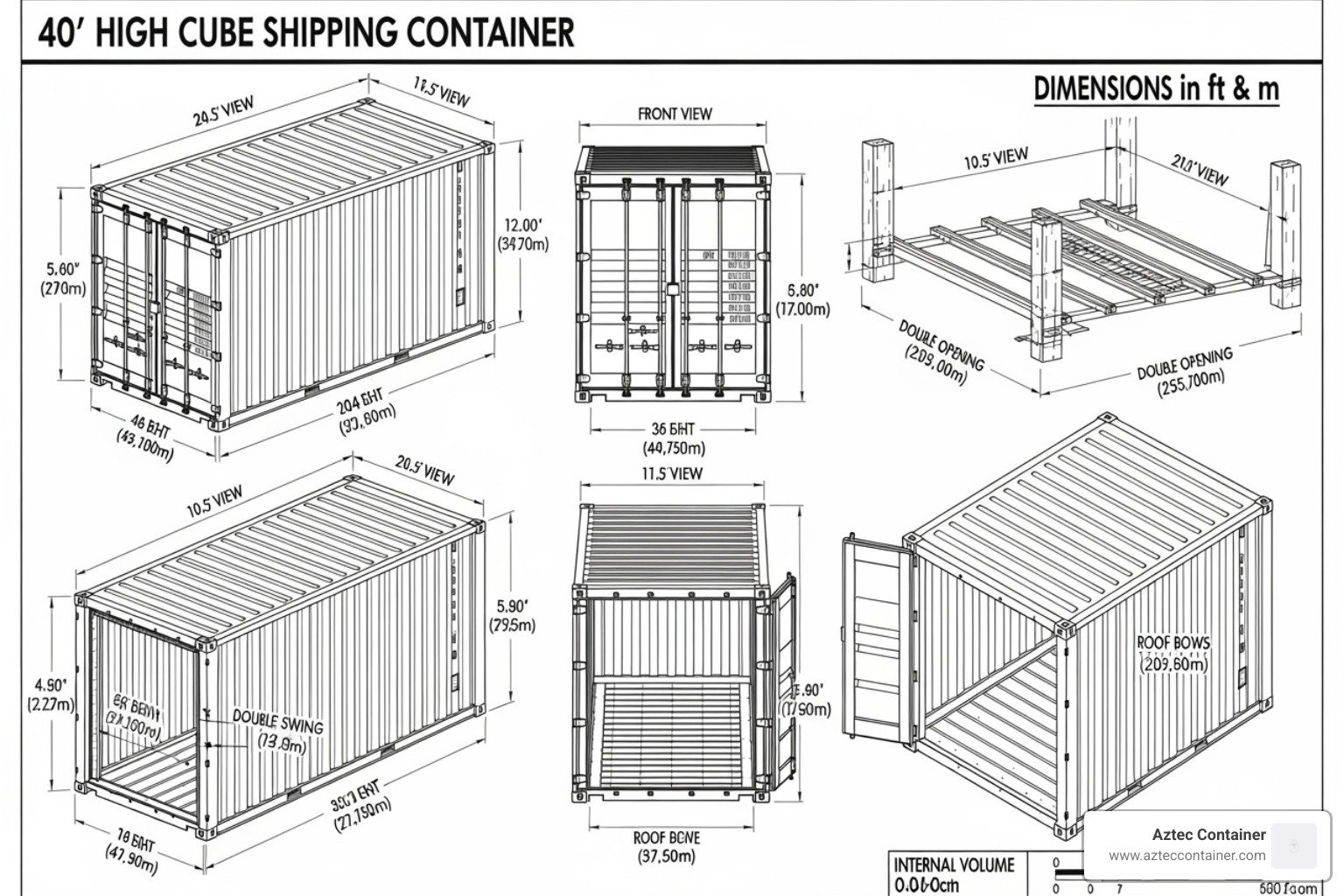
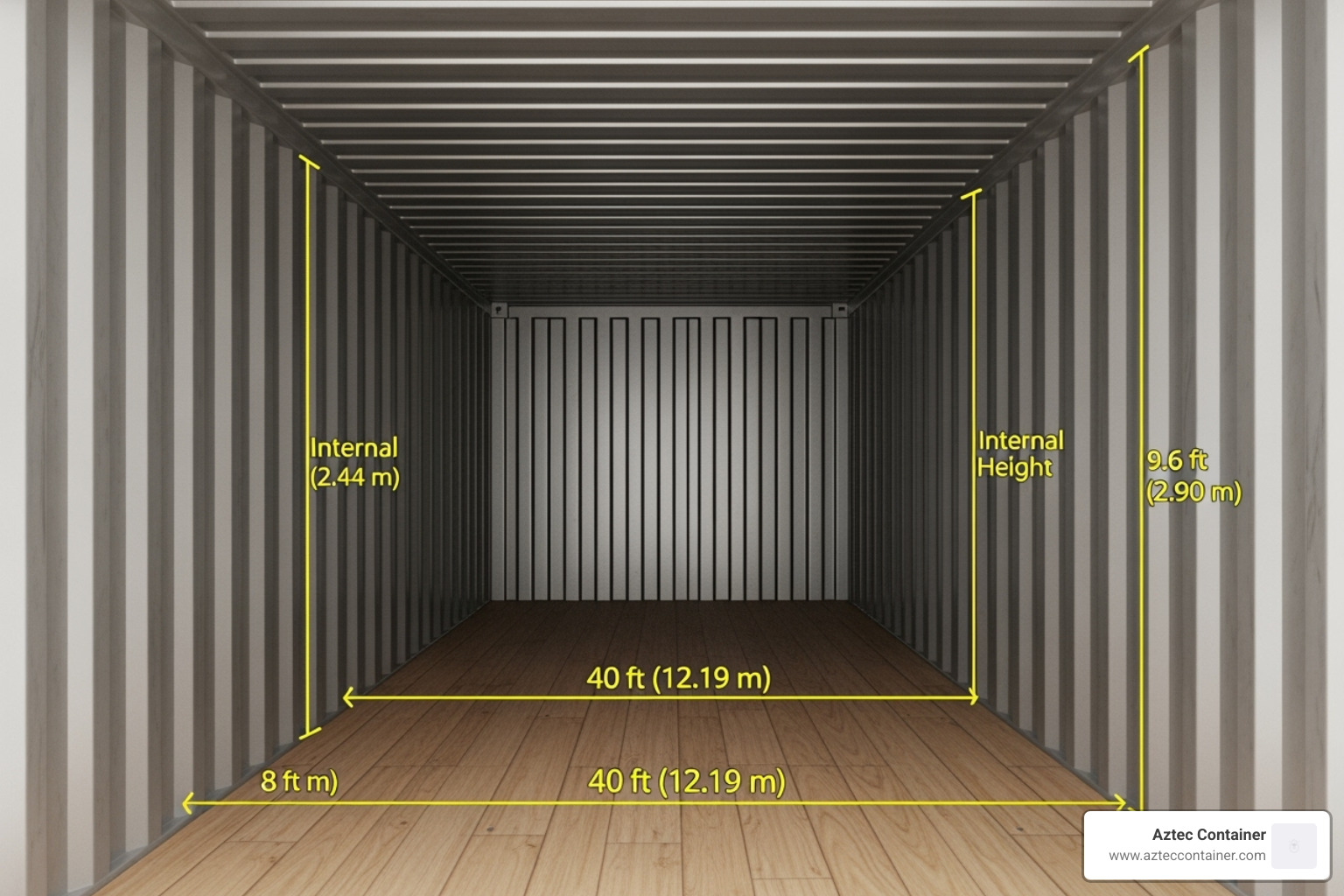
A 40ft High Cube (HC) container has an external length of 1,219.2 cm, a width of 243.8 cm, and a height of 289.6 cm. Internally, the usable space measures approximately 1,203.2 cm in length, 235.2 cm in width, and 269.8 cm in height, providing a total volume of roughly 76.4 cubic meters.
High Cube containers are the backbone of modern global logistics in 2026, favored for their additional vertical space compared to standard units. Whether you are planning a complex international shipment, designing a container-based architectural project, or calculating storage capacity, precision is paramount. While imperial measurements (feet and inches) are common in North America, the international shipping industry and engineering sectors rely on centimeters and millimeters to ensure compatibility with handling equipment and building codes.
Understanding the High Cube Advantage
The primary difference between a standard 40ft container and a 40ft High Cube container is exactly one foot (30.48 cm) of additional height. While standard containers (General Purpose) stand at 259.1 cm tall, the High Cube variant reaches 289.6 cm. This extra vertical clearance is not merely for aesthetics; it allows for the transport of taller cargo that would otherwise require specialized "Open Top" containers, which are often more expensive and less weather-resistant.
In the context of 2026 logistics, the High Cube has become the industry standard for light, voluminous cargo such as electronics, apparel, and furniture. By maximizing the vertical profile within the constraints of semi-truck bridge clearances and rail tunnels, shippers can move more goods per trip, significantly lowering the carbon footprint and cost per unit of the transported items.
External Dimensions: The Global Standard
The external dimensions of a 40ft High Cube container are strictly governed by the ISO 668 standard. This international agreement ensures that every container, regardless of its manufacturer in Asia, Europe, or the Americas, fits perfectly onto container ships, chassis, and rail cars.
- External Length: 1,219.2 cm (40 feet)
- External Width: 243.8 cm (8 feet)
- External Height: 289.6 cm (9 feet 6 inches)
The length of 1,219.2 cm is the total distance between the furthest points of the corner castings. Corner castings are the reinforced steel blocks located at each of the eight corners of the container, used for lifting and securing the unit. It is important to note that the external width of 243.8 cm is uniform across almost all ISO shipping containers, ensuring they can be stacked interchangeably.
Internal Dimensions: Real-World Usable Space
When calculating how much cargo can fit inside, external dimensions are misleading. The internal dimensions are slightly smaller due to the thickness of the corrugated steel walls, the heavy-duty flooring, and the structural frame.
- Internal Length: 1,203.2 cm
- Internal Width: 235.2 cm
- Internal Height: 269.8 cm
The internal width of 235.2 cm is measured from the inner peaks of the corrugated steel panels. This is a critical measurement for palletized shipping. For example, standard Euro-pallets (120 cm x 80 cm) must be arranged strategically to minimize "void" or wasted space. Because the walls are corrugated (wavy) to provide structural strength against the pressures of stacking, the "flat-to-flat" measurement might vary by a few millimeters depending on where the measurement is taken.
The internal height of 269.8 cm is perhaps the most vital metric for 40ft High Cube units. This height includes the clearance from the top of the 28mm thick marine plywood floor to the underside of the roof bows. If you are using the container for a "tiny house" or office conversion in 2026, this height allows for the installation of insulation, wiring, and ceiling finishes while still maintaining a comfortable living environment that exceeds standard residential ceiling heights in many regions.
Door Opening Specifications
Even if your cargo fits the internal dimensions, it must be able to pass through the door frame. The rear doors of a 40ft High Cube container are designed to maximize the available space, but the frame itself subtracts a small amount from the total internal width and height.
- Door Opening Width: 234.0 cm
- Door Opening Height: 258.5 cm
The door opening height is approximately 11.3 cm shorter than the internal ceiling height. This is due to the "header" or the top horizontal beam of the door frame, which provides the necessary structural integrity to support the weight of up to nine fully loaded containers stacked on top. Shippers of oversized machinery or tall pallet stacks must account for this "lip" when planning their loading sequence.
Weight and Payload Capacity
A 40ft High Cube container is built to carry immense weight. To understand its capacity, we must look at three specific weight ratings: Tare Weight, Net Weight (Payload), and Gross Weight.
| Specification | Metric Measurement (kg) | Description |
|---|---|---|
| Tare Weight | 3,940 kg | The weight of the empty container. |
| Max Payload | 28,560 kg | The maximum weight of the cargo. |
| Max Gross Weight | 32,500 kg | Total weight of container plus cargo. |
| Cubic Capacity | 76.4 m³ | Total internal volume. |
The Tare Weight can vary slightly between manufacturers (typically between 3,700 kg and 4,200 kg) depending on the materials used. Most modern containers in 2026 utilize Corten steel (a weather-resistant structural steel) which offers a high strength-to-weight ratio. The Max Payload is the safe limit for the floor and the structural integrity of the corner castings during lifting. While the container can technically hold this much, road weight limits in many countries often restrict the actual cargo weight to much less to remain compliant with trucking regulations.
Practical Applications for Exact CM Measurements
Logistics and Pallet Planning
In professional logistics, every centimeter counts. Shippers use software to "floor load" or "stack load" containers. Knowing the exact 1,203.2 cm internal length allows for precise calculations of how many standard pallets can fit. In a 40ft HC, you can generally fit 20 to 21 standard 120 cm x 100 cm pallets in a single tier, depending on whether they are pinwheeled (rotated).
Architectural Conversions
For those using 40ft High Cube containers for construction—a trend that continues to grow in 2026—the extra 30.48 cm of height is non-negotiable. Standard containers often feel cramped once floor insulation (roughly 5–10 cm) and ceiling insulation (10–15 cm) are added. The High Cube’s 269.8 cm internal height ensures that even after significant insulation and HVAC ductwork, the finished ceiling height remains around 240 cm, which is the standard for modern residential buildings.
Specialized Cargo (Reefer and Open Top)
It is important to distinguish the 40ft HC "Dry Van" from a 40ft HC "Reefer" (Refrigerated container). While they share external dimensions, a Reefer container has much thicker walls and a refrigeration unit at one end. This significantly reduces the internal length to approximately 1,155 cm and the internal width to 229 cm. Always verify if the dimensions you are using apply to a dry unit or an insulated/refrigerated unit.
Material Composition and Structural Integrity
The exact measurements are maintained by the use of corrugated Corten steel. The corrugation is typically 2.0 mm thick for the side panels and 3.0 mm thick for the end walls and doors. The floor is supported by a series of C-channel cross-members spaced approximately every 15 cm.
In 40ft High Cube containers, a "gooseneck tunnel" is a standard feature. This is a recess in the front of the floor (the end opposite the doors) that allows the container to sit lower on a specialized "gooseneck" chassis. This design is what allows the taller High Cube container to maintain a legal total height when being transported on highways, preventing it from hitting low-hanging bridges or power lines.
Technical Tolerances and Variances
While the measurements provided (1,219.2 cm x 243.8 cm x 289.6 cm) are the ISO standard, "exact" measurements can vary by a few millimeters in the real world. Factors affecting this include:
- Thermal Expansion: Steel expands and contracts with temperature. A container measured in a sub-zero warehouse in Northern Europe will be slightly smaller than the same container sitting in the sun in a tropical port.
- Structural Wear: Older containers (often sold for storage or building) may have "bowing" in the side walls or a slightly sagging roof if they have been overloaded or handled roughly. This can reduce the internal width or height by 1–3 cm at the center point.
- Manufacturer Specifics: While the external dimensions are fixed by ISO for compatibility, manufacturers like CIMC or Maersk Container Industry have slight variations in the internal corrugation profile or floor thickness.
Frequently Asked Questions
Is a 40ft High Cube wider than a standard 40ft container?
No. Both standard (General Purpose) and High Cube containers share the same external width of 243.8 cm (8 feet). The only external dimensional difference is the height; the High Cube is 30.48 cm (1 foot) taller.
How many centimeters are added in a High Cube vs a Standard container?
The High Cube container adds exactly 30.48 cm to the external height. This results in an internal height increase from approximately 239.3 cm in a standard unit to 269.8 cm in a High Cube unit.
Can I fit two cars in a 40ft High Cube container?
Yes, and the extra height of the High Cube is often used to install "car racks" or ramps, allowing cars to be stacked or staggered. With a length of 1,203.2 cm, you can easily fit two standard sedans (averaging 450–500 cm each) end-to-end, or even four cars if using professional vehicle racking systems that utilize the extra vertical space.
Why is the internal width less than the external width?
The internal width (235.2 cm) is less than the external width (243.8 cm) because it accounts for the thickness of the steel corner posts and the corrugation of the side walls. The corner posts are the thickest part of the frame, designed to bear the weight of stacked containers.
What is the volume of a 40ft High Cube in cubic meters?
The volume is approximately 76.4 cubic meters (m³). For comparison, a standard 40ft container has a volume of about 67.5 m³. This 13% increase in volume is the primary reason for the High Cube's popularity in global trade.
Final Recommendations for Planning
When working with "exact" measurements for high-stakes projects, always allow for a tolerance of +/- 5mm. If you are building a container home or fitting custom machinery, do not assume the container is perfectly square. Shipping containers are industrial tools; while they are manufactured to high standards, they can experience slight racking (twisting) during their life at sea.
For 2026 logistics planning, use the internal door opening height (258.5 cm) as your maximum cargo height limit rather than the internal ceiling height. This ensures that even with slight loading angles or pallet variations, your goods will clear the entrance without damage. If your project requires absolute precision, such as for pre-fabricated interior wall panels, it is best to measure the specific individual container you have purchased once it is leveled on its foundation.