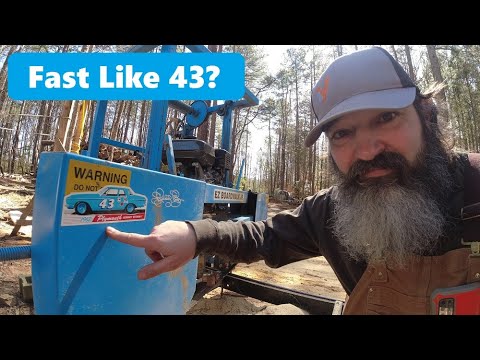
The EZ Boardwalk Model 40, when configured with track extensions to reach a 40-foot cutting length, is a heavy-duty portable bandsaw mill designed to process massive logs into oversized timbers. It features a unique 15-degree angled cutting head, a 40-inch log diameter capacity, and a robust steel frame built for high-torque manual or semi-automatic operation in professional woodworking and timber framing environments.
The demand for extra-long timbers—often used in bridge construction, historical restoration, and large-scale timber frame homes—has made the "40-foot" configuration of the EZ Boardwalk Model 40 a specific point of interest for sawyers. While the standard mill comes with a shorter track, the modular design allows for significant expansion. This overview examines the technical specifications, structural requirements, and operational nuances of utilizing the Model 40 for 40-foot milling projects in 2026.
Understanding the EZ Boardwalk Model 40 Foundation
To understand a 40-foot setup, one must first understand the powerhouse at its center: the Model 40 head unit. Unlike many entry-level mills that struggle with logs over 30 inches, the Model 40 is engineered specifically for "big wood." The "40" in its name refers to its ability to clear a 40-inch diameter log, providing a 34-inch width of cut. This makes it one of the most capable manual mills on the market for handling wide slabs and structural beams.
The 15-Degree Angled Head Advantage
The defining technical feature of EZ Boardwalk mills is the 15-degree angled blade head. In a traditional horizontal bandsaw, the blade enters the log flat, hitting the widest part of the wood and the toughest bark all at once. This creates significant resistance and can lead to blade "wave" or deflection.
The Model 40’s head is tilted, meaning the blade enters the wood at an angle. This slices through the grain more efficiently, reducing the initial impact and power requirement. For a sawyer working on a 40-foot log, where blade heat and dulling are major concerns due to the sheer length of the cut, this angled entry is a critical factor in maintaining straightness over the entire distance.
Frame and Carriage Construction
The carriage is constructed from heavy-wall structural tubing. It is designed to be pushed manually or operated with an optional power feed. In 2026, many professional users opt for the power feed and power up/down kits to handle the physical demands of long-duration cuts. The weight of the carriage provides the necessary inertia to move smoothly through dense hardwoods, which is essential when any stutter in the feed rate could cause a mark on a 40-foot-long finished beam.
Achieving a 40-Foot Cut: Track Extensions and Geometry
A standard EZ Boardwalk Model 40 typically ships with a track length capable of cutting approximately 16 to 20 feet. To reach a 40-foot cutting capacity, the sawyer must integrate multiple track extensions.
Modular Track System
EZ Boardwalk uses a bolt-together track system. Each extension is manufactured to match the original rail specifications, ensuring a seamless transition for the carriage rollers. To reach a 40-foot capacity, a user generally starts with the standard frame and adds two to three additional track sections.
The integrity of these joints is paramount. Any misalignment at the junction where the track sections meet will result in a "jump" in the carriage, which translates directly into a divot or wave in the lumber. Professional setups in 2026 often involve welding the track sections once they are perfectly leveled, or using high-tensile grade 8 bolts with precision shimming.
Stability and Leveling over 40 Feet
Leveling a 10-foot mill is simple; leveling a 40-foot mill is an engineering task. Over a 40-foot span, the curvature of the earth is negligible, but the frost heave of the soil and the compression of the ground under the weight of a multi-ton log are not.
- Foundation: A 40-foot mill should ideally be placed on a concrete pad or a series of deeply set pressure-treated 6x6 timbers.
- Support Points: The Model 40 requires support at every track cross-member. When loading a 40-foot log—which could weigh upwards of 10,000 pounds depending on species and diameter—the pressure on the track is immense.
- Alignment Tools: Many sawyers now utilize rotary lasers to ensure the track is dead-level from the first foot to the fortieth.
Technical Specifications and Power Options
The performance of the mill is largely dictated by the engine and blade configuration. For 40-foot cuts, the resistance built up over the length of the log requires consistent torque.
| Feature | Specification (Model 40 Standard) | 40-Foot Configured Requirements |
|---|---|---|
| Max Log Diameter | 40 Inches | 40 Inches |
| Max Width of Cut | 34 Inches | 34 Inches |
| Engine Options | 18HP to 31HP Gas (Honda/Vanguard) | 24HP+ Recommended for long cuts |
| Blade Size | 1.25" x 15' 8" x .042" | High-carbide or Stellite-tipped preferred |
| Track Construction | 2" x 2" sq. tubing (1/4" wall) | Reinforced with mid-span supports |
| Log Dogging | Manual Cam-Lock | Extra dogs required for 40' stability |
| Blade Lubrication | Gravity Feed (Water/Soap) | High-volume pressurized system recommended |
Engine Performance
While a 13HP or 18HP engine can technically turn the blade, the friction encountered in a 40-foot cut is substantial. In 2026, the 24HP Honda GX690 or the 31HP Briggs & Stratton Vanguard are the preferred choices for the Model 40. These engines provide the "lugging power" needed to maintain blade speed when hitting knots mid-way through a long timber.
Blade Selection for Long-Length Milling
Standard carbon steel blades may struggle to stay sharp for the entirety of a 40-foot pass in dirty or frozen wood. Sawyers typically move to 7-degree or 10-degree hook angles for these long reaches. Using a blade with a slightly thicker gauge (.045 or .050) can also help prevent the blade from wandering over the long distance, though this requires higher tension settings on the mill's tensioning screw.
Practical Applications for 40-Foot Timbers
Why build a 40-foot EZ Boardwalk? The primary driver is the niche market for oversized structural members.
- Timber Frame Construction: Modern architectural designs often call for "clear spans," where a single beam stretches across a great room or a porch. Finding a commercial mill that can handle a 40-foot log is difficult and expensive; owning an EZ Boardwalk with extensions allows a builder to source logs locally and mill them on-site.
- Bridge Beams: Small-scale bridges on private land or in parks often require 30- to 40-foot stringers. The Model 40 can handle the massive diameters of the trees (often White Oak or Douglas Fir) required for these load-bearing applications.
- Masts and Flagpoles: Specialized maritime or ceremonial wood products require continuous grain over 30+ feet, which only a long-track mill can provide.
- Wholesale Timber Supply: There is a significant markup on timbers longer than 24 feet. A sawyer with a 40-foot capacity can command premium pricing because few competitors have the equipment to match that length.
Log Handling and Loading Challenges
The most significant hurdle when operating a 40-foot EZ Boardwalk is not the milling itself, but the logistics of moving the logs. A 40-inch diameter log that is 40 feet long is a massive object.
Loading Equipment
A standard tractor with a front-end loader will rarely have the lift capacity or the width to safely load a 40-foot log onto the mill. Most operators use:
- Log Decks: A stationary ramp system where logs are rolled onto the mill using a parbuckling technique or a winch.
- Telehandlers: These provide the reach and stability necessary to place a long log precisely on the bunks.
- Multiple Support Points: The log must be supported at 4 to 6 points along its length to prevent sagging. If a log sags on the mill, the resulting beam will be bowed once the internal stresses are released during the cut.
Turning the Log
The Model 40 is a manual mill in its base form. Turning a 40-foot log requires a massive cant hook (often 60 inches or longer) and usually the assistance of a winch or a tractor. EZ Boardwalk's log dogs and backstops are built from heavy steel, but they must be positioned carefully to ensure the log doesn't "roll out" of the mill during the turning process.
Operational Limitations and Common Mistakes
Milling at this scale introduces variables that are not present in standard 8-foot or 12-foot lumber production.
Blade Deflection (Diving and Rising)
Over a 40-foot cut, even a 1/16th-inch deviation per 10 feet results in a beam that is a quarter-inch out of square by the end. This is usually caused by:
- Dull Teeth: The blade loses its "set" on one side faster than the other.
- Inconsistent Feed Speed: Pushing too hard in the middle of the log.
- Heat Expansion: The blade expands as it heats up, losing tension. Constant monitoring of the tensioning gauge is required during the pass.
Stress Release in the Wood
All trees contain internal tension. When you remove a large slab from one side of a 40-foot log, the log may "spring" or bow upward. Experienced sawyers on the Model 40 will take thin "relief cuts" from all four sides of the log to balance the tension before taking the final heavy dimension cuts. This ensures the 40-foot beam stays straight after it is removed from the mill.
Sawdust Management
A 40-foot cut generates a massive volume of sawdust. On the EZ Boardwalk, the sawdust is discharged to the side. If the wind is blowing toward the mill or if the discharge chute becomes clogged, the sawdust can build up on the tracks. If the carriage wheels roll over even a small mound of sawdust, it will lift the head and create a hump in the board. Keeping the tracks meticulously clean during a long-length cut is a non-negotiable requirement.
Maintenance for Long-Track Systems
Maintenance requirements scale with the length of the track. For a 40-foot setup, several components require extra attention:
- Track Leveling: Check the level of the track every few weeks or after loading particularly heavy logs.
- Wheel Bearings: The carriage wheels on the Model 40 are heavy-duty, but they cover four times the distance per cut compared to a standard mill. Lubricate bearings according to the manufacturer’s 2026 guidelines.
- Drive Belt Tension: Ensure the centrifugal clutch or drive belts are not slipping. A slip mid-way through a 40-foot cut can ruin the finish of a high-value timber.
Frequently Asked Questions
Can I tow a 40-foot EZ Boardwalk?
Standard trailer packages for the Model 40 are usually designed for 20- to 24-foot lengths. A 40-foot mill is almost always a stationary setup. While you could custom-build a trailer with a 40-foot "backbone," the structural rigidity required to keep the track flat during transport makes this impractical for most users. Most owners set up the 40-foot configuration on a permanent foundation.
How many people are needed to operate the mill at this length?
While the Model 40 can be operated by one person for standard logs, a 40-foot operation generally requires two. One person operates the carriage, while the second monitors the blade exit, manages the lubrication flow, and clears sawdust. Handling the resulting 40-foot slabs also requires at least two people or mechanical assistance.
What is the maximum log weight the Model 40 can handle?
The Model 40 is built with 1/4-inch wall tubing, which is exceptionally strong. It can handle logs weighing 10,000 to 12,000 pounds, provided the track is supported correctly on a solid foundation. The bottleneck is usually the user's ability to load and turn the log rather than the mill's structural capacity.
Is the power feed necessary for 40-foot cuts?
It is highly recommended. Pushing a manual carriage through 40 feet of oak or pine is physically exhausting. More importantly, a power feed provides a constant, steady rate of travel, which is essential for a smooth surface finish on long timbers where manual "stop-and-start" motions would leave visible marks.
Can I add more tracks later to go beyond 40 feet?
Yes. The EZ Boardwalk system is indefinitely expandable. Some specialized users have configured these mills to cut 50- or 60-foot ship masts. The only limit is your ability to find a flat enough piece of land and a way to move the logs.
Final Recommendations for Potential Owners
The EZ Boardwalk Model 40, configured for a 40-foot cutting capacity, represents a significant investment in both equipment and site preparation. To maximize the value of this setup in 2026, prioritize the foundation above all else. A mill is only as accurate as the track it sits on, and over 40 feet, any ground movement will compromise your work.
If you are a timber framer or a commercial sawyer, start with the Model 40 head unit and the 24HP engine option. Begin with the standard track to familiarize yourself with the nuances of the 15-degree angled head, then add the extensions as your project needs grow. This modular approach allows you to scale your business or hobby without the upfront cost of a massive stationary industrial mill, while still maintaining the ability to produce world-class, oversized timbers.