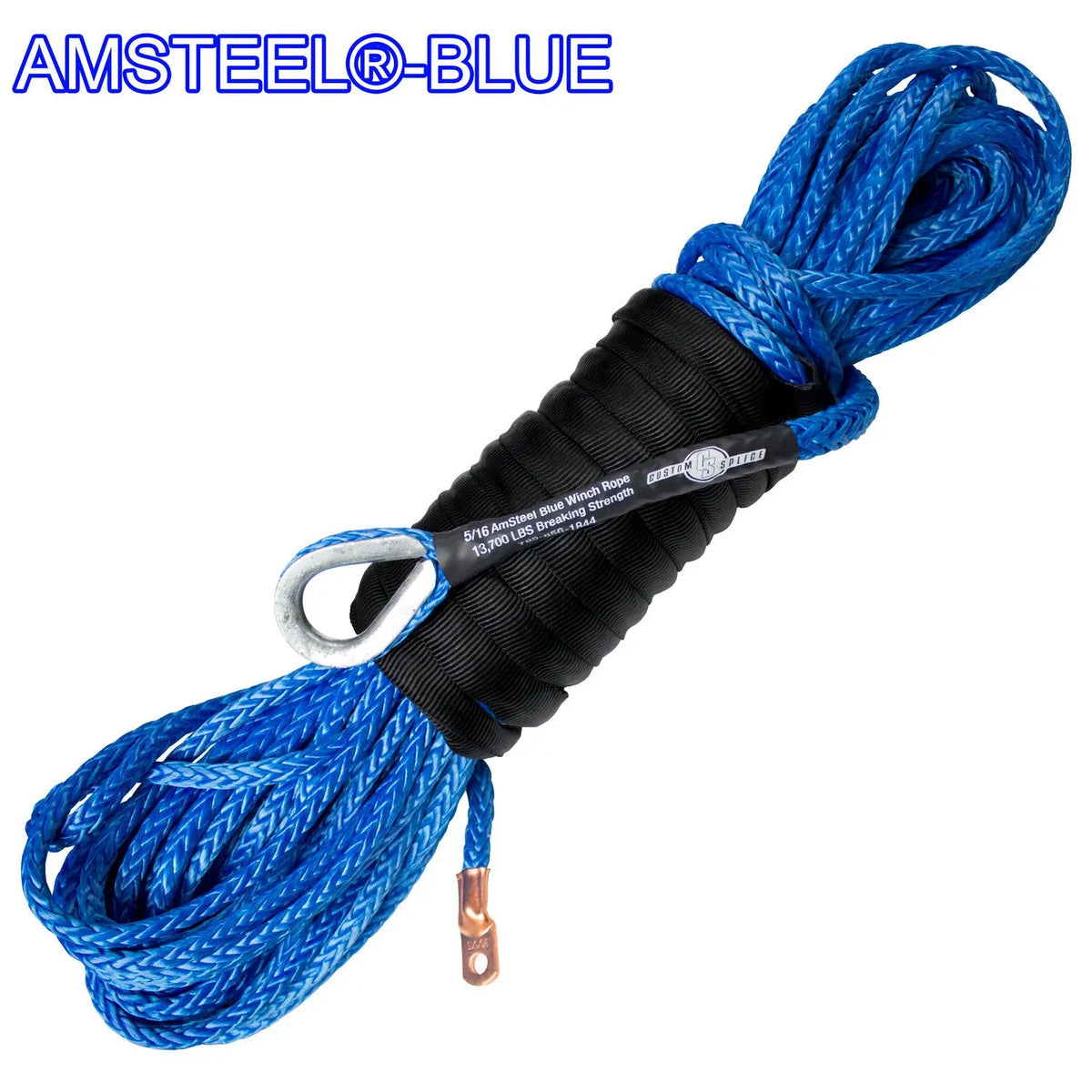
3/16" AmSteel-Blue is a high-performance, 12-strand single-braid synthetic rope manufactured by Samson Rope using Dyneema SK-75 or SK-78 fibers. Known for its exceptional strength-to-weight ratio, this diameter offers an average breaking strength of 5,400 lbs, making it a safer, lightweight, and torque-free alternative to traditional 3/16" steel wire cable in winching and rigging applications.
Understanding the Composition: What is 3/16" AmSteel?
To understand why 3/16" AmSteel has become a benchmark in the cordage industry, one must first look at its chemical and structural composition. While often used as a generic term, AmSteel-Blue is a specific proprietary product of Samson Rope. As of 2026, it remains the industry standard for High Modulus Polyethylene (HMPE) rope.
The "Blue" in the name is a distinctive coating, but the core performance comes from Dyneema fibers. Dyneema is an Ultra-High Molecular Weight Polyethylene (UHMWPE) produced by Avient (formerly DSM). At a molecular level, these fibers consist of extremely long polymer chains that transfer load more effectively to the polymer backbone. This results in a material that is, pound-for-pound, 15 times stronger than steel and significantly more durable than polyester or nylon.
The 12-strand construction is a "single braid," meaning there is no core and no jacket. The strands are woven in a way that makes the rope inherently torque-free. Unlike steel wire, which wants to unspool or "bird-cage" under tension, AmSteel remains neutral. This construction also allows for the rope to be easily spliced in the field, a critical advantage for recovery and industrial operations.
Technical Specifications and Performance Data
When selecting 3/16" AmSteel, understanding the distinction between average strength and minimum breaking strength (MBS) is vital for safety and engineering compliance.
The following data represents the standard specifications for 3/16" (nominal 5mm) AmSteel-Blue as of the 2026 production cycle:
| Property | Specification (3/16" / 4.75mm) |
|---|---|
| Average Breaking Strength | 5,400 lbs (2,450 kg) |
| Minimum Breaking Strength | 4,900 lbs (2,200 kg) |
| Weight per 100 Feet | 0.8 lbs (0.36 kg) |
| Specific Gravity | 0.98 (Floats in water) |
| Elongation at 30% MBS | 0.90% |
| Material | Dyneema SK-75 or SK-78 with Samthane Coating |
| Melting Point | 290°F (144°C) |
| Critical Temperature | 150°F (65°C) |
Strength vs. Weight Dynamics
The most striking feature of 3/16" AmSteel is its weight. At only 0.8 lbs per 100 feet, it is approximately 80% lighter than an equivalent length of 3/16" steel wire rope. In the context of an ATV winch or a portable rigging kit, this reduction in "dead weight" improves vehicle handling and reduces user fatigue. Furthermore, the high strength-to-diameter ratio allows more line to be packed onto a winch drum compared to thicker, weaker alternatives.
The Role of the Samthane Coating
Samson Rope applies a proprietary finish known as Samthane to the fibers. In 2026, this coating remains essential for two reasons:
- Abrasion Resistance: While UHMWPE is naturally slick, the Samthane coating binds the strands together and provides a sacrificial layer against external abrasion from rocks, trees, or fairleads.
- UV Protection: Although Dyneema has excellent inherent UV resistance, the coating provides an additional barrier against long-term solar degradation, which is crucial for ropes used in permanent outdoor installations.
Primary Applications for 3/16" AmSteel
The 3/16" diameter is often considered the "sweet spot" for light-duty winching and high-tension utility work. Its versatility spans several specialized industries.
ATV and UTV Winching
This is the most common use case for 3/16" AmSteel. Most winches in the 2,500 lb to 4,500 lb capacity range are designed for this diameter.
- Safety Factor: If a steel cable snaps, the stored energy causes it to whip back with lethal force. AmSteel has very low stretch and virtually no recoil; if it fails, it typically drops to the ground.
- Handling: Users can handle the rope without gloves (provided it is clean), as there are no "fishhooks" or broken wire strands to puncture the skin.
- Drum Capacity: Because of its flexibility, it stacks neatly on the winch drum, preventing the bunching and binding common with wire.
Arboriculture and Tree Care
Arborists utilize 3/16" AmSteel for several non-climbing tasks. It is frequently used as a speed line for redirecting falling branches or as a heavy-duty throw line for complex rigging setups. Its ability to float and its high visibility (when dyed) make it easy to track through dense canopy or across water features.
Sailing and Marine Rigging
In the marine sector, 3/16" AmSteel replaces stainless steel wire for standing rigging on small dinghies, as well as for control lines like outhauls, vangs, and cunninghams. Since it does not corrode in saltwater environments, it significantly reduces maintenance costs over time.
Tarp Ridge Lines and Hammock Camping
In the outdoor enthusiast community, 3/16" is often overkill for simple guy lines, but it is the preferred choice for structural ridge lines and "whoopie slings" in hammock setups. Its near-zero stretch ensures that a hammock remains at the set height throughout the night, unlike nylon which sags when wet or cold.
Maintenance and Longevity: Best Practices
To ensure the 2026 safety standards are met throughout the lifespan of the rope, 3/16" AmSteel requires specific maintenance that differs from traditional rope.
Cleaning and Inspection
Grit is the enemy of synthetic rope. Fine sand or dirt can work its way between the 12 strands and act like sandpaper, cutting the internal fibers under tension.
- Washing: Periodically soak the rope in a bucket of fresh water with a mild, non-detergent soap. Agitate it to loosen grit, then rinse thoroughly.
- Inspection: Feel along the length of the rope for "flat spots" or hard sections, which may indicate internal melting from friction. While some "fuzzing" of the outer fibers is normal and actually provides a protective layer, deep nicks or cuts that affect more than 10-15% of the rope’s volume require the rope to be retired or the damaged section removed and respliced.
Heat Sensitivity
The primary weakness of AmSteel is its low melting point. In winching applications, the internal brake of the winch drum can generate significant heat.
- The Heat Shield: Most 3/16" winch lines come with a 5–10 foot polyester heat sleeve on the drum end. This is non-negotiable for winches where the brake is located inside the drum.
- Operating Limits: Avoid "powering out" a winch for extended periods, as this generates the most heat.
Chemical Exposure
AmSteel is highly resistant to most chemicals, including gasoline, oil, and battery acid. However, prolonged exposure to strong oxidizing agents should be avoided. Always consult the Samson Rope chemical resistance chart for specific industrial compatibility.
The Superiority of Splicing Over Knotting
One of the most critical technical aspects of 3/16" AmSteel is how it is terminated. Knots significantly weaken synthetic rope. A standard bowline or overhand knot can reduce the strength of AmSteel by 50% to 60% because the tight bends cause uneven loading on the fibers.
Instead, AmSteel is designed to be spliced. A properly executed Brummel Eye Splice or a Long Bury Splice retains nearly 100% of the rope's rated strength. The 12-strand hollow-braid construction makes this process relatively simple. Using a splicing tool (often called a "fid"), one can bury the tail of the rope back into its own center. Under tension, the outer braid constricts around the buried tail like a "Chinese finger trap," creating a secure and permanent termination.
Comparing 3/16" AmSteel to Market Alternatives
When evaluating 3/16" AmSteel in 2026, it is helpful to compare it against other common rigging materials to determine if it is the right tool for the specific task.
| Feature | 3/16" AmSteel-Blue | 3/16" G70 Steel Cable | 3/16" Double-Braid Polyester |
|---|---|---|---|
| Breaking Strength | ~5,400 lbs | ~4,200 lbs | ~1,200 lbs |
| Weight per 100' | 0.8 lbs | 4.2 lbs | 1.1 lbs |
| Elasticity | Very Low | Low | Moderate |
| Corrosion | Immune | High Risk | Immune |
| Heat Resistance | Low | Very High | Moderate |
| Primary Risk | Friction Melting | Whiplash on Failure | Excessive Stretch |
While AmSteel outperforms steel in strength and safety, steel remains superior in high-heat environments or applications where the rope is constantly dragged over sharp, jagged metal edges without protection.
Safety and Design Factors
In professional rigging, the breaking strength is not the working load limit (WLL). To ensure safety, a Design Factor must be applied.
- General Use: A 5:1 design factor is standard. For 3/16" AmSteel (5,400 lbs), the WLL would be approximately 1,080 lbs.
- Critical/Lifting Use: A 10:1 design factor is often required by OSHA or similar regulatory bodies in 2026 for overhead lifting, reducing the WLL to 540 lbs.
Never exceed the WLL of the rope, and always account for the fact that any hardware used (shackles, hooks, pulleys) must have a WLL equal to or greater than the rope's WLL.
Frequently Asked Questions
Does 3/16" AmSteel stretch?
AmSteel has very low "elastic stretch" (under 1% at 30% load). However, new rope may exhibit "constructional stretch," which is the settling of the strands as they are pulled tight for the first time. This is not permanent elongation but rather the braid tightening.
Can I use a standard roller fairlead with 3/16" AmSteel?
It is highly recommended to use a polished aluminum hawse fairlead rather than a roller fairlead. Roller fairleads can have small gaps at the corners where the synthetic rope can get pinched and crushed. If you must use a roller fairlead, ensure the rollers are brand new and free of any burrs left by previous steel cable use.
Is AmSteel-Blue actually blue?
While the trademark color is blue, AmSteel-Blue is manufactured in various colors including orange, green, red, and gray. The "Blue" in the name refers to the specific grade of Dyneema and coating technology, not necessarily the pigment of the rope.
How do I store 3/16" AmSteel?
Store the rope in a cool, dry place away from direct sunlight when not in use. While it is UV resistant, unnecessary exposure to the sun will eventually degrade the Samthane coating. Ensure the rope is dry before long-term storage to prevent the growth of mold or mildew within the braid, although these do not typically affect the strength of the Dyneema fibers themselves.
Can I repair a broken 3/16" AmSteel rope?
Yes. One of the greatest advantages of the 12-strand braid is that it can be field-spliced. An "end-to-end" splice can join two pieces of AmSteel together while maintaining the majority of its strength. However, this will result in a slightly thicker section of rope that may not pass through pulleys or onto a winch drum easily.
Recommendation for Users
For those looking to upgrade their equipment in 2026, 3/16" AmSteel-Blue is the definitive choice for any application requiring high tension in a small diameter. For ATV/UTV owners, it is the single most impactful safety upgrade you can make to your recovery gear. When purchasing, always verify the source to ensure you are receiving genuine Samson AmSteel-Blue, as many "gray market" UHMWPE ropes do not meet the same rigorous testing and coating standards, leading to premature failure under UV exposure or abrasion.