For individuals who passed away in the 2025 calendar year, the New York State estate tax exemption (the Basic Exclusion Amount) is $7,130,000. Unlike the federal estate tax system, New York applies a "tax cliff," meaning that if an estate's value exceeds 105% of this threshold, the entire exemption is forfeited and the state taxes the estate’s full value starting from the first dollar.
New York remains one of the few states in the U.S. that maintains an independent estate tax, often referred to as a "death tax." This tax is separate from federal obligations and operates under significantly different rules regarding portability, gifting, and thresholds. As we move through 2026, many executors and beneficiaries are now navigating the filing requirements for deaths that occurred in 2025. Understanding the specific mechanics of the New York State (NYS) estate tax is vital for accurate tax preparation and future legacy planning.
The 2025 Basic Exclusion Amount (BEA) Explained
The New York State estate tax exemption is officially known as the Basic Exclusion Amount (BEA). For decedents who passed away between January 1, 2025, and December 31, 2025, the BEA is set at $7,130,000. This figure represents an increase from the 2024 exemption of $6,940,000, reflecting inflation adjustments mandated by state law.
New York’s exemption is indexed to inflation, but it does not mirror the federal exemption amount. Under current New York Tax Law § 951, the state BEA was originally tied to a federal formula from 2014, but it did not adopt the massive increases provided by the federal Tax Cuts and Jobs Act (TCJA) of 2017. This has created a significant "gap" between state and federal liabilities. While the federal exemption for 2025 reached $13.99 million, New York’s remains roughly half that amount. Consequently, many New Yorkers may find themselves exempt from federal estate taxes while still owing substantial sums to the state of New York.
How the Exemption is Calculated
The BEA is determined by the New York Commissioner of Taxation and Finance. It is based on the cost-of-living adjustments defined in the Internal Revenue Code (IRC), but specifically applied to the base amounts established in New York’s own legislative framework. This means that even if federal laws change or sunset (as many provisions of the TCJA are scheduled to do at the end of 2025), New York’s exemption path remains governed by its own statutory adjustments.
The Infamous New York "Tax Cliff"
The most critical and often misunderstood aspect of the New York estate tax is the "cliff" effect. In most tax systems, if you exceed an exemption, you only pay tax on the amount over the limit. For example, in the federal system, if you are $10,000 over the limit, you pay tax on $10,000.
New York does not work this way. Under NY Tax Law, the exemption is phased out for estates valued between 100% and 105% of the BEA. Once an estate exceeds 105% of the BEA, the exemption disappears entirely.
Calculating the 2025 Cliff
For a 2025 death, the math works as follows:
- Basic Exclusion Amount (BEA): $7,130,000
- 105% Threshold: $7,486,500
If a New York resident dies in 2025 with a taxable estate valued at $7,130,000 or less, the state estate tax is $0. However, if the estate is valued at $7,500,000 (which is more than 105% of the BEA), the estate receives zero exemption. The tax is then calculated on the full $7,500,000.
This creates a "marginal tax rate" that can exceed 100% for assets just over the limit. An estate that is only slightly over the 105% threshold can end up paying hundreds of thousands of dollars in taxes that it would have avoided entirely had the estate been just a few thousand dollars smaller. This makes precise valuation of assets—including real estate, business interests, and art—extremely high-stakes for New York executors.
Portability: A Major Difference from Federal Law
One of the most significant pitfalls for married couples in New York is the lack of "portability." In the federal estate tax system, if the first spouse dies and does not use their full exemption, the surviving spouse can "inherit" the unused portion (a process known as the Portability of the Deceased Spousal Unused Exclusion, or DSUE).
New York State does not allow portability.
If a New York resident dies and leaves their entire estate to their spouse (which is generally tax-free due to the unlimited marital deduction), they have "wasted" their $7,130,000 state exemption. When the second spouse later dies, they only have their own $7,130,000 exemption to apply to the combined assets of both spouses. If the combined assets exceed the threshold, the estate will face a massive tax bill that could have been avoided with a "Credit Shelter Trust" or "Bypass Trust."
Strategic Planning for Couples
To combat the lack of portability, estate planners often use "Santa Claus" clauses or "disclaimer trusts." These allow the surviving spouse to move assets into a trust that utilizes the deceased spouse's $7.13 million exemption, effectively shielding those assets from being taxed again when the second spouse passes away. In 2026, as families settle 2025 estates, verifying whether these trusts were properly funded is a primary task for legal counsel.
The Three-Year Gift Clawback Rule
While New York does not have a standalone gift tax (unlike Connecticut), it does have a "clawback" provision designed to prevent individuals from making "deathbed gifts" to avoid estate taxes.
For individuals who die in 2025, any taxable gifts made within three years of the date of death are "clawed back" into the taxable estate. These gifts are added to the value of the gross estate when determining if the $7,130,000 threshold has been met and when calculating the total tax due.
Exceptions to the Clawback
There are a few notable exceptions to this rule:
- Gifts made while the decedent was a non-resident of New York.
- Gifts made before April 1, 2014.
- Gifts that were already taxable under the federal gift tax system (though this is rare given the high federal threshold).
- Annual exclusion gifts. For 2025, the federal annual gift tax exclusion was $19,000 per recipient. These small gifts generally do not trigger the clawback.
This three-year rule means that "giving it all away" just before death is an ineffective strategy for New York residents. Planning must be proactive and occur well in advance of health declines.
Filing Requirements and Deadlines
If a New York resident passed away in 2025 and their gross estate (plus the three-year gift clawback) exceeds the BEA of $7,130,000, the executor must file Form ET-706, the New York State Estate Tax Return.
Important Timelines
- Filing Deadline: The return and the tax payment are due within nine months of the date of death.
- Extensions: An extension of up to six months can be requested for filing the return, but this does not extend the time to pay the tax. Interest will accrue on any unpaid tax from the nine-month deadline.
- Penalties: New York is stringent regarding late filings. Penalties for late payment can significantly increase the overall liability.
Even if no tax is due because of the marital deduction (leaving everything to a spouse), a return may still be required if the gross estate exceeds the threshold. This filing creates a record of the "stepped-up basis" for the assets, which is crucial for the heirs when they eventually sell the property and need to calculate capital gains taxes.
New York State Estate Tax Rates 2025
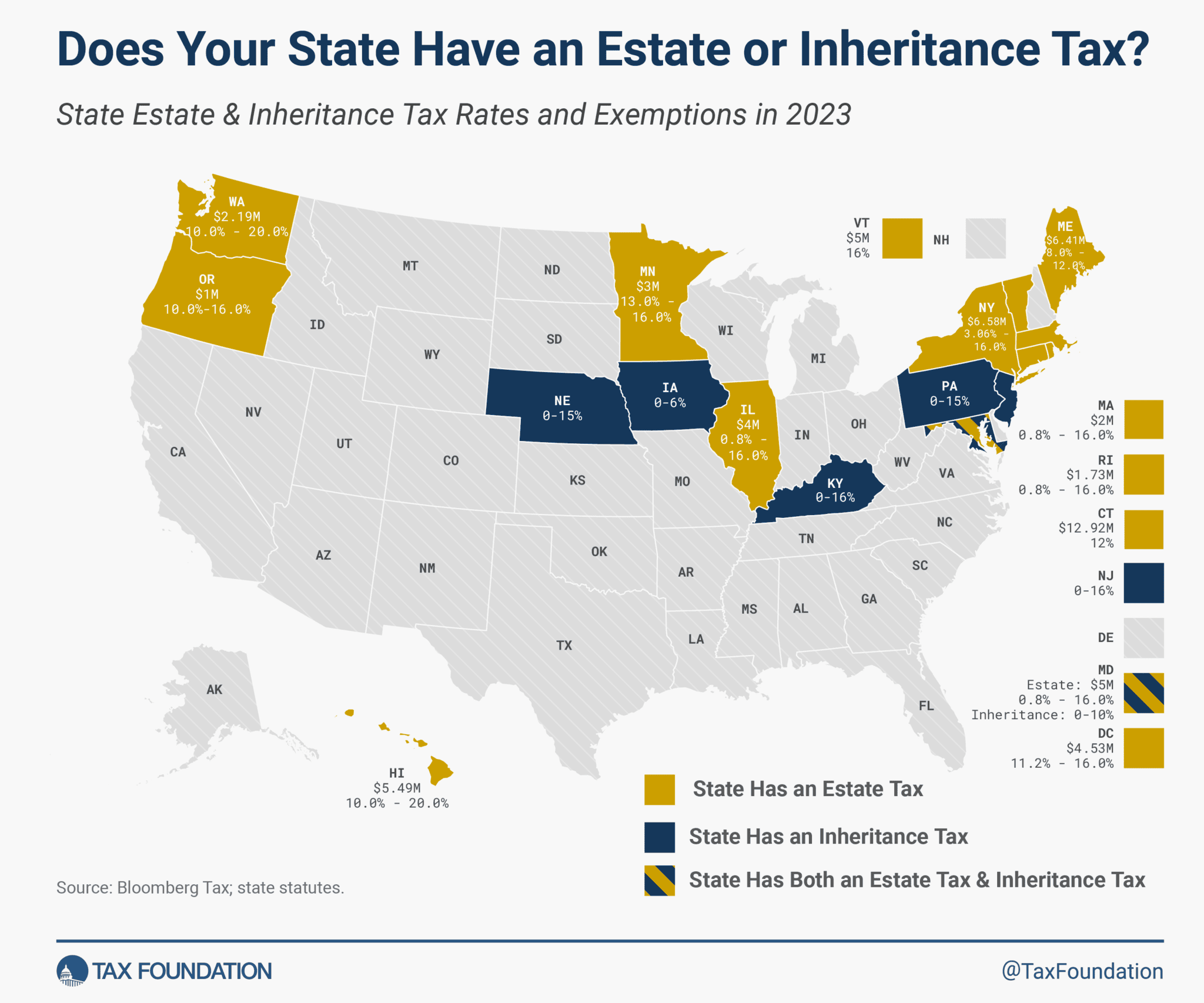
If an estate is determined to be taxable (either because it has no surviving spouse or because it exceeds the 105% cliff), New York applies a progressive tax rate. The rates start at 3.06% and cap at 16%.
| Taxable Estate Brackets | Tax Rate on Bracket |
|---|---|
| First $500,000 | 3.06% |
| $500,001 – $1,000,000 | 5.0% |
| $1,000,001 – $1,500,000 | 5.85% |
| $1,500,001 – $2,100,000 | 6.7% |
| $2,100,001 – $2,700,000 | 7.55% |
| $2,700,001 – $3,300,000 | 8.4% |
| $3,300,001 – $3,900,000 | 9.25% |
| $3,900,001 – $4,900,000 | 10.1% |
| $4,900,001 – $5,900,000 | 10.95% |
| $5,900,001 – $7,100,000 | 11.8% |
| $7,100,001 – $8,100,000 | 12.8% |
| $8,100,001 – $9,100,000 | 13.8% |
| $9,100,001 – $10,100,000 | 14.8% |
| Over $10,100,000 | 16.0% |
Note: The tax calculation is cumulative. For an estate of $11 million, the first $500,000 is taxed at 3.06%, the next $500,000 at 5%, and so on, until the portion over $10.1 million is taxed at 16%.
Non-Resident and Partial Resident Issues
New York also taxes the estates of non-residents if they own "tangible" property located within the state. This typically includes real estate (such as a Manhattan condo or a Hamptons summer home) and tangible personal property (like art or cars kept in New York).
For a non-resident who died in 2025, the tax is calculated as if they were a resident, including all their worldwide assets, and then pro-rated based on the percentage of the estate located in New York. This means a non-resident with a $10 million global estate and a $2 million New York apartment will still hit the "tax cliff" because their total estate exceeds the $7.13 million threshold, even though their New York assets alone do not.
Intangible Property
Intangible property, such as stocks, bonds, or cash held in New York bank accounts, is generally not subject to the NYS estate tax for non-residents. Consequently, many non-residents choose to hold New York real estate through an entity like an LLC or a corporation to convert "tangible" real estate into "intangible" business interests, though New York tax authorities scrutinize these structures closely.
Common Deductions and Adjustments
To arrive at the "taxable estate" for 2025, several deductions can be subtracted from the gross estate:
- Marital Deduction: Assets passing to a surviving spouse who is a U.S. citizen are generally 100% deductible.
- Charitable Deduction: Bequests made to qualified 501(c)(3) organizations are deductible. This is a common strategy for estates near the cliff; donating just enough to a charity to drop the estate below the $7,130,000 threshold can save the heirs more in taxes than the cost of the donation.
- Debts and Mortgages: Debts owed by the decedent at the time of death, including mortgages on New York property, are deductible.
- Administrative Expenses: Attorney fees, executor commissions, and funeral costs are deductible.
Frequently Asked Questions
Does New York have an inheritance tax?
No. New York has an estate tax, not an inheritance tax. An estate tax is paid by the estate itself before the assets are distributed to the heirs. An inheritance tax is paid by the person receiving the money. While the end result—less money for the beneficiary—is similar, the filing requirements and legal responsibility fall on the executor of the estate.
What happens if the federal estate tax exemption drops in 2026?
Under current federal law (TCJA), the federal exemption is scheduled to "sunset" on December 31, 2025. Unless Congress acts, the federal exemption will drop from approximately $14 million back to roughly $7 million (adjusted for inflation) on January 1, 2026. This would bring the federal exemption much closer to the New York State exemption, potentially subjecting many more estates to double taxation (both state and federal).
Is life insurance included in the $7,130,000 limit?
Yes. Many people mistakenly believe life insurance is "tax-free." While life insurance proceeds are generally free from income tax, the death benefit is included in the taxable estate if the decedent owned the policy. For a person with a $5 million home and a $3 million life insurance policy, their estate would be $8 million—well over the New York tax cliff. Using an Irrevocable Life Insurance Trust (ILIT) is a common way to keep these proceeds out of the taxable estate.
Can I avoid the "cliff" by giving money away on my deathbed?
Generally, no. As discussed, New York's three-year clawback rule adds any taxable gifts made within three years of death back into the estate for tax calculation purposes. To effectively reduce your estate's value for New York tax purposes, you must complete the gifts at least three full years before passing away.
How do I value my home for the 2025 return?
For estate tax purposes, assets must be valued at their fair market value as of the date of death. For real estate, this usually requires a formal appraisal by a certified professional. Using the "Zestimate" or the property tax assessment is generally not sufficient for Form ET-706 and could lead to an audit.
Practical Recommendation
If you are an executor for someone who passed away in 2025, your first step should be a preliminary "back-of-the-envelope" calculation of the gross estate, including the value of New York real estate, all financial accounts, business interests, and any taxable gifts made since 2022.
If the total is anywhere near $7,130,000, you must consult with a qualified New York tax attorney or CPA immediately. Because of the "cliff," a valuation error of even 1% can result in a tax liability of over $500,000. For those still in the planning stages in 2026, consider utilizing Credit Shelter Trusts and strategic charitable bequests to ensure that your estate stays safely on the "right side" of the cliff.