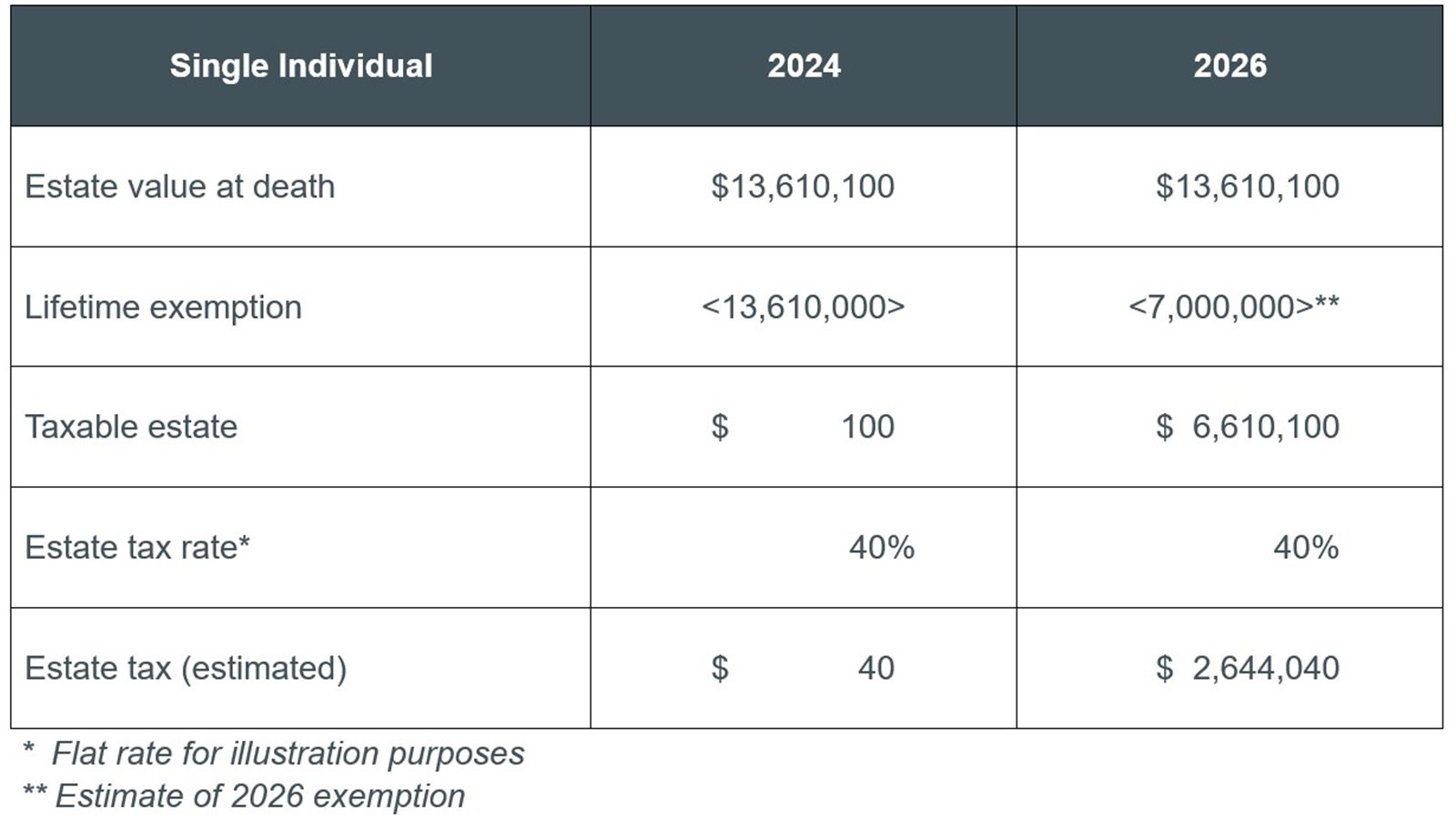
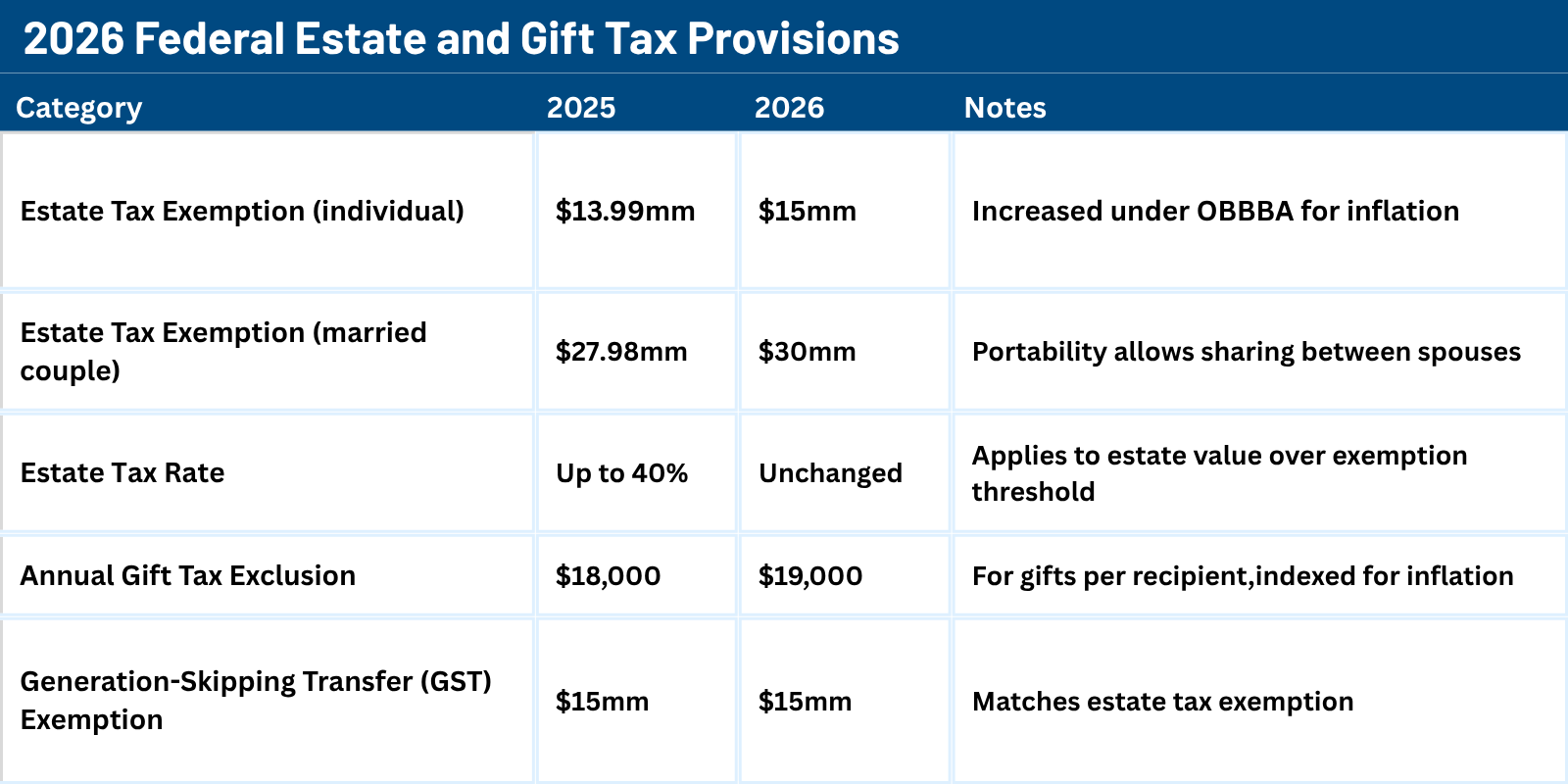
For the 2025 tax year, the IRS increased the federal estate and gift tax basic exclusion amount to $13.99 million per individual, up from $13.61 million in 2024. For a married couple, the combined exclusion reached $27.98 million. This historical peak represents the final inflation-adjusted increase under the Tax Cuts and Jobs Act (TCJA) of 2017 before major statutory provisions expired.
Understanding the 2025 Estate Tax Exemption ($13.99 Million Threshold)
The federal estate tax exemption determines how much wealth an individual can transfer during their lifetime or at death without triggering the federal estate tax, which carries a top rate of 40%. In late 2024, the Internal Revenue Service released Revenue Procedure 2024-40, establishing official inflation adjustments across more than 60 tax provisions for 2025. Among these adjustments was the increase in the unified estate and gift tax exclusion to $13,990,000.
This adjustment provided high-net-worth individuals and families an additional $380,000 of tax-free gifting capacity per person over 2024 levels, or $760,000 for married couples. Because the federal estate tax is unified with the federal gift tax, lifetime transfers that exceed the annual gift exclusion consume portions of this $13.99 million lifetime allowance.
Understanding this threshold requires distinguishing between three distinct tax components:
- The Federal Estate Tax: Applied to the gross estate of a decedent, less allowable deductions, to the extent the taxable estate exceeds the remaining basic exclusion amount.
- The Federal Gift Tax: Applied to lifetime transfers of property where full consideration is not received in return.
- The Generation-Skipping Transfer (GST) Tax: Applied to transfers made to beneficiaries more than one generation below the transferor (such as grandchildren or irrevocable trusts for their benefit). The GST tax exemption for 2025 was also adjusted to $13.99 million.
Historical Context: The TCJA and the 2025 Peak
To understand why the $13.99 million exclusion amount in 2025 is significant, one must trace its legislative origin back to the Tax Cuts and Jobs Act of 2017.
Prior to the TCJA, the base federal estate tax exemption stood at $5 million per individual (adjusted annually for inflation), reaching $5.49 million in 2017. The TCJA temporarily doubled this base exclusion amount from $5 million to $10 million per individual, indexed for chained CPI-U inflation from 2018 through 2025.
Historical Individual Exemption Trajectory: 2017: $5.49 Million (Pre-TCJA Baseline) 2018: $11.18 Million (TCJA Enactment) 2020: $11.58 Million 2022: $12.06 Million 2023: $12.92 Million 2024: $13.61 Million 2025: $13.99 Million (TCJA Peak)
The doubling provision in the TCJA was designed with a explicit statutory sunset date: December 31, 2025. On January 1, 2026, the basic exclusion amount was mandated by statute to revert back to the pre-2018 baseline of $5 million per individual, adjusted for inflation accumulated since 2011 (projected to sit near $7 million per individual, depending on final index figures).
Consequently, the 2025 tax year represented the absolute apex of federal wealth-transfer tax relief under the TCJA legislation. High-net-worth individuals faced a unique window of opportunity to lock in lifetime transfers under the expanded allowance before statutory reduction.
How Federal Estate and Gift Tax Rules Work Together
The federal wealth transfer system is unified, meaning the IRS tracks lifetime gifts and testamentary distributions under a single cumulative shield. Utilizing lifetime exemption reduces the amount available to offset estate tax liabilities upon death.
Lifetime Gifting vs. Estate Tax Exemption
When a donor makes a taxable gift, it does not immediately trigger an out-of-pocket tax liability unless the donor has already exhausted their entire cumulative lifetime exemption. Instead, gifts exceeding the annual exclusion amount are reported to the IRS on Form 709 (United States Gift and Generation-Skipping Transfer Tax Return).
The taxable portion of the gift subtracts from the donor's available basic exclusion amount. At death, the decedent's remaining unused exclusion is applied against their gross taxable estate. If the taxable estate exceeds the remaining exclusion, the excess is taxed at progressive rates reaching a maximum of 40%.
The Annual Gift Tax Exclusion
The annual gift tax exclusion operates independently of the unified lifetime exemption. For tax year 2025, the annual exclusion rose to $19,000 per recipient ($38,000 for a married couple utilizing gift-splitting under Internal Revenue Code Section 2513).
Key mechanics of the annual exclusion include:
- No Exemption Exhaustion: Direct gifts up to $19,000 per donee per year do not reduce the donor's $13.99 million lifetime exemption.
- Unlimited Donees: A donor can give $19,000 each to an unlimited number of individuals annually.
- Direct Payments for Tuition and Medical Expenses: Unlimited direct payments made directly to educational institutions for tuition or to medical providers for healthcare expenses are exempt from gift tax under IRC Section 2503(e) and do not count against either the annual exclusion or lifetime exemption.
Portability and the Deceased Spousal Unused Exclusion (DSUE)
Under IRC Section 2010(c)(5), the surviving spouse of a decedent who died holding unused estate tax exemption can elect to transfer that remaining allowance to themselves. This mechanism is known as portability, and the transferred amount is called the Deceased Spousal Unused Exclusion (DSUE).
To secure portability, the executor of the deceased spouse's estate must file a timely federal estate tax return (Form 706), even if the estate is otherwise below the mandatory filing threshold.
Important Note on Portability: While estate tax exemption is portable between spouses, the Generation-Skipping Transfer (GST) tax exemption is NOT portable. If a decedent does not allocate their $13.99 million GST exemption during life or at death via their own estate tax return, that specific allocation opportunity is permanently lost.
The TCJA Sunset and Treasury Anti-Clawback Regulations
The scheduled expiration of the TCJA's expanded exclusion amounts created initial technical uncertainty: if a taxpayer gifted $13 million between 2018 and 2025, but died in 2026 or later when the exemption dropped back to ~$7 million, would the IRS "claw back" the excess tax on gifts that exceeded the new, lower post-sunset exemption?
Treasury Decision 9884 (The Anti-Clawback Rule)
To resolve this issue, the Department of the Treasury and the IRS issued final regulations under Treasury Decision 9884 (Treas. Reg. § 20.2010-1(c)).
These anti-clawback rules establish a favorable "use-it-or-lose-it" principle:
- Taxpayers who utilized the higher basic exclusion amount between 2018 and 2025 will not be penalized if the exemption drops in subsequent years.
- The credit against estate tax upon death is calculated using the higher of the basic exclusion amount applied to lifetime gifts or the basic exclusion amount in effect on the date of death.
Anti-Clawback Mechanism Example: ----------------------------------------------------------------------- 2025 Lifetime Gift Made: $13,990,000 (Uses full 2025 exclusion) Post-Sunset Exemption (2026+): $7,000,000 (Assumed statutory drop) ----------------------------------------------------------------------- IRS Calculation Treatment: Estate tax credit allows full $13.99M prior gift. No retrospective tax or "clawback" applied to the $6.99M difference.
However, to benefit from the anti-clawback provisions, lifetime gifts must actually exceed the post-sunset baseline threshold. Making a $3 million lifetime gift in 2025 leaves the donor utilizing only their bottom-tier exemption, which will be subsumed by the lower post-sunset exemption level without yielding tax advantages from the temporary boost.
Strategic Estate Planning Tools to Leverage Exemption Thresholds
Given the high exemption threshold of $13.99 million in 2025, high-net-worth families utilized specialized trust structures to lock in high valuation exemptions while retaining multi-generational asset control.
Spousal Lifetime Access Trusts (SLATs)
A Spousal Lifetime Access Trust (SLAT) is an irrevocable trust created by one spouse (the grantor) for the benefit of the other spouse (and potentially children or other descendants).
- Mechanism: The grantor makes a completed gift of assets to the SLAT, utilizing their available $13.99 million lifetime exemption.
- Benefit: The gifted assets and all future appreciation are removed from the couple's gross taxable estates. However, because the beneficiary spouse has access to distributions according to the trust agreement, the couple retains indirect access to trust funds.
- Reciprocal Trust Doctrine Caution: If both spouses establish SLATs for each other, they must ensure the trust terms, trustees, funding dates, and asset compositions are sufficiently distinct to avoid IRS challenge under the United States v. Estate of Grace (395 U.S. 316) reciprocal trust doctrine.
Grantor Retained Annuity Trusts (GRATs)
A Grantor Retained Annuity Trust (GRAT) is an irrevocable tax-planning vehicle authorized under IRC Section 2702.
- Mechanism: The grantor transfers appreciating assets into a trust in exchange for an annuity stream paid over a designated term of years. The annuity value is calculated using the IRS Section 7520 interest rate.
- Zeroed-Out GRAT: By setting the annuity payments equal to the initial trust value plus the Section 7520 rate, the calculated taxable gift value drops to virtually $0.
- Benefit: Any asset growth above the prescribed Section 7520 hurdle rate passes to remaining trust beneficiaries or continuing trusts free of gift tax, preserving the donor's $13.99 million exclusion for other assets.
Irrevocable Life Insurance Trusts (ILITs)
Life insurance death benefits are generally free from federal income tax, but under IRC Section 2042, proceeds are fully taxable in the insured's gross estate if the insured held any "incidents of ownership" within three years of death.
- Mechanism: An ILIT holds ownership of life insurance policies on the grantor.
- Benefit: Death benefit proceeds are excluded from the insured's taxable estate upon death, offering liquidity to pay estate taxes, fund buy-sell agreements, or equalize distributions among heirs without exhausting lifetime exemptions.
Federal Estate Tax Exemption Over Time
The table below outlines the historical progression of federal estate, gift, and GST tax exemptions, along with top tax rates and annual exclusions.
| Tax Year | Individual Estate Exemption | Married Couple Exemption | Top Federal Estate Tax Rate | Annual Gift Exclusion | Legislative Context |
|---|---|---|---|---|---|
| 2017 | $5,490,000 | $10,980,000 | 40% | $14,000 | Pre-TCJA Baseline |
| 2018 | $11,180,000 | $22,360,000 | 40% | $15,000 | TCJA Enactment |
| 2019 | $11,400,000 | $22,800,000 | 40% | $15,000 | TCJA Inflation Adjustment |
| 2020 | $11,580,000 | $23,160,000 | 40% | $15,000 | TCJA Inflation Adjustment |
| 2021 | $11,700,000 | $23,400,000 | 40% | $15,000 | TCJA Inflation Adjustment |
| 2022 | $12,060,000 | $24,120,000 | 40% | $16,000 | TCJA Inflation Adjustment |
| 2023 | $12,920,000 | $25,840,000 | 40% | $17,000 | TCJA Inflation Adjustment |
| 2024 | $13,610,000 | $27,220,000 | 40% | $18,000 | TCJA Inflation Adjustment |
| 2025 | $13,990,000 | $27,980,000 | 40% | $19,000 | TCJA Exemption Peak |
Common Pitfalls and Planning Mistakes
Navigating wealth transfer around high exemption thresholds involves complex legal rules. Common errors include:
1. Failing to Account for Income Tax Basis Step-Up
Assets retained until death receive a step-up in income tax basis to fair market value under IRC Section 1014. Lifetime gifts, by contrast, pass with the donor's carryover basis under IRC Section 1015.
If high-appreciation assets are gifted during lifetime to remove them from a non-taxable estate, donees may face capital gains taxes upon sale that outweigh any savings on estate taxes.
2. Neglecting State-Level Estate Taxes
The $13.99 million exclusion applies strictly to federal estate tax. Numerous jurisdictions maintain separate state estate or inheritance taxes with drastically lower exemption thresholds.
For example, states such as Oregon, Massachusetts, New York, and Washington enforce state estate tax exemptions that are significantly lower than federal levels, with top state rates ranging between 10% and 20%. Gifting strategies must consider state-specific tax laws alongside federal provisions.
Federal vs. State Estate Tax Exemption Differences (Example Framework): ------------------------------------------------------------------ Federal Exemption (2025): $13.99 Million State Exemptions (Typical): $1.0 Million to $7.0 Million (Varies by state) Result: Estates exempt from federal tax may still face significant state-level tax obligations. ------------------------------------------------------------------
3. Missing the Portability Election Deadline
If a surviving spouse fails to file Form 706 within the required timeframe following the first spouse's death, the deceased spouse's unused exemption (DSUE) is lost. Under IRS Revenue Procedure 2022-19, simplified relief offers an extended 5-year window to make late portability elections for non-taxable estates, but proactive filing remains essential.
Frequently Asked Questions
What was the 2025 federal estate tax exemption amount?
The 2025 federal estate tax basic exclusion amount was $13.99 million per individual ($13,990,000). For a married couple electing portability or structuring joint planning, the combined exclusion reached $27.98 million.
What was the annual gift tax exclusion for 2025?
The annual gift tax exclusion for 2025 was $19,000 per recipient. Married couples who agreed to split gifts under IRS rules could transfer up to $38,000 per donee without reporting taxable gifts or drawing down their lifetime exemption.
Did the IRS claw back lifetime gifts made under the $13.99 million threshold?
No. Treasury Decision 9884 enacted explicit anti-clawback rules. Taxpayers who utilized the expanded lifetime exemption amounts between 2018 and 2025 will not face retroactive taxation on those gifts if exemption limits drop in later tax years.
How does the estate tax exemption apply to non-U.S. citizens?
Surviving spouses who are U.S. citizens can receive unlimited tax-free transfers under the marital deduction. However, if the surviving spouse is a non-U.S. citizen, transfers do not qualify for the standard unlimited marital deduction unless placed in a Qualified Domestic Trust (QDOT). Non-resident aliens holding U.S.-situs property receive a basic estate tax exclusion of only $60,000.
What happens if an estate exceeds the basic exclusion amount?
Portions of a taxable estate that exceed the remaining available lifetime exclusion amount are taxed at progressive federal estate tax rates, reaching a top rate of 40%.
Actionable Recommendations for Estate Planning
- Review Existing Estate Documents: Evaluate current wills, revocable trusts, and formula clauses. Formula gifts tied strictly to "the maximum basic exclusion amount" must be audited to ensure they align with your intended distribution balance among surviving spouses, trusts, and children.
- Audit Lifetime Gifting History: Gather historical Form 709 filings to calculate your exact remaining lifetime exemption balance, taking into account past taxable transfers and allocated GST exemptions.
- Analyze Basis vs. Estate Tax Savings: Coordinate with your tax professional to run dual projections comparing potential capital gains liabilities (carryover basis on gifted assets) against federal and state estate tax exposure.
- Evaluate Irrevocable Trust Vehicles: For estates exceeding projected statutory exemption levels, consult an experienced estate planning attorney to discuss strategies such as SLATs, GRATs, or ILITs.
Disclaimer: Estate planning involve complex federal and state statutes, IRS regulations, and personal financial considerations. This guide is provided for educational and informational purposes only and does not constitute formal legal, accounting, or financial advice. Consult qualified estate planning attorneys and certified tax specialists regarding your specific circumstances.