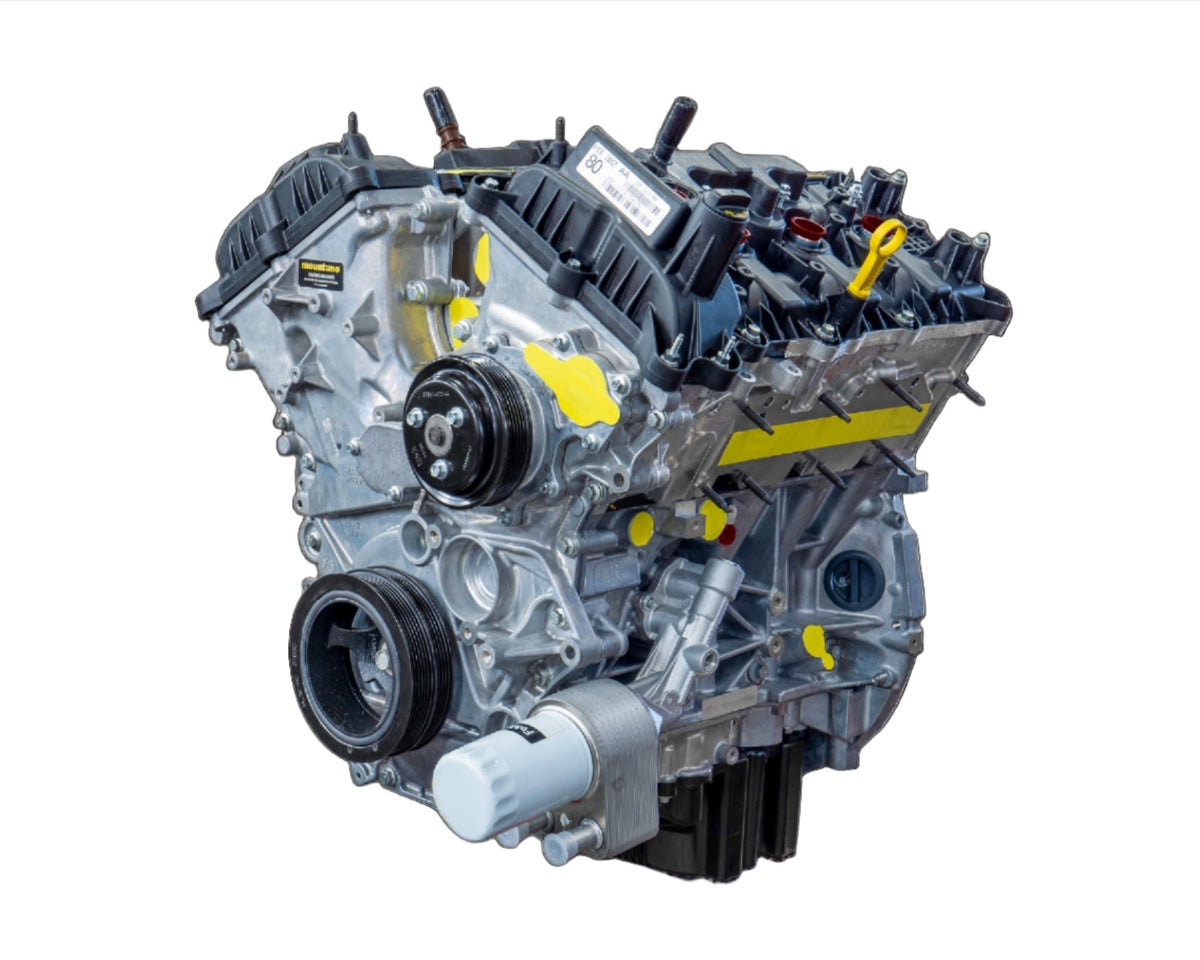
The 2016 Ford F-150 3.5L EcoBoost V6 delivers 365 horsepower and 420 lb-ft of torque, providing a maximum towing capacity of 12,200 pounds when properly equipped. This powertrain, paired with a 6-speed SelectShift automatic transmission, remains a benchmark for the 13th-generation aluminum-bodied F-Series, balancing heavy-duty capability with modern fuel efficiency.
The Architecture of the 3.5L EcoBoost V6
To understand the 2016 F-150 3.5L EcoBoost, one must look at the mechanical foundation that defined Ford's "Power over Displacement" philosophy. This engine belongs to the first generation of the EcoBoost family (Gen 1), featuring a 60-degree V6 block made of high-strength compacted graphite iron and aluminum.
Twin-Turbocharger Configuration
Unlike single-turbo setups that may suffer from significant lag, the 3.5L EcoBoost utilizes two Garrett GT1548L turbochargers operating in parallel. Each turbocharger services one bank of three cylinders. This configuration is designed to spool up quickly at low RPMs, which is critical for truck owners who need immediate torque when pulling a trailer or merging onto a highway. In the 2016 model, these turbos are water-cooled to prevent "coking" (the baking of oil inside the turbo) after the engine is shut down.
Direct Fuel Injection and Cooling
The 2016 iteration relies on a high-pressure direct-injection system. By spraying fuel directly into the combustion chamber rather than the intake port, the engine achieves a cooling effect that allows for a higher compression ratio (10.0:1) than is typically found in turbocharged engines. This improves thermal efficiency and power output. Additionally, the engine features an air-to-air intercooler (Charge Air Cooler or CAC) located behind the front bumper, which is essential for densifying the intake air before it reaches the cylinders.
Comprehensive Performance and Engine Specs
The 3.5L EcoBoost was the premium "workhorse" engine for the 2016 model year, often positioned as the more capable alternative to the naturally aspirated 5.0L Ti-VCT V8. While the V8 offered a classic exhaust note, the EcoBoost provided superior low-end torque.
| Feature | Specification | Notes |
|---|---|---|
| Engine Type | 3.5L V6 Twin-Turbocharged | DOHC, 24-valve |
| Horsepower | 365 hp @ 5,000 rpm | Measured on 87 octane (regular) |
| Torque | 420 lb-ft @ 2,500 rpm | Peak torque at low RPM |
| Bore x Stroke | 3.64 in. x 3.41 in. | Over-square design |
| Compression Ratio | 10.0:1 | Optimized for direct injection |
| Fuel Delivery | Direct Injection | High-pressure system |
| Oil Capacity | 6.0 Quarts | Recommended 5W-30 synthetic blend |
| Transmission | 6-speed Automatic | SelectShift with Tow/Haul mode |
| Max Towing | 12,200 lbs | Requires Max Trailer Tow Package |
| Max Payload | 3,240 lbs | Varies by cab/bed configuration |
The most significant aspect of these specs is the torque curve. Because the 420 lb-ft of torque peaks at just 2,500 RPM, the 2016 F-150 3.5L EcoBoost feels more like a diesel engine than a traditional gasoline V6. This low-end grunt reduces the need for the transmission to downshift constantly when navigating grades or carrying heavy loads.
Towing and Hauling Capabilities
The 2016 model year was a pivotal point for Ford's towing technology. This was the first year Ford introduced the Pro Trailer Backup Assist, a system that allows drivers to steer a trailer using a dashboard knob while the truck handles the steering wheel.
Maximum Towing Capacity
To achieve the 12,200-pound maximum towing rating, the 2016 F-150 required the SuperCab or SuperCrew configuration with the 3.5L EcoBoost engine, 4x2 drivetrain, and the Max Trailer Tow Package (Option 53C). This package included:
- An upgraded rear bumper and Class IV hitch receiver.
- A 3.55 or 3.73 electronic-locking rear axle.
- An auxiliary transmission oil cooler.
- An upgraded front stabilizer bar.
- An integrated trailer brake controller.
Payload Considerations
The 2016 F-150 utilized a high-strength, military-grade aluminum alloy body, which shed approximately 700 pounds compared to the previous steel-bodied generation. This weight savings was redirected toward payload capacity. While the 3.5L EcoBoost is a heavy engine compared to the 2.7L variant, it still allows for substantial hauling. Users should always check the Tire and Loading Information placard on the B-pillar (door jamb) for the "as-built" payload capacity, as heavy options like sunroofs and power running boards can reduce this number by hundreds of pounds.
Fuel Economy and Real-World Efficiency
Fuel efficiency is one of the primary reasons buyers chose the EcoBoost over the V8 in 2016. However, it is important to note that the "Eco" and "Boost" rarely happen at the same time.
- EPA Estimates (2WD): 17 city / 24 highway / 20 combined MPG.
- EPA Estimates (4WD): 16 city / 22 highway / 18 combined MPG.
In real-world 2026 conditions, after a decade of engine wear and potential modifications (such as larger tires or leveling kits), many owners report slightly lower figures. Towing significantly impacts these numbers; when pulling a 7,000-pound trailer, fuel economy can drop into the 8–11 MPG range, as the turbochargers stay constantly engaged (on boost), requiring a richer fuel-to-air mixture to keep combustion temperatures safe.
Long-Term Reliability and Maintenance in 2026
As of 2026, many 2016 F-150s have reached or exceeded the 150,000-mile mark. For those looking at specs and purchasing one of these trucks second-hand, understanding the long-term maintenance requirements of the Gen 1 3.5L EcoBoost is vital.
Timing Chain and Cam Phasers
Early 3.5L EcoBoost engines were known for "timing chain stretch." This occurs when the long timing chain wears down, causing a misalignment between the crankshaft and camshafts. Symptoms include a rattling noise on cold starts. By the 2016 model year, Ford had implemented several revisions to the chain and tensioner designs, making them more robust than the 2011–2014 units, but regular oil changes remain non-negotiable to prevent this issue.
Carbon Buildup on Intake Valves
Because the 2016 3.5L EcoBoost uses direct injection only (not the dual-port and direct injection system found in 2017+ models), fuel does not wash over the back of the intake valves. Over time, oil vapors from the PCV system can bake onto the valves, forming carbon deposits. This can lead to restricted airflow, rough idling, and decreased fuel economy. High-quality synthetic oil and an oil catch can are common aftermarket solutions used by enthusiasts to mitigate this.
Spark Plug Gap and Ignition Coils
The turbocharged environment is notoriously hard on spark plugs. The high cylinder pressures can "blow out" the spark if the gap is too wide. For the 2016 model, mechanics often recommend changing spark plugs every 30,000 to 40,000 miles, gapped specifically to 0.030 inches, to maintain peak performance and prevent ignition coil failure.
Drivetrain and Chassis Specifications
The 2016 F-150 was built on a fully boxed ladder frame with a high percentage of high-strength steel (78%, up from 23% in the previous generation). This provided the rigidity needed to handle the 420 lb-ft of torque generated by the 3.5L engine.
- Front Suspension: Independent double-wishbone with coil-over shocks and a stamped-steel lower control arm.
- Rear Suspension: Leaf springs with outboard-mounted shock absorbers for better stability under load.
- Steering: Electric Power-Assisted Steering (EPAS). Unlike hydraulic systems, EPAS does not draw power from the engine, contributing to the overall efficiency of the EcoBoost platform.
- Brakes: Four-wheel vented disc brakes with ABS. The 3.5L EcoBoost models typically feature larger rotors to accommodate the increased towing weight.
3.5L EcoBoost vs. 5.0L V8: The 2016 Debate
When reviewing the 2016 specs, many buyers find themselves choosing between the 3.5L EcoBoost and the 5.0L "Coyote" V8.
The 3.5L EcoBoost wins on torque (420 lb-ft vs 387 lb-ft) and towing capacity. It delivers its power lower in the RPM range, making it the superior choice for heavy towing and high-altitude driving, where the turbochargers compensate for thin air.
The 5.0L V8 wins on simplicity and sound. Being naturally aspirated, it lacks the complexity of turbochargers, intercoolers, and extensive vacuum lines. For owners who plan on keeping the truck for 20+ years or who prefer the linear power delivery of a V8, the 5.0L was often the preferred choice, even though its max towing capacity (11,100 lbs) was slightly lower than the EcoBoost.
Frequently Asked Questions
What kind of oil does the 2016 F-150 3.5L EcoBoost require?
Ford recommends using Motorcraft SAE 5W-30 Premium Synthetic Blend Motor Oil or an equivalent that meets the WSS-M2C946-A specification. Full synthetic oil is highly recommended for turbocharged engines to better withstand the high heat generated by the turbos. The oil capacity is 6.0 quarts including the filter.
Does the 2016 3.5L EcoBoost require premium gasoline?
No, the 2016 3.5L EcoBoost is designed to run on 87-octane regular unleaded gasoline. However, for maximum performance—especially when towing or in hot weather—Ford recommends using premium fuel (91 octane or higher). The engine's computer can advance timing and increase boost more aggressively when it detects higher-octane fuel, resulting in a noticeable increase in power under load.
How do I know if my 2016 F-150 has the 3.5L EcoBoost or the 2.7L EcoBoost?
The easiest way to verify the engine is by checking the VIN. The 8th digit of the VIN identifies the engine: "G" indicates the 3.5L EcoBoost, while "P" indicates the 2.7L EcoBoost. Additionally, the 3.5L EcoBoost has a distinct twin-intake tube setup over the engine cover, whereas the 2.7L has a more compact, centralized intake.
What are the common signs of turbo failure in a 2016 F-150?
Common signs include a significant loss of power, a loud whistling or "dentist drill" noise under acceleration, excessive blue or grey smoke from the exhaust, and an illuminated Check Engine Light (CEL) with codes related to underboost (e.g., P0299). If you notice oil leaking from the turbo cooling lines or around the compressor housing, it is important to address it immediately to avoid catastrophic engine damage.
Is the 6-speed transmission reliable in the 2016 model?
The 6R80 6-speed automatic transmission is generally considered very reliable and is often preferred by some enthusiasts over the 10-speed transmission that followed in 2017. It is known for its durability and smooth shifting. Standard maintenance involves a fluid and filter change every 60,000 to 100,000 miles, depending on towing frequency.
Final Recommendation for Owners and Buyers
The 2016 Ford F-150 with the 3.5L EcoBoost remains a highly capable vehicle in 2026. Its combination of an aluminum body and high-torque turbocharged engine makes it a modern-feeling truck even a decade after its release. For those looking to maximize the longevity of this specific powertrain, the priority should be rigorous maintenance: 5,000-mile oil change intervals, high-quality spark plugs every 40,000 miles, and occasional intake valve cleaning.
If you are buying one used, prioritize vehicles that have a documented service history and have had the "cold start rattle" addressed. When properly cared for, the 3.5L EcoBoost is a versatile tool that can handle everything from daily commuting to heavy-duty trailering with ease.