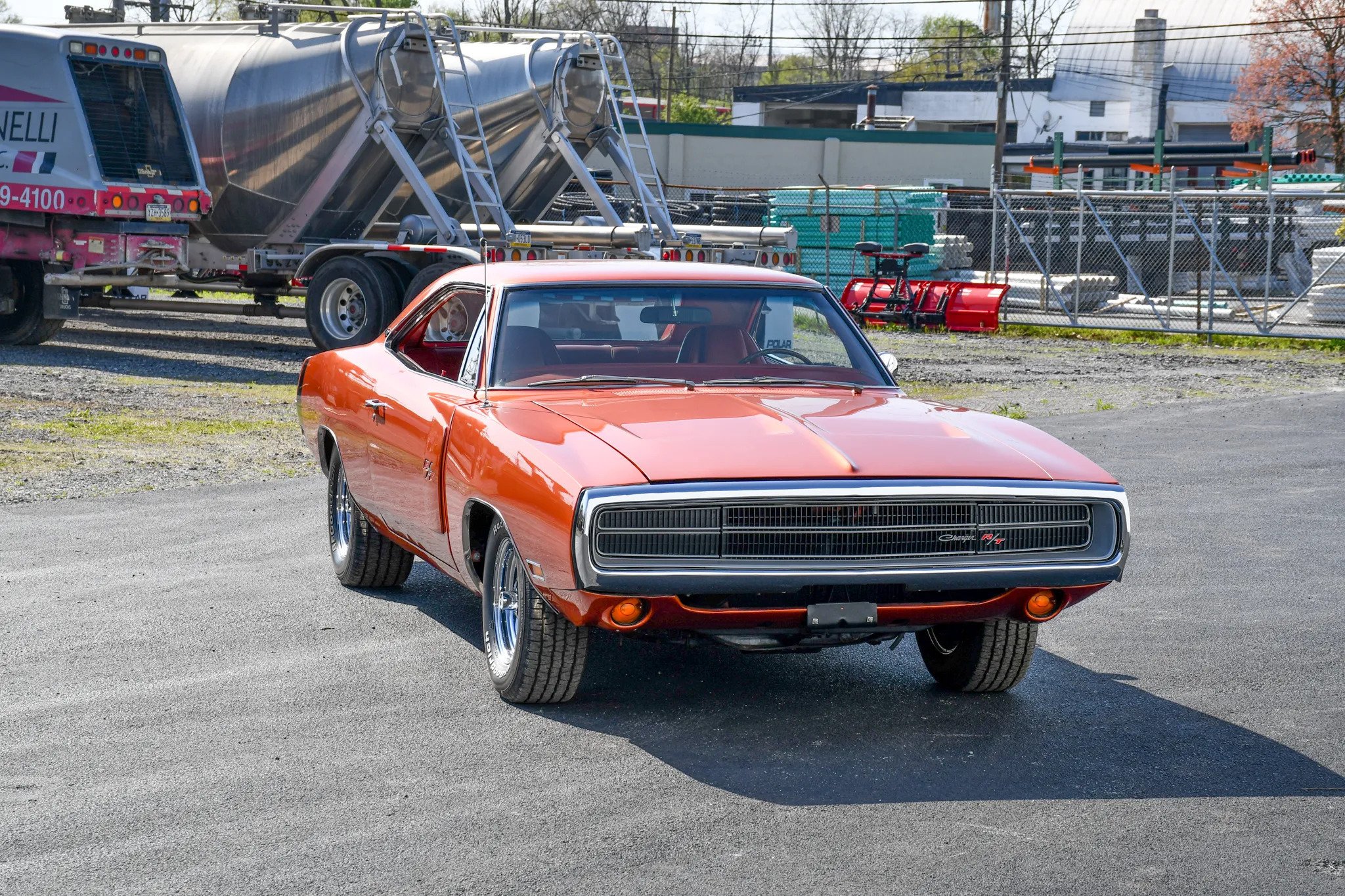
The 1970 Dodge Challenger offered a wide range of horsepower ratings depending on the chosen engine option, spanning from a modest 145 horsepower for the base inline-six up to an officially rated 425 horsepower for the legendary 426 HEMI V8. Designed to enter the fiercely competitive pony car market late, Dodge provided an expansive lineup of powerplants to suit everything from casual daily driving to dominating drag strips.
The Historical Context of the 1970 Dodge Challenger
In 1970, Chrysler entered the pony car segment relatively late, as competitors like the Ford Mustang and Chevrolet Camaro had already established a firm grip on the market since the mid-1960s. Built upon the new Chrysler E-body platform—which it shared with the slightly larger Plymouth Barracuda—the Dodge Challenger was engineered from the ground up to accommodate virtually every engine size in Chrysler’s extensive inventory.
This corporate strategy resulted in a diverse performance hierarchy. Buyers could order a mild commuter vehicle with an economical slant-six or upgrade through a dizzying array of small-block and big-block V8 engines. Understanding the 1970 Dodge Challenger horsepower specifications requires breaking down these powerplants individually, as each engine imparted entirely distinct driving dynamics, weight distributions, and performance characteristics to the car.
Inline-Six and Small-Block V8 Engines
While the heavy-hitting big-block engines captured the imagination of street racers and automotive journalists, the entry-level and mid-tier small-block powerplants formed the backbone of everyday Challenger sales.
The 225 cubic-inch "Slant-Six" (145 HP)
At the base of the lineup sat the dependable 225 cubic-inch inline-six, commonly known as the "Slant-Six" due to its 30-degree tilted cylinder block. Producing 145 horsepower, this engine was paired predominantly with the standard Challenger coupe and convertible models. While it lacked the acceleration thrust of its V8 siblings, it offered reliability, better fuel economy, and lower insurance rates, making it an attractive option for budget-conscious buyers during an era of rising insurance premiums for young drivers.
The 318 cubic-inch LA V8 (230 HP)
Stepping up to V8 territory introduced buyers to the 318 cubic-inch small-block V8. Equipped with a two-barrel carburetor, this engine generated 230 horsepower. It struck a practical balance between the efficiency of the inline-six and the thirsty performance of the larger displacement V8s, serving as a smooth, capable cruiser engine for daily driving.
The 340 cubic-inch LA V8 (275 HP)
For drivers seeking genuine performance without stepping up to the heavier big-block engines, the 340 cubic-inch small-block V8 with a four-barrel carburetor was a revelation. Rated at 275 horsepower, the 340 was praised for its high-revving nature and relatively lightweight block, which allowed Challengers equipped with it to handle twisty backroads with superior agility compared to their nose-heavy big-block counterparts.
Big-Block V8 Powerhouses
When performance enthusiasts talk about the raw muscle of the 1970 Challenger, they are usually referring to Chrysler’s formidable big-block engines. These powerplants filled the engine bays of the high-performance R/T (Road/Track) models.
The 383 cubic-inch "B" V8 (290 to 330 HP)
The entry point into big-block Challenger ownership was the 383 cubic-inch V8. In standard two-barrel configuration, it produced 290 horsepower. However, when ordered with the four-barrel carburetor and higher compression ratio (often referred to as the "Magnum" version), output rose to 330 horsepower. This engine provided substantial low-end torque, turning the rear tires into smoke with ease while maintaining decent street manners.
The 440 cubic-inch "RB" Magnum (375 HP)
Moving higher up the displacement ladder brought buyers to the 440 cubic-inch Magnum V8. Fitted with a single four-barrel carburetor, this big-block engine pushed out 375 horsepower. It was a torque monster, delivering effortless acceleration at highway speeds and establishing the Challenger R/T as a formidable highway cruiser.
The 440 cubic-inch "Six Pack" (390 HP)
To extract even more performance from the 440 block without jumping to the HEMI, Dodge offered the legendary 440 Six Pack setup. This induction system utilized three two-barrel Holley carburetors mounted on an aluminum intake manifold. Rated at 390 horsepower, the Six Pack delivered explosive throttle response and exceptional top-end power, making it a favorite among street racers and stock-class drag strip competitors.
The Apex Predator: The 426 HEMI
At the absolute summit of 1970 Dodge Challenger horsepower stood the legendary 426 cubic-inch HEMI V8. Often called the "Elephant Motor" due to its massive physical dimensions and weight, the street HEMI was conservatively rated by Chrysler at 425 horsepower, though automotive historians and engine dynamometer tests have long suggested actual output exceeded 500 horsepower in factory tune.
| Engine Option | Displacement | Factory Horsepower | Induction Type |
|---|---|---|---|
| Slant-Six | 225 cu in | 145 HP | 1-BBL Carburetor |
| LA Small-Block | 318 cu in | 230 HP | 2-BBL Carburetor |
| LA Small-Block | 340 cu in | 275 HP | 4-BBL Carburetor |
| B Big-Block | 383 cu in | 290 - 330 HP | 2-BBL or 4-BBL |
| RB Big-Block | 440 cu in | 375 HP | 4-BBL Magnum |
| RB Six Pack | 440 cu in | 390 HP | 3 x 2-BBL Carb |
| 426 HEMI | 426 cu in | 425 HP | 2 x 4-BBL Carb |
| T/A Small-Block | 340 cu in | 290 HP | 3 x 2-BBL (Trans) |
The HEMI featured hemispherical combustion chambers, massive valves, cross-bolted main bearing caps, and dual four-barrel carburetors mounted on an aluminum intake. Ordering the HEMI option added a massive financial premium to the window sticker—costing roughly an extra $800 to $1,000 in 1970 dollars—which kept production numbers relatively low. Today, original 1970 HEMI Challengers command staggering prices at collector car auctions precisely because of this elite performance pedigree.
The Trans-Am Special: The 340 Six Pack T/A
An exceptional variation in the horsepower lineup was the specialized 340 Six Pack engine built exclusively for the 1970 Dodge Challenger T/A (Trans Am). Built to homologate the car for Sports Car Club of America (SCCA) Trans-American sedan racing, the T/A featured a unique 340 cubic-inch small-block equipped with three two-barrel carburetors resting on an Edelbrock aluminum intake manifold.
Though official factory specifications rated the Challenger T/A at 290 horsepower—matching the Chevrolet Camaro Z/28 and Ford Mustang Boss 302 for racing class regulations—automotive experts widely agree that the true output was closer to 320 or 330 horsepower. The T/A engine also featured offset valve covers, side-exit exhaust pipes, and a massive fiberglass hood finished in matte black, making it one of the most visually and mechanically distinct variants of the model year.
Understanding Gross vs. Net Horsepower Ratings
When examining the horsepower figures of the 1970 Dodge Challenger, contemporary readers must account for how automotive power was measured during that era. In 1970, the Society of Automotive Engineers (SAE) used the "gross" horsepower rating system.
- SAE Gross Rating: Measured engines on an engine dynamometer in a laboratory setting with optimal tuning, open exhaust headers, and without power-robbing accessories like water pumps, alternators, or factory emission control equipment.
- SAE Net Rating: Adopted by American manufacturers starting in the 1972 model year, this system measured power with all factory accessories, air filters, and full exhaust systems installed, yielding significantly lower, more realistic numbers.
If a 1970 Challenger 440 Magnum was rated at 375 gross horsepower, its modern equivalent under net ratings would likely sit closer to 305 or 320 horsepower. Understanding this distinction prevents confusion when comparing vintage muscle car specifications with modern performance vehicles.
Frequently Asked Questions
What was the most powerful engine available in a 1970 Dodge Challenger?
The most powerful engine option was the 426 cubic-inch HEMI V8, which carried an official factory rating of 425 horsepower. It utilized dual four-barrel carburetors and hemispherical combustion heads to deliver blistering acceleration and legendary quarter-mile times.
Did the 1970 Dodge Challenger T/A really make only 290 horsepower?
While officially rated at 290 horsepower to comply with SCCA racing displacement and class rules, automotive historians and engine builders generally agree that the 340 Six Pack T/A engine produced closer to 320 or 330 horsepower in actual factory tune.
Why are 1970 gross horsepower ratings different from modern ratings?
Gross horsepower ratings measured bare engines on engine dynos without accessories like alternators, power steering pumps, or full exhaust systems. Modern net ratings measure power as delivered to the drivetrain with all factory accessories attached, resulting in lower numerical values for identical output.
Which 1970 Challenger engine is the rarest?
The 426 HEMI V8 is the rarest engine option for 1970, particularly when paired with manual transmissions or convertible body styles. Due to its high initial cost and specialized maintenance requirements, only a small fraction of total 1970 Challenger production left the factory equipped with the HEMI.
How does the 340 small-block compare to the 383 big-block in performance?
While the 383 big-block had a displacement and torque advantage, the 340 small-block was significantly lighter. This reduced front-end weight gave 340-equipped Challengers superior handling and cornering balance, making them surprisingly competitive against their heavier big-block stablemates on winding roads.
Practical Next Steps for Enthusiasts and Buyers
For prospective buyers, restorers, or automotive researchers examining a 1970 Dodge Challenger, verifying the engine code stamped on the engine block and matching it against the vehicle identification number (VIN) and fender tag is critical. Because original high-horsepower big-block and HEMI cars command substantial financial premiums, vehicle documentation and professional appraisals are essential before making purchasing decisions. When evaluating performance claims or restoring a classic E-body, always rely on verified factory service manuals and original broadcast sheets to confirm authentic specifications.