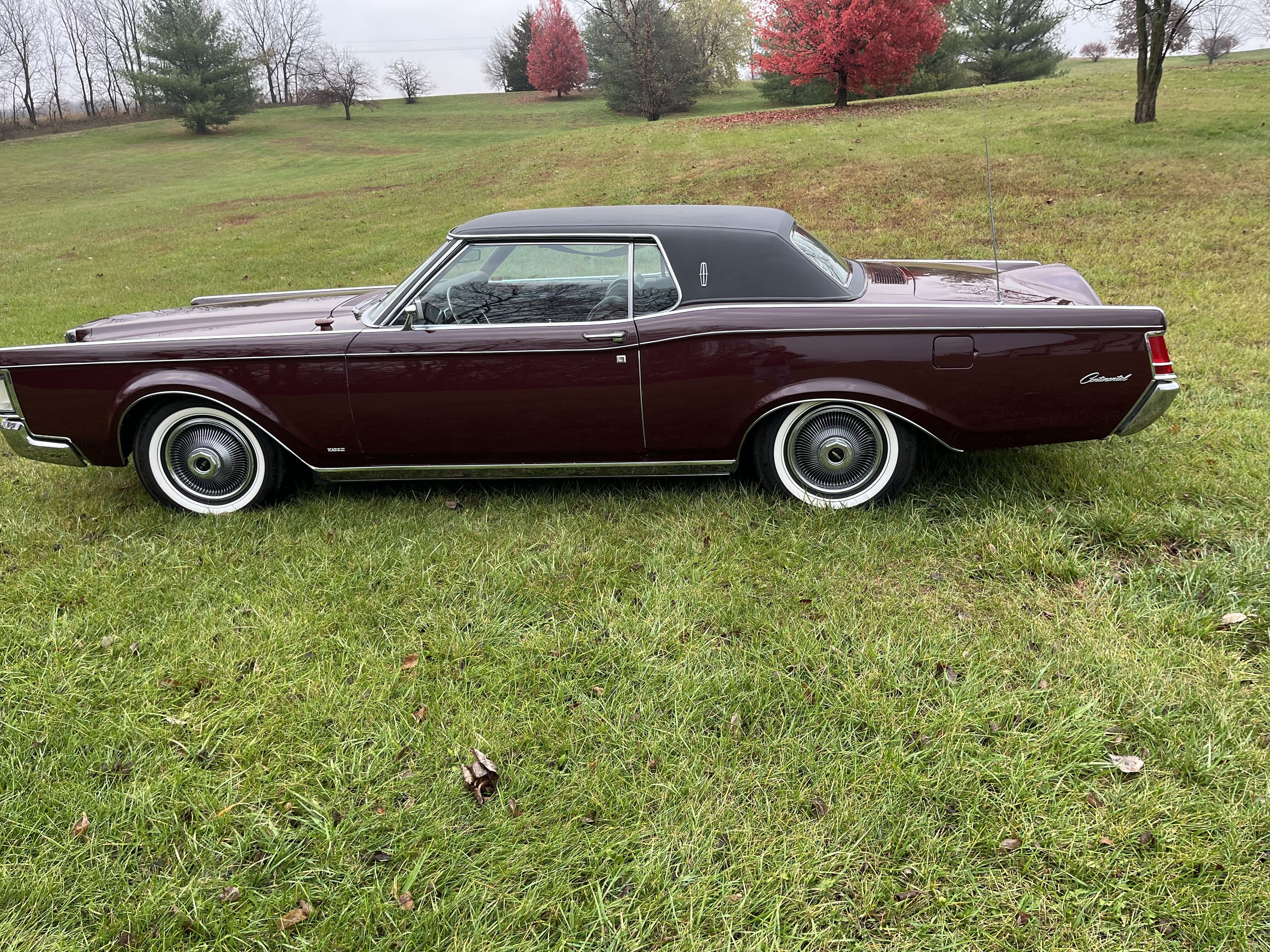
The 1969 Lincoln Mark III stands as a defining monument of American automotive design, pairing a commanding exterior profile with a massive 460-cubic-inch V8 engine to define the personal luxury car segment of its era. Developed under the direction of Ford Motor Company Vice President Lee Iacocca and Chief Stylist Elwood Engel, this two-door coupe was engineered to directly challenge Cadillac’s dominance in the high-end luxury market by offering understated elegance, meticulous craftsmanship, and effortless highway performance.
Origins and Development of the Mark III Concept
The lineage of the Lincoln Continental Mark series traces back to the ultra-exclusive 1956–1957 Continental Mark II, a handcrafted status symbol that famously lost money for Ford on every unit produced. Following the success of the unibody Continental four-door sedans and convertibles of the early 1960s, Ford executives recognized a growing demand among affluent buyers for a distinct, prestigious personal luxury coupe.
By the mid-1960s, Elwood Engel and his design team began translating European grand touring cues into an American idiom. Rather than developing an entirely new platform from scratch, the engineering team smartly utilized a modified version of the Ford Thunderbird chassis. This sharing of architecture allowed Ford to pour resources into the vehicle's unique bodywork, acoustic insulation, and interior appointments while maintaining strict structural rigidity. The result was a platform that provided a peerless ride quality without the astronomical development costs that plagued the original Mark II.
The vehicle made its debut in April 1968 as a 1969 model, instantly capturing the attention of affluent consumers, celebrities, and industrialists. It arrived at a time when American manufacturing was reaching peak confidence, and its introduction effectively created a lucrative new tier of personal luxury automobiles that prioritized driver comfort, road presence, and exclusivity over sheer seating capacity.
Exterior Styling and Distinctive Design Cues
Visually, the 1969 Lincoln Mark III is defined by sharp, clean-cut lines, a long hood, and a short deck that emphasized classic proportions. Unlike the flamboyant tailfins and excessive chrome plating found on many late-1960s competitors, the Mark III relied on architectural mass and precise detailing to convey authority.
| Design Element | Description & Purpose |
|---|---|
| Radiator-Style Grille | Vertical, upright chrome grille modeled after classic Rolls-Royce motorcars to project formal prestige. |
| Dummy Continental Tire Hump | Embossed rear trunk lid contour mimicking the classic rear-mounted spare tire of pre-war luxury cars. |
| Hidden Headlamps | Vacuum-operated doors that conceal quad headlights when not in use, maintaining a clean front fascia. |
| Opera Windows | Small, oval rear side windows that enhance cabin privacy and establish a formal roofline aesthetic. |
The most prominent styling feature is the upright radiator-style chrome grille, flanked by concealed headlamps that open automatically when the driver turns on the headlights. This dramatic front end flows into slab-sided body panels free of unnecessary ornamentation, interrupted only by subtle wheel-lip moldings and standard vinyl roof coverings. At the rear, the trunk lid featured a distinctive vertical stamping that mimicked the traditional Continental spare tire carrier, a design touch that became an enduring signature of the Mark series.
Powertrain and Mechanical Specifications
Beneath the expansive hood of the 1969 Lincoln Mark III lies a powerhouse designed specifically for effortless, high-speed cruising. The engine bay housed a newly developed 460-cubic-inch (7.5-liter) 385-series V8 engine, which replaced older MEL engine families.
| Specification | Detail |
|---|---|
| Engine Type | 460 cu in (7.5 L) Ford 385-series OHV V8 |
| Induction | Ford Motorcraft 4-barrel carburetor |
| Power Output | 365 gross horsepower at 4,600 RPM |
| Torque | 500 lb-ft at 2,800 RPM |
| Transmission | C6 3-speed automatic |
| Curb Weight | Approximately 4,800 lbs |
This heavy-duty powerplant generated an impressive 365 horsepower and a massive 500 lb-ft of torque at a low 2,800 RPM. This immense torque curve allowed the nearly 5,000-pound coupe to accelerate from a standstill with supreme authority and pass highway traffic with minimal throttle input. Power was routed through a durable Ford C6 three-speed automatic transmission to a conventional rear axle, typically equipped with a highway-friendly gear ratio optimized for serene, low-RPM cruising.
The chassis utilized independent front suspension with coil springs, upper and lower control arms, and a heavy stabilizer bar, paired with a live rear axle and three-link coil-spring setup. Power steering and power-assisted front disc brakes—a notable safety and performance upgrade for American luxury cars of the era—came standard, ensuring the heavy coupe could be managed with minimal driver effort.
Interior Luxury, Amenities, and Craftsmanship
Stepping inside the cabin of a 1969 Lincoln Mark III revealed an interior designed to evoke a private executive study or a luxury hotel suite. Ford engineers placed a heavy emphasis on sound deadening, utilizing thick acoustic glass, extensive fiberglass insulation, and specialized body-mount bushings to isolate passengers from road noise and engine vibration.
The dashboard featured a distinctive simulated walnut or optional genuine wood appliqué, housing clear analog gauges, climate controls, and an optional AM/FM stereo radio with an 8-track tape player integrated into the center console. A standout feature of the instrument panel was the genuine Cartier-signed analog clock mounted prominently in the center of the dash, reinforcing the vehicle's high-end market positioning.
Seating options included plush Twin Comfort Lounge seats with individual center armrests, upholstered in either premium leather or patterned nylon cloth. Deep-pile carpeting, courtesy lights throughout the cabin, and power-operated windows and door locks underscored the comprehensive standard equipment list. Automatic temperature control, introduced earlier in the decade by Ford, allowed occupants to set a specific cabin climate that the system maintained automatically regardless of external weather conditions.
Market Reception and Commercial Impact
Upon its release, the 1969 Lincoln Mark III achieved immediate commercial success, comfortably outselling its primary rival, the Cadillac Eldorado, in several key metrics during its initial production run. Buyers appreciated that the Mark III offered traditional American luxury dimensions without the front-wheel-drive complexity found in contemporary Cadillac models.
The success of the Mark III not only revitalized Lincoln’s brand image but also established a profitable blueprint for Ford Motor Company. By sharing platform components while maintaining exclusive styling and interior appointments, Ford demonstrated that premium vehicles could generate substantial profit margins. This strategy laid the groundwork for subsequent generations of the Mark series, culminating in the even larger Mark IV and Mark V models of the 1970s.
Collector Status and Ownership Considerations
In the collector car market, the 1969 Lincoln Mark III is prized for its uncompromised 1960s styling, robust mechanical engineering, and relative value compared to rarer European contemporaries. Because these vehicles were built to high standards using durable mechanical components, many examples survive in sound condition.
Key Inspection Areas for Prospective Buyers
- Rust and Structural Integrity: While heavy gauge steel provides durability, lower quarter panels, floor pans, trunk floors, and the frame rails surrounding the rear wheels require careful inspection for corrosion.
- Vacuum Accessories: The hidden headlamps, hidden windshield wipers, and door locks rely on engine vacuum. Ensuring the rubber lines and vacuum motors are intact is essential for proper operation.
- Electrical Systems: Power windows, seat motors, and the complex automatic climate control system require verification to avoid costly electrical repairs.
- Cooling System: The high-output 460 V8 generates substantial heat; ensuring the radiator, water pump, and fan clutch are in top condition is vital for reliable operation in modern traffic.
Frequently Asked Questions
What engine came standard in the 1969 Lincoln Mark III?
The 1969 Lincoln Mark III came standard with a 460-cubic-inch (7.5-liter) Ford 385-series V8 engine. It produced 365 gross horsepower and 500 lb-ft of torque, providing smooth, effortless acceleration suited for high-speed grand touring.
How does the 1969 Mark III differ from the Cadillac Eldorado of the same year?
While both cars competed in the personal luxury coupe segment, the 1969 Mark III used a traditional front-engine, rear-wheel-drive layout based on a modified Thunderbird chassis. In contrast, the Cadillac Eldorado utilized a front-wheel-drive platform. The Mark III also featured a distinctive upright Rolls-Royce-inspired grille and a simulated spare tire hump on the trunk.
Did the 1969 Lincoln Mark III have front disc brakes?
Yes, power-assisted front disc brakes were standard equipment on the 1969 Lincoln Mark III, paired with rear drum brakes. This setup provided significantly improved stopping power and fade resistance compared to standard four-wheel drum systems of the era.
Where is the Cartier clock located in a 1969 Mark III?
The genuine Cartier-signed analog clock is mounted prominently in the center of the dashboard wood-grain panel, positioned between the primary instrument cluster and the passenger side air vents, serving as a focal point of the interior luxury appointments.
Conclusion and Next Actions
The 1969 Lincoln Mark III remains a pinnacle of late-1960s American automotive engineering, combining striking proportions, a potent 460 V8 powertrain, and a lavishly appointed cabin. For enthusiasts and collectors looking to acquire or maintain one of these classic personal luxury coupes, the primary next steps involve verifying structural integrity, testing all vacuum and electrical accessories, and joining dedicated marque registries such as the Lincoln and Continental Owners Club (LCOC) for technical support and parts sourcing.