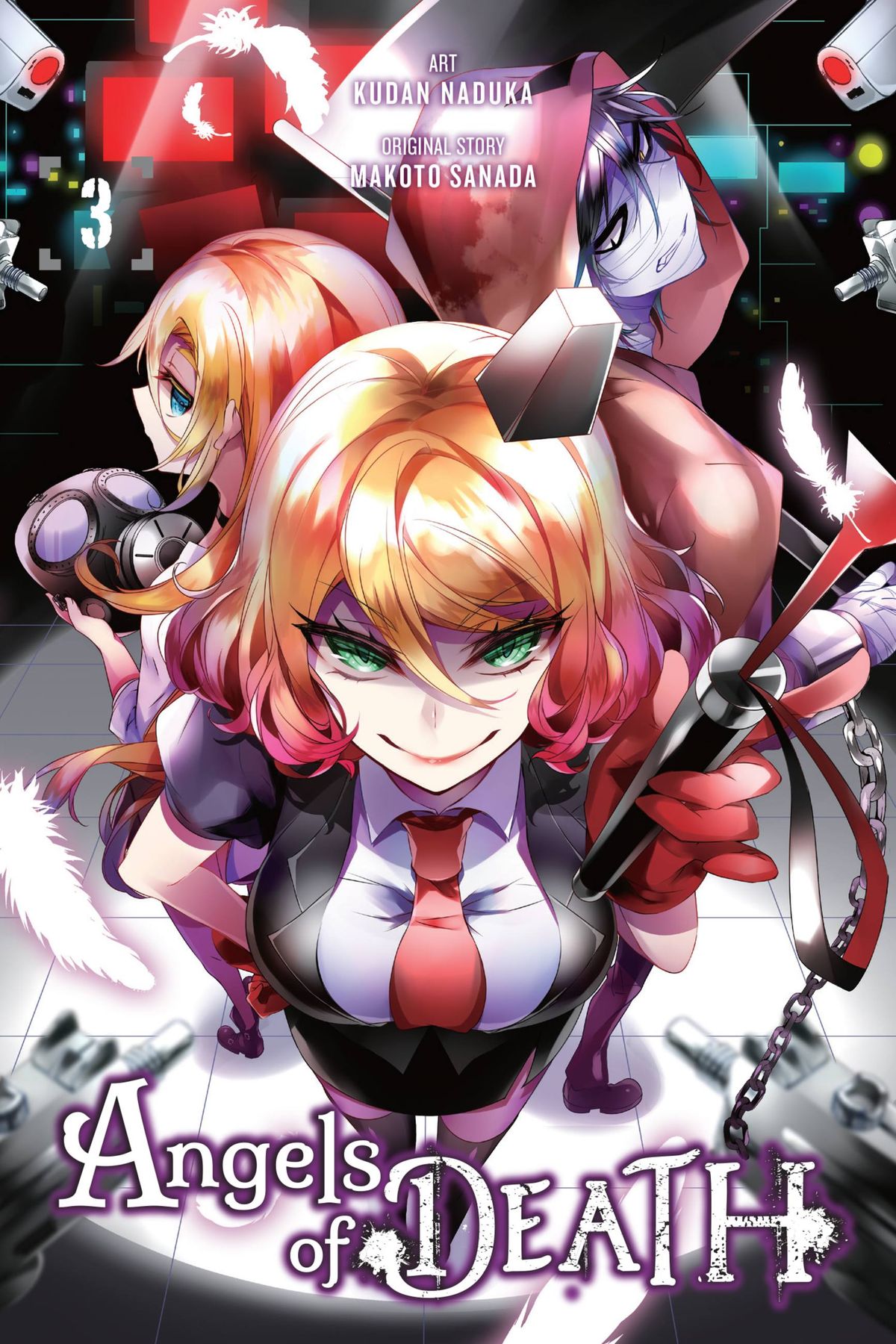
The plot of Angels of Death (Satsuriku no Tenshi) follows 13-year-old Rachel Gardner and serial killer Isaac "Zack" Foster as they attempt to escape a lethal, floor-based underground facility. Bound by a macabre pact—where Zack promises to kill Rachel if she helps him escape—the duo confronts a series of "Floor Masters" who challenge their morality, sanity, and distorted perceptions of God.
Originally a psychological horror adventure game developed by Hoshizuku Kuzu (Makoto Sanada) using RPG Maker, Angels of Death has since expanded into a multi-media franchise including manga, light novels, and a popular 16-episode anime. As of 2026, the series remains a cornerstone of the psychological horror genre, praised for its dark atmosphere and the complex, trauma-bonded relationship between its two protagonists. Understanding the plot requires looking past the surface-level violence to the deep-seated psychological scars that define each character.
The Premise: The Basement of Judgment
The story begins with Rachel "Ray" Gardner waking up in the basement of a mysterious building with no memory of how she arrived. The facility is structured like a vertical gauntlet: each floor (from B6 to B1) is the domain of a "Floor Master" who has complete control over their territory. Anyone who enters a floor they do not belong to is designated as "sacrificed," giving the Floor Master the right to hunt and kill them.
Rachel initially encounters Zack on Floor B6. Zack is a bandage-wrapped killer armed with a scythe, driven by a simple, primal urge to kill anyone who shows fear or "sparkle" in their eyes. However, the dynamic shifts when Rachel reaches Floor B5 and encounters her therapist, Dr. Danny. After a traumatic realization regarding her parents, Rachel loses her "sparkle"—her will to live and her emotional reactivity.
This change confuses and repulses Zack. He finds no joy in killing someone who is already "dead" inside. This leads to the central conflict and the driving force of the narrative: Rachel wants to die but believes she needs a "God" or an outside force to grant her that wish, while Zack needs Rachel’s intelligence to navigate the building’s puzzles. They form a vow: if Rachel helps Zack escape to the surface, Zack will be the one to kill her.
The Floor Masters: A Hierarchy of Madness
To understand the plot's progression, one must analyze the individual trials Ray and Zack face. Each floor represents a different form of psychological obsession or moral failing, curated by the building's architect, Father Gray.
Floor B6: Isaac Foster (The Hunter)
Zack’s floor is a grimy, blood-spattered labyrinth. Zack represents pure, unadulterated destruction. Unlike the other masters, he has no complex ideology or aesthetic preference; he kills because it is the only way he knows how to interact with a world that abandoned him in an orphanage. His abandonment of his floor to follow Rachel is the first "sin" against the building's rules.
Floor B5: Daniel Dickens (The Obsessor)
Dr. Danny is Rachel’s therapist, but his care is a mask for a grotesque obsession with eyes. Having been born without one eye, he is fixated on "perfect" eyes that reflect the soul. He views Rachel as his ideal because of her "dead" eyes. His floor serves as the catalyst for Rachel’s psychological shutdown, as he forces her to confront the reality of what happened to her parents.
Floor B4: Edward Mason (The Gravedigger)
Eddie is a young boy who wears a burlap mask and maintains the building’s gardens and graves. He falls in love with Rachel, not out of romance, but out of a desire to own her by killing her and burying her in a beautiful grave. He represents the theme of "possessive love." He offers Rachel a peaceful death, but she rejects him because of her vow to Zack, establishing that her bond with Zack is not about the act of dying, but about the person who performs it.
Floor B3: Catherine Ward (The Condemner)
Cathy, known as "The Punisher," views herself as a judge. Her floor is a high-tech torture chamber where she forces "sinners" to undergo painful trials. She is obsessed with the concept of sin and punishment, believing that she is the only one righteous enough to deliver justice. Her confrontation with Ray and Zack tests the physical limits of their partnership, particularly when she forces them into a room with poisonous gas and a single syringe of antidote.
Floor B2: Father Gray (The Architect)
Father Gray is a priest who views the entire building as a religious experiment. He considers himself a proxy for God, observing how the "angels" (Floor Masters) interact with the "sacrifices." Gray is the most dangerous antagonist because he attacks the characters' souls rather than their bodies. He uses hallucinogenic incense to force Rachel to confront her own "godhood" and the selfishness of her desires.
Rachel Gardner’s Past: The "Secret" of Floor B1
The most significant plot twist occurs on Floor B1, which is revealed to be Rachel’s own floor. Throughout the journey, Rachel is portrayed as an innocent victim, but the final act reveals a much darker truth.
Rachel was raised in a violent household. Her father was abusive, and her mother was neglectful. One night, after her father murdered her mother, Rachel killed her father with a handgun. Traumatized and desperate for a "perfect family," Rachel used her skills in taxidermy—taught to her through her hobbies—to sew her parents back together, creating "dolls" that would never leave her or hurt her again.
This act of "fixing" things is Rachel’s core trauma. When she was brought to the facility, Father Gray saw her potential as a Floor Master because of her total lack of traditional morality and her desire to create her own "God." Rachel’s wish for Zack to kill her is not just a suicidal urge; it is a religious obsession. She views Zack as her "God" because he is the only one who can deliver the finality she believes she deserves.
| Floor | Master | Theme | Primary Weapon/Method |
|---|---|---|---|
| B6 | Isaac Foster (Zack) | Survival/Impulse | Scythe / Physical Prowess |
| B5 | Daniel Dickens (Danny) | Obsession/Voyeurism | Surgical Tools / Psychological Manipulation |
| B4 | Edward Mason (Eddie) | Possession/Infatuation | Shovel / Graveyard Traps |
| B3 | Catherine Ward (Cathy) | Judgment/Sadism | Electricity / Torture Devices |
| B2 | Father Gray | Faith/Experimentation | Hallucinogens / Authority |
| B1 | Rachel Gardner | Self-Deception/Fixation | Handgun / Taxidermy/Sewing |
The Meaning of the Vow
The phrase "Please, kill me" is often misinterpreted as a simple request for euthanasia. However, within the context of Angels of Death, the vow is a complex contract of mutual recognition.
For Zack, the vow represents a human connection. He was raised as a "tool" and later lived as a "monster." By making a promise to Rachel, he enters into a social contract for the first time in his life. He stops killing randomly and starts killing with "purpose."
For Rachel, the vow is an anchor to reality. She is prone to dissociation and hallucinations. By placing her life in Zack's hands, she creates a version of "God" that is tangible and honest. Unlike the "God" Father Gray preaches or the "perfect parents" she tried to sew together, Zack is brutally real. He doesn't lie, and he doesn't pretend to be righteous. This honesty is what Rachel clings to.
The Ending Explained: Fact vs. Interpretation
The ending of Angels of Death is famously ambiguous and continues to be debated by fans in 2026. After Zack and Rachel escape the building, it is set on fire and destroyed. Zack is eventually captured by the police and sentenced to death for his past murders and the kidnapping of Rachel. Rachel is sent to a mental health facility to be "rehabilitated."
In the final scene, Zack escapes from prison (or perhaps he was never captured, depending on the interpretation of the timeline) and breaks into Rachel’s room at the hospital. He is carrying his scythe, which was previously broken. He tells Rachel, "Don't cry anymore. Smile." They jump out of the window together as the police arrive.
The Realistic Interpretation
One theory suggests that Zack truly did escape and came to fulfill his promise. In this version, the two of them likely died together or entered a life on the run. The broken scythe being "whole" again is often cited as a flaw in this theory, unless Zack found a replacement or the visual is symbolic.
The Hallucinatory Interpretation
Another theory posits that Rachel, unable to cope with Zack’s impending execution, suffered a final psychotic break. In this version, Zack did not break into the room; Rachel hallucinated him. The blood found on the windowsill in the aftermath could be Rachel’s own blood from self-harm or the act of jumping alone. This interpretation aligns with the series' focus on Rachel’s unstable mental state and her history of creating "ideal" versions of reality when the truth is too painful.
The Symbolic Interpretation
The most widely accepted view is that the ending is intentionally metaphorical. Whether Zack was physically there or not matters less than the fact that Rachel died "believing" in her God. The window represents the final barrier between the "building" (their trauma) and "freedom" (death/the afterlife). By jumping, they are both finally free from the roles the world forced upon them.
The Role of Father Gray’s Theology
Father Gray serves as the philosophical backbone of the plot. He explains that the facility was designed to see if humans could create their own "Gods" through extreme circumstances. He views Zack as a "pure" being because Zack does not hide his nature.
Gray eventually realizes that the bond between Ray and Zack has surpassed his experiment. They didn't just become "angels" or "sacrifices"; they became human to one another. This realization leads Gray to assist them in the final moments, suggesting that even his rigid, cruel theology was moved by the sincerity of their macabre vow.
Frequently Asked Questions
Why did Rachel Gardner kill her parents?
Rachel killed her parents in a moment of extreme trauma and self-defense. Her father had just murdered her mother and was turning on her. However, her subsequent actions—sewing them together—revealed a deep-seated psychological need to "fix" her broken reality and create a perfect, unchanging family environment.
Is Zack a hero or a villain?
Zack is an anti-villain. While he is a serial killer who has committed horrific crimes, he is portrayed with empathy as a victim of extreme childhood abuse and abandonment. He lacks a traditional moral compass, but he possesses a fierce sense of honesty. He does not kill Rachel because he respects the "humanity" she shows him, making him a protagonist but not a "hero" in the traditional sense.
What is the significance of the "Blue Moon"?
The blue moon is a recurring visual motif that signals a shift in Rachel’s perception. It often appears when the line between reality and her internal "God" becomes blurred. It represents the "unnatural" state of her world and the facility.
How does the manga ending differ from the anime?
The manga and the anime both follow the same general path to the ambiguous window scene. However, the manga provides more internal monologue from Rachel, further emphasizing her obsession with the "God" she found in Zack. The RPG Maker game is the most explicit about the "puzzles," while the anime focuses more on the cinematic tension of the Floor Master encounters.
What happened to the other Floor Masters?
Danny was shot multiple times but survived long enough to attempt to stop Ray and Zack at the very end before presumably perishing in the building's fire. Eddie was killed by Zack. Cathy was shot by Zack and then finished off by him during her own "judgment" game. Father Gray’s fate is left somewhat open, though he is seen remaining in the burning building, accepting his "judgment" as the architect of the madness.
Final Recommendation
For those who have completed the series and are looking for more context, the prequel manga and light novel series, Angels of Death Episode 0, is highly recommended. It provides the essential backstories for the Floor Masters, explaining how Father Gray recruited Danny, Cathy, and Eddie, and the specific tragedies that led them to the facility. This context enriches the main plot by showing that Ray and Zack were not the only ones broken by the world—they were simply the only ones who found a way to rely on each other to escape it.