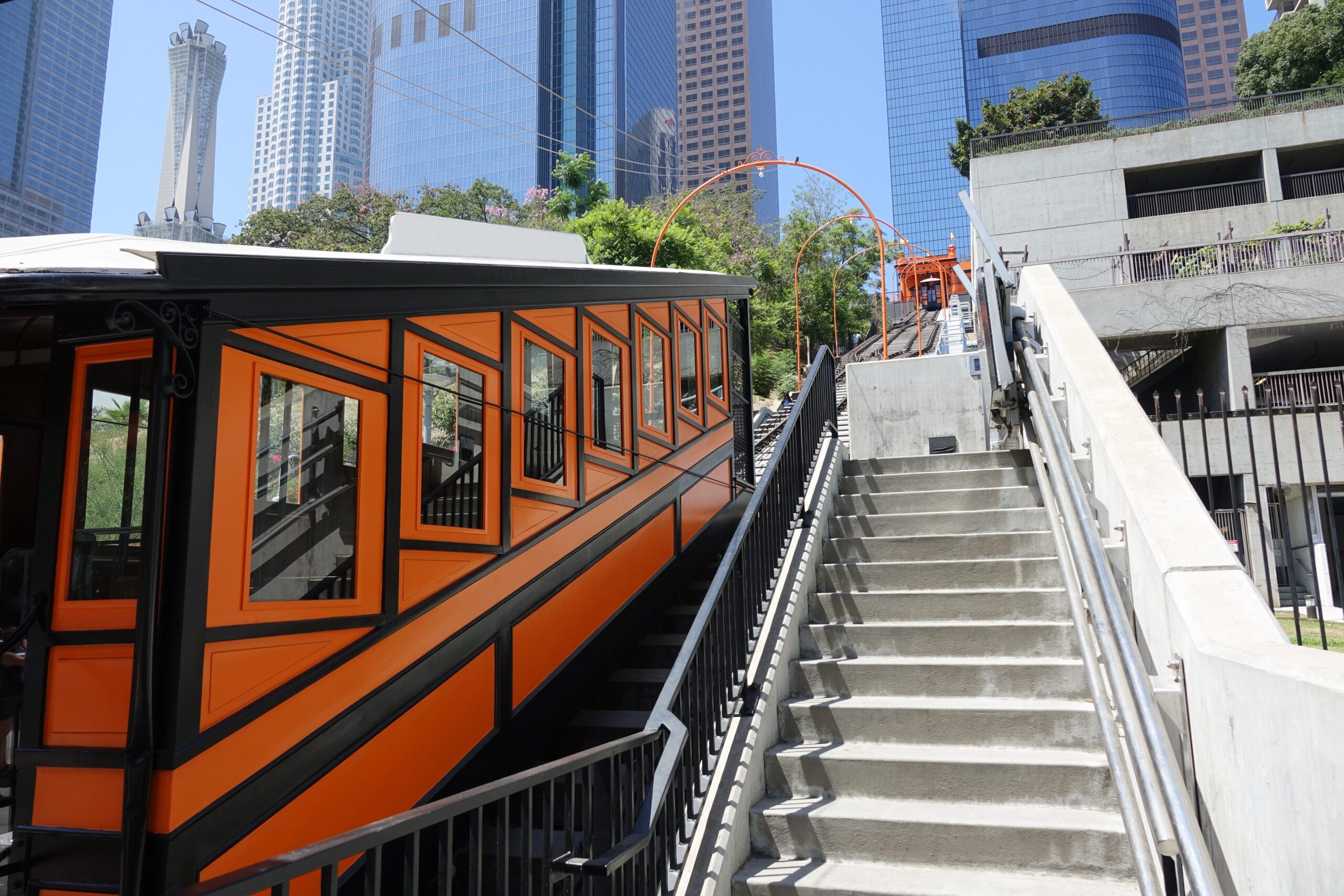
Angels Flight is a historic narrow-gauge funicular railway located in the Bunker Hill district of Downtown Los Angeles. Carrying passengers between Hill Street and Olive Street on a 298-foot track, it serves as both a functional transit link and a cherished cultural landmark, having operated sporadically since 1901.
The Essence of Angels Flight: A Los Angeles Icon
To understand Angels Flight is to understand the soul of Downtown Los Angeles (DTLA). Often called "The World's Shortest Railway," this funicular is more than just a tourist attraction; it is a survivor of the city’s massive urban shifts. As of 2026, it remains a vital connection between the historic core and the modern heights of Bunker Hill.
The railway consists of two iconic orange-and-black wooden cars named Sinai and Olivet. These cars travel in opposite directions on a single track that splits into a passing loop in the middle. The journey is brief—lasting roughly 60 seconds—but it offers a tangible link to a version of Los Angeles that existed before the era of freeways and glass skyscrapers.
The primary purpose of Angels Flight is to negotiate the steep 33% grade of Bunker Hill. In the early 20th century, this hill was an elite residential enclave, and the railway spared residents the arduous climb of several flights of stairs. Today, it serves commuters moving between the Metro Red Line station at Pershing Square and the corporate towers or museums atop the hill, such as The Broad and MOCA.
The Historical Timeline: From 1901 to 2026
The history of Angels Flight is a saga of relocation, closure, and resurrection. Understanding its timeline is essential for appreciating why the structure is so fiercely protected by locals and historians alike.
The Eddy Era and Early Success
The railway was the brainchild of Colonel J.W. Eddy, a lawyer and engineer who saw the need for a mechanical lift for the residents of Bunker Hill. It opened on December 31, 1901. At that time, Bunker Hill was filled with Victorian mansions. The railway was an immediate success, charging just a penny per ride. It originally sat half a block north of its current location, connecting Hill Street to Olive Street at a slightly different angle.
The 1969 Dismantling and Dormancy
By the mid-20th century, Bunker Hill had transitioned from a wealthy neighborhood to a neglected area of rooming houses. The city embarked on a massive "urban renewal" project, which involved leveling the hill’s peaks and demolishing almost every historic structure. In 1969, Angels Flight was dismantled. The cars were placed in storage, with the city promising they would be restored within two years.
That "two-year" promise stretched into twenty-seven. Sinai and Olivet sat in a warehouse while the landscape of Downtown Los Angeles was fundamentally reshaped into the financial hub it is today.
The 1996 Reopening and Relocation
After decades of advocacy from the Los Angeles Conservancy and railway enthusiasts, Angels Flight was finally rebuilt and reopened in 1996. However, it was not placed in its original footprint. It was relocated half a block south to its current position across from Grand Central Market. This move was necessary because the original site had been built over by modern development.
Modern Challenges and Safety Upgrades
The 21st century brought significant hurdles. A fatal accident in 2001 and a minor derailment in 2013 led to long-term closures. These incidents were primarily attributed to mechanical failures in the braking system and the bypass of safety protocols.
The railway underwent a massive $5 million modernization in 2017, involving the ACS Group and the Angels Flight Railway Foundation. This included the installation of an emergency end-to-end walkway, advanced electronic braking systems, and updated drive motors. These improvements have ensured that the railway meets 2026 safety standards while maintaining its 1901 aesthetic.
Technical Specifications and Engineering
The engineering of Angels Flight is a classic example of a funicular. Unlike a standard train that uses its own engine to turn its wheels, a funicular uses a cable system where two cars act as counterweights to one another.
The Counterweight System
When Sinai moves down the hill, its weight helps pull Olivet up. This makes the system incredibly energy-efficient. The motor located at the top station (Olive Street) provides the extra force needed to overcome friction and the weight of the passengers.
Track Geometry
The track uses a three-rail system for the majority of the run. In the middle of the 298-foot journey, the track expands into four rails, creating a "passing loop" or "turnout." This allows the two cars to pass each other safely without the need for complex moving switches.
Component Breakdown
| Feature | Specification |
|---|---|
| Length of Track | 298 feet (approx. 91 meters) |
| Gradient | 33% incline |
| Car Names | Sinai and Olivet |
| Material | Wood (Cedar and Maple) with metal chassis |
| Capacity | Approximately 20-25 passengers per car |
| Operational Speed | 3.5 miles per hour |
| Year of Landmark Status | 1952 (Los Angeles Historic-Cultural Monument #4) |
Visitor Information: Practical Guidance for 2026
If you are planning to ride Angels Flight in 2026, there are several logistical details to keep in mind. Despite being a historical monument, it remains an integrated part of the city's transit network.
Location and Access
- Lower Station: 351 South Hill Street, Los Angeles, CA 90013. This is directly across from the famous Grand Central Market.
- Upper Station: California Plaza, 350 South Olive Street. This puts you within walking distance of the Walt Disney Concert Hall and the Omni Hotel.
Pricing and Fare Payment
As of early 2026, the standard fare for a one-way trip is $1.00. However, the railway offers a discount for users of the Los Angeles Metro TAP card. If you use a loaded TAP card, the fare is typically reduced to $0.50. Tickets can be purchased at the top station (Olive Street) either before or after your ride. There are no "round trip" tickets per se; you simply pay for each leg of the journey.
Hours of Operation
Angels Flight typically operates 365 days a year, including holidays. Standard hours are from 6:45 AM to 10:00 PM. However, it is always wise to check for temporary maintenance closures, which are often posted on the official Angels Flight social media channels or the foundation's website.
Cultural Impact and Media Presence
Angels Flight is perhaps the most filmed funicular in the world. Its distinct orange cars provide a "noir" atmosphere that has been utilized by filmmakers for over a century.
- Classic Noir: The railway appeared in 1950s classics like The Turning Point and Criss Cross, often symbolizing the gritty, vertical nature of the old Bunker Hill.
- Modern Cinema: Most famously in recent years, it was featured in the 2016 musical La La Land. The scene featuring Ryan Gosling and Emma Stone on the railway led to a massive resurgence in public interest, which helped fund the 2017 reopening.
- Television and Literature: It plays a recurring role in Michael Connelly’s Harry Bosch novels (and the subsequent TV series) and was a central location in the HBO revival of Perry Mason.
For many, riding the railway is an attempt to capture the "Old Hollywood" or "Vintage LA" aesthetic. Photographers frequently gather at the Hill Street entrance to capture the cars as they pass each other in the center of the track.
Why Does Angels Flight Matter?
One might wonder why the city maintains a 298-foot railway when there are modern elevators and escalators nearby (such as those in California Plaza). The answer lies in the concept of historic preservation as identity.
Downtown Los Angeles spent much of the late 20th century trying to erase its past to make room for the future. Angels Flight is one of the few surviving pieces of the original Bunker Hill. It serves as a reminder of the city's Victorian roots and its early attempts at solving urban transit issues. It also acts as a "human-scale" intervention in an area dominated by massive concrete plazas and steel towers.
Furthermore, the railway is a registered National Historic Landmark. This status provides it with legal protections that ensure it cannot be easily removed or altered, preserving the skyline of the Hill Street corridor for future generations.
Common Mistakes and Troubleshooting
When visiting Angels Flight, tourists often encounter a few common points of confusion:
- Thinking it’s a "loop": The railway does not go around. It is a straight line up and down. If you want to return to your starting point, you must wait for the car to head back or walk the nearby stairs.
- Payment Confusion: You do not need a ticket to board at the bottom (Hill Street). You board the car, ride to the top, and pay the attendant at the Olive Street station. If you board at the top, you pay before entering the car.
- Accessibility: While the 2017 renovations improved many things, the cars themselves are historic wooden structures with narrow doors and steps. Large motorized wheelchairs may face limitations, though the staff generally assists where possible. For full ADA access to the top of the hill, there are modern elevators located within the adjacent California Plaza.
- The Stairs: If the line for the railway is too long, there is a public staircase immediately adjacent to the tracks. It is a steep climb but offers great views of the cars in motion.
Frequently Asked Questions
Is Angels Flight the same as a cable car?
Not exactly. While both use cables, a cable car (like those in San Francisco) clamps onto a constantly moving cable beneath the street. A funicular, like Angels Flight, has the cable permanently attached to the cars, which act as counterweights to each other.
How long does the ride take?
The actual travel time is approximately 50 to 60 seconds. However, with boarding and unloading, the entire process takes about 3 to 5 minutes.
Can I take my pet on Angels Flight?
Small pets in carriers are generally allowed. Service animals are permitted according to ADA guidelines. Large dogs that are not service animals are typically not permitted due to the small, enclosed nature of the cars.
Why is it called "Angels Flight"?
The name was chosen by Colonel Eddy to reflect the "heavenly" heights of Bunker Hill compared to the bustling, often dirty streets of the lower business district in 1901.
Has anyone ever lived in the cars?
No, the cars have always been for transit only. However, during the period when the railway was dismantled (1969–1996), the cars were stored in a warehouse, and there were several humorous local legends about "ghost passengers" waiting for the cars to return.
What is the best time to visit?
To avoid crowds, visit on a weekday morning. For the best photography, the "Golden Hour" (just before sunset) provides beautiful light hitting the orange paint of the cars against the backdrop of the DTLA skyline.
Practical Recommendation
If you are visiting Angels Flight in 2026, pair the experience with a visit to Grand Central Market across the street. Grab a coffee or a meal at the market, then use your Metro TAP card for a discounted 50-cent ride up to Bunker Hill. Once at the top, walk two blocks north to see the Walt Disney Concert Hall or visit The Broad museum. This sequence offers the perfect blend of Los Angeles history, culinary culture, and modern art, all within a three-block radius.