Mold remediation is a comprehensive professional process designed to identify, contain, and eliminate fungal growth within a structure while restoring indoor air quality to safe levels. It involves adhering to the IICRC S520 standard, utilizing specialized high-efficiency particulate air (HEPA) filtration, and addressing the underlying moisture source to prevent recurrence and ensure long-term structural health.
The Evolution of Mold Remediation Standards in 2026
As of 2026, the landscape of mold remediation has shifted toward a more integrated, data-driven approach. While the core biological principles of mold growth remain unchanged, the standards for addressing it have become more rigorous. The primary governing document remains the IICRC S520 Standard for Professional Mold Remediation, which is now in its latest revised edition. This standard emphasizes that "killing" mold with biocides is insufficient; the physical removal of the mold spores and the contaminated materials is the only way to ensure a truly remediated environment.
The shift in 2026 focuses heavily on the distinction between "remediation" and "cleaning." Cleaning is a surface-level activity, whereas remediation is a structural and environmental intervention. This distinction is vital for property owners to understand, especially regarding liability and health. In modern building science, we recognize three distinct "Conditions" of indoor environments:
- Condition 1 (Normal): An indoor environment that may contain settled spores but is otherwise typical.
- Condition 2 (Settled Spores): An environment contaminated with settled spores or fragments that were dispersed from a Condition 3 area.
- Condition 3 (Actual Growth): An environment with active or visible fungal growth.
Professional remediation aims to return a Condition 3 or Condition 2 environment back to Condition 1.
The Core Prerequisites: Moisture Control and Assessment
Before a single piece of drywall is cut or a vacuum is turned on, a successful remediation project requires two critical prerequisites: a definitive moisture solution and a professional assessment.
Identifying and Fixing the Moisture Source
Mold cannot survive without moisture. Whether it is a slow pinhole leak in a copper pipe, hydrostatic pressure in a basement, or high relative humidity (above 60%) due to an undersized HVAC system, the water source must be eliminated. In 2026, professionals use advanced moisture meters and FLIR (Forward-Looking Infrared) thermal imaging cameras to "see" behind walls and identify moisture pockets that are invisible to the naked eye. If remediation proceeds while the leak persists, the mold will inevitably return within 24 to 48 hours.
The Role of the Industrial Hygienist (IH)
For large-scale projects or those involving sensitive occupants (such as individuals with respiratory issues or CIRS—Chronic Inflammatory Response Syndrome), it is standard practice in 2026 to hire a third-party Industrial Hygienist or Mold Assessment Consultant. This professional provides an unbiased protocol for the remediation company to follow and performs the Post-Remediation Verification (PRV). Maintaining a "firewall" between the testing company and the remediation company is essential to prevent conflicts of interest.
The Comprehensive 7-Step Mold Remediation Process
The following steps represent the industry-standard workflow for a professional "all-in-one" remediation project. Each step is designed to prevent cross-contamination, which is the most common mistake in DIY attempts.
1. Project Documentation and Initial Containment
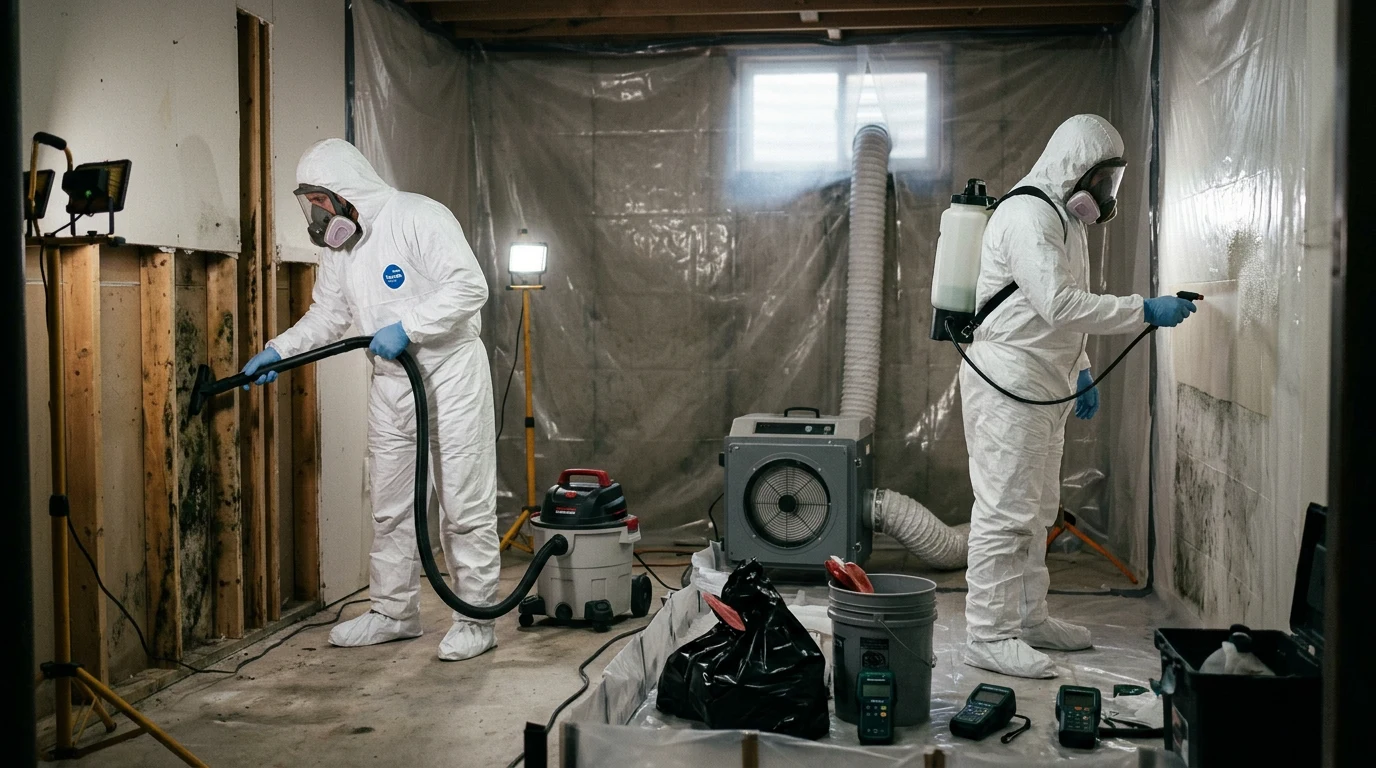
Upon arrival, technicians document the current state of the property with photos and moisture readings. Containment is then established. This usually involves 6-mil polyethylene sheeting to seal off the affected area from the rest of the house. In 2026, "critical barriers" are used to seal HVAC vents, doors, and any gaps where air could escape.
2. Establishing Negative Air Pressure
This is perhaps the most technical aspect of remediation. An air scrubber equipped with HEPA filtration is used to pull air out of the containment zone and exhaust it outside. This creates a vacuum effect (negative pressure), ensuring that if a seal in the plastic sheeting fails, air rushes into the contaminated zone rather than blowing spores out into the clean areas of the home.
3. High-Efficiency Air Filtration
Air scrubbers run continuously throughout the project. These machines are designed to cycle the air in the room multiple times per hour (Air Changes per Hour, or ACH). In 2026, HEPA filters are required to capture 99.97% of particles down to 0.3 microns, which includes the vast majority of mold spores and fragments.
4. Removal of Contaminated Materials
Materials are categorized by their porosity:
- Porous (Category 3): Drywall, insulation, and carpeting. These usually cannot be cleaned effectively and must be removed.
- Semi-Porous (Category 2): Solid wood and concrete. These can often be saved through intensive cleaning methods like "media blasting" (using dry ice or soda) or HEPA vacuuming and sanding.
- Non-Porous (Category 1): Metal, glass, and hard plastics. These can be cleaned and sanitized.
All debris must be double-bagged before being moved through the house to the disposal site.
5. HEPA Vacuuming and Detailed Cleaning
Once the bulk materials are removed, the "fine cleaning" phase begins. Technicians use HEPA-rated vacuums on all surfaces within the containment area. This is followed by a "damp wipe" using an EPA-registered antimicrobial solution. In 2026, there is a preference for botanical-based antimicrobials, such as those derived from thymol, which provide high efficacy without the harsh chemical off-gassing of traditional biocides.
6. Professional Drying and Dehumidification
The remaining structural elements (studs, subfloors) must be dried to a "dry standard," usually below 15% moisture content for wood. Commercial-grade dehumidifiers and high-velocity air movers are used to achieve this. This step is monitored daily with moisture probes.
7. Post-Remediation Verification (PRV)
The containment remains in place until a third-party inspector clears the area. This involves a visual inspection (checking for dust and debris) and air/surface sampling. Only after the samples show that the indoor spore counts are lower than or comparable to the outdoor "baseline" samples is the containment removed.
Essential Equipment for 2026 Remediation
The technology used in mold remediation has become more specialized to ensure efficacy and worker safety.
| Equipment Type | Function | 2026 Standard Requirement |
|---|---|---|
| HEPA Air Scrubber | Filters airborne spores and creates negative pressure. | Must achieve minimum 4-6 air changes per hour (ACH). |
| Infrared (IR) Camera | Detects thermal anomalies indicating hidden moisture. | High-resolution sensors for precise leak mapping. |
| Negative Air Machine | Exhausts filtered air to the exterior of the structure. | Integrated pressure manometers for real-time monitoring. |
| Antimicrobial Fogger | Applies biocides to hard-to-reach areas/HVAC. | ULV (Ultra-Low Volume) fogging for consistent coverage. |
| Media Blaster | Removes mold from wood framing without chemicals. | Dry ice or specialized abrasive media for deep cleaning. |
| PPE (Personal Protective Equipment) | Protects technicians from spore inhalation and chemicals. | N95 or P100 respirators, Tyvek suits, and nitrile gloves. |
DIY vs. Professional Remediation: Making the Choice
A common question in 2026 is whether a homeowner can handle mold remediation themselves. The Environmental Protection Agency (EPA) provides a general guideline: if the affected area is less than 10 square feet (roughly a 3'x3' patch), it may be manageable as a DIY project. However, this assumes the mold is on a surface and not hidden within the wall cavity.
When to hire a professional:
- Size: The contamination exceeds 10 square feet.
- HVAC Involvement: If mold is suspected inside the ductwork or the air handling unit.
- Health: If any occupants have compromised immune systems or mold allergies.
- Source: If the water damage is from "black water" (sewage) or long-term flooding.
- Liability: If you are planning to sell the home, professional documentation is essential for disclosure.
DIY mistakes, such as using bleach on porous wood or running a standard household vacuum (which exhausts spores back into the air), often lead to much more expensive professional cleanups later.
Cost Estimates and Financial Considerations in 2026
The cost of mold remediation is highly variable, depending on the location, the severity of the growth, and the accessibility of the area. In 2026, the following price ranges are typical for professional services:
- Attic Remediation: $2,500 – $7,000. Costs are higher if the roof sheathing requires media blasting or if insulation removal is necessary.
- Basement or Crawl Space: $1,500 – $5,000. Crawl spaces are often more expensive due to limited access and the need for vapor barrier installation.
- HVAC and Ductwork: $2,000 – $6,000. Requires specialized equipment to clean non-porous metal ducts and often involves replacing flex ducts.
- Whole-House Remediation: $10,000 – $30,000+. This usually occurs after significant flooding or long-term abandonment.
Insurance and Mold
In 2026, most standard homeowners' insurance policies have strict limits on mold coverage, often capped at $5,000 or $10,000. Crucially, mold is generally only covered if it is the result of a "sudden and accidental" peril, such as a pipe burst. Mold resulting from lack of maintenance or high humidity is typically excluded. Always review your policy for a "Mold Endorsement" to understand your specific coverage limits.
Common Myths in Mold Remediation
As a senior technical editor, I frequently encounter misconceptions that can lead to failed remediation:
Myth: Bleach kills mold on drywall. Fact: Bleach is mostly water. On porous surfaces like drywall or wood, the chlorine stays on the surface while the water soaks in, potentially feeding the mold roots (hyphae) and allowing them to grow back deeper.
Myth: If you can’t see mold, it’s not a problem. Fact: Mold often grows behind baseboards, under vinyl flooring, and inside wall cavities. If you smell a "musty" or "earthy" odor, there is likely active growth occurring out of sight.
Myth: Ozone machines are a safe way to remove mold. Fact: While ozone can kill biological organisms, it is a lung irritant and can react with other chemicals in the home to create toxic byproducts. Furthermore, ozone does not remove the allergenic mold fragments; only physical removal and HEPA filtration can do that.
Preventive Maintenance: The Final Step
Remediation is only a temporary fix if the environment is not managed. To maintain a mold-free home in 2026:
- Maintain Humidity: Keep indoor relative humidity between 30% and 50%. Use a hygrometer to monitor this.
- Ensure Ventilation: Use exhaust fans in bathrooms and kitchens. Ensure your clothes dryer vents to the exterior.
- Routine Inspections: Check under sinks, around water heaters, and in the attic at least twice a year.
- Immediate Response: Dry any water spills or leaks within 24 to 48 hours to prevent fungal germination.
Frequently Asked Questions
Is mold remediation safe for pets?
Professional remediation is safe for pets as long as they are kept out of the containment zone. During the cleaning phase, some antimicrobials may have strong odors, but modern botanical solutions like Benefect are significantly safer than traditional chemicals. Pets should ideally stay in a separate part of the house or be boarded until the final PRV clearance is achieved.
How long does the remediation process take?
For a standard room or basement, the process typically takes 3 to 5 days. This includes the setup of containment, the physical removal of materials, the "dry time" for structural elements, and the 24-48 hours required for lab results from air sampling.
Does professional remediation guarantee mold won't return?
A professional remediation guarantees that the current mold growth has been removed and the area has been cleaned. However, it cannot prevent future mold growth if a new leak occurs or if humidity levels remain high. Mold spores are naturally occurring everywhere; the goal of remediation is to prevent them from finding a hospitable environment to grow.
Can I stay in my home during mold remediation?
In many cases, yes. If the mold is confined to one area (like a basement or a specific bathroom) and proper negative pressure containment is used, the rest of the home remains safe. However, if the HVAC system is contaminated or if the remediation covers a large percentage of the living space, relocation for a few days may be recommended for comfort and safety.
What is the difference between black mold and other types?
"Black mold" usually refers to Stachybotrys chartarum, which is known for producing mycotoxins. However, many other molds are black in color but are not Stachybotrys. Conversely, molds that are white, green, or yellow (like Aspergillus or Penicillium) can also cause significant health issues. Professional remediation treats all mold types with the same level of caution, as any indoor fungal growth is considered a contaminant.
Final Recommendation
If you suspect a mold problem in 2026, your first action should be to identify the water source. Once the leak is stopped, obtain an assessment from a certified mold professional. Do not attempt to clean large areas of mold with household chemicals, as this often aerosolizes spores and spreads the contamination. Investing in professional remediation following the IICRC S520 standards is the only verified way to protect your property value and your health.