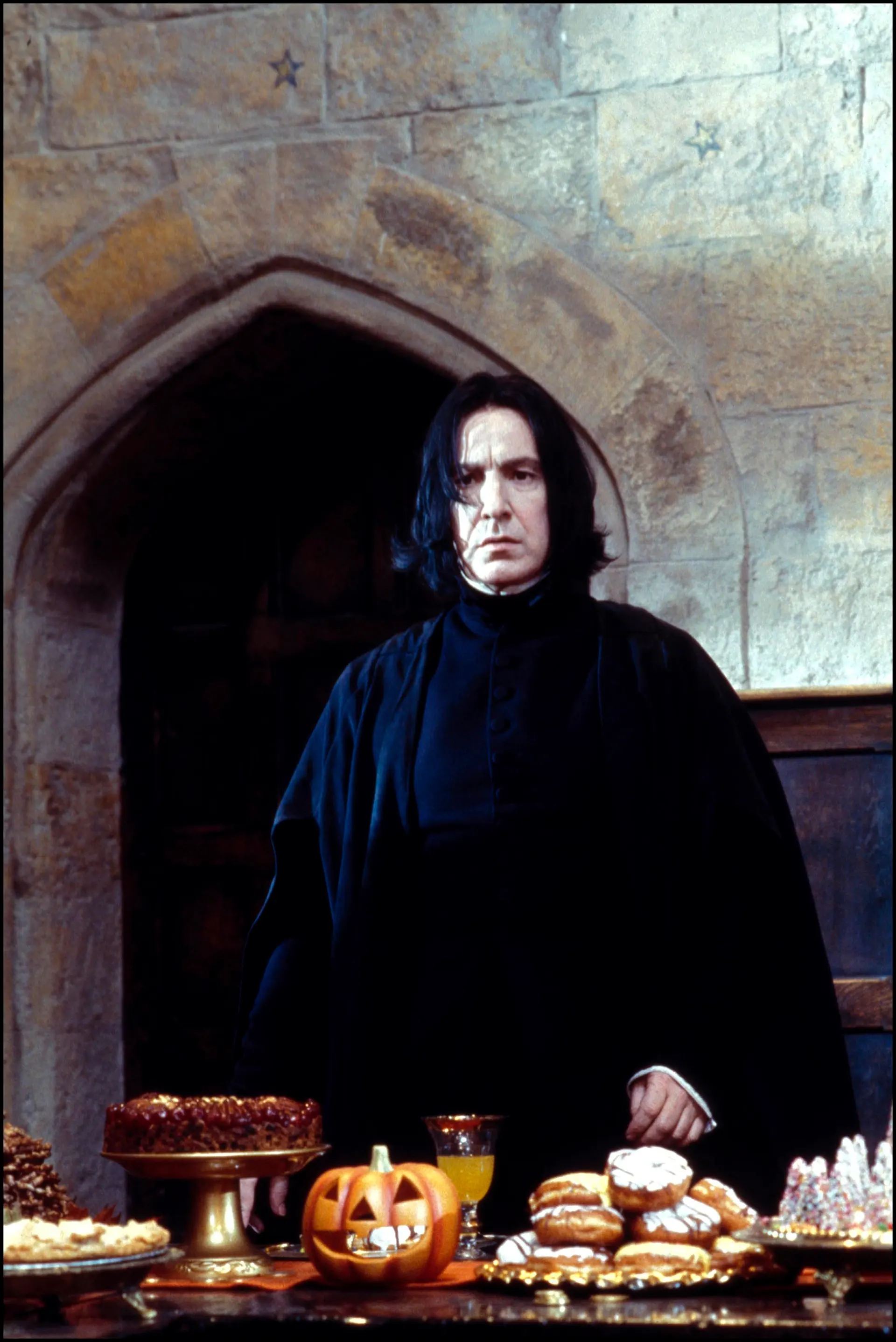
Alan Rickman’s portrayal of Severus Snape is widely considered one of the most masterful performances in cinematic history. Over eight films, Rickman balanced Snape’s cold, intimidating exterior with a hidden vulnerability, ultimately revealing a tragic hero whose secret loyalty and enduring love for Lily Potter defined the emotional climax of the entire series.
The Foundation of a Cinematic Icon: Casting and Preparation
When the production of Harry Potter and the Sorcerer’s Stone began at the turn of the millennium, the casting of Severus Snape was arguably the most critical decision for the franchise's longevity. While several actors were considered, it was J.K. Rowling herself who championed Alan Rickman for the role. Rickman, already a veteran of the stage and screen known for his work in Die Hard and Sense and Sensibility, brought a gravity to the production that bridged the gap between a "children's movie" and a serious piece of dramatic cinema.
One of the most legendary aspects of Rickman’s preparation was the "secret" shared with him by J.K. Rowling. Long before the final books were published, Rowling provided Rickman with a crucial piece of information regarding Snape’s true motivations. She revealed the word "Always"—a reference to his lifelong love for Lily Potter. This knowledge allowed Rickman to infuse his early performances with subtle nuances, double meanings, and fleeting moments of hesitation that only made sense to the audience years later.
By 2026, looking back at the complete body of work, this foresight is even more impressive. Rickman was essentially playing two characters simultaneously: the bitter Potions Master the students saw, and the grieving, protective double agent known only to Albus Dumbledore. This layered approach is why the performance remains a subject of study in acting schools and film analysis circles.
The Art of the Performance: Voice, Presence, and Stillness
Alan Rickman’s Snape was defined as much by what he didn't do as by what he did. In an era of high-energy CGI and frantic pacing, Rickman opted for a performance rooted in absolute stillness and precise vocal control.
The "Snape" Voice
Rickman utilized his natural baritone to create a speech pattern that was both hypnotic and terrifying. He famously used "the pause"—protracted silences between words—to command the room. This wasn't just a stylistic choice; it reflected Snape’s calculated nature. In the classroom scenes, his voice rarely rose to a shout. Instead, he weaponized a "deadly whisper" that forced the boisterous Gryffindors into silence.
Physicality and Wardrobe
The costume design for Snape remained remarkably consistent throughout the decade-long production. Clad in black, floor-length robes that billowed behind him, Rickman used his height and posture to create a silhouette that looked more like a predatory bird than a teacher. He moved with a gliding motion, rarely showing effort, which added to the character's aura of omnipotence within the walls of Hogwarts.
Chronological Evolution: From Antagonist to Tragic Hero
To understand the depth of Rickman's work, one must examine how the performance shifted across the various directorial eras of the franchise.
The Early Years (2001–2002)
Under the direction of Chris Columbus, Snape was the quintessential "pantomime villain." He was the primary suspect in every mystery, the man who seemed to have a personal vendetta against an eleven-year-old boy. Rickman played these notes perfectly, providing the necessary friction to make Harry’s entry into the wizarding world feel dangerous.
The Transition and Deepening (2004–2005)
With Alfonso Cuarón and Mike Newell, the films took on a darker, more hormonal tone. Rickman’s Snape became more sardonic. In Harry Potter and the Prisoner of Azkaban, we see the first real cracks in his composure during the confrontation in the Shrieking Shack. Rickman brilliantly portrayed Snape’s genuine trauma regarding Sirius Black and Remus Lupin, hinting that his hatred for Harry was fueled by ghosts of the past.
The Climax and Revelation (2007–2011)
The final four films, directed by David Yates, belonged to Rickman. In The Half-Blood Prince, Rickman had to portray the ultimate betrayal—the killing of Dumbledore. The subtle look of anguish and "disgust" on Rickman's face in that moment was later revealed to be Snape’s revulsion at the task he had to perform, not the man he was killing. By The Deathly Hallows Part 2, the "Prince’s Tale" sequence solidified Rickman’s legacy, as he transitioned Snape from a reviled murderer back into a protector in a matter of minutes through the Pensieve memories.
Critical Comparison: Snape Across the Film Series
The following table outlines the shifting dynamics of Alan Rickman's portrayal across the eight-film arc, highlighting the primary focus of the performance in each phase.
| Film Era | Primary Director | Tone of Performance | Key Character Development |
|---|---|---|---|
| Philosopher's Stone / Chamber of Secrets | Chris Columbus | Intimidating, Suspicious | The classic antagonist; established the "Potions Master" aura. |
| Prisoner of Azkaban | Alfonso Cuarón | Visceral, Traumatized | Exposure of Snape's history with the Marauders; first signs of deep-seated pain. |
| Goblet of Fire / Order of the Phoenix | Newell / Yates | Authoritarian, Guarded | The return of Voldemort; Snape as the Occlumency teacher and member of the Order. |
| Half-Blood Prince | David Yates | Melancholy, Decisive | The Unbreakable Vow; the tragic burden of the double agent's endgame. |
| Deathly Hallows (Parts 1 & 2) | David Yates | Isolated, Redemptive | The death of Snape and the revelation of his lifelong loyalty to Lily Potter. |
The Impact on the Young Cast and Production
Alan Rickman was more than just a co-star to the younger actors; he was a mentor and a professional benchmark. Daniel Radcliffe has frequently recounted how Rickman was one of the first "adult" actors on set to treat him as a peer rather than a child. Rickman’s dedication to the craft—often staying in character between takes to maintain the atmosphere of the classroom—helped ground the performances of Radcliffe, Emma Watson, and Rupert Grint.
The production staff also noted Rickman’s attention to detail regarding his character's surroundings. He famously insisted that the potions classroom feel claustrophobic and that his desk be cluttered with authentic-looking (and often strange) props. This commitment to world-building ensured that Snape felt like a lived-in part of the Hogwarts architecture, rather than a guest.
Moral Ambiguity and the "Gray" Character
In the landscape of 21st-century cinema, Severus Snape remains one of the most debated "gray" characters. He was often cruel, biased, and bitter. He bullied students and harbored grudges for decades. However, Rickman’s performance ensured that the audience never fully gave up on him.
By portraying Snape as a man who lived in a state of perpetual mourning, Rickman added a layer of tragedy that justified (though perhaps did not excuse) his coldness. The 2026 perspective on the character emphasizes that Snape’s heroism was not born of inherent goodness, but of a singular, transformative act of contrition. Rickman’s ability to communicate this complex moral compass without long monologues or overt emotional outbursts is a testament to his skill as a minimalist actor.
Legacy and Cultural Impact in 2026
Even a decade after Alan Rickman's passing in 2016, his portrayal of Snape continues to dominate discussions of the Harry Potter franchise. While new adaptations or expansions of the "Wizarding World" may emerge, Rickman's version of the character is considered definitive.
His performance helped elevate the entire genre. It proved that a character in a fantasy blockbuster could possess the same psychological depth as a lead in a Shakespearean tragedy. The phrase "Always" has transcended the films to become a shorthand for loyalty and love in popular culture, a phenomenon that would likely not have happened without the specific weight Rickman gave to that single word in his final scenes.
Frequently Asked Questions
Did Alan Rickman know the ending of the Harry Potter books?
Yes, he was one of the few people outside of J.K. Rowling’s inner circle who knew Snape’s true motivation. Rowling told him that Snape was in love with Lily Potter as early as the filming of the first movie to help him understand why the character acted the way he did toward Harry.
Why was Alan Rickman's voice so distinctive in the films?
Rickman possessed a naturally deep baritone, but for Snape, he intentionally slowed his speech. This created a sense of "vocal power," where the character never felt the need to rush because he was always in control of the conversation.
Did Alan Rickman perform his own stunts in the Harry Potter films?
While the films relied heavily on stunt doubles for the more dangerous magical duels and falls, Rickman was very active in his physical performance. He handled the intricate wand work himself and was involved in the "flying" sequences and the physical skirmishes seen in The Half-Blood Prince and Deathly Hallows.
Is there a difference between the book version of Snape and Rickman's version?
The book version of Snape is often described as more unhinged, vocal, and physically "greasy." Rickman’s portrayal was more controlled, dignified, and dryly humorous. Many fans feel Rickman made the character more sympathetic than he was originally written on the page.
How did the cast react to Alan Rickman's death?
The cast, particularly Daniel Radcliffe and Matthew Lewis (Neville Longbottom), spoke at length about Rickman’s kindness. They noted that despite his intimidating appearance as Snape, he was incredibly supportive and would often attend their stage plays and offer career advice long after the films ended.
Practical Recommendation for Viewers
To truly appreciate the depth of Rickman's performance, a "Snape-centric" rewatch is highly recommended. Pay close attention to Rickman’s eyes during the Occlumency lessons in The Order of the Phoenix and his subtle hesitation when Dumbledore asks him to perform the ultimate task in The Half-Blood Prince. When you watch the films knowing the ending, you see a completely different performance—one of the most meticulously planned and executed arcs in cinema history.