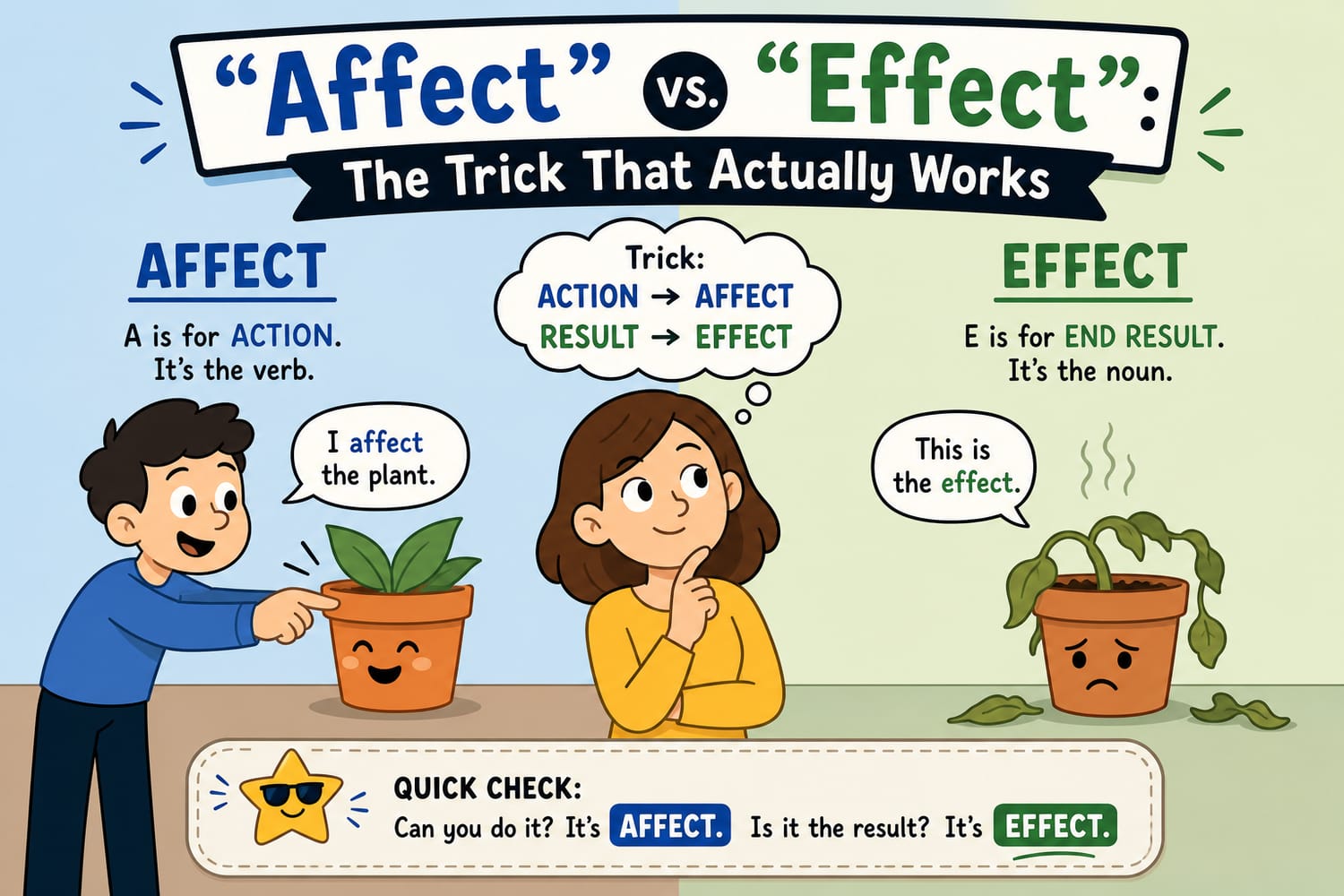
In the vast majority of cases, affect is a verb meaning to influence or produce a change in something, while effect is a noun referring to the result or consequence of a change. A simple way to distinguish them is the RAVEN mnemonic: Remember Affect Verb Effect Noun.
The English language is notorious for homophones and near-homophones that lead even seasoned writers into traps. Among these, the "affect versus effect" dilemma remains one of the most persistent challenges in professional, academic, and creative writing. As we navigate the communication standards of 2026, where clarity and precision are paramount in both AI-assisted and human-authored content, mastering this distinction is essential for maintaining credibility.
Understanding the difference requires more than just memorizing two definitions. It involves looking at the grammatical function of the words, their specific roles within a sentence, and the rare but important exceptions where their parts of speech are swapped. This guide provides a comprehensive breakdown of these terms, their etymology, and practical strategies for never mixing them up again.
Understanding Affect as a Verb
The word affect most commonly functions as a verb. When you use it in this capacity, you are describing an action—specifically, the act of influencing or moving something in a particular direction.
To Influence or Change
When one thing produces an alteration in another, it is said to affect that thing. For example, "The rising interest rates will affect the housing market." Here, the interest rates are the agent of change, and the housing market is the subject being influenced.
In a scientific or medical context, you might say, "The new medication affects the patient's heart rate." This indicates that the drug is causing a change in the physiological state of the patient. Because it is an action being performed by the medication, the verb form is required.
To Touch the Emotions
Another common usage of affect as a verb relates to emotional impact. If a story, a piece of music, or an event moves someone deeply, it has affected them. For instance, "The documentary on climate change deeply affected the students." In this sense, the word is synonymous with "moved," "touched," or "stirred."
To Assume a Persona (Affectation)
A less frequent but still important use of affect as a verb means to put on a pretense or to adopt a certain behavior or style. This is where the noun "affectation" comes from. For example, "He affected a British accent after spending only a week in London." In this case, the subject is intentionally assuming an appearance or mannerism that is not natural to them.
Understanding Effect as a Noun
While affect is the action, effect is the result. It is a noun that identifies the outcome, consequence, or appearance produced by an agent or cause.
The Result of an Action
If you are discussing the outcome of a situation, you are looking for the effect. For example, "The effect of the new law was an immediate decrease in urban pollution." Here, the law is the cause, and the decrease in pollution is the result—the effect.
Think of the phrase "cause and effect." Because "cause" in this context is a noun (the thing that makes something happen), its partner "effect" must also be a noun (the thing that happened).
In Operation or In Force
Effect is frequently used in phrases describing whether something is currently active. If a rule is currently being enforced, it is "in effect." If a new policy starts on Monday, it "takes effect" on that day. These idiomatic expressions always use the noun form because they refer to the state or status of a condition.
Personal Belongings
In a more specific and formal context, effects (always plural) refers to a person’s movable property or goods. You will often see this in legal documents or travel contexts, such as "The hotel is not responsible for guests' personal effects." While this seems distant from "cause and effect," it stems from the same linguistic root—these are the items that belong to the person as a result of their ownership.
The Tricky Exceptions: When the Roles Reverse
The primary reason for the persistent confusion between these two words is that both can technically function as either a noun or a verb, though these instances are specialized.
When Effect is a Verb
In formal and technical writing, effect can be used as a verb meaning "to bring about" or "to accomplish." This is most commonly seen in the phrase "to effect change."
Consider the difference:
- "The protest affected the policy." (The protest influenced the policy.)
- "The protest effected a change in the policy." (The protest directly caused the change to happen.)
Using effect as a verb implies a sense of completion and direct agency. It is not just influencing a process; it is creating the result itself. According to Merriam-Webster, this usage is often found in business or governmental contexts where a specific outcome is being forced or implemented.
When Affect is a Noun
In the fields of psychology and psychiatry, affect is used as a noun to describe the outward expression of an internal emotional state. A therapist might note that a patient has a "flat affect," meaning they show no emotional expression on their face or in their voice, regardless of their actual feelings.
This technical usage is highly specific to the mental health profession. Unless you are writing a clinical report or a psychological analysis, you are unlikely to use affect as a noun.
Comparison and Quick Reference
To help you decide which word to use in 2026's fast-paced writing environments, refer to this comparison table.
| Word | Primary Part of Speech | Common Definition | Typical Example |
|---|---|---|---|
| Affect | Verb | To influence or change | "The cold weather will affect the crops." |
| Effect | Noun | The result or outcome | "The medicine had a positive effect." |
| Effect | Verb (Formal) | To bring about/cause | "The CEO worked to effect a merger." |
| Affect | Noun (Technical) | Emotional expression | "The patient displayed a flat affect." |
Linguistic Context: Prepositions and Common Phrases
The words that surround affect and effect often provide clues to which one is correct.
Common "Affect" Phrasings
- Affect by: "The region was affected by the storm."
- Directly affect: "This decision will directly affect our budget."
- Adversely affect: "Lack of sleep can adversely affect cognitive function."
Common "Effect" Phrasings
- The effect of: "We are studying the effect of light on plant growth." (Note the article "the" or "an" almost always precedes "effect").
- To have an effect: "The speech had an effect on the audience."
- In effect: "The current regulations remain in effect."
- Take effect: "The new tax rates take effect next January."
- Side effect: "Dizziness is a common side effect of this treatment."
Strategies for Mastery
Even with the definitions in hand, the choice can feel ambiguous in the heat of writing. Use these three strategies to verify your choice.
1. The RAVEN Method
As mentioned, RAVEN stands for Remember Affect Verb Effect Noun. If you are describing an action, you likely need the "A" word. If you are describing a thing, you need the "E" word.
2. The Substitution Test
If you are unsure, try substituting a different verb or noun to see if the sentence still makes sense.
- For Affect: Replace it with "change" or "influence." If the sentence works, affect is correct.
- Example: "The news will affect (influence) him." (Correct)
- For Effect: Replace it with "result" or "outcome." If the sentence works, effect is correct.
- Example: "The effect (result) was clear." (Correct)
3. Look for the Article
Nouns in English are frequently preceded by articles (a, an, the) or adjectives (this, that, some, any). If you see one of these words immediately before the "affect/effect" choice, you almost certainly need the noun effect.
- "The effect..."
- "A significant effect..."
- "This effect..."
Common Pitfalls and Misunderstandings
One area where even advanced writers stumble is when they use the words in close proximity. "The way you affect others has a lasting effect on your reputation." In this sentence, both are used correctly. The first is the action (verb), and the second is the result (noun).
Another pitfall is the confusion between affective and effective.
- Affective relates to emotions or "affect" (e.g., Seasonal Affective Disorder).
- Effective relates to "effect" and describes something that produces the desired result (e.g., "an effective strategy").
In the professional landscape of 2026, the misuse of these terms can be flagged by automated grammar checkers, but those tools sometimes struggle with the "effecting change" or "psychological affect" nuances. Manual verification is always the safest route for high-stakes documentation.
Frequently Asked Questions
Is it "side affect" or "side effect"?
The correct term is side effect. A side effect is a result or consequence of a primary action (such as taking medication), making it a noun. You should never use "side affect" unless you are discussing a psychological phenomenon in a very specialized clinical setting.
Can I use "affect" as a noun in a normal sentence?
Generally, no. Unless you are writing about psychology or describing someone’s facial expression of emotion, "affect" should always be used as a verb. Using it as a noun in standard business or casual writing is considered a grammatical error.
What does "to effect change" mean exactly?
To effect change means to cause change to happen or to implement change directly. While you could say "the policy affected change" (meaning the policy influenced the change that was already happening), saying "the policy effected change" means the policy was the direct instrument that brought the change into existence.
How can I remember which one is the verb?
Think of the "A" in Affect standing for Action. Verbs are action words. Think of the "E" in Effect standing for End result. Nouns often represent the end result of a process.
Are "affective" and "effective" the same thing?
No. Affective is an adjective describing something that deals with emotions or moods. Effective is an adjective describing something that works well and produces the intended result. For example, a teacher might have an effective lesson plan that also has a positive affective impact on the students' confidence.
Practical Recommendation for Writers
To ensure you are using these terms correctly, always perform a final "Part of Speech" check during your editing phase. Identify the subject and the verb of your sentence. If your chosen "affect/effect" word is the main action following the subject, use affect. If it follows an article like "the" or "an," or if it functions as the object of a preposition (like "of" or "on"), use effect.
For those working in specialized fields like law or psychology, create a specific style sheet that notes the "Verb-Effect" (to bring about) and "Noun-Affect" (emotional display) exceptions to avoid confusion during peer reviews.