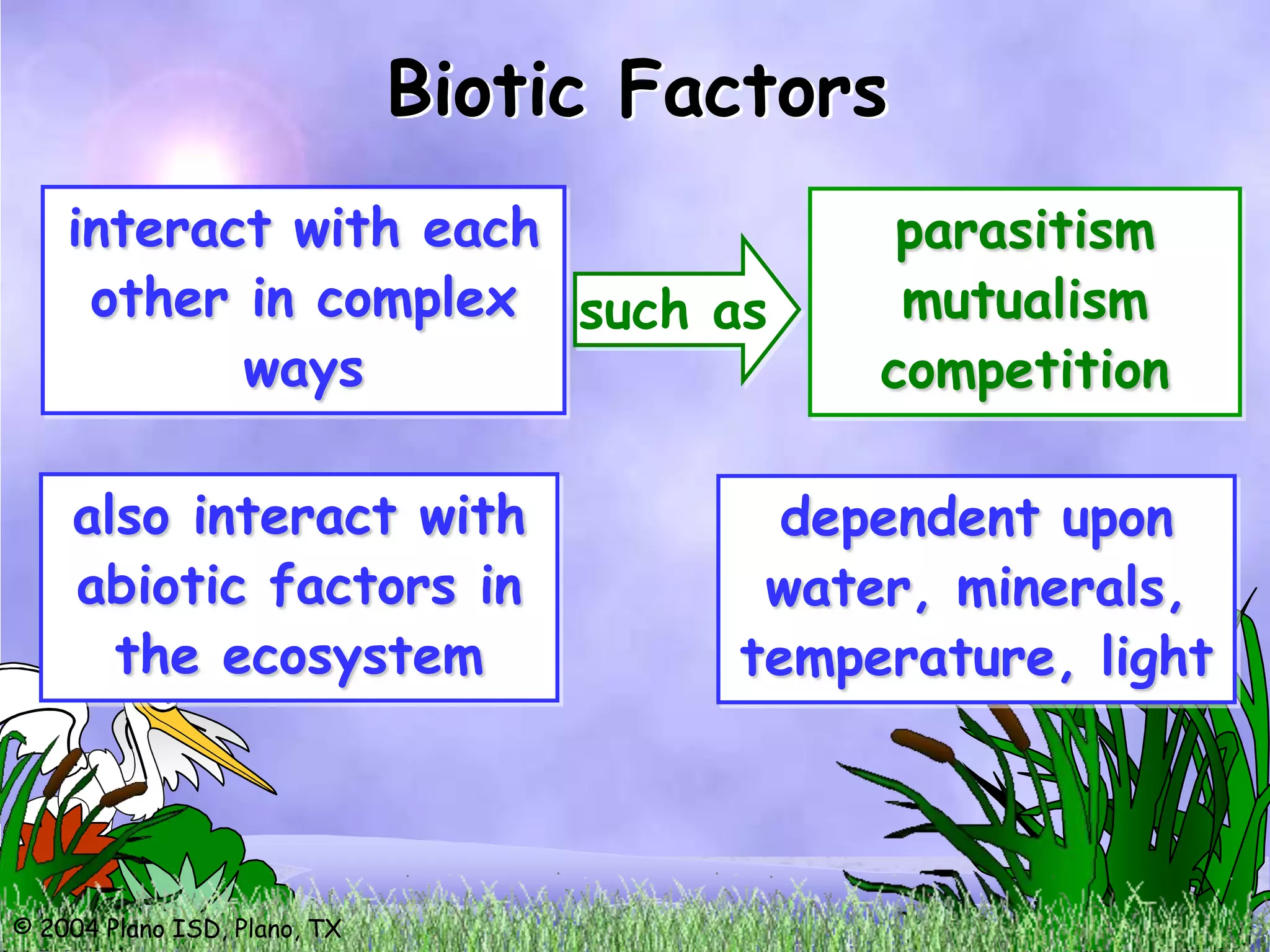
Abiotic factors are the non-living chemical and physical components of an environment that determine the survival, growth, and reproduction of living organisms. These "invisible architects" include sunlight, temperature, water, and soil composition, forming the foundational structure that dictates which species can inhabit and thrive within a specific ecological niche or geographic region.
The Fundamental Pillars of Ecological Structure
Every ecosystem on Earth is a complex tapestry woven from two primary threads: biotic and abiotic factors. While the biotic components—plants, animals, fungi, and bacteria—often receive the most attention, they are entirely dependent on the abiotic framework. As of 2026, ecological research continues to emphasize that abiotic factors do not merely coexist with life; they define the boundaries of what is biologically possible.
An ecosystem’s abiotic profile acts as a rigorous filter. For an organism to persist in a given location, it must possess physiological adaptations that allow it to tolerate the local abiotic stressors. This concept, often referred to as the "environmental filter," explains why we do not find cacti in the Arctic or polar bears in the Sahara. The abiotic environment sets the stage, determines the available resources, and establishes the "rules of engagement" for all biological interactions, from competition to predation.
Understanding these factors requires looking beyond simple weather patterns. It involves analyzing the chemical composition of the atmosphere, the mineralogy of the soil, the physics of light penetration in water, and the thermodynamics of heat exchange. These elements interact in a synergistic fashion, meaning the impact of one factor often depends on the state of another. For instance, high temperatures are far more lethal to vegetation when accompanied by low humidity and minimal soil moisture.
Solar Radiation: The Primary Energy Driver
Sunlight is the most influential abiotic factor in nearly every terrestrial and shallow aquatic ecosystem. It serves as the primary source of energy, fueling the process of photosynthesis, which converts light energy into chemical energy. However, the influence of solar radiation extends far beyond the simple caloric intake of primary producers.
The Quality and Quantity of Light
The intensity and duration of sunlight, known as photoperiodism, trigger critical biological rhythms. In 2026, phenological studies remain a cornerstone of ecology, tracking how organisms use day length to signal migration, flowering, and hibernation. The quality of light—the specific wavelengths that reach an organism—is equally vital. In aquatic environments, water absorbs longer wavelengths (reds and oranges) quickly, leaving only shorter blue and green wavelengths to penetrate deeper zones. This "spectral filtering" dictates the vertical distribution of seaweed and phytoplankton.
Thermal Energy and Heat Budgets
Solar radiation is also the primary driver of temperature. The Earth's energy budget, managed by the National Aeronautics and Space Administration (NASA), determines the global distribution of biomes. Regions near the equator receive direct sunlight year-round, resulting in high energy input and stable, warm temperatures. Conversely, polar regions receive slanted rays that must pass through more atmosphere, leading to significant energy loss and colder climates. These variations create the latitudinal gradients in biodiversity that we observe across the globe.
The Hydrosphere: Water as a Biological Solvent
Water is frequently cited as the most limiting abiotic factor for terrestrial life. It is the universal solvent, facilitating the transport of nutrients within an organism and through the soil. The availability of water is not just about total rainfall; it involves a complex balance of precipitation, evaporation, and the water-holding capacity of the substrate.
Freshwater vs. Marine Environments
In aquatic ecosystems, the chemical composition of the water—specifically its salinity—is a dominant abiotic architect. Salinity affects the osmotic balance of organisms. Most aquatic species are specialized as either stenohaline (able to tolerate only a narrow range of salinity) or euryhaline (able to tolerate wide fluctuations). The National Oceanic and Atmospheric Administration (NOAA) provides extensive data on how salinity and temperature drive ocean currents, which in turn distribute nutrients and heat globally, influencing both marine and terrestrial life.
Dissolved Gases and pH
For aquatic life, the concentration of dissolved oxygen (DO) and carbon dioxide is a matter of survival. Cold water can hold more dissolved oxygen than warm water, which is why trout and salmon are typically found in cold, fast-moving streams. Furthermore, the pH of the water—its acidity or alkalinity—can drastically alter the bioavailability of nutrients and toxins. In 2026, the ongoing monitoring of ocean acidification highlights how shifts in the abiotic chemical balance, driven by increased atmospheric CO2, can compromise the ability of calcifying organisms like corals and mollusks to build their shells.
Temperature and Metabolic Boundaries
Temperature is a measure of kinetic energy that directly influences the rate of chemical reactions within living cells. Every species has an "optimal thermal window" in which its metabolic processes function most efficiently.
Enzyme Function and the Q10 Rule
Biological reactions are governed by enzymes, which are highly sensitive to temperature. The Q10 temperature coefficient is a measure of the rate of change of a biological or chemical system as a consequence of increasing the temperature by 10 °C. For most biological systems, the metabolic rate doubles or triples with every 10-degree rise, up to a point. Beyond an organism's thermal maximum, enzymes begin to denature, and cellular structures break down.
Ectothermy and Endothermy
Organisms have evolved different strategies to manage this abiotic pressure. Ectotherms (such as reptiles and insects) rely on external heat sources to regulate their body temperature, making them highly dependent on microclimates. Endotherms (such as birds and mammals) generate internal heat, allowing them to inhabit colder environments but at a significantly higher metabolic cost. This distinction determines the geographic range and activity levels of species across different climates.
Edaphic Factors: The Chemistry of the Substrate
In terrestrial ecosystems, the soil (edaphic factors) provides the physical anchorage and the nutrient reservoir for plants. Soil is not a static medium; it is a dynamic mixture of weathered rock, organic matter, air, and water.
Soil Texture and Porosity
The size of soil particles—sand, silt, and clay—determines the soil’s texture, which in turn controls drainage and aeration. Sandy soils have large pores that allow water to drain rapidly, often carrying away nutrients (leaching). Clay soils have tiny pores that hold water tightly but may lack sufficient oxygen for root respiration. The ideal soil for most agricultural purposes is loam, a balanced mixture that provides both moisture retention and aeration.
Nutrient Availability and Cation Exchange
The chemical fertility of the soil depends on its ability to hold and release essential ions like potassium, calcium, and magnesium. This is known as Cation Exchange Capacity (CEC). The United States Geological Survey (USGS) monitors how nutrient runoff and soil degradation affect broader ecosystem health. Soil pH also plays a critical role; if the soil is too acidic or too alkaline, essential nutrients may become chemically "locked," making them unavailable to plants regardless of how much is present in the ground.
Atmospheric and Topographic Influences
While often overlooked, the physical movement of air and the shape of the land significantly modify other abiotic factors.
Wind as a Dispersal Agent
Wind affects ecosystems by increasing evaporation rates and physically shaping vegetation (a phenomenon known as krummholz in alpine regions). It is also a vital dispersal agent for seeds, pollen, and even small insects. On a global scale, atmospheric circulation patterns distribute heat and moisture, creating the distinct climate zones that define our planet's biomes.
Topography and Aspect
The "lay of the land" creates diverse microclimates. In the Northern Hemisphere, south-facing slopes receive more direct sunlight than north-facing slopes, leading to warmer, drier conditions that support entirely different plant communities. Altitude also plays a role; for every 1,000-meter increase in elevation, the temperature drops by approximately 6.5 °C. This "lapse rate" means that climbing a high mountain can be ecologically equivalent to traveling thousands of miles toward the poles.
Comparison of Abiotic Profiles Across Major Biomes
The following table compares the primary abiotic constraints and characteristics of four distinct biomes as of 2026.
| Biome | Primary Abiotic Constraint | Solar Input | Typical Soil Profile | Water Availability |
|---|---|---|---|---|
| Tropical Rainforest | Nutrient Availability | High / Consistent | Nutrient-poor (leached), acidic | Extremely High |
| Desert | Water Availability | Very High | Mineral-rich but dry, sandy | Extremely Low |
| Tundra | Temperature / Growing Season | Low / Seasonal | Permafrost, waterlogged in summer | Low (mostly frozen) |
| Temperate Forest | Seasonal Variability | Moderate / Seasonal | Nutrient-rich, deep organic layer | Moderate / Consistent |
The Interaction: Abiotic-Biotic Feedback Loops
It is a mistake to view abiotic factors as a one-way street. While abiotic factors shape life, life also modifies the abiotic environment. This creates a feedback loop that stabilizes or transforms ecosystems.
For example, a dense forest canopy reduces the amount of sunlight reaching the forest floor, lowers the ground temperature, and increases humidity. The roots of the trees hold the soil in place, preventing erosion and altering the soil's chemical structure through the addition of organic leaf litter. On a global scale, the oxygen in our atmosphere is a direct result of billions of years of biotic activity (photosynthesis). In 2026, as we face rapid environmental changes, understanding these feedback loops is essential for conservation and restoration efforts.
Human Alterations to Abiotic Baselines
Human activity has become a significant driver of abiotic change. Through the release of greenhouse gases, industrial runoff, and land-use changes, we are shifting the very baselines that organisms have adapted to over millennia.
- Climate Modification: Rising global temperatures are shifting the thermal boundaries of ecosystems, forcing species to migrate toward higher latitudes or altitudes.
- Nutrient Loading: The excessive use of nitrogen and phosphorus in agriculture leads to eutrophication in water bodies, an abiotic shift that depletes oxygen and creates "dead zones."
- Habitat Fragmentation: Creating roads and urban areas changes the wind patterns, sunlight penetration (edge effects), and hydrological cycles of the remaining natural patches.
Monitoring these changes requires robust data. The Environmental Protection Agency (EPA) provides resources and frameworks for understanding how human-induced abiotic changes impact public health and ecological integrity.
Frequently Asked Questions
Which abiotic factor is most important?
No single factor is universally "most important," as their significance depends on the specific ecosystem. In a desert, water is the primary limiting factor. In the deep ocean, sunlight and pressure are the dominant architects. In the tundra, temperature dictates the biological tempo. Ecology follows the "Law of the Minimum," which states that growth is controlled not by the total resources available, but by the scarcest resource (limiting factor).
Can abiotic factors change over time?
Yes, abiotic factors are dynamic. They change on short-term scales (diurnal and seasonal cycles), medium-term scales (El Niño events or decadal climate oscillations), and long-term geological scales (ice ages or continental drift). Human-induced climate change is currently accelerating these shifts at a rate faster than many species can adapt.
How do abiotic factors influence natural selection?
Abiotic factors act as the selective pressure in natural selection. Individuals with traits that allow them to better survive the local abiotic conditions (e.g., a waxy cuticle to prevent water loss in a desert or thick fur for insulation in the cold) are more likely to survive and pass those traits to the next generation. This leads to the evolution of specific adaptations.
What is the difference between an abiotic factor and a resource?
An abiotic factor is a physical or chemical condition of the environment. A resource is something that an organism consumes or uses, which can then become unavailable to others. While some abiotic factors are resources (like water or minerals), others are strictly conditions (like temperature or pH) that cannot be "consumed" but still profoundly affect life.
How do researchers measure abiotic factors in 2026?
Researchers use a combination of remote sensing (satellites), automated sensor networks (Internet of Things), and traditional field sampling. In 2026, satellite technology allows for real-time monitoring of sea-surface temperatures, soil moisture, and atmospheric composition with unprecedented precision, providing a global view of the "invisible architects" at work.
Next Steps for Further Exploration
To truly understand an ecosystem, one must become an observer of its non-living components. If you are a student, land manager, or enthusiast, start by identifying the primary limiting factors in your local area. Use tools like soil pH testers, thermometers, and light meters to quantify the environment. For those looking to dive deeper into global trends, regularly consult the data repositories of the USGS and NOAA to see how the abiotic foundations of our world are shifting in this decade.