Choosing the right ABEM board review course depends on your specific career stage, learning style, and whether you are preparing for the initial Qualifying Exam, the Virtual Oral Board Exam, or the MyEMCert modules. In 2026, top-tier options integrate high-yield question banks, interactive video content, and adaptive learning algorithms to maximize retention and pass rates.
The Landscape of Emergency Medicine Certification in 2026
The American Board of Emergency Medicine (ABEM) serves as the primary certifying body for emergency physicians in the United States. Achieving and maintaining board certification is a rigorous process that signals a high level of expertise to hospitals, patients, and the medical community. As of 2026, the certification pathway remains a multi-step journey: the initial Qualifying Exam (written), the Oral Certifying Exam, and the ongoing MyEMCert longitudinal assessment process.
Board review courses have evolved from simple weekend seminars into sophisticated, multi-platform educational ecosystems. These courses are designed to align with the "Model of the Clinical Practice of Emergency Medicine," which serves as the blueprint for all ABEM examinations. For many physicians, the challenge is not just finding information, but filtering the vast amount of medical knowledge into "high-yield" concepts that are most likely to appear on the exam.
Professional organizations like the American College of Emergency Physicians (ACEP) and private entities like Hippo EM or Rosh Review provide different pedagogical approaches. Whether you prefer the rapid-fire nature of a question bank (Q-bank) or the deep-dive context of a lecture series, selecting the right tool is the first step toward a successful outcome.
Primary Examination Paths and Their Requirements
Before selecting a review course, it is essential to identify which specific ABEM requirement you are attempting to satisfy. The study strategies for a 305-question written exam differ significantly from those required for a simulated patient encounter in the oral boards.
The ABEM Qualifying Examination (QE)
The Qualifying Exam is the first hurdle for recent residency graduates. It is a computer-based, multiple-choice assessment that covers the full breadth of emergency medicine. Review courses for the QE focus on breadth of knowledge, rapid diagnosis, and "classic" board presentations that may differ slightly from nuanced real-world practice.
The Virtual Oral Board Exam (VOBE)
Once the QE is passed, candidates must complete the Oral Certifying Exam. In 2026, the virtual format (VOBE) is the standard, requiring candidates to manage complex cases through verbal interaction with an examiner. Review courses for this stage emphasize "oral board logic"—a specific way of verbalizing actions, orders, and physical exam requests that ensures the examiner can award points for the candidate’s clinical reasoning.
MyEMCert Longitudinal Assessment
For diplomates maintaining their certification, the traditional 10-year ConCert exam has been fully replaced by MyEMCert. This consists of shorter, topic-specific modules (e.g., Trauma, Abnormal Vital Signs, Neurology) that can be taken at the physician’s convenience. Review materials for MyEMCert are more modular and focused on updated clinical guidelines and "Key Advances" in the field.
Evaluating Top-Tier ABEM Review Providers
The market for ABEM prep is dominated by several established players, each with a distinct reputation and methodology.
ACEP and PEER (Physician's Evaluation and Educational Review)
As the official review product of the American College of Emergency Physicians, PEER is often considered the gold standard for question quality and alignment with the ABEM blueprint. In 2026, PEER continues to offer a massive database of questions that mirror the style and difficulty of the actual exam.
- Best for: High-fidelity question practice and residents who want the "official" feel of the exam.
- Strengths: Exceptional images, detailed explanations, and strong mobile integration.
Ohio ACEP: The "Rivers" Course Legacy
Historically known for the Dr. Carol Rivers’ board review materials, Ohio ACEP offers one of the most comprehensive "Deep Dive" courses. They provide both an intensive live/virtual course and a textbook that many consider the "Bible" of EM board prep.
- Best for: Physicians who need a structured, classroom-style environment or a comprehensive reference text.
- Strengths: High-yield summaries and a long-standing track record of success. Learn more at the Ohio ACEP website.
Rosh Review (A Blueprint Company)
Rosh Review revolutionized board prep with its highly visual explanations and "one-step-further" pearls. Their platform uses adaptive learning technology to identify a user's weak points and suggest targeted study areas.
- Best for: Busy clinicians who prefer "learning by doing" through 10-20 questions a day.
- Strengths: Excellent performance analytics and a "Pass Guarantee" that provides a refund if the candidate fails. Visit Rosh Review for current pricing.
Hippo EM
Hippo EM focuses on high-production-value video content. Their approach is designed to fight "study fatigue" by using humor, high-quality animations, and engaging presenters.
- Best for: Visual and auditory learners who find traditional textbooks or dry Qbanks difficult to digest.
- Strengths: The "ER Cast" style of delivery and integrated CME credits. Explore their modules at Hippo Education.
Comparative Overview of ABEM Review Courses
The following table compares the primary features of leading ABEM review courses available in 2026. Prices are estimates based on standard individual subscriptions.
| Provider | Primary Format | Best For | Estimated Price (2026) | Key Feature |
|---|---|---|---|---|
| PEER (ACEP) | Q-bank | QE Prep | $400 - $600 | Official ACEP Alignment |
| Rosh Review | Q-bank / Adaptive | Self-Paced Study | $350 - $550 | Advanced Analytics |
| Ohio ACEP | Live/Textbook | Deep Comprehensive | $800 - $1,200 | Expert Live Instruction |
| Hippo EM | Video / Audio | Visual Learners | $500 - $750 | High Production Quality |
| EMRAP (C3) | Audio / Video | Continuous Learning | $400 - $600 | Monthly Content Updates |
| MedChallenge | Gamified Q-bank | Rapid Fire Review | $300 - $450 | Competitive Leaderboards |
Strategic Selection: How to Choose Your Course
With so many high-quality options, the "best" course is the one that aligns with your specific constraints and learning habits.
Assess Your Learning Style
- The Active Recaller: If you learn best by making mistakes and correcting them, a Q-bank like Rosh Review or PEER is essential. These platforms use the "Testing Effect," which is scientifically proven to improve long-term retention better than passive reading.
- The Conceptual Learner: If you need to understand the "why" behind a pathophysiology before you can remember the "what," a video-based course like Hippo EM or a comprehensive text like the Ohio ACEP "Rivers" book is superior.
- The Commuter: For those who study while driving or exercising, audio-focused options like EMRAP or the Hippo EM audio feed allow you to reclaim "dead time."
Consider the Time Horizon
If your exam is six months away, a comprehensive textbook or a year-long Q-bank subscription is appropriate. However, if you are in the "cram phase" (4-6 weeks before the exam), focus on high-yield "cram courses" or intensive boot camps that filter out the noise and focus on the most commonly tested associations.
Verification of CME and Institutional Funding
Most ABEM board review courses qualify for Category 1 CME credits. In 2026, many hospital systems and residency programs provide an annual "CME Stipend." Ensure the course you choose provides the necessary documentation to have the cost reimbursed by your employer.
Master the Oral Board Logic
The Oral Certifying Exam requires a different set of tools. You are not being tested on your ability to pick 'B' out of a list of five options; you are being tested on your ability to lead a room, manage a nurse, and stabilize a deteriorating patient while thinking out loud.
Review courses for the Oral Boards, such as those offered by AAEM or specialized coaches, focus on:
- The "Stamp" of the Patient: Quickly identifying the "sick vs. not sick" status.
- Order Sequences: Verbalizing the ABCs (Airway, Breathing, Circulation) before asking for a CT scan.
- The Differential Diagnosis: Frequently updating the examiner on your thought process.
- Critical Actions: Identifying the one or two things in a case that must be done to prevent patient harm.
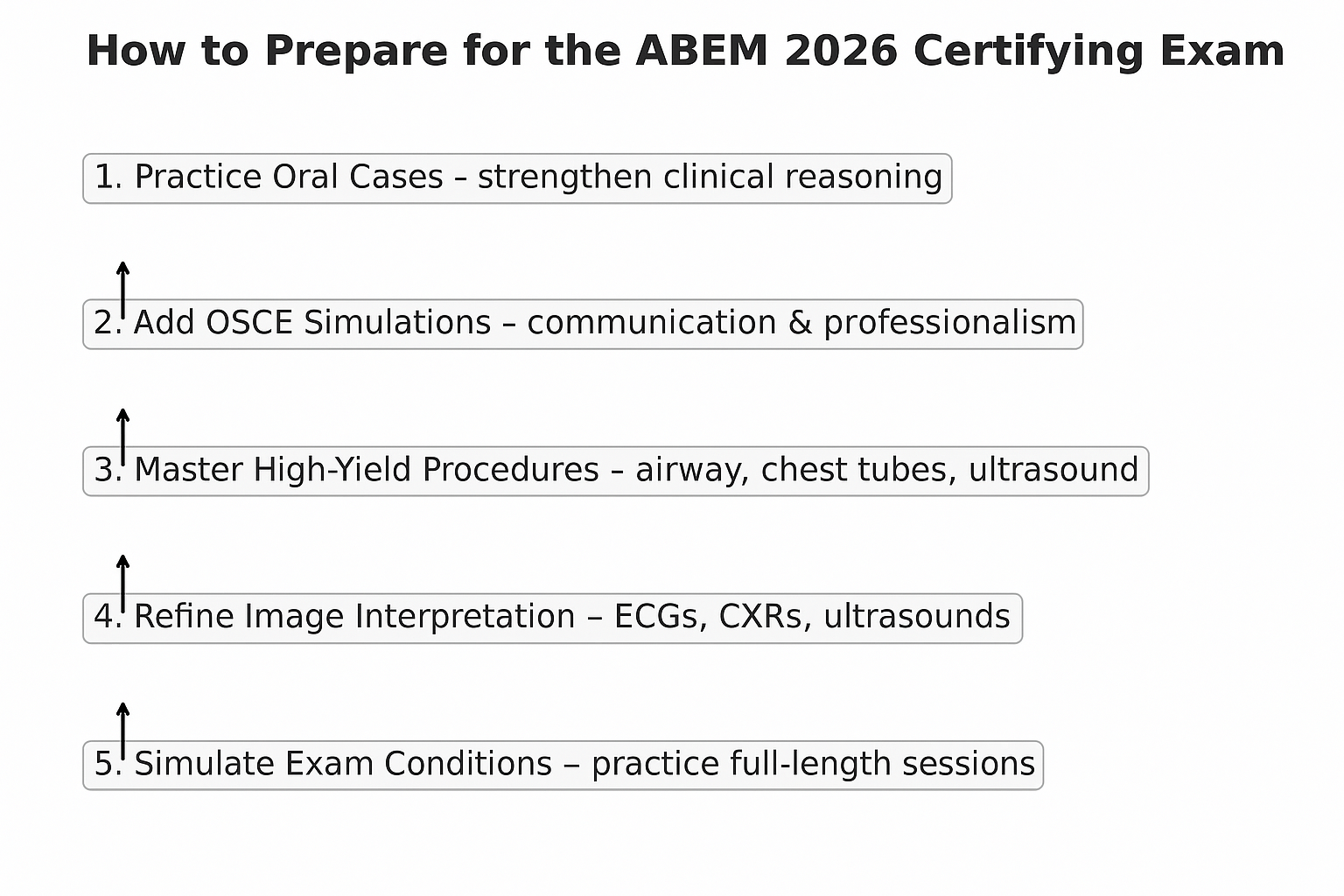
Many candidates fail the oral boards not because they lack medical knowledge, but because they fail to follow the "rules of the game." A dedicated oral board review course provides mock simulations that are invaluable for overcoming this hurdle.
Common Pitfalls in Board Preparation
Even with the best course, your preparation can falter if you fall into common study traps.
Over-reliance on Passive Learning
Reading a textbook from cover to cover is one of the least efficient ways to prepare for a standardized exam. The ABEM exams are designed to test application, not just recognition. Ensure at least 60% of your study time is spent on "active" tasks like answering questions or explaining concepts out loud.
Ignoring the "Blueprint"
ABEM publishes a specific weight for each category (e.g., Cardiovascular 10%, Orthopedics 6%). Do not spend three weeks mastering rare dermatological conditions that make up only 2% of the exam while ignoring high-frequency topics like Toxicology or Trauma.
Neglecting the "Key Advances"
For MyEMCert especially, ABEM emphasizes recent changes in clinical guidelines. If your study material is more than two years old, it may not reflect the current "correct" answer for the boards, even if it reflects what you do in your local practice.
Technical Specifications and Accessibility
In 2026, accessibility is a major factor. A review course that lacks a robust mobile app is significantly less valuable. The ability to sync your progress between a desktop at the hospital and a phone during a break is crucial for maintaining a consistent study rhythm. Look for platforms that offer:
- Offline Access: For studying in areas with poor hospital Wi-Fi.
- Searchability: The ability to quickly look up a "pearl" during a shift.
- Customizable Tests: The ability to create a quiz focusing only on your "incorrect" questions or specific organ systems.
Frequently Asked Questions
What is the average pass rate for the ABEM Qualifying Exam?
Historically, the pass rate for first-time takers of the ABEM Qualifying Exam hovers between 90% and 93%. However, this rate can be deceptive, as candidates are typically high-achieving medical professionals. Most who fail cite lack of structured study time or focusing on the wrong material as the primary reason.
When should I start studying for the initial certification?
Most residents begin a light review (20-30 questions a week) at the start of their final year of residency. Intensive study (10-15 hours a week) usually begins 3-4 months before the exam date.
Does Hippo EM or Rosh Review offer a better "Pass Guarantee"?
Both offer variations of a guarantee. Typically, if you complete a certain percentage of their question bank (usually 100%) and still fail the ABEM exam, they will offer either a full refund or a free subscription extension. Always read the fine print, as these guarantees often require proof of failure within a specific timeframe.
Can I use MyEMCert materials for the initial Qualifying Exam?
While there is overlap, MyEMCert materials are often too narrow for the Qualifying Exam. The QE requires a broad "generalist" knowledge base, whereas MyEMCert is focused on specific modules. It is better to use a dedicated QE prep course for your initial certification.
Are live board review courses still relevant in 2026?
Yes. While digital platforms are more convenient, live courses (physical or synchronous virtual) provide the benefit of "forced" focus. For physicians who struggle with self-discipline or have busy home lives, a 3-day intensive course provides a dedicated environment free from distractions.
Final Recommendation
For the most comprehensive and balanced preparation, a hybrid approach is recommended. Use a high-volume question bank like Rosh Review or PEER as your daily foundation to build "pattern recognition." Supplement this with a high-yield video or audio series like Hippo EM to reinforce difficult concepts during your commute or downtime. If you are preparing for the Oral Boards, do not rely solely on books; invest in at least one interactive simulation course to master the specific verbal requirements of the VOBE.
Always verify the current exam dates and specific requirements directly through the Official ABEM Website to ensure your study plan aligns with the latest 2026 mandates.