Choosing the right institution to study accounting in North Carolina lays the groundwork for a successful career in auditing, corporate finance, taxation, or advisory services. The state features several distinguished universities recognized by major accounting firms, employers, and professional licensing boards for rigorous curricula, high CPA exam pass rates, and robust recruiting pipelines.
North Carolina is home to a rich mix of public research powerhouses and private liberal arts institutions offering specialized undergraduate and graduate accounting degrees. Selecting the best accounting college in the state involves looking beyond general university rankings to evaluate program accreditation, curriculum flexibility, faculty expertise, and opportunities for internships with regional and national public accounting firms.
Understanding the Landscape of Accounting Education in North Carolina
The Tar Heel State holds a strong reputation for business education. When evaluating accounting colleges, prospective students must consider the ultimate goal of most accounting majors: qualifying to sit for the Certified Public Accountant (CPA) exam and earning a license. Most U.S. states, including North Carolina, require 150 semester hours of college credit to secure full CPA licensure, which typically means completing either a specialized Master of Accounting (MAC) program or a rigorous five-year combined bachelor's and master's track.
The top accounting colleges in North Carolina balance technical proficiency in financial reporting, auditing, and tax law with data analytics, ethics, and communication skills. Employers increasingly look for graduates who understand not just traditional ledger accounting, but also data visualization tools, enterprise resource planning (ERP) systems, and modern forensic auditing techniques.
1. University of North Carolina at Chapel Hill (Kenan-Flagler Business School)
The Kenan-Flagler Business School at the University of North Carolina at Chapel Hill consistently ranks among the premier business and accounting schools in the nation. While undergraduate students can major in business administration with a concentration in accounting, Kenan-Flagler is widely recognized for its elite Master of Accounting (MAC) program.
Program Structure and Highlights
- Degree Options: Full-time On-Campus MAC, Online MAC (@UNC), and Undergraduate Business Concentration.
- CPA Exam Performance: Chapel Hill graduates historically achieve pass rates on the CPA exam that significantly exceed national averages.
- Recruiting: The school maintains deep recruiting ties with the Big Four accounting firms (Deloitte, Ernst & Young, KPMG, and PwC) as well as major corporate finance departments across the Southeast and nationwide.
Admissions and Prerequisites
Admission to the undergraduate business program requires a competitive application process during the sophomore year at UNC. The MAC program accepts applicants from any undergraduate major, provided they complete prerequisite coursework in financial accounting, managerial accounting, and microeconomics.
2. Duke University (Fuqua School of Business / Undergraduate Economics & Finance)
While Duke University does not offer a standalone undergraduate major in accounting, its educational ecosystem—anchored by Trinity College of Arts & Sciences and the Fuqua School of Business—prepares exceptional quantitative thinkers who routinely enter the upper echelons of public accounting, investment banking, and corporate advisory.
Program Structure and Highlights
- Curriculum Focus: Students interested in accounting typically major in Economics with a concentration in finance or pursue a Certificate in Markets and Management. They supplement this with rigorous coursework in financial reporting and corporate valuation.
- Graduate Pathways: Duke's Fuqua School of Business offers a Master of Quantitative Management (MQM) in Business Analytics, which attracts many students aiming for advanced financial and data-driven accounting roles.
- Global Network: Duke's alumni network provides unparalleled access to elite financial hubs in New York, Charlotte, and London.
Admissions and Prerequisites
Duke is notoriously selective, with holistic admissions evaluating exceptional SAT/ACT scores (when submitted), rigorous high school transcripts, and demonstrated leadership. For students already enrolled, declaring an economics or finance track requires maintaining a strong GPA and fulfilling intermediate quantitative prerequisites.
3. North Carolina State University (Poole College of Management)
Located in Raleigh, NC State’s Poole College of Management provides a pragmatic, highly respected accounting curriculum designed to meet the immediate demands of modern industry and public practice. The Department of Accounting at Poole is renowned for its Jenkins Master of Accounting (MAC) program and its unique Enterprise Risk Management (ERM) integration.
Program Structure and Highlights
- Degree Options: Bachelor of Science in Accounting and the Jenkins MAC program (available on-campus and online).
- Specializations: The Jenkins MAC allows students to choose distinct tracks, such as Enterprise Risk Management, Information Technology, or Financial Analysis.
- Industry Connection: NC State sits at the heart of the Research Triangle, giving students direct access to technology startups, manufacturing giants, and regional accounting practices.
Admissions and Prerequisites
Undergraduate admission to NC State requires competitive high school class ranks, GPA, and standardized testing scores. The Jenkins MAC program welcomes both accounting majors and non-accounting majors (via foundational "boot camp" bridge courses), making it one of the most accessible top-tier graduate programs in the state.
4. Wake Forest University School of Business
Wake Forest University, located in Winston-Salem, maintains a legendary reputation for accounting excellence, consistently achieving some of the highest CPA exam pass rates and employment placement percentages in the United States. Wake Forest emphasizes an integrated five-year BS/MSA (Master of Science in Accountancy) track.
Program Structure and Highlights
- Integrated BS/MSA Curriculum: Students are admitted with the expectation of completing both their undergraduate degree and the Master of Science in Accountancy in five total years, seamlessly fulfilling the 150-hour CPA requirement.
- Class Size and Attention: Unlike massive public research universities, Wake Forest offers small class sizes, intensive faculty mentorship, and a cohort-based learning model.
- Employment Outcomes: Historically, nearly 100% of Wake Forest MSA graduates secure job offers prior to graduation, primarily with national and international public accounting firms.
Admissions and Prerequisites
Admission to Wake Forest is highly competitive at both the freshman undergraduate level and for external applicants seeking entry directly into the graduate MSA program. Applicants must demonstrate strong quantitative aptitude, clear leadership potential, and exceptional interpersonal skills, which are heavily weighted during admissions interviews.
5. Appalachian State University (Walker College of Business)
Appalachian State University’s Walker College of Business, located in Boone, offers an exceptional, value-driven accounting education that prepares students thoroughly for regional and national careers. The Department of Accounting at App State is widely respected by employers across North Carolina for producing graduates with strong technical skills and a high-degree of professional readiness.
Program Structure and Highlights
- Degree Options: Bachelor of Science in Business Administration (BSBA) in Accounting and a Master of Science in Accounting (MSA).
- CPA Success: App State graduates consistently achieve top-tier pass rates on the CPA exam among regional comprehensive universities.
- Experiential Learning: The college emphasizes practical experience through mandatory internships, professional student organizations like Beta Alpha Psi, and Volunteer Income Tax Assistance (VITA) programs.
Admissions and Prerequisites
App State offers a more accessible admissions threshold than elite private universities like Duke or Wake Forest, while maintaining strict retention and progression standards within the Walker College of Business. Students must maintain a designated GPA in introductory business and accounting courses to be officially admitted into the upper-level accounting major.
Comparative Overview of Top NC Accounting Programs
| Institution | Primary Degree Offerings | Key Specializations / Features | Average Profile / Notes |
|---|---|---|---|
| UNC Chapel Hill (Kenan-Flagler) | BSBA (Accounting), Full-time & Online MAC | Big Four recruiting powerhouse, elite national reputation | Highly selective; requires sophomore business admission or external MAC application. |
| Duke University | Economics/Finance Track, MQM Analytics | Quantitative finance, elite corporate network | Ultra-selective; no standalone undergraduate accounting major. |
| NC State University (Poole) | BS in Accounting, Jenkins MAC | Enterprise Risk Management (ERM), IT auditing | Strong Research Triangle presence; flexible MAC bridge courses for non-majors. |
| Wake Forest University | Integrated BS / Master of Science in Accountancy (MSA) | 5-year 150-hour track, near 100% placement | Small cohorts, intensive faculty mentorship, exceptional CPA pass rates. |
| Appalachian State University | BSBA in Accounting, Master of Science in Accountancy | Practical field experience, VITA program, regional firms | High value, strong regional employer ties, rigorous progression standards. |
Key Factors to Consider When Choosing an Accounting College
Selecting the best program involves aligning personal career goals with institutional strengths. Students should evaluate several critical criteria before submitting applications or committing to a program:
1. CPA Exam 150-Hour Compliance
Because licensing boards require 150 credit hours, a standard four-year bachelor's degree (which typically awards 120 hours) is insufficient for full licensure. Programs that feature an integrated fifth-year Master's degree—such as those at Wake Forest and NC State—simplify this transition by ensuring all 150 hours are completed smoothly without requiring students to apply to a separate graduate school.
2. Recruiting Footprint and Alumni Networks
Public accounting firms recruit heavily on campus. Schools like UNC Chapel Hill, Wake Forest, and NC State host dedicated accounting career fairs where representatives from national, regional, and local firms interview students directly. Evaluating the employment report of a target school provides clear insight into whether Big Four or mid-tier firms actively recruit on campus.
3. Cost and Financial Return on Investment (ROI)
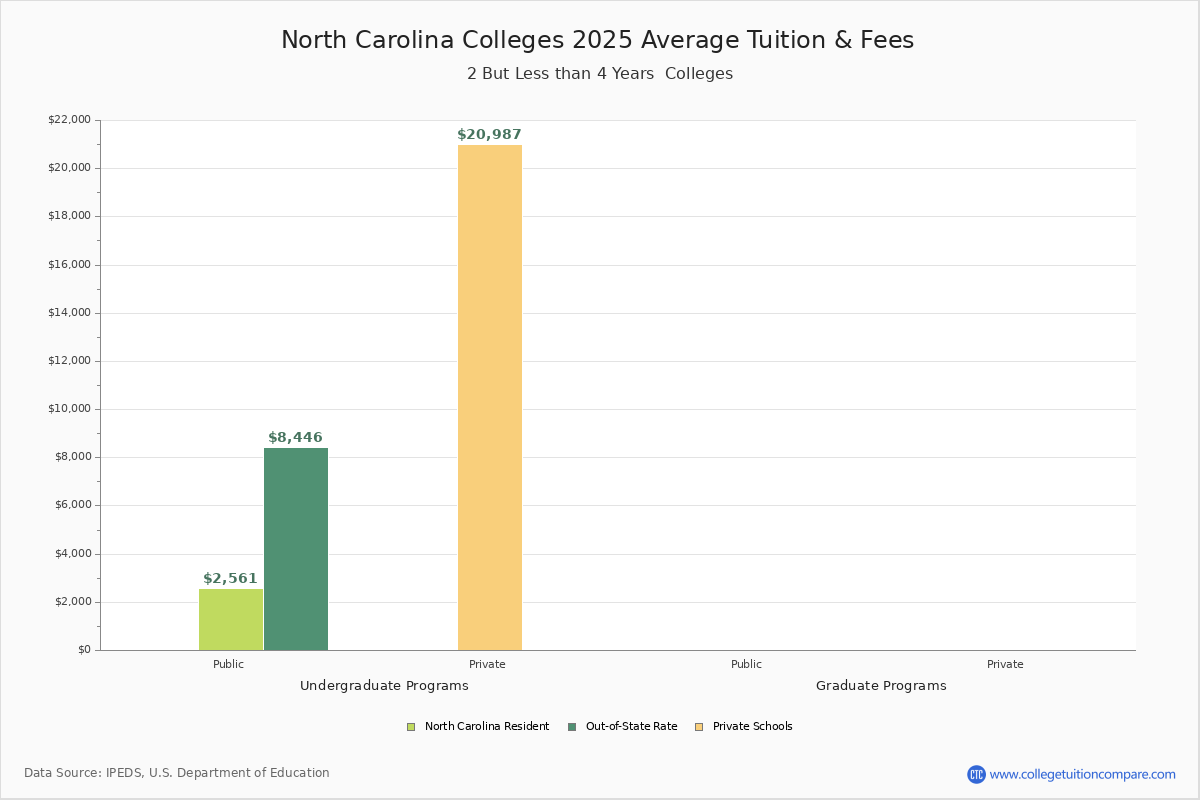
Tuition costs vary dramatically between public institutions (such as UNC, NC State, and App State) and private universities (such as Duke and Wake Forest). Prospective students should weigh net tuition costs against starting salaries in public accounting and corporate finance to calculate realistic financial outcomes.
Frequently Asked Questions About Accounting Colleges in NC
Do I need a master's degree to become a CPA in North Carolina?
The North Carolina State Board of Certified Public Accountant Examiners requires 150 semester hours of college education, including specific concentrations in accounting, auditing, business, and taxation, to secure a CPA license. While a master's degree is not strictly mandatory if you accumulate 150 hours through a double major or advanced coursework, completing a dedicated MAC or MSA program is the most direct and reliable way to meet these educational requirements.
Are online accounting degrees from North Carolina universities respected?
Yes. Programs such as the Online MAC at NC State and the Online MAC at UNC Chapel Hill confer the exact same academic rigor and diploma value as their on-campus counterparts. They are designed specifically for working professionals or career-switchers who need scheduling flexibility without sacrificing recruiter access.
Which North Carolina accounting schools have the best placement with Big Four firms?
UNC Chapel Hill (Kenan-Flagler) and Wake Forest University historically lead the state in placement numbers with the Big Four (Deloitte, EY, KPMG, and PwC). However, NC State’s Poole College of Management also places a significant number of graduates into these global firms annually, particularly within audit and risk advisory practices.
Can non-accounting majors apply to graduate accounting programs in NC?
Several top graduate programs, including the Jenkins MAC at NC State and the MAC program at UNC Chapel Hill, actively welcome non-accounting majors. These programs offer foundational "summer boot camps" or prerequisite bridge courses that bring humanities, STEM, and social science graduates up to speed before entering advanced graduate-level accounting coursework.
Next Steps for Prospective Accounting Students
To begin your journey toward an accounting career in North Carolina, identify three to four institutions from this list that align with your academic profile and financial parameters. Review their specific prerequisite course checklists, register for campus information sessions or virtual open houses, and reach out directly to undergraduate or graduate business admissions counselors to discuss your application strategy.