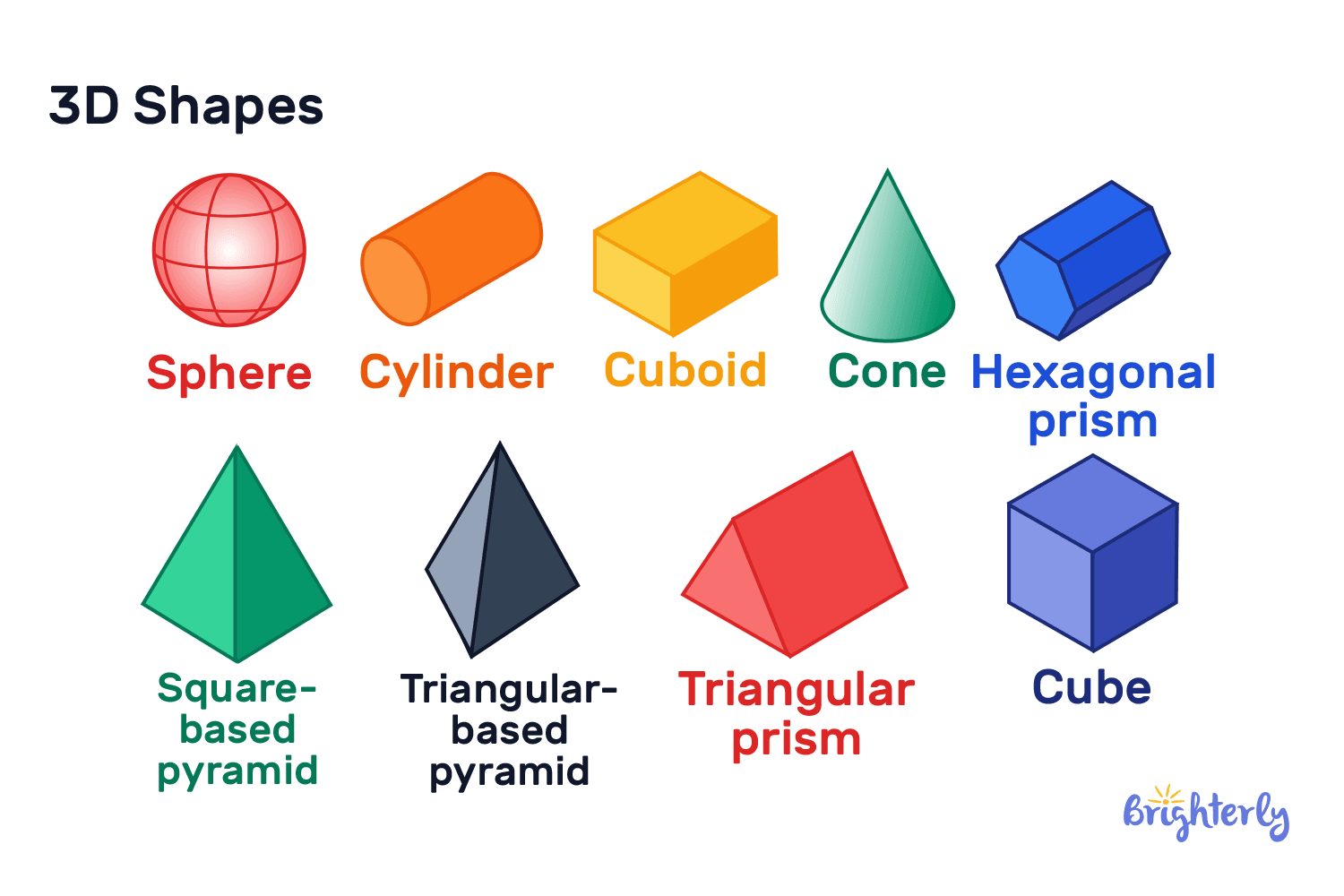
In geometry, a 3D shape with eight sides—more accurately referred to as eight faces—is known as an octahedron. While the regular octahedron (a Platonic solid) is the most recognizable version, the category also includes hexagonal prisms, heptagonal pyramids, and various truncated polyhedra, each defined by unique vertex and edge configurations.
Geometry often feels like a rigid field, but when we look at three-dimensional space, the diversity of forms is staggering. To understand a "3D shape with eight sides," we must first clarify the terminology. In two-dimensional geometry, a side is a line segment. In three-dimensional geometry, "sides" are typically called faces. A polyhedron is a 3D solid bounded by polygons, and any polyhedron with exactly eight faces is an octahedron.
As of 2026, educational standards and architectural modeling continue to rely on these fundamental shapes for everything from structural integrity to data visualization. This guide explores the different types of 8-faced solids, their mathematical properties, and how they manifest in the physical world.
The Regular Octahedron: The Platonic Ideal
The most famous 8-sided 3D shape is the regular octahedron. It is one of the five Platonic solids, which are convex polyhedra where every face is an identical regular polygon and the same number of faces meet at each vertex.
Structure and Symmetry
The regular octahedron is composed of eight equilateral triangles. It has six vertices and twelve edges. If you were to visualize it, it looks like two square-based pyramids joined at their bases. Because of its high degree of symmetry (octahedral symmetry), it is a staple in the study of crystallography and molecular chemistry.
In mathematical terms, the regular octahedron is the "dual" of the cube. This means that if you place a point in the center of each face of a cube and connect those points, you will form a regular octahedron. Conversely, placing points in the center of an octahedron’s faces results in a cube. This relationship is a cornerstone of Euclidean geometry and spatial reasoning.
Surface Area and Volume
For a regular octahedron with an edge length of a, the mathematical formulas are precise:
- Surface Area: $2\sqrt{3} \times a^2$
- Volume: $\frac{\sqrt{2}}{3} \times a^3$
These calculations are vital for professionals in fields like 3D printing and material science, where calculating the exact volume of resin or filament is necessary for cost-efficient production in 2026.
The Hexagonal Prism: An Everyday Octahedron
While the regular octahedron is aesthetically pleasing, the hexagonal prism is arguably more common in industrial design and nature (such as in honeycomb structures). A prism is a polyhedron with two congruent, parallel bases and rectangular sides.
Why It Has Eight Faces
A hexagonal prism consists of:
- Two hexagonal bases (top and bottom).
- Six rectangular side faces (connecting the edges of the hexagons).
$2 \text{ (bases)} + 6 \text{ (sides)} = 8 \text{ faces total.}$
Unlike the regular octahedron, the faces of a hexagonal prism are not all the same shape. It has 12 vertices and 18 edges. This shape is frequently used in the design of fasteners, such as nuts and bolts, because the six rectangular sides provide multiple flat surfaces for a wrench to grip, while the overall 8-faced structure remains compact.
The Heptagonal Pyramid
Another variation of the 8-sided 3D shape is the heptagonal pyramid. A pyramid is formed by connecting a polygonal base to a point called the apex.
Composition
To achieve eight total faces, the base must be a heptagon (a 7-sided polygon).
- One heptagonal base.
- Seven triangular faces that meet at the apex.
This configuration results in 8 vertices (7 on the base and 1 at the apex) and 14 edges. Heptagonal pyramids are rarer in classical architecture compared to square pyramids, but they are often studied in advanced geometry to demonstrate how increasing the number of base edges approaches the shape of a cone.
The Truncated Tetrahedron: An Archimedean Solid
Moving into more complex territory, the truncated tetrahedron is an 8-faced solid that falls into the category of Archimedean solids. These are highly symmetric, semi-regular convex polyhedra.
Formation and Faces
A truncated tetrahedron is created by taking a regular tetrahedron (a 4-faced pyramid) and cutting off its four corners (vertices). This process results in:
- Four hexagonal faces (where the original faces were).
- Four triangular faces (where the corners were cut off).
Totaling eight faces, this shape is significant in modern chemistry for representing certain molecular structures and in the design of specialized aerodynamic components. It has 12 vertices and 18 edges.
Johnson Solids and Irregular Octahedrons
Beyond the well-known prisms and Platonic solids, there are several "Johnson Solids"—strictly convex polyhedra where each face is a regular polygon, but the shape is not a Platonic or Archimedean solid.
The Triangular Cupola (J3)
The triangular cupola is an 8-faced Johnson solid. It consists of a hexagonal base, a triangular top, and a "belt" of three squares and three triangles. It is a piece of a larger shape known as a cuboctahedron.
The Gyrobifastigium (J26)
This uniquely named shape consists of 8 faces: four squares and four equilateral triangles. It is essentially formed by joining two triangular prisms along a square face after one has been rotated. It is the only Johnson solid that can "tessellate" or tile 3D space, meaning you can stack them perfectly without leaving gaps—a property highly valued in 2026 for modular construction and self-assembling robotics.
Comparing 8-Sided 3D Shapes
Because "octahedron" can refer to many different configurations, it is helpful to compare their properties side-by-side.
| Shape Name | Type | Face Composition | Vertices | Edges |
|---|---|---|---|---|
| Regular Octahedron | Platonic Solid | 8 Equilateral Triangles | 6 | 12 |
| Hexagonal Prism | Prism | 2 Hexagons, 6 Rectangles | 12 | 18 |
| Heptagonal Pyramid | Pyramid | 1 Heptagon, 7 Triangles | 8 | 14 |
| Truncated Tetrahedron | Archimedean | 4 Hexagons, 4 Triangles | 12 | 18 |
| Triangular Cupola | Johnson Solid | 1 Hexagon, 1 Triangle, 3 Squares, 3 Triangles | 9 | 15 |
| Gyrobifastigium | Johnson Solid | 4 Squares, 4 Triangles | 8 | 14 |
Euler's Formula: The Mathematical Proof
Regardless of the shape’s complexity, all convex 8-sided 3D shapes must obey Euler’s Formula for polyhedra. This formula states that the number of vertices ($V$) minus the number of edges ($E$) plus the number of faces ($F$) must always equal 2.
$$V - E + F = 2$$
Let’s test this with a regular octahedron:
- $V = 6$
- $E = 12$
- $F = 8$
- $6 - 12 + 8 = 2$
Now, let’s test it with a hexagonal prism:
- $V = 12$
- $E = 18$
- $F = 8$
- $12 - 18 + 8 = 2$
This mathematical consistency allows architects and engineers to verify the structural integrity of complex designs. If a 3D model of an 8-sided structure does not satisfy this equation, it is likely not a "closed" or "convex" solid, which could indicate a flaw in the digital design file.
Real-World Applications of 8-Sided Shapes
Understanding 8-sided 3D shapes is not just an academic exercise. These forms are integrated into various industries and natural phenomena.
1. Crystallography and Mineralogy
Many natural crystals form in octahedral structures. The most famous example is diamond. Pure carbon atoms often arrange themselves in an octahedral lattice because it is an incredibly stable and energy-efficient configuration. Fluorite is another mineral that frequently presents as perfect octahedrons. Scientists use the knowledge of these "eight sides" to identify minerals and understand their cleavage properties (how they break).
2. Gaming and Probability
In the world of tabletop gaming (such as Dungeons & Dragons), the d8 is a standard eight-sided die. It is shaped like a regular octahedron. Because it is a Platonic solid, it is "fair," meaning every face has an equal probability of landing face-up. This symmetry is why only Platonic solids are traditionally used for dice; an 8-faced shape like a hexagonal prism would not be a fair die because the hexagonal faces are larger than the rectangular ones.
3. Architecture and Engineering
Hexagonal prisms are ubiquitous in engineering. Look at a standard pencil or a honeycomb; the hexagonal faces allow for high structural strength while using minimal material. In 2026, many sustainable building designs utilize 8-faced modular units because they can be arranged to maximize interior volume while minimizing the exterior surface area, which helps in thermal regulation.
4. Chemistry and Molecular Geometry
The "octahedral molecular geometry" describes the shape of compounds where six atoms or groups of atoms are symmetrically arranged around a central atom. While there are six surrounding atoms, they form the vertices of an imaginary octahedron, creating eight triangular faces of interaction. Sulfur hexafluoride ($SF_6$) is a classic example of this. You can find more on molecular geometry at Wolfram MathWorld.
How to Visualize and Draw an Octahedron
Visualizing an 8-sided shape like the regular octahedron can be challenging because it lacks the flat "upright" stance of a cube. The easiest way to visualize it is to imagine a square floating in space. Now, imagine a point directly above the center of that square and a point directly below it. Connect all four corners of the square to the top point and then to the bottom point.
For students or designers, "nets" are often used to construct these shapes. A net is a 2D template that can be folded into a 3D solid.
- Net of a Regular Octahedron: Usually looks like a chain of four triangles with another chain of four triangles attached.
- Net of a Hexagonal Prism: Consists of a long strip of six rectangles with a hexagon attached to the top and bottom of one of the rectangles.
Common Misconceptions About 8-Sided Shapes
There are a few common points of confusion when discussing these shapes:
- "Sides" vs. "Edges": In casual conversation, people often say "an 8-sided shape" when they mean an octagon (2D). In 3D, it is vital to distinguish between faces (the flat surfaces), edges (where faces meet), and vertices (the corners).
- All Octahedrons are Regular: Many assume that an octahedron must be the Platonic solid made of triangles. However, any polyhedron with 8 faces is an octahedron. A hexagonal prism is just as much an octahedron as the triangle-based one.
- The "Stop Sign" Confusion: A stop sign is an octagon (8 sides, 2D). If you extrude it into 3D, it becomes a hexagonal prism only if the base is hexagonal. A 3D stop sign is actually a very thin octagonal prism, which has 10 faces (2 octagonal bases + 8 rectangular sides). Therefore, a 3D stop sign is not an 8-sided 3D shape; it is a 10-sided one.
Frequently Asked Questions
What is the name of a 3D shape with 8 sides?
The general name for any 3D shape with eight faces is an octahedron. The most common types are the regular octahedron (8 triangles), the hexagonal prism (6 rectangles, 2 hexagons), and the heptagonal pyramid (7 triangles, 1 heptagon).
Is a cube an octahedron?
No, a cube has 6 faces. However, a cube and a regular octahedron are duals of each other. This means they share a mathematical symmetry where the number of faces of one equals the number of vertices of the other.
How many vertices does an 8-sided 3D shape have?
The number of vertices depends on the specific shape. A regular octahedron has 6 vertices, a hexagonal prism has 12, and a heptagonal pyramid has 8. All of these variations satisfy Euler's Formula ($V - E + F = 2$).
Are all 8-sided 3D shapes "fair" for dice?
No. Only the regular octahedron is used for fair dice (d8) because all its faces are identical equilateral triangles. Shapes like the hexagonal prism have different types of faces (hexagons and rectangles), which would cause certain sides to land face-up more frequently than others.
Where can I find 8-sided shapes in nature?
The most prominent examples are in crystals. Diamonds and fluorite often grow in octahedral shapes. Additionally, some microscopic organisms, like certain types of radiolaria, exhibit octahedral symmetry in their skeletal structures. For more technical details on polyhedra in nature, visit Britannica's Polyhedron entry.
Recommendation for Next Steps
If you are a student or a hobbyist looking to master 3D geometry, the best next step is to move from theory to practice.
- Construct a Net: Download or draw a template for a regular octahedron and a hexagonal prism. Physically folding these shapes helps internalize the relationship between 2D surfaces and 3D volume.
- Explore Digital Modeling: Use free software like Tinkercad or Blender to create an 8-faced solid. Try "truncating" a cube or a tetrahedron in the software to see how new faces are formed.
- Study Duals: Look into the "Dual Polyhedron" concept further. Understanding why a cube and an octahedron are linked will provide a much deeper foundation for advanced mathematics and spatial design.
By 2026, with the rise of spatial computing and augmented reality, being able to identify and manipulate these fundamental 3D forms is becoming an essential skill across various technical and creative disciplines.