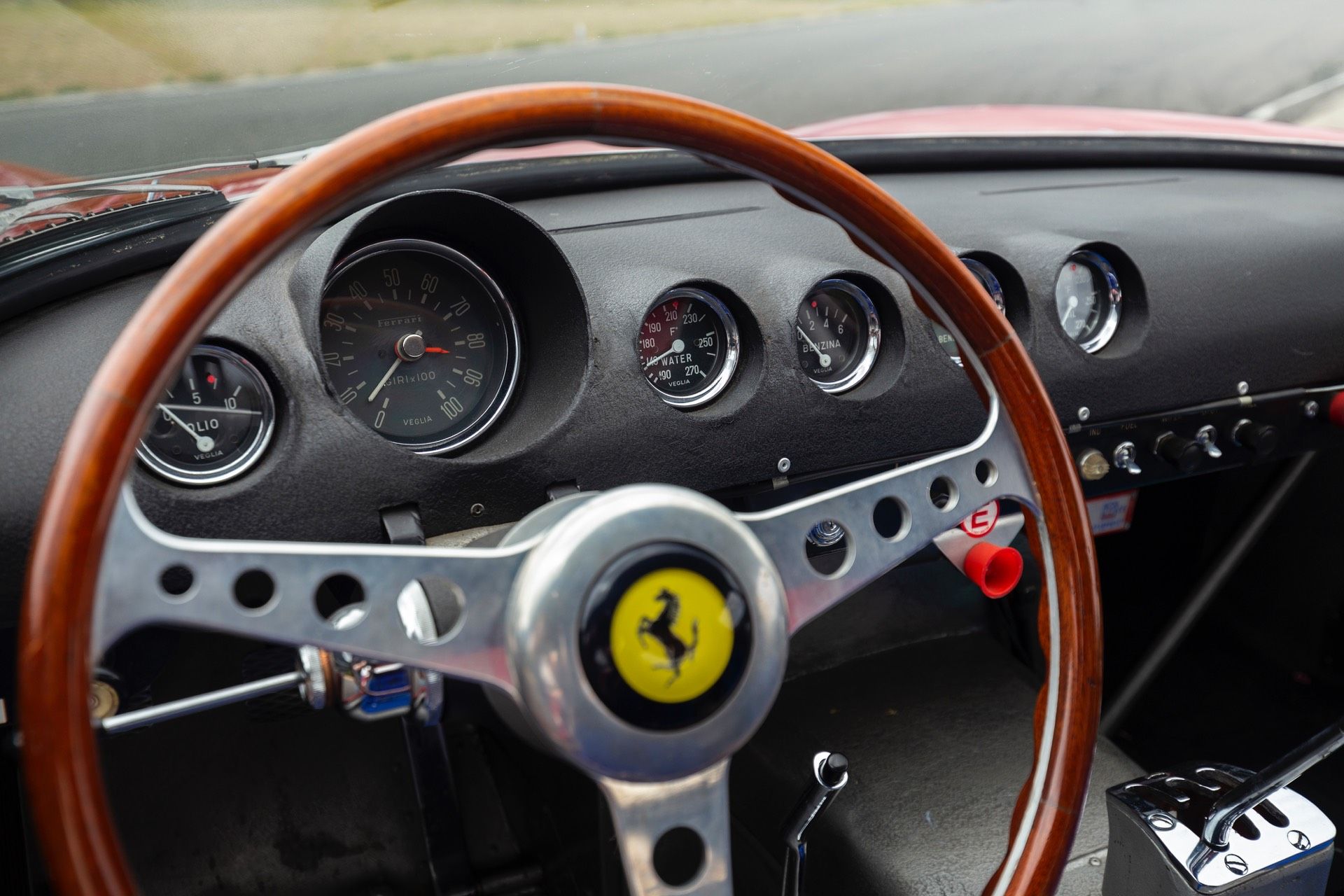
The Ferrari 250 GTO interior is defined by its stark, functionalist design, prioritizing weight reduction and driver focus over luxury. Featuring a bare aluminum floor, a simple wood-rimmed steering wheel, and sparse instrumentation, the cabin reflects the car's primary purpose as a dominant 1960s GT racer, offering only the essentials required for high-speed endurance competition.
The Philosophy of Purpose: Beyond Aesthetic Luxury
To understand the interior of the 250 GTO, one must first discard modern expectations of automotive interiors. Produced between 1962 and 1964, the 250 GTO was not intended to be a grand tourer in the traditional sense; it was a homologated racing machine designed to capture the FIA World Sportscar Championship. Every element inside the cockpit was subject to a rigorous "weight is the enemy" philosophy, enforced by Enzo Ferrari’s engineers.
Unlike the contemporary Ferrari 250 GT Lusso, which featured a plush, leather-lined cabin, the GTO interior is unapologetically raw. The cockpit is a space where the driver’s interface with the machinery is prioritized above all else. This results in a design that is visually sparse but technically profound. The absence of carpets, sound deadening, and elaborate dashboard cladding was not merely an aesthetic choice; it was a fundamental performance requirement that allowed the GTO to maintain its competitive edge on the circuits of Le Mans, Sebring, and the Targa Florio.
The Driver’s Interface: Steering and Shifting
The most critical components of the 250 GTO interior are those that facilitate control. The steering wheel is a signature Nardi unit, characterized by its thin wood rim and aluminum spokes. This design provided the tactile feedback necessary for high-speed maneuvers on varied track surfaces. The simplicity of the wheel reflects the lack of power steering; the driver is directly connected to the rack-and-pinion system, feeling the nuances of the tires' contact patches through the wooden rim.
Central to the driving experience is the open-gate manual shifter. Ferrari’s iconic gated gearbox is mounted on a tall, central transmission tunnel. This mechanical arrangement ensures precise gear changes, preventing the driver from accidentally selecting the wrong gear during the intense heat of a race. The metallic "click-clack" sound of the lever moving through the metal gate has become synonymous with the mechanical purity of the era. The gear knob itself is typically a simple, spherical wooden or plastic piece, designed for a positive grip even when the driver is wearing racing gloves.
Instrumentation and Ergonomics
The dashboard of the 250 GTO is a flat, painted or covered metal panel that houses a minimalist array of Veglia Borletti gauges. Positioned directly in front of the driver, these dials prioritize clarity over aesthetics. The tachometer is the most prominent gauge, often placed centrally or highlighted to ensure the driver can monitor the Colombo V12’s high-revving output without distraction.
Secondary gauges, including oil pressure, oil temperature, and water temperature, are grouped alongside the speedometer. These instruments are analog, utilizing needle movements that provide immediate, instinctive visual cues. Because the 250 GTO was a tool for endurance, the ergonomics were focused on the driver's ability to monitor vital engine health during multi-hour stints. The seating position is low, placing the driver deep within the chassis for a lower center of gravity and improved weight distribution, further emphasizing the car’s racing pedigree.
Materiality: The Utility of Aluminum and Leather
Inside the cabin, the materials reflect a blend of durability and weight saving. The floors are typically bare aluminum, often featuring a textured or "diamond" pattern to provide grip for the driver's feet. This choice prevents the accumulation of dirt and allows for easy cleaning, but more importantly, it eliminates the weight of floor mats and carpet adhesive.
The seats in a 250 GTO are bucket-style racing seats, typically upholstered in black or dark-colored leather or vinyl. These seats were designed to provide significant lateral support, essential for keeping the driver secure during high-G cornering. Unlike modern racing seats that feature complex harnesses, the GTO’s seats rely on their form to hold the driver in place, supplemented by simple four-point racing belts. The door panels are equally basic, often consisting of thin aluminum sheets or lightweight, pull-strap door releases, further reducing mass where structural integrity is not compromised.
Comparison: 250 GTO vs. 250 GT Lusso Interiors
It is common for enthusiasts to confuse the GTO with its more refined sibling, the 250 GT Lusso. While both are built on the 250 series chassis, their interiors serve completely different masters.
| Feature | 250 GTO | 250 GT Lusso |
|---|---|---|
| Primary Goal | Competitive Racing | Grand Touring/Comfort |
| Floor Covering | Bare Metal/Aluminum | High-Quality Carpet |
| Dashboard | Painted Metal, Sparse | Leather-Covered, Padded |
| Gauges | Centrally Positioned for Focus | Driver-Oriented (Central Console) |
| Door Trim | Minimalist/Raw | Leather Upholstery |
| Overall Ambiance | Utilitarian & Mechanical | Luxurious & Refined |
This table highlights the divergence in design intent. While the Lusso was crafted for owners who valued the 250 V12 engine's performance within the context of a road-going luxury vehicle, the GTO was an instrument of war for the track.
Maintenance and Preservation of the Cockpit
For owners and collectors in 2026, preserving the interior of a 250 GTO presents a unique challenge. Because these interiors were originally constructed for utility, the materials—specifically the aging leather and the thin metal panels—are susceptible to degradation. Restoration of a 250 GTO interior requires a commitment to "correct" historical accuracy. Replacing original materials with modern, more durable alternatives can significantly diminish the historical value and provenance of the vehicle.
Collectors prioritize original patina over "over-restoration." If a piece of the original leather seat is frayed or a dashboard gauge has lost its original finish, conservationists often choose to stabilize the existing components rather than replace them. This approach respects the history of the car, as the wear and tear inside a GTO often tell the story of its racing life.
Frequently Asked Questions
Why does the Ferrari 250 GTO have such a sparse interior? The interior was designed for a singular purpose: winning races. By removing all non-essential elements like luxury trim, soundproofing, and heavy carpeting, Ferrari’s engineers could shed critical kilograms, which directly improved the car's power-to-weight ratio and handling on the track.
Are all 250 GTO interiors identical? While they follow the same design language, individual GTOs often show slight variations. Because these cars were hand-built in the early 1960s, custom adjustments were often made to suit the specific racing team or the preferences of the original owner. However, the core elements—Nardi wheel, gated shifter, and raw metal surfaces—remain consistent.
What is the "open-gate" shifter design's benefit? The gated shifter provides tactile feedback and mechanical precision. By forcing the gear lever through a steel gate, the design minimizes the chance of missing a shift during high-RPM driving, which is crucial for preserving the longevity of the transmission in a racing environment.
How should a collector maintain an original GTO interior today? Preservation is the gold standard. Use climate-controlled storage to prevent leather cracking and metal oxidation. Avoid heavy cleaning agents that could strip the original finish. If professional work is required, seek out specialists who focus on period-correct materials and techniques.
Is the driving position in a 250 GTO comfortable for long trips? No. By modern standards, the GTO is physically demanding. The seating is upright, the cabin is loud due to the lack of insulation, and the heat from the transmission tunnel can be significant. It was built for endurance racing, not touring comfort.
Practical Recommendation for Owners
If you are responsible for the stewardship of a 250 GTO, your primary goal for the interior should be documentation and stabilization. Create a comprehensive photographic survey of the cabin in its current state, noting any original components that may be nearing the end of their material lifespan. If you intend to drive the vehicle, ensure that the seat mounting points and safety harnesses are certified for safety by a specialist who understands the specific metallurgy of 1960s Italian racing chassis. Prioritize preserving the "as-raced" condition, as this is where the true historical and market value of a GTO resides.