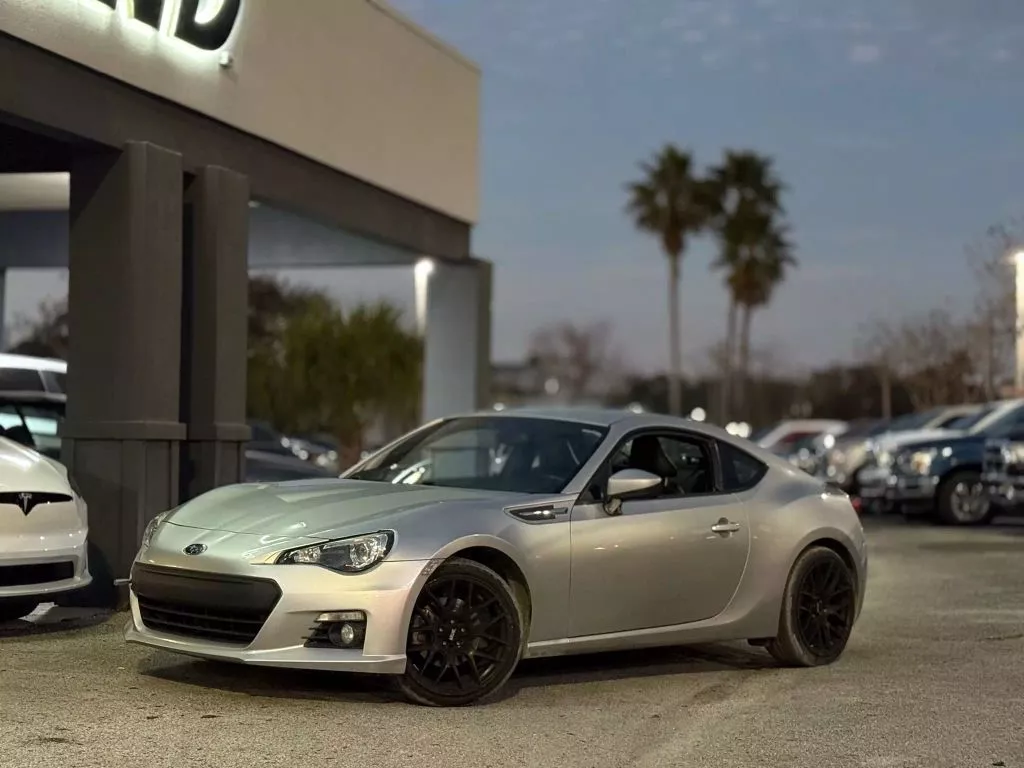
The 2014 Subaru BRZ curb weight ranges between 2,762 pounds (1,253 kg) and 2,824 pounds (1,281 kg), depending on the trim level and transmission choice. The lightest configuration is the base Premium trim equipped with a six-speed manual transmission, while the fully equipped Limited trim with a six-speed automatic transmission represents the top of the weight spectrum.
2014 Subaru BRZ Weight Overview by Trim and Transmission
Engineered as a lightweight, rear-wheel-drive sports coupe, the 2014 Subaru BRZ was co-developed by Subaru and Toyota to prioritize chassis balance, low center of gravity, and driver feedback over raw horsepower. Vehicle mass plays a foundational role in achieving these dynamics.
Subaru offered the 2014 BRZ in two main trim levels for the North American market: Premium and Limited. Both trims feature the naturally aspirated 2.0-liter FA20 horizontally opposed (boxer) four-cylinder engine, but equipment differences and transmission selections alter the overall curb weight.
| Transmission | Trim Level | Curb Weight |
|---|---|---|
| Manual Transmission (6-Speed) | Premium Trim | 2,762 lbs (1,253 kg) |
| Manual Transmission (6-Speed) | Limited Trim | 2,776 lbs (1,259 kg) |
| Automatic Transmission (6-Speed) | Premium Trim | 2,809 lbs (1,274 kg) |
| Automatic Transmission (6-Speed) | Limited Trim | 2,824 lbs (1,281 kg) |
Premium vs. Limited Trim Mass Differences
The standard equipment package accounts for the 14-pound variance between the Premium and Limited trims:
- Premium Trim: Features high-friction cloth upholstery, manual climate control, standard halogen headlights with LED daytime running lights, and a streamlined interior package. By omitting heavier luxury hardware, the Premium trim maintains the lowest possible base curb weight.
- Limited Trim: Adds comfort features including heated front seats upholstered in leather and Alcantara inserts, dual-zone automatic climate control, fog lights, heated side mirrors, keyless access with push-button start, and a body-color rear spoiler. The combined weight of these additional electrical components, heating elements, actuators, and trim materials adds roughly 14 pounds (6.3 kg) to the vehicle.
Transmission Weight Penalty
The choice of gearbox carries a more noticeable impact on vehicle mass than interior trim options:
- 6-Speed Manual Transmission (TL70): Features a lightweight aluminum casing and a simple mechanical clutch mechanism. The manual gearbox keeps total curb weight at 2,762 lbs (Premium) or 2,776 lbs (Limited).
- 6-Speed Torque-Converter Automatic Transmission (A960E): Incorporates a hydraulic torque converter, planetary gearsets, internal clutch packs, an auxiliary transmission fluid cooler, and associated electronic control units. These components add approximately 47 to 48 pounds (21 to 22 kg) over the manual transmission variant, bringing total weight to 2,809 lbs (Premium) or 2,824 lbs (Limited).
Complete 2014 Subaru BRZ Weight and Dimensional Specifications Matrix
Understanding vehicle weight requires looking beyond basic curb weight. Payload capacity, Gross Vehicle Weight Rating (GVWR), fluid weights, and weight distribution define how the chassis performs under dynamic conditions.
| Specification Parameter | Premium 6-Speed Manual | Limited 6-Speed Manual | Premium 6-Speed Automatic | Limited 6-Speed Automatic |
|---|---|---|---|---|
| Curb Weight (lbs / kg) | 2,762 lbs / 1,253 kg | 2,776 lbs / 1,259 kg | 2,809 lbs / 1,274 kg | 2,824 lbs / 1,281 kg |
| Gross Vehicle Weight Rating (GVWR) | 3,682 lbs / 1,670 kg | 3,682 lbs / 1,670 kg | 3,682 lbs / 1,670 kg | 3,682 lbs / 1,670 kg |
| Maximum Payload Capacity | ~750 lbs / 340 kg | ~736 lbs / 334 kg | ~703 lbs / 319 kg | ~688 lbs / 312 kg |
| Front / Rear Weight Distribution | 53% Front / 47% Rear | 53% Front / 47% Rear | 54% Front / 46% Rear | 54% Front / 46% Rear |
| Center of Gravity Height | 18.1 in / 460 mm | 18.1 in / 460 mm | 18.1 in / 460 mm | 18.1 in / 460 mm |
| Fuel Tank Capacity Mass (Full) | ~81.8 lbs / 37.1 kg | ~81.8 lbs / 37.1 kg | ~81.8 lbs / 37.1 kg | ~81.8 lbs / 37.1 kg |
| Engine Assembly Weight (FA20) | ~375 lbs / 170 kg | ~375 lbs / 170 kg | ~375 lbs / 170 kg | ~375 lbs / 170 kg |
Note: Curb weight includes a 100% full fuel tank, engine oil, coolant, windshield washer fluid, and brake fluid, but excludes passengers and cargo.
Chassis Engineering: Center of Gravity and Weight Distribution
Mass quantity is only one part of vehicle engineering; mass distribution dictates how a car behaves during cornering, acceleration, and braking.
- FRONT AXLE: ~53% OF MASS
- Engine mounted low & back
- Steering rack & cooling
- Wheelbase: 101.2 in
- CoG Height: 18.1 in
- REAR AXLE: ~47% OF MASS
- Differential & axles
- Fuel tank beneath seat
18.1-Inch Center of Gravity
One of the standout design characteristics of the 2014 BRZ is its 18.1-inch (460 mm) center of gravity (CoG). To achieve this low figure, Subaru leveraged its flat-four (boxer) engine design:
- Horizontal Cylinder Orientation: Unlike inline-four or V6 engines, which position heavy cylinder heads high in the engine bay, the FA20 engine sits flat.
- Front-Midship Engine Placement: The engine block is positioned as far back toward the firewall and as low down relative to the front crossmember as possible.
- Low Driving Position: The driver and passenger hip points sit low to the road surface, preventing human mass from elevating the vehicle’s overall CoG.
This 18.1-inch CoG height puts the 2014 BRZ in line with or below exotic supercars from its production era, such as the Porsche Cayman (~18.9 inches) and Ferrari 458 Italia (~18.5 inches). Lowering the center of gravity reduces body roll and load transfer during sharp lateral transitions, allowing the vehicle to corner flatly without requiring exceptionally stiff anti-roll bars or overly harsh spring rates.
53/47 Static Weight Distribution
The 2014 BRZ features a static weight distribution of 53% over the front axle and 47% over the rear axle. While enthusiasts often consider 50/50 balance ideal, a slight front weight bias offers distinct dynamic advantages in a front-engine, rear-wheel-drive setup:
- Turn-in Traction: The slight front bias keeps weight over the front tires during corner entry, providing sharp steering response and preventing initial understeer.
- Dynamic Weight Transfer: Under hard braking into a turn, weight shifts forward to maximize front tire mechanical grip. When accelerating out of a corner, weight shifts toward the rear axle, evening out the weight split to near 50/50 and improving traction at the rear drive wheels.
2014 Subaru BRZ Weight vs. Competitors
To evaluate the 2014 BRZ's mass effectively, it must be compared to rival sports cars, roadsters, and muscle cars of the same model year.
| Model | Curb Weight |
|---|---|
| Mazda MX-5 Miata (NC) | 2,480 lbs |
| 2014 Subaru BRZ (6MT) | 2,762 lbs |
| Scion FR-S (6MT) | 2,758 lbs |
| Honda S2000 (AP2)* | 2,855 lbs |
| Nissan 370Z Coupe | 3,232 lbs |
| Ford Mustang V6 Coupe | 3,501 lbs |
*Included as historical benchmark reference.
Comparison Breakdown
- Scion FR-S (2,758 lbs): As the mechanical twin built on the same assembly line in Ota, Japan, the 2014 Scion FR-S is virtually identical in weight. The 4-pound difference compared to the BRZ Premium (2,762 lbs) comes down to basic trim items: the FR-S used a simpler headlight assembly, a different front bumper cover, and stripped-down stereo unit options.
- Mazda MX-5 Miata NC (2,480 lbs): The NC-generation Miata is approximately 280 lbs lighter than the BRZ. However, the Miata is a strict two-seater convertible with a shorter wheelbase, smaller overall dimensions, less chassis rigidity, and significantly less cargo utility compared to the 2-plus-2 BRZ coupe layout.
- Nissan 370Z (3,232 lbs): The 370Z packs a larger 3.7-liter V6 engine and robust drivetrain components, but carries a heavy penalty—weighing nearly 470 pounds more than the BRZ. This extra mass creates higher thermal stress on brakes and tires during track use.
- Ford Mustang V6 (3,501 lbs): Mustang models of this era offer higher peak power numbers, but weigh over 730 pounds more than the BRZ. This extra mass leads to slower direction changes, increased tire roll, and reduced agility on tight back roads or autocross courses.
How Weight Shapes Driving Dynamics and Performance
Vehicle weight directly impacts acceleration, braking distances, cornering limits, and long-term running costs.
Power-to-Weight Ratio
The 2014 BRZ produces 200 horsepower at 7,000 RPM and 151 lb-ft of torque between 6,400 and 6,600 RPM. Paired with its curb weight, the power-to-weight metrics break down as follows:
$$\text{Power-to-Weight Ratio (Manual)} = \frac{2,762 \text{ lbs}}{200 \text{ hp}} = 13.81 \text{ lbs/hp}$$
$$\text{Power-to-Weight Ratio (Automatic)} = \frac{2,809 \text{ lbs}}{200 \text{ hp}} = 14.045 \text{ lbs/hp}$$
Because the FA20 engine delivers moderate power, keeping vehicle mass under 2,800 pounds allows the BRZ to sprint from 0 to 60 mph in roughly 6.4 seconds (manual) while maintaining strong throttle response at higher rev ranges.
Braking and Thermal Efficiency
Kinetic energy increases linearly with vehicle mass ($E_k = \frac{1}{2}m v^2$). Because the 2014 BRZ is lightweight, its braking system has less kinetic energy to dissipate as heat.
- Rotors: Standard ventilated discs (11.6-inch front, 11.4-inch rear) perform reliably under track conditions without immediate fading.
- Pad Life: Lower overall mass reduces pad wear and brake fluid boiling risks compared to heavier cars like the Nissan 370Z or Ford Mustang.
Unsprung and Rotational Mass
Unsprung mass refers to components not supported by the suspension (wheels, tires, brakes, hub assemblies). The 2014 BRZ features light aluminum front lower control arms and compact rear multi-link suspension hardware, which allows the dampers to keep the tires planted over uneven road surfaces.
The OEM 17x7.0-inch aluminum alloy wheels weigh approximately 20.1 pounds (9.1 kg) each, while the stock Michelin Primacy HP tires (size 215/45R17) weigh around 20 pounds each. Reducing rotational mass at these four points directly improves acceleration and steering feedback.
Proven Weight Reduction Strategies for 2014 BRZ Owners
For enthusiasts looking to increase performance on track days or autocross events, reducing total vehicle mass is often cheaper and more reliable than trying to extract extra horsepower from the naturally aspirated FA20 engine.
| Component Swaps | Weight Saved |
|---|---|
| Single-Exit Exhaust System | -15 to -25 lbs |
| Lightweight LiFePO4 Battery | -18 to -22 lbs |
| Aftermarket Forged Wheels | -12 to -16 lbs (total) |
| Rear Seat & Spare Tire Delete | -35 to -40 lbs |
| TOTAL POTENTIAL SAVINGS | -80 to -103 lbs |
1. Exhaust System Modifications
The factory 2014 BRZ exhaust system is durable, but its thick piping and large dual-exit rear muffler add unnecessary mass:
- OEM Rear Muffler: ~26 lbs (11.8 kg).
- OEM Front Pipe & Cat: ~12.5 lbs (5.7 kg).
- Aftermarket Titanium or Single-Exit Stainless System: Replacing the heavy dual-exit system with a single-exit stainless or full titanium exhaust system saves 15 to 25 pounds behind the rear axle, right where it helps reduce polar moment of inertia.
2. Battery Replacement
The factory Group 35 lead-acid battery weighs roughly 30 to 32 pounds. Replacing it with a compact lithium-iron phosphate (LiFePO4) or small AGM racing battery saves 18 to 22 pounds. Because the battery is mounted high in the engine bay, this upgrade lowers the car's center of gravity.
3. Lightweight Wheels and Brake Rotors
Replacing the factory 20.1-lb wheels with forged aluminum wheels (weighing 14 to 16 lbs each) sheds 16 to 24 pounds of total unsprung rotational weight. Upgrading to two-piece floating brake rotors saves another 4 to 6 pounds per corner, yielding noticeable improvements in turn-in feel, suspension control, and acceleration responsiveness.
4. Interior Deletes and Spare Tire
Removing unused interior items provides instant weight savings with zero monetary cost:
- Spare Tire, Jack, and Tools: Removing these items from the trunk saves approximately 32 lbs (14.5 kg).
- Rear Seat Assembly: The upper and lower rear seat cushions weigh roughly 11 lbs (5 kg) combined.
- Sound Deadening: Removing trunk matting and under-carpet insulation can strip another 10 to 15 lbs.
Frequently Asked Questions
What is the exact curb weight of a 2014 Subaru BRZ?
Depending on trim and transmission, the 2014 Subaru BRZ curb weight ranges from 2,762 lbs (1,253 kg) for a Premium manual up to 2,824 lbs (1,281 kg) for a Limited automatic.
How much heavier is the automatic 2014 BRZ than the manual?
The six-speed automatic transmission adds 47 to 48 pounds (21 to 22 kg) compared to the six-speed manual gearbox. It also adjusts static weight distribution slightly forward, shifting from 53/47 (manual) to 54/46 (automatic).
Is the Scion FR-S lighter than the 2014 Subaru BRZ?
Yes, but only by a negligible margin. The base 2014 Scion FR-S manual weighs 2,758 lbs, making it just 4 pounds lighter than a manual 2014 BRZ Premium. The difference comes down to slight trim packaging variations, such as different headlight assemblies and basic interior fittings.
What is the weight distribution of the 2014 BRZ?
The static weight distribution is 53% front and 47% rear on manual transmission models, and 54% front and 46% rear on automatic transmission models.
How low is the center of gravity on a 2014 BRZ?
The center of gravity sits at 18.1 inches (460 mm) from the ground. This low height was achieved by utilizing Subaru's flat-four boxer engine layout and mounting the engine low and back in the chassis.
How much payload can a 2014 Subaru BRZ carry?
The Gross Vehicle Weight Rating (GVWR) is 3,682 lbs. Subtracting the base curb weight leaves a maximum payload capacity of 688 to 750 lbs, which covers the combined weight of passengers and cargo.
Practical Recommendations for Owners and Buyers
When choosing, tuning, or driving a 2014 Subaru BRZ, consider how weight impacts your goals:
- Prioritize the Manual Transmission for Performance: If maximum agility and lowest overall weight are your top priorities, choose the 6-speed manual trim. It saves ~48 lbs of overall weight and delivers a sharper 53/47 weight balance.
- Focus Modifications on Rotational Mass: For track days or autocross, start by replacing heavy factory wheels and brake components. Removing 15 pounds of unsprung rotational weight makes a far more noticeable difference in handling and acceleration than shedding 15 pounds of static interior trim.
- Keep the Battery Weight Low: When replacing the factory lead-acid battery, opt for a lightweight AGM or lithium unit. Removing ~20 lbs from high up in the engine bay directly benefits the car's 18.1-inch center of gravity.