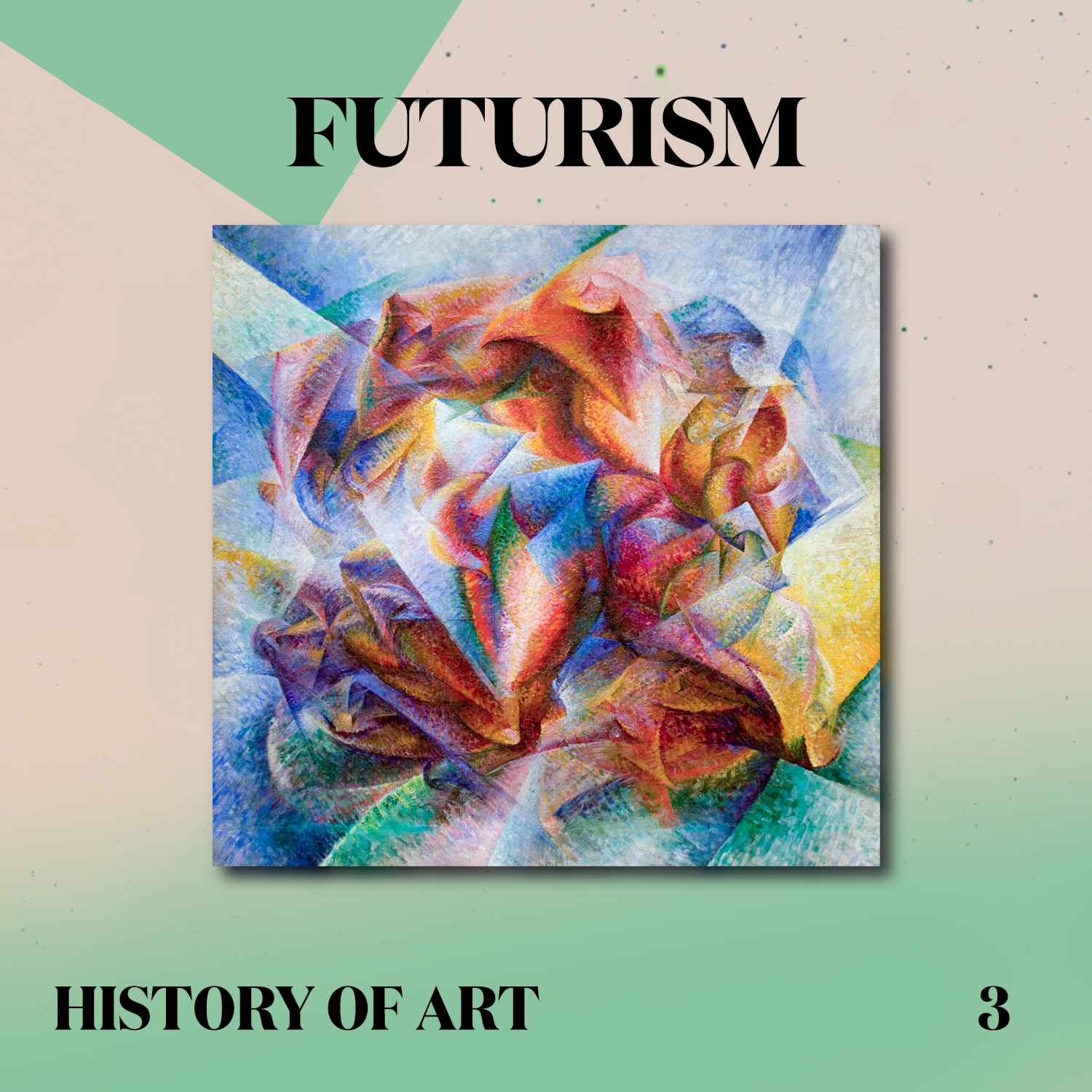
Futurism was an influential avant-garde movement that originated in Italy during the early 20th century, characterized by an obsession with speed, industry, machinery, and the dynamics of modern life. These 10 examples of futurism art demonstrate the movement's radical departure from tradition, focusing on the synthesis of time, motion, and technological advancement to capture the pulse of the industrial age.
The Futurist movement sought to liberate art from the "museum culture" of the past. Led by Filippo Tommaso Marinetti, who published the Futurist Manifesto in 1909, the movement celebrated the beauty of the automobile, the airplane, and the industrial cityscape. Artists associated with this style did not merely depict objects; they attempted to visualize the "force lines" of energy and the kinetic experience of movement across a static canvas.
1. Unique Forms of Continuity in Space by Umberto Boccioni (1913)
Perhaps the most iconic sculpture of the movement, this bronze work depicts a striding human figure where the form appears to merge with the surrounding environment. Boccioni aimed to represent the body in flux, with muscular shapes flowing into aerodynamic lines, suggesting the figure is piercing through space at high speed. It remains a quintessential example of how Futurism applied physical dynamism to traditional sculptural forms.
2. The City Rises by Umberto Boccioni (1910)
This large-scale oil painting serves as a visual bridge between the old world and the new. It depicts the construction of a modern city, characterized by chaotic, swirling brushstrokes and vibrant, non-naturalistic colors. The central focus is a massive, straining horse, symbolizing the brute strength of labor and the relentless expansion of urbanization, flanked by rising scaffolding and chimneys.
3. Dynamism of a Dog on a Leash by Giacomo Balla (1912)
Balla was fascinated by chronophotography—the study of movement through sequences of images. In this work, he captures the rapid, rhythmic movement of a dachshund’s feet, a woman’s feet, and the leash by painting multiple, overlapping images of these elements in a single frame. This technique creates an illusion of jittery, high-speed movement, mimicking the physiological reality of seeing motion.
4. Street Light by Giacomo Balla (1909)
In this work, Balla explores the intersection of nature and artificial light. The painting depicts an electric street lamp whose jagged, multi-colored rays of light dominate the night sky, effectively drowning out the subtle, waning moon. It is a bold statement on the triumph of human invention and industrial progress over the natural world, a core tenet of Futurist ideology.
5. The Funeral of the Anarchist Galli by Carlo Carrà (1911)
Unlike the purely celebratory works of Balla or Boccioni, this painting utilizes Futurist techniques—such as broken lines and intersecting planes—to depict a politically charged event. The work is organized around the violent, jagged motion of a crowd, creating an overwhelming sense of kinetic energy and chaos. It demonstrates the movement's ability to translate emotional intensity into structural force.
6. Armored Train in Action by Gino Severini (1915)
Severini focused on the modern machine as a source of aesthetic power. This painting features a military train equipped with cannons, depicted through sharp, geometric fragmentation. By utilizing a "Vorticist" or cubist-influenced approach, Severini breaks the train into overlapping angles, conveying both the mechanical rigidity of the weapon and the destructive energy of its movement.
7. Elasticity by Umberto Boccioni (1912)
This painting is an exploration of the synthesis of light, color, and movement. It depicts a rider on a galloping horse, rendered in a series of fragmented, overlapping color planes. The title refers to the Futurist desire to show how objects "stretch" and interact with the space around them when in motion, emphasizing that everything is in a constant state of transformation.
8. Abstract Speed + Sound by Giacomo Balla (1913-1914)
Moving toward total abstraction, Balla attempted to visualize the intangible qualities of speed and noise. Using a palette of muted browns, whites, and blacks, he paints a series of curved, intersecting lines that mimic the sound waves of a racing vehicle. This work is significant because it shifts the focus from the machine itself to the "vibrations" and energy field the machine creates.
9. Ricostruzione futurista dell'universo (Futurist Reconstruction of the Universe) by Giacomo Balla and Fortunato Depero (1915)
This is not a single canvas but a manifesto-driven installation project. Balla and Depero expanded the movement into the realm of design, creating colorful, geometric, and mobile constructions. This project fundamentally changed the scope of Futurism, moving it from traditional painting and sculpture into the decorative arts, toys, and graphic design, signaling the movement's goal to permeate every aspect of modern life.
10. The Cyclist by Natalia Goncharova (1913)
While Goncharova was associated with the Russian Rayonism movement, her work shares a profound stylistic debt to Italian Futurism. The Cyclist depicts a man riding a bicycle through a bustling street, surrounded by fragmented signs and blurred motion. The use of multiple perspectives and radiating lines captures the sensory overload of navigating a crowded, early-20th-century urban environment.
Comparison of Futurist Techniques
The following table summarizes the primary methods utilized by these artists to convey their signature "dynamism."
| Artist | Primary Technique | Focus Area |
|---|---|---|
| Umberto Boccioni | Fluid, organic lines | Human form in motion |
| Giacomo Balla | Chronophotography style | Sensory perception of speed |
| Carlo Carrà | Fragmented spatial planes | Emotional/Sociopolitical energy |
| Gino Severini | Geometric fragmentation | Industrial/Military machinery |
| Natalia Goncharova | Radiating force lines | Urban atmosphere |
Understanding the Futurist Aesthetic
To truly appreciate these works, one must understand that Futurism was as much a philosophy as an artistic style. The artists believed that the past was a weight holding humanity back. By destroying traditional perspective—the "window" into a scene that defined Renaissance art—they created a more "immersive" experience.
For the modern observer in 2026, viewing these works requires acknowledging the historical context. The Futurists were enamored with technology, yet they did not foresee the catastrophic consequences that mechanization would bring to the battlefield during World War I. Many of the artists, including Boccioni and Sant'Elia, lost their lives in the conflict, marking an abrupt and tragic end to the movement's initial, optimistic phase.
Frequently Asked Questions
What defines the Futurist art style? Futurism is defined by the depiction of speed, motion, and technology. It rejects static representation in favor of "force lines," which show the direction and intensity of movement. It often incorporates fragmented geometric forms to represent the chaotic energy of the machine age.
How did Futurism differ from Cubism? While both movements used fragmented planes, Cubism was largely concerned with analyzing an object from multiple static viewpoints to create a three-dimensional composition. Futurism, by contrast, sought to represent the fourth dimension: time. Its goal was to express the kinetic movement of the subject through space.
Were there female Futurists? Yes. While the early manifestos were heavily patriarchal, artists like Natalia Goncharova and Valentine de Saint-Point were crucial to the movement's evolution. They brought unique perspectives on how speed and modern life interacted with the female identity, though they often faced greater challenges in receiving mainstream recognition at the time.
Is Futurism still relevant to modern design? The visual language of Futurism—specifically its focus on movement, geometric abstraction, and the integration of technology into daily life—is a precursor to contemporary motion graphics and kinetic typography. Many digital designers today unconsciously use "force lines" to guide the user's eye across screens, a direct descendant of early 20th-century Futurist composition.
What is the best way to study original Futurist works? The most comprehensive collections of Futurist art are housed in the Estorick Collection of Modern Italian Art in London, the Peggy Guggenheim Collection in Venice, and the Museum of Modern Art (MoMA) in New York. Viewing the original scale of these works is essential, as the sense of "force" is often lost in digital reproduction.
Next Steps for Enthusiasts
If you wish to explore the movement further, start by reading the Futurist Manifesto (1909) by Filippo Tommaso Marinetti. Understanding the movement's radical, often aggressive, rhetoric provides essential context for why the paintings look as chaotic as they do. For a more visual approach, examine the transition of Giacomo Balla’s work from figurative painting to pure abstract light studies, which illustrates the logical end-point of the movement's quest to paint "speed" rather than "things."