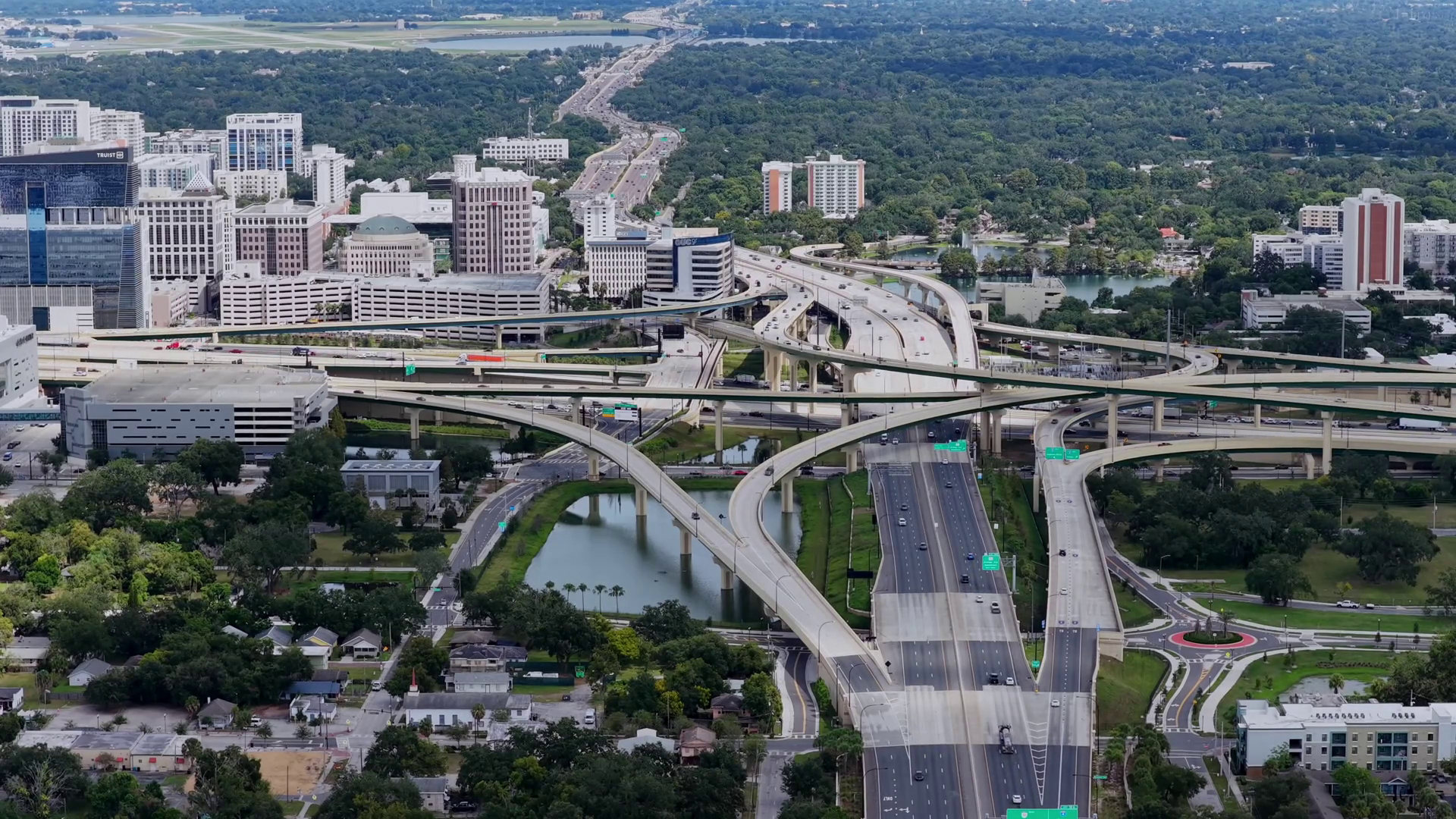
Navigating the Interstate 4 (I-4) corridor in Orlando requires a sophisticated understanding of peak congestion windows, managed lane dynamics, and regional bottlenecks. In 2026, traffic patterns are defined by the mature I-4 Express system and ongoing "Beyond the Ultimate" expansions, making strategic timing and lane selection essential for reliable travel times across Central Florida.
The Evolution of the I-4 Corridor: A 2026 Perspective
The Interstate 4 corridor has long been the primary arterial vein of Central Florida, connecting the Gulf Coast to the Atlantic Coast through the heart of Orlando. For decades, it was notorious for unpredictable delays and a lack of capacity. However, as we examine the landscape in 2026, the "I-4 Ultimate" project—which reconstructed 21 miles of the highway through the downtown core—is no longer a new development but a settled infrastructure reality. The introduction of managed lanes, known as I-4 Express, has fundamentally shifted how traffic distributed itself across the general-purpose lanes.
In 2026, the focus of traffic examination has moved from the downtown core toward the "I-4 Beyond the Ultimate" segments. These extensions address the "funnel effect" that previously occurred at the termini of the initial project. Specifically, the segments in South Orange County and Osceola County, as well as the northern stretches in Seminole and Volusia counties, have seen significant capacity improvements. Despite these upgrades, the Annual Average Daily Traffic (AADT) counts continue to rise as Orlando’s population and tourism sector reach new peaks. This volume means that "clear" traffic is a relative term, usually reserved for the late-night hours between 11:00 PM and 5:00 AM.
Understanding current patterns requires recognizing that I-4 is no longer a single road but a tiered system. Drivers must choose between the General Purpose (GP) lanes, which remain subject to high-volume congestion and frequent "stop-and-go" waves, and the Express Lanes, which use dynamic pricing to maintain a target speed of 50 mph or higher. This dual-structure system has created a "sorting" effect in traffic patterns, where long-distance commuters and time-sensitive travelers gravitate toward the center-managed lanes, while local traffic remains in the outer lanes.
Identifying Daily Peak Congestion Windows
The traditional "rush hour" has expanded into "rush periods" in 2026 Orlando. Because the region is both a major employment hub and a global tourism destination, the traffic patterns on I-4 do not follow a simple 9-to-5 commute cycle. Instead, the patterns are bimodal, with a heavy morning peak and a prolonged, often more intense, afternoon and evening peak.
The Morning Inbound Surge (6:30 AM – 9:30 AM)
During the morning hours, the primary flow of traffic moves "inbound" toward the Downtown Orlando business district and the tourism corridor near Universal Studios and Walt Disney World. For drivers coming from the north (Deltona, Lake Mary, and Altamonte Springs), the heaviest congestion typically begins near the E.E. Williamson Road overpass and intensifies through the Maitland interchange. In the south, commuters from Lakeland and Davenport experience significant slowing as they approach the ChampionsGate area, which remains one of the most challenging bottlenecks in the state due to the convergence of residential growth and theme park access.
The Afternoon Outbound Struggle (3:00 PM – 7:30 PM)
The afternoon peak is notoriously more difficult to predict and generally lasts longer than the morning surge. Traffic patterns show a massive "outbound" push as workers leave the urban core and tourists migrate between different attractions or head back to hotels. The "I-4/408 Interchange"—once a site of constant gridlock—now flows better due to the multi-level flyovers, but the sheer volume of vehicles often exceeds the capacity of the General Purpose lanes. By 5:15 PM, average speeds in the GP lanes can drop to 15-20 mph, whereas the I-4 Express lanes typically maintain significantly higher velocities, albeit at a premium toll price.
Mid-Day and Weekend Variations
A unique feature of I-4 traffic patterns in 2026 is the "Mid-Day Hump." Between 11:30 AM and 1:30 PM, there is a measurable spike in traffic, particularly in the Lake Buena Vista and International Drive segments. This is attributed to lunch-hour traffic and tourists switching parks or attending mid-day events. Weekends also defy traditional interstate logic; Saturday afternoons can often be as congested as a Tuesday morning, driven almost entirely by the hospitality and retail sectors.
Regional Bottlenecks and Geographic Hotspots
Despite the massive infrastructure investments of the last decade, specific geographic "hotspots" continue to define the I-4 experience. These are areas where lane geometry, merging traffic, or local density create natural friction points.
The ChampionsGate/SR 532 Interchange
Located in the southwest portion of the Orlando metro area, ChampionsGate remains a persistent thorn for I-4 travelers. Even with the "Diverging Diamond Interchange" (DDI) and lane additions, the sheer volume of traffic entering from the rapidly growing Four Corners area creates a persistent "accordion effect." Traffic frequently backs up for miles heading eastbound in the morning and westbound in the evening. This area is a critical monitoring point for the Florida Department of Transportation (FDOT) as it represents the transition between the urbanized Orlando corridor and the more rural stretches toward Polk County.
The Maitland Boulevard (SR 414) Exchange
To the north of Downtown, the Maitland interchange is a complex web of flyovers and collector-distributor roads. While the redesign has eliminated the dangerous weaving patterns of the past, the high volume of commuters from the Maitland Center office parks means that merging onto I-4 Eastbound (toward Volusia County) remains a high-stress maneuver during the evening peak. Patterns here show that a single minor fender-bender on the Maitland ramps can cause a ripple effect that slows traffic all the way back to the Ivanhoe Boulevard exit.
The Downtown "S-Curve" and 408 Transition
The stretch of I-4 passing through Downtown Orlando, specifically near the Amway Center and the Dr. Phillips Center, features several curves and high-density exit/entrance points. Even with the 2026-era signage and lane markings, drivers frequently brake unnecessarily through the curves, leading to "phantom traffic jams" where traffic stops for no apparent reason other than the collective braking of the lead vehicles. The integration with the SR 408 (East-West Expressway) is a primary source of this volume, as it serves as the main artery for residents of East Orlando and the UCF area.
The Impact and Mechanics of I-4 Express Lanes
The most significant change to traffic patterns in the 2020s has been the implementation of the I-4 Express lanes. These are two managed lanes in each direction, physically separated from the general-purpose lanes by concrete barriers. In 2026, these lanes are fully integrated into the regional transportation strategy.
Dynamic Tolling and Demand Management
The Express lanes utilize a dynamic pricing model. Sensors embedded in the roadway monitor traffic density and speed in real-time. As the lanes become more crowded, the toll price increases to discourage more vehicles from entering, thereby preserving a minimum speed (usually 50 mph). Conversely, during low-traffic periods, the toll drops to a minimum "base" rate. This creates a predictable "relief valve" for the corridor. Examining the 2026 data shows that the Express lanes carry approximately 20-30% of the total corridor volume during peak hours, significantly reducing the "crush" on the General Purpose lanes.
Access Points and Strategic Usage
One common mistake drivers make is failing to plan their entry and exit points for the Express lanes. Unlike General Purpose lanes, you cannot exit the Express lanes at every interchange. In 2026, there are specific "slip ramps" and direct-connect ramps (such as the one from the Florida's Turnpike).
| Feature | General Purpose (GP) Lanes | I-4 Express (Managed) Lanes |
|---|---|---|
| Cost | Free (Tax-funded) | Variable Toll (SunPass/E-Pass) |
| Access | All local exits | Strategic entry/exit points only |
| Target Speed | N/A (Subject to congestion) | 50+ MPH |
| Vehicle Restrictions | All legal street vehicles | No trucks over 2 axles or trailers |
| Primary Users | Local/Short-distance travelers | Long-distance commuters/Time-sensitive |
Seasonal and Event-Based Fluctuations
Orlando’s traffic patterns are heavily influenced by the "Tourist Calendar" and the "Event Calendar." In 2026, these factors can override standard weekly patterns.
- Spring Break (March-April): This is historically the most congested period for I-4. The volume of rental cars, driven by visitors unfamiliar with the lane configurations, leads to an increase in sudden lane changes and slowed speeds near the I-Drive exits.
- The "Hurricane Season" Effect (June-November): Summer afternoon thunderstorms are a daily occurrence in Orlando. These storms significantly alter traffic patterns by reducing visibility and causing immediate speed reductions. Data suggests that even a light rain can increase travel times on I-4 by 25-40% due to the "hydroplaning risk" and collective driver caution.
- Conventions and Sports: Large-scale events at the Orange County Convention Center or major games at the Camping World Stadium create localized surges. On these days, the westbound traffic toward the convention center can remain heavy well past the traditional morning peak, often lasting until noon.
Safety, Incident Response, and Technology
The "Road Rangers" program remains a cornerstone of I-4 traffic management in 2026. These service vehicles patrol the corridor to assist stranded motorists and clear debris. Because I-4 is hemmed in by concrete barriers in many sections, even a minor stall can block a lane entirely, leading to massive backups.
The technical examination of traffic patterns reveals that "incident-related delay" accounts for nearly 50% of all non-recurring congestion on I-4. To combat this, the FDOT utilizes an Advanced Traffic Management System (ATMS). This system includes:
- CCTV Monitoring: Full coverage of the corridor to identify accidents within seconds.
- DMS (Dynamic Message Signs): Providing real-time travel times and incident alerts to drivers before they reach critical decision points.
- VPD (Vehicle Probe Data): Using anonymous data from cellular devices and GPS units to map "slow zones" with high precision.
For drivers, this means that the information provided on overhead signs is highly accurate. If a sign indicates a 20-minute delay ahead, it is statistically likely to be correct, and seeking an alternative route or entering the Express lanes is advised.
Strategic Recommendations for I-4 Travelers
Based on the examination of 2026 traffic patterns, the following strategies are recommended for navigating the I-4 corridor efficiently:
- Leverage the "Shoulder" Periods: If your schedule allows, aim to pass through the Downtown core before 6:45 AM or after 9:15 AM. In the evening, waiting until after 6:45 PM can save significant time.
- Maintain an Active Transponder: Whether it is a SunPass, E-Pass, or LeeWay, having a transponder is essential. The I-4 Express lanes do not accept cash, and "Toll-by-Plate" often carries higher administrative fees and lacks the seamless integration of a transponder.
- Monitor the "Beyond the Ultimate" Updates: Stay informed about the current construction phases in Osceola and Volusia counties. These areas are the most likely to have nighttime lane closures and shifting traffic patterns as the 2026 expansion projects move toward completion.
- Use Navigation Apps with Real-Time Tolling: Ensure your navigation software is configured to consider toll roads. In 2026, most major apps can calculate whether the I-4 Express toll is "worth it" based on the current minutes saved.
- Avoid the "Tourism Triangle": The area between the Florida’s Turnpike, I-4, and SR 528 is a high-volume zone nearly 18 hours a day. If you are a local commuter, using "back door" routes like Turkey Lake Road or Universal Boulevard can sometimes bypass the heaviest I-4 main-line congestion.
Frequently Asked Questions
What are the peak hours for I-4 traffic in Orlando in 2026?
Peak morning traffic occurs between 6:30 AM and 9:30 AM, with the heaviest volume moving toward Downtown Orlando. Afternoon peak starts as early as 3:00 PM and can last until 7:30 PM, primarily affecting outbound traffic heading toward the suburbs in Seminole and Osceola counties.
How much do the I-4 Express lanes cost?
The cost is dynamic, meaning it changes based on traffic volume. During off-peak hours, tolls may be as low as $0.50 per segment. During heavy congestion, tolls can rise significantly to several dollars per segment to manage demand and maintain travel speeds. You should check current rates on the I-4 Express official website or via the FDOT "Florida 511" system.
Are there any vehicle restrictions for the Express lanes?
Yes. I-4 Express lanes are restricted to two-axle vehicles. Trucks with more than two axles and vehicles pulling trailers are prohibited from using the managed lanes. This restriction helps maintain a consistent flow of traffic and reduces the risk of major accidents that could block the limited-access segments.
Why is traffic still heavy after the I-4 Ultimate project was completed?
While the I-4 Ultimate project increased capacity and improved geometry through the downtown core, the regional population has grown faster than the infrastructure. Additionally, the "induced demand" phenomenon suggests that improved roads often attract more drivers who previously used alternate routes, eventually leading to new equilibrium levels of congestion.
What should I do if my car breaks down on I-4?
If possible, move your vehicle to the nearest shoulder or "emergency refuge" area. Stay inside the vehicle with your seatbelt on and call *FHP (*347) or 911. The FDOT Road Rangers patrol I-4 specifically to assist with these situations and can provide fuel, tire changes, or a jump-start to get you moving again safely.
Final Practical Recommendation
For the most reliable experience on I-4 in 2026, prioritize the I-4 Express lanes for any trip exceeding 10 miles during peak hours. While the toll cost is a factor, the time savings and reduced "stop-and-start" wear on your vehicle generally outweigh the expense. Always consult the Florida 511 (FL511) app before departing to check for real-time incidents that may have closed specific lanes or access points.