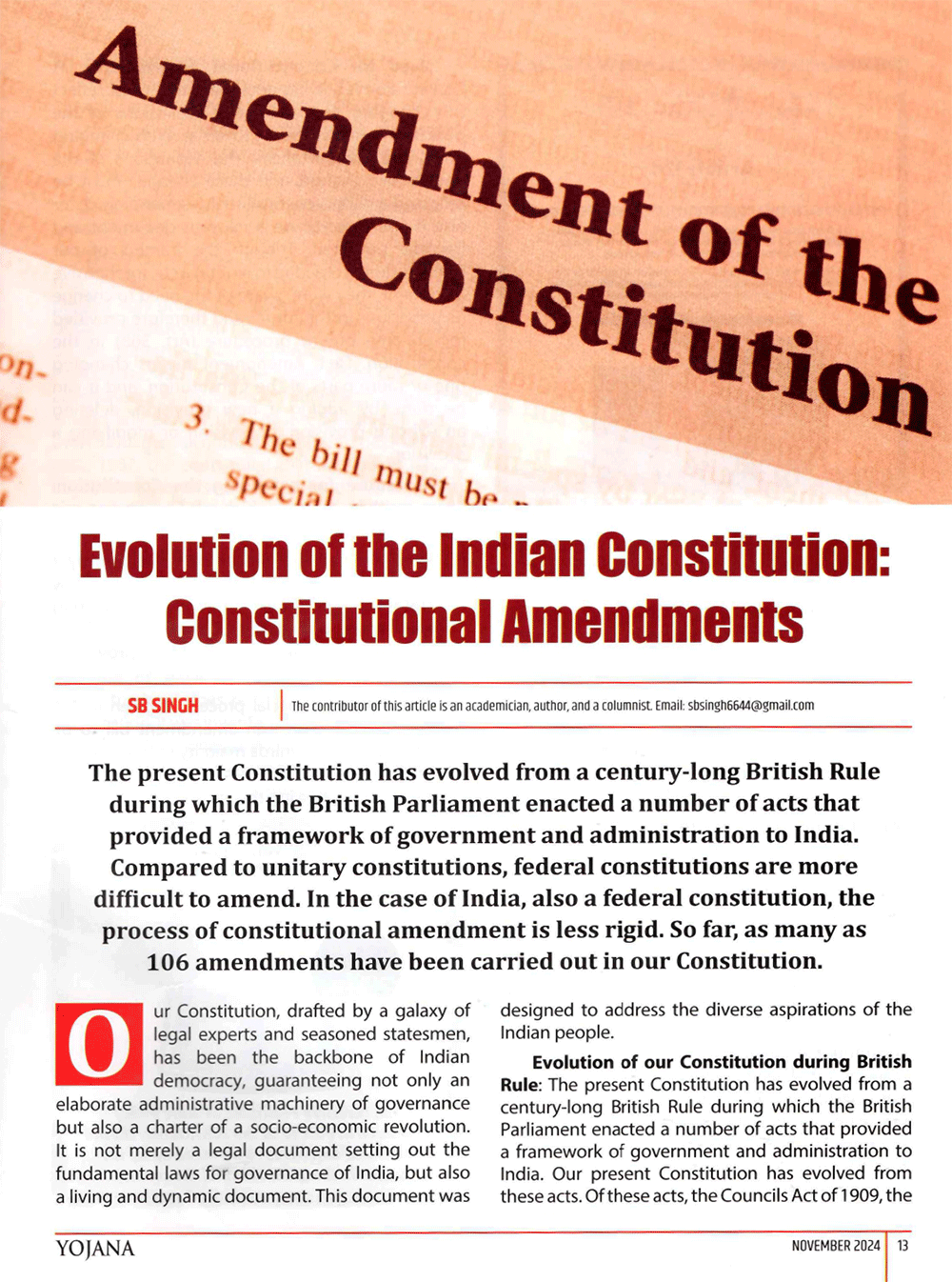
The amendment of the Constitution of India is the formal process of altering the nation’s fundamental law as provided under Article 368 of Part XX. This mechanism allows the Parliament to add, vary, or repeal any provision to ensure the document remains a "living instrument" capable of adapting to the evolving social, political, and economic needs of the people.
As of 2026, the Constitution of India continues to balance the necessity of flexibility with the requirement of stability. The amending process is neither as easy as in the United Kingdom nor as difficult as in the United States. Instead, the framers of the Indian Constitution devised a three-tier system of amendments that ensures routine administrative changes occur easily, while fundamental constitutional shifts require a broad national consensus.
The Constitutional Basis: Article 368 and the Power of Parliament
Article 368 of the Indian Constitution grants the Parliament the power to amend the Constitution and defines the specific procedures for doing so. This article serves as the primary source of amending authority, though it has been the subject of intense judicial scrutiny and historical debate.
The power to amend is not absolute. While the Parliament is the supreme legislative body, its power to alter the Constitution is checked by the judiciary through the "Basic Structure Doctrine." This doctrine ensures that while the text can be updated, the essential features—such as secularism, federalism, and the separation of powers—cannot be destroyed or abrogated.
Why a Living Constitution Matters
A constitution that cannot change becomes an obstacle to progress. In the Indian context, amendments have been used to implement land reforms, protect the rights of marginalized communities, introduce the Goods and Services Tax (GST), and most recently, ensure legislative representation for women. By 2026, the history of Indian amendments reflects the country's journey from a newly independent nation to a global economic powerhouse.
The Three Categories of Constitutional Amendments
The Indian Constitution provides for three distinct ways in which its provisions can be amended. The method used depends entirely on the significance and nature of the provision being changed.
1. Amendment by Simple Majority
Certain provisions of the Constitution can be amended by a simple majority of the members of each House of Parliament present and voting. Interestingly, these amendments are not technically considered "amendments to the Constitution" under the specific scope of Article 368.
This category includes administrative and organizational matters such as:
- Admission or establishment of new states: Alteration of areas, boundaries, or names of existing states (Articles 2, 3, and 4).
- Abolition or creation of legislative councils in states: Under Article 169.
- Salaries and allowances: Pertaining to the President, Governors, Speaker, and judges (Second Schedule).
- Quorum in Parliament: Rules of procedure and privileges of Parliament.
- Official Language: Use of English or other languages in Parliament.
- Citizenship: Acquisition and termination of citizenship.
2. Amendment by Special Majority
The majority of constitutional provisions are amended under Article 368 by a "Special Majority." This requires the bill to be passed in each House by:
- A majority of the total membership of that House (regardless of vacancies or absentees).
- A majority of not less than two-thirds of the members of that House present and voting.
This rigorous requirement ensures that the ruling party cannot unilaterally change the Constitution without significant support from other factions or a massive mandate. Provisions like Fundamental Rights (Part III) and Directive Principles of State Policy (Part IV) are typically amended through this method.
3. Special Majority and Ratification by States
When an amendment aims to change the federal structure of the country or the distribution of powers between the Union and the States, it requires an even higher threshold. After being passed by the Special Majority in both Houses of Parliament, the amendment must be ratified by the legislatures of at least half of the states by a simple majority.
Provisions requiring state ratification include:
- The election and manner of the election of the President (Articles 54 and 55).
- Extent of the executive power of the Union and the States.
- The Supreme Court and High Courts.
- Distribution of legislative powers between the Union and the States.
- Any of the Lists in the Seventh Schedule (Union, State, and Concurrent lists).
- The representation of states in Parliament.
- Article 368 itself (the power to amend).
The Step-by-Step Procedure for Amending the Constitution
The formal process for an amendment is strictly regulated to prevent arbitrary changes. The procedure, as outlined in Article 368, involves several mandatory stages.
Initiation of the Bill
An amendment can be initiated only by the introduction of a bill for the purpose in either the Lok Sabha (House of the People) or the Rajya Sabha (Council of States). It cannot be introduced in state legislatures. The bill can be introduced either by a Minister or a private member and does not require the prior permission of the President.
Passing the Bill in Each House
The bill must be passed in each House by the required majority (Simple or Special, depending on the subject). If the bill seeks to amend federal provisions, the ratification by half of the states must be obtained after the bill passes both Houses of Parliament.
The Prohibition of Joint Sittings
Unlike ordinary bills, there is no provision for a joint sitting of both Houses in the case of a Constitutional Amendment Bill. If there is a disagreement between the Lok Sabha and the Rajya Sabha, the bill simply fails. This highlights the importance of bicameral consensus for constitutional changes.
Presidential Assent
Once the bill is passed by both Houses (and ratified by states where necessary), it is presented to the President of India. Under the 24th Constitutional Amendment Act of 1971, the President must give their assent to the bill. The President can neither withhold assent nor return the bill to Parliament for reconsideration. Upon receiving the signature, the bill becomes an Act, and the Constitution stands amended.
The Basic Structure Doctrine: A Judicial Shield
One of the most critical aspects of constitutional law in India is the limitation on Parliament’s amending power. In the landmark case of Kesavananda Bharati v. State of Kerala (1973), the Supreme Court of India ruled that while Parliament has the right to amend any part of the Constitution, it cannot alter the "Basic Structure."
Key Elements of the Basic Structure
Though the court never provided an exhaustive list, various judgments have identified the following as part of the Basic Structure:
- The supremacy of the Constitution.
- The republican and democratic form of government.
- The secular character of the Constitution.
- The separation of powers between the legislature, executive, and judiciary.
- The federal character of the Constitution.
- Unity and integrity of the nation.
- Judicial review and the rule of law.
- The parliamentary system.
By 2026, this doctrine remains the cornerstone of Indian constitutionalism, ensuring that even a government with a massive majority cannot transform India into a non-democratic or theocratic state through legal amendments.
Landmark Amendments and Their Impact
Over the decades, several amendments have fundamentally reshaped the Indian socio-political landscape. The following table summarizes key amendments that have had a lasting impact.
| Amendment Act | Year | Key Changes and Impact |
|---|---|---|
| 1st Amendment | 1951 | Introduced the Ninth Schedule to protect land reform laws from judicial review. |
| 7th Amendment | 1956 | Reorganized states on a linguistic basis and abolished the classification of states into Parts A, B, C, and D. |
| 24th Amendment | 1971 | Affirmed Parliament's power to amend any part of the Constitution, including Fundamental Rights. |
| 42nd Amendment | 1976 | Known as the "Mini-Constitution." Added "Socialist," "Secular," and "Integrity" to the Preamble and introduced Fundamental Duties. |
| 44th Amendment | 1978 | Reversed several changes made by the 42nd Amendment to restore democratic checks and balances after the Emergency. |
| 73rd & 74th | 1992 | Provided constitutional status to Panchayati Raj Institutions (rural) and Municipalities (urban). |
| 86th Amendment | 2002 | Made right to education a Fundamental Right (Article 21A) for children aged 6–14. |
| 101st Amendment | 2016 | Introduced the Goods and Services Tax (GST), overhaulng the indirect tax regime. |
| 103rd Amendment | 2019 | Provided 10% reservation for Economically Weaker Sections (EWS) in jobs and education. |
| 106th Amendment | 2023 | Provided 33% reservation for women in the Lok Sabha and State Legislative Assemblies (Nari Shakti Vandan Adhiniyam). |
Critical Challenges and Evaluations
The amendment process in India is often criticized for being both too flexible and too rigid at the same time.
The Question of Rigidity vs. Flexibility
Critics argue that the "Special Majority" is relatively easy to achieve for a dominant political party, potentially leading to the politicization of the Constitution. Conversely, proponents argue that the requirement for state ratification for federal changes and the "Basic Structure" intervention by the judiciary provide sufficient safeguards against the "tyranny of the majority."
Lack of State Initiative
Unlike some federal systems, Indian states cannot initiate an amendment to the Constitution. They can only request the creation or abolition of a Legislative Council, but the final power resides with the Union Parliament. This centralization of amending power is a point of contention in debates over Indian federalism.
Judicial Overreach
Some legal scholars suggest that the "Basic Structure Doctrine" gives the judiciary too much power, as it allows judges to strike down amendments passed by elected representatives based on an undefined set of "basic features." However, in the context of 2026, most observers agree that this doctrine has been essential in maintaining India's democratic stability.
Frequently Asked Questions
Can the Preamble of the Constitution be amended?
Yes, the Preamble can be amended, provided the amendment does not violate the Basic Structure of the Constitution. This was clarified by the Supreme Court in the Kesavananda Bharati case. The Preamble has been amended only once, in 1976 by the 42nd Amendment Act, which added the words "Socialist," "Secular," and "Integrity."
Is there a time limit for states to ratify an amendment?
The Constitution does not prescribe a specific timeframe within which the state legislatures must ratify a constitutional amendment bill referred to them. However, the bill cannot be presented for Presidential assent until the required number of states (at least half) have passed the resolution of ratification.
Why is there no joint sitting for constitutional amendments?
The absence of a joint sitting provision ensures that a constitutional amendment must have the independent support of both the Lok Sabha and the Rajya Sabha. This prevents the larger Lok Sabha from overrunning the Rajya Sabha's concerns, thereby protecting the federal interests and ensuring a more thorough deliberative process for fundamental changes.
Can a private member introduce a constitutional amendment bill?
Yes, a private member (a Member of Parliament who is not a Minister) can introduce a bill to amend the Constitution. While most successful amendments are government-sponsored, the procedure for a private member's bill is identical, requiring the same special majorities in both Houses.
What happens if the President refuses to sign an amendment bill?
Under the current legal framework established by the 24th Amendment Act, the President does not have the power to refuse, withhold assent, or return a Constitutional Amendment Bill for reconsideration. The President is constitutionally obligated to sign the bill once it has been passed by the Parliament according to the prescribed procedure.
Practical Recommendations for Scholars and Citizens
For those studying the Indian legal system or preparing for administrative services, it is vital to track not just the text of the amendments but the judicial interpretations that follow. The Constitution is not merely a historical document but a functional framework that reacts to the needs of the day.
- Monitor the Official Gazette: Always refer to the Gazette of India for the most accurate and updated text of new amendments.
- Study Judicial Review: When a new amendment is passed, look for subsequent challenges in the Supreme Court to understand how the "Basic Structure" test is applied in a contemporary context.
- Distinguish Procedures: Clearly categorize whether a change requires a simple majority, a special majority, or state ratification to understand the political weight behind the reform.
The amendment process remains the most significant tool for ensuring that the Constitution of India continues to serve as an effective foundation for the world's largest democracy as it moves further into the 21st century.