Amber Guyger, a former Dallas police officer, was convicted of murder in 2019 for the 2018 shooting death of Botham Jean in his own apartment. As of 2026, Guyger remains incarcerated in a Texas state prison following a denied parole request in late 2024, with her next eligibility review scheduled for October 2026.
The case of Amber R. Guyger remains one of the most significant legal touchstones in modern American jurisprudence regarding police accountability, the "Castle Doctrine," and the intersection of race and law enforcement. The incident, which occurred on September 6, 2018, involved an off-duty police officer entering the wrong apartment and fatally shooting the lawful resident. The subsequent trial and sentencing sparked national dialogue and led to substantive legislative changes in Texas.
The Shooting of Botham Jean: A Detailed Chronology
The events of September 6, 2018, began when Amber Guyger, then a four-year veteran of the Dallas Police Department (DPD), finished an intensive 13.5-hour shift. Guyger, still in her police uniform, drove to the South Side Flats apartment complex where she resided.
The Confusion of Floors
Guyger lived in apartment 310, located on the third floor. However, she parked her vehicle on the fourth floor of the complex's parking garage. The South Side Flats featured a layout where the floors were architecturally identical, a factor that would later become a central point of the defense’s "mistake of fact" argument.
Upon reaching what she believed was her unit, Guyger encountered a door that was slightly ajar. Evidence presented at trial indicated that the electronic lock mechanism on Botham Jean’s door (unit 410) was malfunctioning, preventing it from latching completely. Guyger entered the darkened apartment and encountered 26-year-old Botham Jean, an accountant for PwC and a worship leader at his church, who was sitting on his couch eating ice cream.
The Fatal Encounter
Believing Jean was an intruder in her home, Guyger drew her service weapon and fired two shots. One bullet struck Jean in the chest, piercing his heart and lungs. Guyger’s subsequent 911 call, which lasted nearly six minutes, captured her repeated assertions: "I thought it was my apartment." Despite arriving paramedics' efforts, Jean was pronounced dead at Baylor University Medical Center.
The Investigation and Indictment Process
The immediate aftermath of the shooting was marked by procedural controversy. While the Dallas Police Department initially handled the call, the investigation was quickly turned over to the Texas Rangers to ensure impartiality.
From Manslaughter to Murder
Three days after the shooting, Guyger was arrested and charged with manslaughter. She was released on a $300,000 bond. The initial charge of manslaughter—defined under Texas law as recklessly causing the death of an individual—was met with significant public protest. Critics argued that the intent behind firing a service weapon at a person’s torso inherently met the threshold for murder.
In November 2018, a Dallas County grand jury disagreed with the initial manslaughter assessment. After reviewing the evidence, the grand jury indicted Guyger on a charge of murder. Under Texas Penal Code Section 19.02, a person commits murder if they "intentionally or knowingly cause the death of an individual" or "intend to cause serious bodily injury and commit an act clearly dangerous to human life."
The Joshua Brown Factor
A critical witness for the prosecution was Joshua Brown, a neighbor who lived across the hall from Botham Jean. Brown testified about the sounds he heard on the night of the shooting, specifically noting that he did not hear Guyger give clear police commands before the shots were fired. Tragically, Joshua Brown was shot and killed in an unrelated incident just days after his testimony, an event that added further tension to the already high-profile case.
The Trial: State of Texas v. Amber Guyger
The trial began in September 2019 in the 204th District Court, presided over by Judge Tammy Kemp. The legal strategies employed by both sides provided a masterclass in the application of the Castle Doctrine and the "Mistake of Fact" defense.
The Defense: Mistake of Fact and Castle Doctrine
Guyger’s defense team, led by Robert Rogers and Toby Shook, focused on the "Mistake of Fact" defense. They argued that Guyger’s belief that she was in her own apartment was reasonable given her fatigue and the identical nature of the hallways.
They also attempted to invoke the Castle Doctrine, a legal principle that allows individuals to use deadly force to protect their "castle" (home) from an intruder. However, the prosecution successfully argued that because Guyger was not in her own home, she could not claim the legal protections afforded to a homeowner defending their property. The jury was eventually instructed that they could consider the Castle Doctrine only if they believed Guyger’s mistake of fact was reasonable.
The Prosecution: Use of Force and Intent
Prosecutors Jason Hermus and Jason Fine focused on Guyger’s training as a police officer. They argued that even if she believed she was in her own home, her first instinct as a trained officer should have been to retreat and call for backup rather than entering and engaging with deadly force.
The prosecution highlighted Guyger’s text messages sent earlier that evening, which they argued showed a lack of focus and professionalism. They also pointed out that Guyger failed to provide adequate CPR to Jean after the shooting, focusing instead on her own impending legal trouble during the 911 call.
The Verdict and Sentencing
On October 1, 2019, after less than 24 hours of deliberation, the jury returned a verdict of Guilty of Murder. The verdict was seen as a landmark moment, as police officers are rarely convicted of murder for on-duty (or off-duty) shootings.
The Sentencing Phase
During the sentencing phase, the jury heard about "sudden passion," a legal mitigator in Texas that can reduce the sentencing range for murder from 5–99 years down to 2–20 years. Sudden passion is defined as an emotional state provoked by the victim that would cause an ordinary person to lose self-control. The jury ultimately rejected the sudden passion argument but settled on a sentence of 10 years in the Texas Department of Criminal Justice.
The Hug Heard 'Round the World
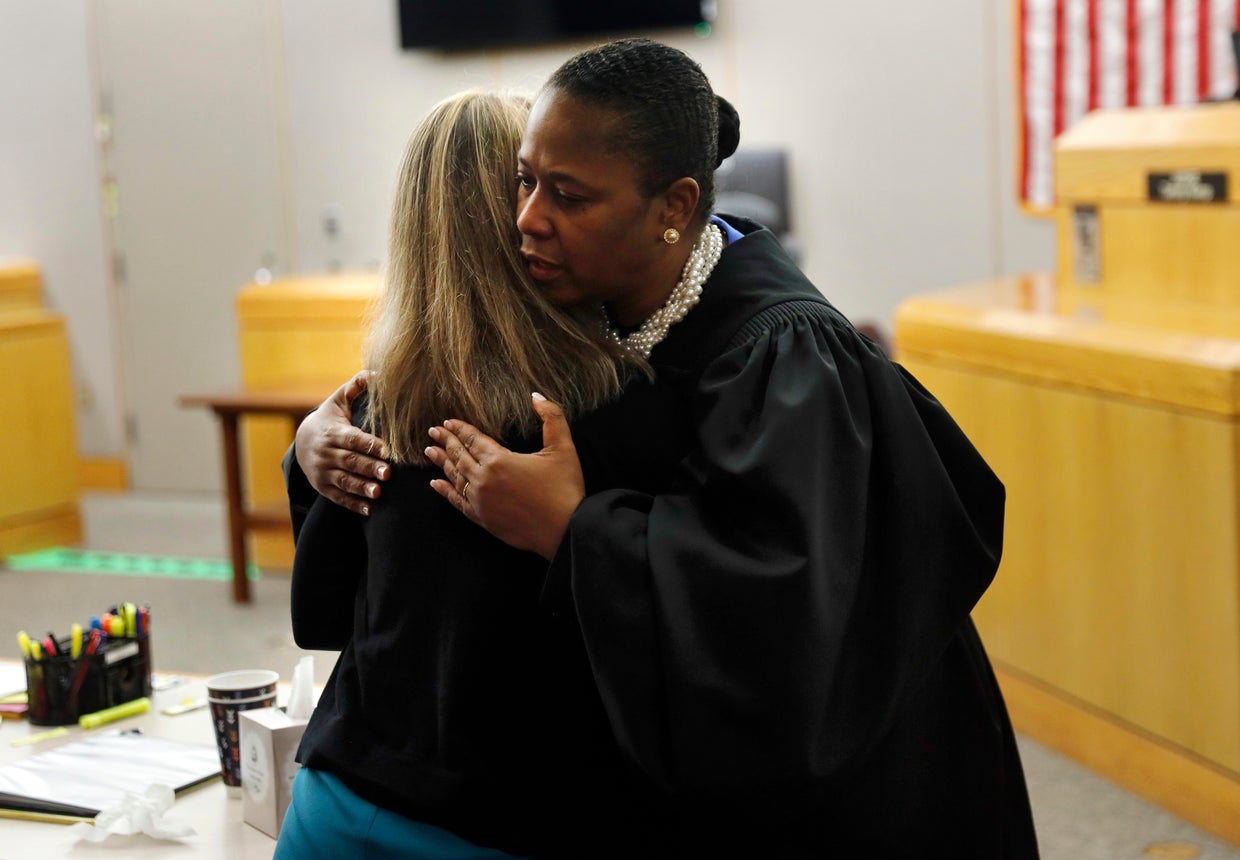
The trial concluded with two extraordinary moments of humanity. Botham Jean’s younger brother, Brandt Jean, addressed Guyger during his victim impact statement. He told her he forgave her and asked Judge Kemp if he could give her a hug. The two embraced in the center of the courtroom. Shortly after, Judge Kemp also hugged Guyger and gifted her a Bible, an act that later drew complaints to the State Commission on Judicial Conduct, though the commission ultimately cleared Kemp of wrongdoing.
Appeals and Legal Challenges (2020–2022)
Following her conviction, Guyger’s legal team launched a series of appeals aimed at overturning the murder conviction in favor of a lesser charge.
- The 2021 Appeal: Defense attorneys argued that the evidence was legally insufficient to support a murder conviction. They contended that Guyger’s "mistaken belief" meant she lacked the necessary "malice" for murder and should have been charged with criminally negligent homicide.
- Fifth Court of Appeals Ruling: In August 2021, the Texas Fifth Court of Appeals affirmed the murder conviction. The justices ruled that Guyger’s intent to kill was clear the moment she pulled the trigger, regardless of whether she was mistaken about her location.
- Court of Criminal Appeals: In 2022, the Texas Court of Criminal Appeals, the state's highest criminal court, refused to review the lower court's decision, effectively exhausting Guyger’s state-level appeals process.
| Key Milestone | Date | Outcome |
|---|---|---|
| The Shooting of Botham Jean | Sept 6, 2018 | Botham Jean killed in his apartment |
| Guyger's Indictment | Nov 30, 2018 | Indicted for Murder (upgraded from Manslaughter) |
| Trial Verdict | Oct 1, 2019 | Jury finds Guyger Guilty of Murder |
| Sentencing | Oct 2, 2019 | Sentenced to 10 years in prison |
| First Appeal Ruling | Aug 5, 2021 | Conviction upheld by Fifth Court of Appeals |
| State High Court Refusal | Mar 20, 2022 | Texas Court of Criminal Appeals denies review |
| First Parole Hearing | Oct 2024 | Parole denied by Texas Parole Board |
| Next Parole Eligibility | Oct 2026 | Scheduled for second review |
The Legislative Legacy: Bo's Law
The Amber Guyger case served as the primary catalyst for the Botham Jean Act (HB 929), often referred to as "Bo's Law," which was signed into law by Texas Governor Greg Abbott in 2021.
Objectives of Bo's Law
The Act was designed to increase transparency in police interactions. It mandates that officers participating in an investigation or responding to a call must keep their body-worn cameras activated for the entirety of the encounter. This addressed concerns raised during the Guyger investigation regarding when and how body-cam footage is recorded and preserved.
Impact on Police Training
In addition to the state law, the Dallas Police Department implemented several internal changes:
- De-escalation Requirements: Enhanced mandatory training on de-escalation tactics for all officers.
- Wellness and Fatigue Policy: New limits on consecutive hours worked to mitigate the risk of "fatigue-induced errors" similar to those claimed by Guyger.
- Administrative Leave Policy: Standardized procedures for officers involved in shootings to ensure they are immediately stripped of police powers pending investigation.
Current Status in 2026
As of 2026, Amber Guyger is serving her sentence at the Mountain View Unit in Gatesville, Texas. Her time in prison has been relatively quiet, with no major disciplinary infractions reported.
The 2024 Parole Denial
Guyger first became eligible for parole in late September 2024, having served half of her 10-year sentence (a requirement for parole eligibility for murder convictions in Texas). On October 10, 2024, the Texas Board of Pardons and Paroles denied her request for early release. The board cited the "nature of the offense" and the "profound loss of life" as primary reasons for the denial.
Looking Toward the October 2026 Review
Under Texas law, after a parole denial, the board sets a "set-off" period before the next review. Guyger was given a two-year set-off, making her next eligibility date in October 2026. During this upcoming review, the board will again consider:
- Her behavior while incarcerated.
- Participation in prison programs (education, vocational training).
- Letters of support or opposition from the victim's family and the community.
- The original trial records and the severity of the crime.
Frequently Asked Questions
Why was Amber Guyger charged with murder instead of manslaughter?
In Texas, murder involves the intentional act of causing death. While Guyger claimed she made a mistake regarding the apartment, the act of aiming a firearm at a person's chest and pulling the trigger is viewed as an intentional act to cause death or serious bodily injury. Manslaughter would require proving "recklessness" without the specific intent to kill, which the grand jury and trial jury found inconsistent with the evidence of the shooting.
What is the "Mistake of Fact" defense used in this case?
Mistake of Fact is a defense under Texas Penal Code Section 8.02. It asserts that the defendant acted based on a reasonable misunderstanding of the facts. In this case, Guyger argued she mistakenly believed she was in her own home. However, for this to result in an acquittal, the jury had to believe the mistake was "reasonable." The jury ultimately determined that a reasonable person, especially a trained officer, should have recognized they were in the wrong location.
Did Botham Jean's family ever sue the city of Dallas?
Yes. The family of Botham Jean filed a civil rights lawsuit against the City of Dallas and Amber Guyger. The lawsuit alleged that Guyger used excessive force and that the Dallas Police Department failed to properly train its officers. While much of the litigation against the city was initially dismissed based on qualified immunity and the fact that Guyger was off-duty, the case against Guyger herself proceeded, seeking damages for the wrongful death of Jean.
How much time will Amber Guyger actually serve?
In Texas, an individual convicted of murder must serve at least half of their sentence before being eligible for parole. With a 10-year sentence, Guyger was required to serve five years before her first hearing in 2024. Because her parole was denied, she will continue serving until her next review in 2026 or until her "mandatory discharge date" (the end of the 10-year term), whichever comes first.
What is the Botham Jean Act?
HB 929, known as the Botham Jean Act, is a Texas law requiring police officers to keep their body cameras turned on for the duration of an investigation. It was passed to prevent "gaps" in evidence that often occur during police-involved shootings and to ensure that the initial moments of an encounter are captured for legal review.
Summary of Next Actions for Interested Parties
For those following the legal developments of the Amber Guyger case in 2026, the following steps are recommended:
- Monitor the Texas Board of Pardons and Paroles: Public records of parole decisions are typically updated following the October 2026 review session.
- Review the Botham Jean Foundation: The family established a foundation in Botham’s name to promote social justice and provide scholarships. Supporting this organization is the primary way to contribute to his legacy.
- Study Texas Penal Code Updates: For legal students, the Guyger case remains a primary example of "Mistake of Fact" and the "Castle Doctrine." Reviewing the 2021 and 2022 appellate court transcripts provides deep insight into how these laws are interpreted in modern courts.