Allen Bradley remains the cornerstone of global industrial automation, representing a century-long evolution from basic motor starters to the sophisticated, AI-driven Integrated Architecture of 2026. As the premier brand under Rockwell Automation, it defines modern manufacturing through its Programmable Logic Controllers (PLCs), Human-Machine Interfaces (HMIs), and the EtherNet/IP communication standard that powers the Connected Enterprise.
The Foundations of an Industrial Giant
The story of Allen-Bradley is inextricably linked to the birth of the American industrial era. Founded in 1903 by Lynde Bradley and Dr. Stanton Allen in Milwaukee, Wisconsin, the company began with a humble $1,000 investment and a revolutionary idea: the compression rheostat. In an era where controlling electric motors was both dangerous and imprecise, the Bradley brothers’ carbon-pile technology allowed for smooth, reliable speed control, a prerequisite for the mass production lines that would soon define the 20th century.
Throughout the early 1900s, the company’s "octagon" logo became a symbol of rugged reliability. While competitors focused on delicate electronics, Allen-Bradley built hardware that could survive the heat, vibration, and dust of steel mills and automotive plants. This focus on "industrial hardening" created a brand loyalty that persists today. By the time the company was acquired by Rockwell International in 1985 for $1.651 billion—the largest acquisition in Wisconsin history at the time—Allen-Bradley had already transitioned from a component manufacturer to a systems provider, setting the stage for the digital revolution.
The PLC Revolution: From Relay Logic to Digital Intelligence
Perhaps no single contribution defines the Allen-Bradley legacy more than the popularization of the Programmable Logic Controller (PLC). Before the 1970s, industrial control was managed by massive walls of hard-wired electromagnetic relays. Changing a production process required weeks of rewiring.
The introduction of the PLC-2 and the subsequent PLC-5 changed the trajectory of manufacturing. The PLC-5, introduced in 1986, became one of the most successful industrial computers in history. Its architecture allowed for modular I/O (Input/Output) and introduced the world to "Data Highway Plus" (DH+), one of the first reliable industrial networks.
The Shift to Logix Architecture
As we look at the landscape in 2026, the transition from the legacy PLC-5 and SLC 500 systems to the Logix Control Platform stands as a masterclass in technological migration. The introduction of the ControlLogix 5550 in the late 1990s moved the industry away from memory-address-based programming to "tag-based" programming. This allowed engineers to use descriptive names (e.g., Main_Conveyor_Start) rather than cryptic memory addresses (e.g., B3:0/1), significantly reducing programming errors and commissioning time.
Core Technologies and Product Ecosystems in 2026
In 2026, the Allen-Bradley ecosystem is built upon the "Logix" engine, which provides a common control platform across different hardware scales. This "Integrated Architecture" ensures that a program written for a small machine can be scaled to an entire plant floor with minimal reconfiguration.
ControlLogix and CompactLogix
The ControlLogix 5580 and CompactLogix 5380 series represent the current high-performance standard. These controllers feature multi-core processors capable of handling high-speed motion control, safety, and standard logic simultaneously.
- Performance: Modern controllers handle up to 300 nodes of EtherNet/IP motion and offer gigabit embedded Ethernet ports.
- Safety Integration: The GuardLogix variants incorporate "SIL 3" safety ratings directly into the controller, eliminating the need for separate safety relays and allowing for "Safe Torque Off" and "Safe Speed" functions over the network.
PowerFlex Drives and Kinetix Motion
The legacy of the rheostat lives on in the PowerFlex variable frequency drives (VFDs) and Kinetix servo drives. In 2026, these devices are more than just motor controllers; they are data sensors. Using "TotalForce" technology, PowerFlex drives can predict motor bearing failure before it occurs by analyzing torque ripples and current signatures, feeding this data directly into predictive maintenance software.
The HMI and Visualization Layer
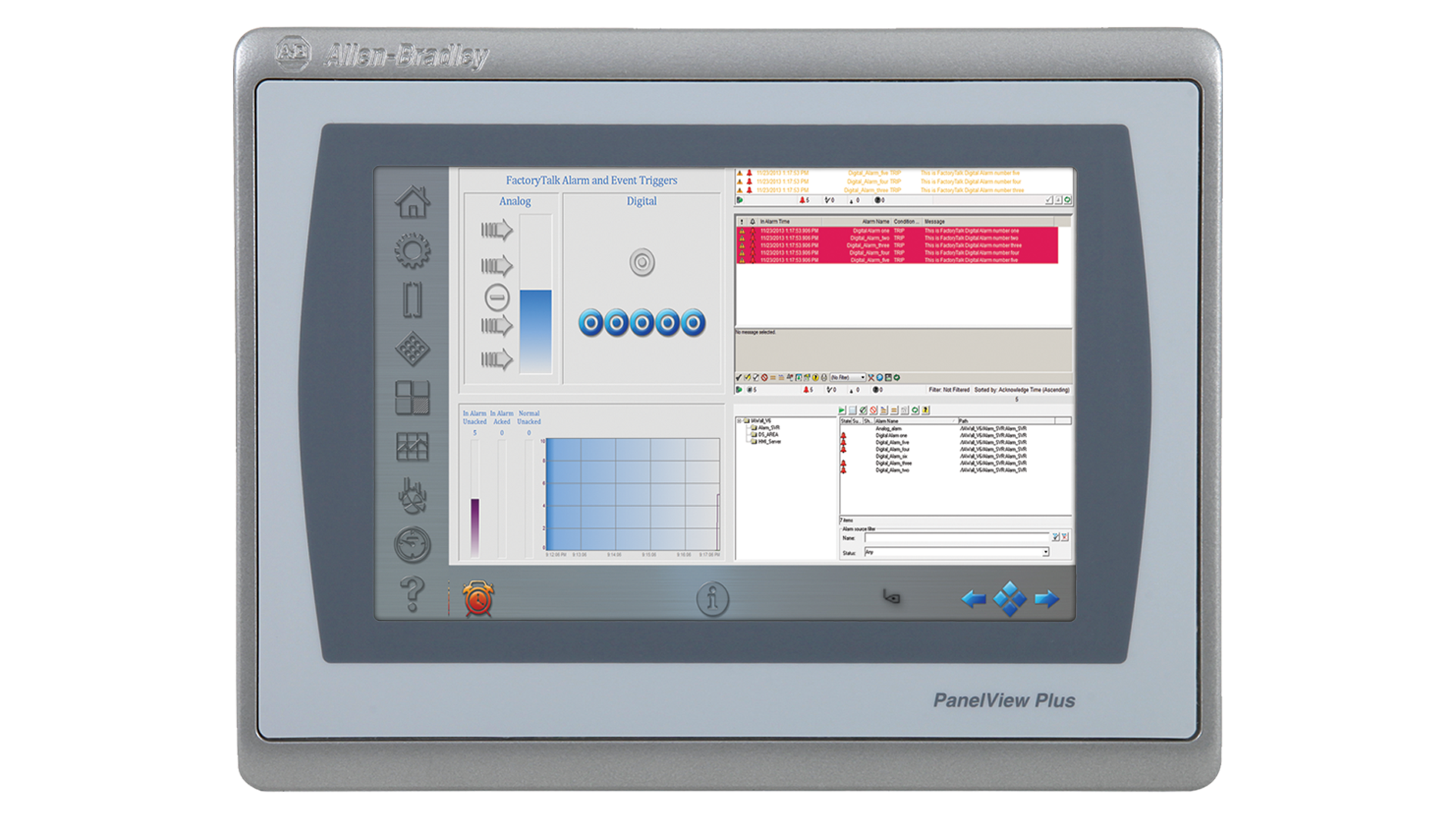
The PanelView Plus 7 and the newer OptixPanel series provide the interface between human and machine. Under the FactoryTalk Optix platform, Allen-Bradley has embraced open standards, allowing HMIs to run web-based graphics and connect to third-party cloud services via MQTT and OPC UA, bridging the gap between the factory floor and the executive suite.
Comparison of Allen-Bradley Controller Generations
| Feature | PLC-5 (Legacy) | SLC 500 (Legacy) | ControlLogix (Modern) | CompactLogix (Modern) |
|---|---|---|---|---|
| Architecture | Rack-based, 1771 I/O | Chassis-based, 1746 I/O | Modular, 1756 I/O | All-in-one/Small Modular |
| Programming | RSLogix 5 | RSLogix 500 | Studio 5000 Logix Designer | Studio 5000 Logix Designer |
| Addressing | Octal/Rack-Group | File-based (N7, B3) | Tag-based (Symbolic) | Tag-based (Symbolic) |
| Networking | DH+, Remote I/O | DH-485, DeviceNet | EtherNet/IP (Gigabit) | EtherNet/IP (Gigabit) |
| Safety | External Relays Only | External Relays Only | Integrated GuardLogix | Integrated GuardLogix |
| Best Use Case | Legacy support only | Small legacy machines | Large, complex plants | Mid-sized OEM machines |
The Software Evolution: From RSLogix to Studio 5000
The legacy of Allen-Bradley hardware is sustained by its software environment. The transition from RSLogix to Studio 5000 marked a shift from a simple ladder logic editor to a comprehensive engineering environment.
In 2026, Studio 5000 encompasses several key modules:
- Logix Designer: The primary tool for programming logic using Ladder Diagram (LD), Structured Text (ST), Function Block Diagram (FBD), and Sequential Function Chart (SFC).
- View Designer: For configuring PanelView 5000 HMI screens.
- Architect: Used to visualize the entire system network and hardware configuration.
- Application Code Manager: Allows for the use of "libraries," where pre-tested code blocks for valves, motors, and PID loops can be dragged and dropped, ensuring consistency across different engineering teams.
A major development in the 2026 timeframe is the deep integration of Logix Echo, a digital twin controller. Engineers can now test their entire code base in a virtual environment that mimics the physical hardware's scan times and I/O responses, reducing physical commissioning time by up to 50%.
Modern Challenges: Cybersecurity and IIoT
As Allen-Bradley systems have moved from isolated "islands of automation" to fully networked entities, the legacy of the brand has expanded to include robust cybersecurity. The move to EtherNet/IP, while beneficial for data flow, introduced vulnerabilities.
To combat this, Rockwell Automation implemented CIP Security (Common Industrial Protocol Security) across the Allen-Bradley line. This protocol provides:
- Data Integrity: Ensuring that the "Start" command actually came from the HMI and wasn't spoofed.
- Authentication: Verifying that only authorized devices can join the industrial network.
- Encryption: Protecting sensitive recipe data as it travels across the plant.
Furthermore, the "Legacy of Automation" now involves the Industrial Internet of Things (IIoT). Allen-Bradley hardware now acts as the primary data producer for "The Connected Enterprise." By utilizing FactoryTalk DataMosaix and Edge computing modules that plug directly into the ControlLogix backplane, facilities can process massive amounts of sensor data locally before sending refined insights to the cloud.
Managing the Legacy: Migration and Obsolescence
One of the greatest challenges for companies using Allen-Bradley is managing the longevity of the equipment. It is not uncommon to find a PLC-5 that has been running continuously since 1992. However, as parts become scarce and expertise fades, migration is essential.
Rockwell Automation provides specific "Migration Paths" to preserve the legacy of the code while updating the hardware:
- I/O Conversion Kits: These allow a customer to keep their existing field wiring (the most expensive part of a retrofit) while replacing the old PLC-5 or SLC 500 rack with a modern 1756 or 5069 I/O system.
- Code Conversion Utilities: These tools attempt to translate old memory-map addresses into modern tags. While rarely 100% perfect, they significantly reduce the manual labor of rewriting 30 years of logic.
For many organizations in 2026, the focus has shifted from "rip and replace" to "phased modernization." This involves adding a modern "Gateway" controller that talks to legacy racks via DH+ or ControlNet while bridging that data to a modern EtherNet/IP backbone.
Environmental Responsibility and Sustainability
In 2026, the legacy of Allen-Bradley is also defined by energy management. Automation is no longer just about speed; it is about efficiency. Modern Allen-Bradley VFDs and controllers are designed with "Energy Intelligence."
By monitoring the power consumption of every motor in real-time, the ControlLogix system can automatically adjust machine speeds during peak demand periods or identify air leaks in pneumatic systems by monitoring compressor cycle times. This shift represents the brand’s evolution from simple mechanical control to being an active participant in a company’s ESG (Environmental, Social, and Governance) goals.
The Next Frontier: AI and Autonomous Control
Looking forward from 2026, the legacy is being written by Project Stealth and the integration of "Machine Learning at the Edge." Allen-Bradley has begun shipping modules that contain pre-trained AI models. These modules don't require a data scientist; they "learn" the normal vibration and temperature patterns of a machine and autonomously adjust PID gains to maintain quality or trigger an alert when the machine deviates from its "trained" state.
This move toward autonomous control marks the next great era for the brand. From the first rheostats to AI-driven controllers, the common thread remains the same: the reduction of human error and the maximization of industrial output.
Frequently Asked Questions
Is Allen-Bradley the same as Rockwell Automation? Allen-Bradley is a brand name owned by Rockwell Automation. While Allen-Bradley refers specifically to the hardware (PLCs, drives, sensors), Rockwell Automation is the parent company that provides the overarching software (FactoryTalk), services, and global infrastructure. The brand was acquired by Rockwell in 1985.
Can I still get parts for legacy Allen-Bradley systems like the SLC 500? While many legacy series are "End of Life" or "Discontinued," Rockwell Automation and third-party resellers often provide refurbished parts and migration kits. However, as of 2026, it is highly recommended to migrate to the CompactLogix or ControlLogix platforms to ensure cybersecurity compliance and modern data integration capabilities.
What is the primary programming language for Allen-Bradley PLCs? The most common language is Ladder Diagram (LD), which mimics the look of traditional electrical relay circuits. However, modern Studio 5000 environments fully support the IEC 61131-3 standard, which includes Structured Text (similar to C or Pascal), Function Block Diagrams, and Sequential Function Charts.
Why is Allen-Bradley more expensive than some competitors? The premium price often reflects the "industrial hardening" of the hardware, the longevity of the product lifecycle (often 20+ years), and the extensive global support network. For critical infrastructure where an hour of downtime can cost hundreds of thousands of dollars, the reliability of Allen-Bradley is considered a strategic investment.
What is the "Octagon" logo's significance? The octagon has been the Allen-Bradley trademark for over a century. In the industrial world, it is synonymous with "Industrial Grade" quality. Even as the company has moved into software and cloud services, the octagon remains on the hardware to signify its ability to withstand harsh manufacturing environments.
Final Recommendation for Manufacturers
For facilities operating on legacy Allen-Bradley hardware, the priority in 2026 should be a comprehensive risk assessment of your control layer. Evaluate the age of your PLC-5 and SLC 500 processors and create a phased migration plan using 1756-I/O conversion kits. Embracing the Logix platform is not merely an upgrade; it is a necessary step to secure your facility against modern cyber threats and to unlock the predictive analytics required for competitive manufacturing in the late 2020s.