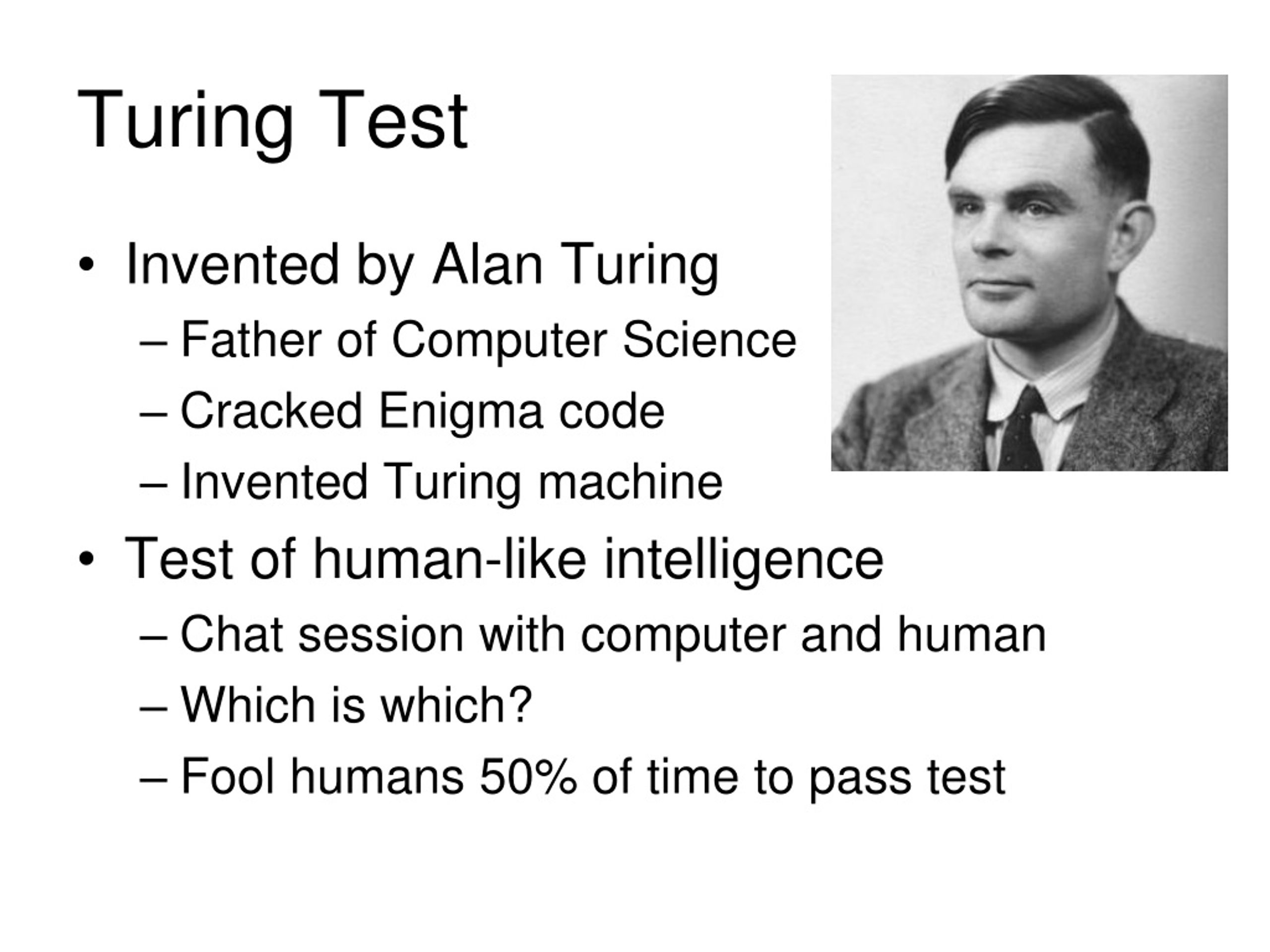
The Turing Test, originally proposed by Alan Turing in his 1950 paper "Computing Machinery and Intelligence," is a foundational experiment designed to assess a machine's ability to exhibit intelligent behavior equivalent to, or indistinguishable from, that of a human. By using a blind linguistic interaction as the benchmark, Turing shifted the focus of artificial intelligence from abstract philosophical definitions of "thought" to observable, functional performance.
The Origins of the Turing Test
In 1950, Alan Turing, a British mathematician and computer scientist who had already secured his place in history for his contributions to code-breaking at Bletchley Park during the Second World War, published his seminal work in the journal Mind. He began the article with a provocative question: "Can machines think?"
Turing recognized that terms like "machine" and "think" were loaded with subjective, imprecise baggage. Rather than attempting to define consciousness or biological cognition, he proposed the "Imitation Game." This experiment replaced the philosophical query with a measurable, empirical process. He argued that if a machine could interact through text in a way that an interrogator could not reliably distinguish it from a human, the machine should be credited with intelligence in a functional sense.
Understanding the Structure of the Imitation Game
The original setup of the test involved three participants: a human interrogator, a human subject, and a machine. These individuals are physically separated, communicating only via text-based channels (Turing imagined a teleprinter).
- The Interrogator: The interrogator’s goal is to determine which participant is the human and which is the machine by asking a series of questions.
- The Human Subject: The human aims to provide convincing, natural responses to assist the interrogator in identifying them as the person.
- The Machine: The machine’s goal is to deceive the interrogator, making it impossible for the human interrogator to distinguish the machine from the human participant.
If the machine succeeds in fooling the interrogator for a significant proportion of the time, it is said to have "passed" the test. Turing proposed that by the year 2000, machines would have the capacity to store enough memory and process information quickly enough to play the game well enough that an average interrogator would have no more than a 70 percent chance of making the right identification after five minutes of questioning.
Core Requirements for a Turing-Capable System
For a machine to succeed in the Imitation Game, it must demonstrate mastery of several high-level cognitive and linguistic capabilities. Unlike early computational tasks that relied solely on brute-force calculation, the Turing Test demands flexibility.
Natural Language Processing (NLP)
The system must be capable of understanding nuances, idioms, sarcasm, and the context of a conversation. It cannot simply retrieve data from a database; it must generate novel, context-aware responses.
Knowledge Representation
To mimic a human, the machine must possess a vast array of common-sense knowledge. It needs to understand the physical world, social norms, and cultural references. If a human subject discusses the weather or a recent news event, the machine must be able to contribute relevant, believable information.
Emotional Simulation
While the machine does not necessarily need to "feel," it must simulate human emotional intelligence. This includes responding to emotional cues from the interrogator, such as showing empathy, annoyance, or humor, which are essential components of human social interaction.
Adaptive Learning
The machine must maintain internal consistency throughout the conversation. If it claims to be a certain age or from a specific city early in the text exchange, it must remember and abide by those facts later to avoid being caught in a logical contradiction.
Comparison of Machine Intelligence Paradigms
Distinguishing between the Turing Test and other benchmarks for machine intelligence is critical for understanding current research in the field.
| Benchmark | Focus | Primary Metric |
|---|---|---|
| Turing Test | Linguistic indistinguishability | Deception of a human interrogator |
| Winograd Schema | Logical disambiguation | Resolving pronoun ambiguity |
| GLUE Benchmark | Natural language understanding | Accuracy on multi-task language datasets |
| Big-Bench | Complex reasoning & capability | Performance on diverse, challenging tasks |
While the Turing Test remains the most famous philosophical benchmark, modern AI researchers often look toward benchmarks like GLUE or Big-Bench, which evaluate specific competencies—such as mathematical reasoning, translation, and logical consistency—rather than the capacity to deceive a human.
Criticisms and Limitations
Despite its historical significance, the Turing Test has faced substantial criticism from the scientific and philosophical communities. The primary contention is that passing the test does not necessarily imply "understanding."
The Chinese Room Argument
Philosopher John Searle famously proposed the "Chinese Room" thought experiment in 1980. He argued that a machine could follow a set of instructions to manipulate symbols (like Chinese characters) to produce a coherent, correct response without actually understanding the meaning behind the symbols. If a computer can simulate conversation by matching patterns and probabilities, it is performing a syntactic task, not a semantic one. Therefore, the Turing Test measures a machine’s ability to manipulate language, not its ability to experience consciousness.
The Problem of Human Fallibility
The test relies on the subjective judgment of a human interrogator. Humans are notoriously susceptible to bias, anthropomorphism, and manipulation. A machine does not need to be truly intelligent to pass if it knows how to exploit the psychological weaknesses of its interrogator—such as by feigning ignorance, using humor to deflect deep questioning, or adopting an emotional persona that makes the interrogator less likely to challenge it critically.
Lack of Practical Utility
In 2026, many developers argue that the Turing Test is an outdated goal for AI development. Modern AI systems are often designed for specific, high-utility tasks such as medical diagnostics, legal analysis, or software engineering. A system that can pass the Turing Test might be highly effective at deception but completely useless at performing complex logical calculations or helping a scientist model climate data.
The Evolution of the Test in the 21st Century
By 2026, the discussion surrounding the Turing Test has shifted toward "Total Turing Tests." These variations extend the requirements beyond text to include visual, auditory, and sensory inputs. Researchers argue that intelligence is deeply linked to the ability to navigate the physical environment. A truly intelligent machine, some propose, should be able to manipulate objects, recognize emotions through facial expressions, and exhibit social awareness in real-world scenarios.
Furthermore, the emergence of Large Language Models (LLMs) has essentially forced a re-evaluation of the test. LLMs can now converse with enough sophistication that, in short, casual exchanges, they often leave human interrogators unable to discern whether they are speaking to a person. However, these systems still struggle with long-term memory, factual consistency over extended sessions, and reasoning in novel domains, proving that while they have mastered the "imitation" aspect of Turing's game, the broader question of whether they "think" remains unresolved.
Frequently Asked Questions
Did Alan Turing believe that passing the test meant a machine was alive?
No. Turing was careful to distance himself from biological definitions. He viewed the test as an operational definition of intelligence. He was interested in what a machine could do rather than what it was. He explicitly stated that the question "Can machines think?" was "too meaningless to deserve discussion."
Is the Turing Test still used by AI researchers today?
It is rarely used as a formal engineering benchmark. While it remains a significant cultural and philosophical touchstone, modern researchers prefer rigorous, reproducible benchmarks that test specific capabilities like zero-shot reasoning, code generation, and multi-modal integration.
What is the primary difference between a chatbot and a "Turing-passing" AI?
A basic chatbot typically relies on scripted responses or simple keyword mapping. An AI aiming to pass a Turing-style test must demonstrate adaptability, the ability to maintain context, and the capacity to generate unique content that mimics the unpredictability of human conversation.
Can an AI pass the Turing Test without being conscious?
Yes, according to the mainstream consensus in computer science. Most researchers agree that a system can effectively simulate the outward behaviors of intelligence and human-like conversation through advanced statistical probability and neural network processing without possessing subjective experience or "consciousness."
Next Actions for Further Research
To gain a deeper understanding of this subject, students and researchers should begin by reading the original 1950 paper, Computing Machinery and Intelligence, which is widely available in digital archives. It is essential to contrast Turing’s original text with modern advancements in transformer-based architecture. For those interested in the philosophical implications, John Searle’s writings on the Chinese Room offer the most significant counter-argument. Ultimately, the study of the Turing Test serves as a gateway into the broader field of the philosophy of mind, forcing us to constantly re-evaluate what we consider unique to human intellect.