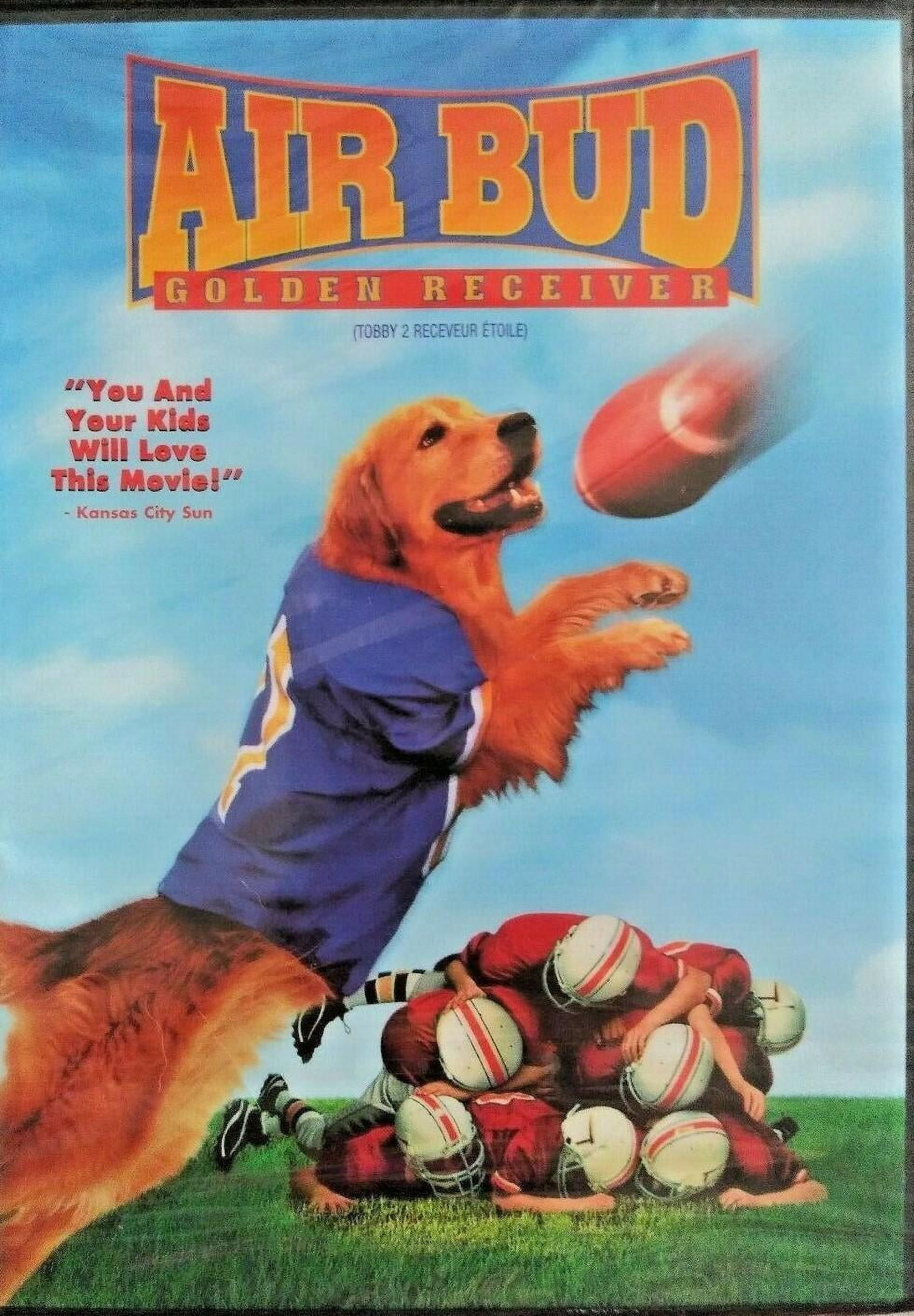
Released in 1998, Air Bud: Golden Receiver is a seminal sports comedy that successfully transitioned the franchise from the basketball court to the American football field. Following the massive success of the 1997 original, this sequel solidified the "Air Bud" brand, proving that the premise of a multi-talented Golden Retriever could sustain a long-running cinematic universe.
Historical Context: From the Court to the Gridiron
The late 1990s represented a golden age for live-action family films, particularly those centered around animals and sports. After the original Air Bud grossed over $27 million on a modest budget, a sequel was inevitable. However, the production of Air Bud: Golden Receiver faced a significant emotional and technical hurdle: the passing of the original canine star, Buddy.
Buddy, the real-life Golden Retriever who had been found as a stray and rose to fame on Late Show with David Letterman and Full House, died of synovial sarcoma in early 1998. Consequently, the sequel was dedicated to his memory and required the casting of several new canine athletes to fill his "shoes." This transition was pivotal, as it proved the franchise could survive with different dogs, leading to a decade of direct-to-video "Buddies" spin-offs.
The shift in sports from basketball to football was a strategic move to capture the quintessential American autumn atmosphere. While the first film leaned into the underdog (literally) narrative of the NBA-style dream, Golden Receiver focuses on the structure of junior high school athletics, making it highly relatable to its primary target audience of children and pre-teens.
Plot Analysis: Football, Family, and International Espionage
The narrative of Air Bud: Golden Receiver operates on three distinct levels: the sports journey, the family drama, and the slapstick villain subplot.
The Sports Journey
Josh Framm (played by Kevin Zegers) has moved from elementary school to junior high. To help him cope with his mother's new relationship, he joins the school’s struggling football team, the Timberwolves. When Josh discovers that Buddy also has an innate talent for catching a football—becoming a "Golden Receiver"—the team begins a winning streak. The film leans heavily into the "Air Bud Rule," the comedic trope suggesting that because the rulebook doesn't explicitly forbid dogs, they are allowed to compete.
The Family Narrative
The emotional core of the film involves Josh’s mother, Jackie (Cynthia Stevenson), and her budding romance with local veterinarian Patrick Sullivan (Gregory Harrison). Josh initially struggles with the idea of a new father figure, using his bond with Buddy as an emotional shield. This subplot provides the necessary groundedness that balances the more fantastical elements of a dog playing organized football.
The Antagonists
In keeping with 1990s family movie conventions, the film introduces two bumbling villains, Natalya (Nora Dunn) and Popov (Perry Anzilotti). These Russian circus owners attempt to kidnap Buddy to turn him into a star attraction in their traveling show. This adds a "ticking clock" element to the third act, as Josh and his friends must rescue Buddy in time for the big championship game.
Canine Performers: Replacing the Original Buddy
One of the most technically interesting aspects of the 1998 production was the use of multiple dogs to replicate the feats performed by the original Buddy. Because football requires different physical maneuvers than basketball—specifically long-distance sprints and high-impact jumping for catches—the training regime was rigorous.
The lead dog for the film was Rush, a Golden Retriever who underwent months of specialized training to track the trajectory of a football. Unlike a basketball, which has a predictable bounce, a football’s erratic movement required the canine actors to have exceptional hand-eye (or mouth-eye) coordination.
The production utilized several "stunt" dogs:
- Rush: Primary actor for close-ups and basic stunts.
- Chuck: Specialized in certain athletic maneuvers.
- Bailey and Jace: Used for background shots and specific light-work.
The training was overseen by Kevin DiCicco, the man who originally discovered Buddy. DiCicco’s method focused on positive reinforcement and "ball drive," ensuring the dogs viewed the filming process as a game rather than a task.
Technical Production and Direction
Directed by Richard Martin, the film opted for a visual style that emphasized the bright, saturated colors of a suburban American town (though it was primarily filmed in Vancouver, British Columbia). This "Anytown, USA" aesthetic is a hallmark of the Keystone Family Pictures production house.
Cinematography and Editing
The sports sequences utilized early "shaky cam" and low-angle shots to simulate the intensity of a football game from a dog’s perspective. Editors had the difficult task of cutting between the human actors and the canine performers to create the illusion of seamless play-making. In 1998, CGI was too expensive and technically limited for this type of production, so every catch seen on screen was a genuine feat performed by a dog.
The "No Rule" Philosophy
A significant part of the film's technical legacy is how it handled the logic of its universe. The screenplay by Tim McGregor and Paul Tamasy leans into the absurdity of the situation. By having a referee actually consult a rulebook and find no "anti-dog" clause, the film created a template for sports comedies that would be parodied for decades to come.
The Evolution of the Cast: Kevin Zegers and the Ensemble
Kevin Zegers, who played Josh Framm, was one of the most prolific child actors of the late 90s. His performance in Golden Receiver is often cited for its sincerity. Unlike many child actors who played "over-the-top," Zegers portrayed Josh as a quiet, somewhat grieving teenager, which gave the film more weight than its "dog-plays-football" premise might suggest.
The supporting cast included:
- Cynthia Stevenson: Returning as Jackie Framm, she provided the maternal warmth necessary for the family subplot.
- Gregory Harrison: As Patrick Sullivan, he played the "nice guy" who eventually wins Josh over, a staple character type in 90s family cinema.
- Nora Dunn: A Saturday Night Live alum, Dunn brought a level of comedic pedigree to the villainous Natalya, making the kidnapping subplot more entertaining for adult viewers.
Critical and Commercial Performance
Upon its release in August 1998, Air Bud: Golden Receiver received mixed reviews from critics but was a moderate success at the box office, grossing approximately $10.2 million domestically. While this was lower than the original film’s theatrical run, the movie found its true success in the home video market.
In the late 90s and early 2000s, VHS and DVD sales were the lifeblood of family franchises. Golden Receiver became a staple of "Blockbuster" nights and school holiday television programming. Critics noted that while the film followed a predictable formula, it was "harmless, wholesome fun" that didn't rely on the "toilet humor" that was beginning to permeate other family comedies of the era.
Technical Specifications and Comparative Data
For film historians and technical editors, understanding the production's scope is essential. Below is a breakdown of the key technical and performance data for Air Bud: Golden Receiver.
| Feature | Specification / Data |
|---|---|
| Director | Richard Martin |
| Release Date | August 14, 1998 |
| Runtime | 90 Minutes |
| Aspect Ratio | 1.85:1 (Theatrical) |
| Budget | Estimated $5 million |
| Domestic Box Office | $10,224,116 |
| Filming Location | Vancouver, BC, Canada |
| Distributor | Dimension Films (Miramax) |
| Lead Canine | Rush (successor to Buddy) |
The Air Bud Rule: A Cinematic Trope Examined
Air Bud: Golden Receiver is often the specific film people think of when discussing the "Air Bud Rule" (the "Ain't no rule says a dog can't play" trope). In legal and sports circles, this has actually become a humorous point of reference for "legalistic literalism"—the idea that if something isn't explicitly forbidden, it must be allowed.
In the context of the 1998 film, this trope serves as the ultimate "deus ex dogina." It allows the resolution of the sports conflict to hinge on the dog's participation, forcing the audience to suspend their disbelief in favor of a feel-good ending. This logic was later applied to baseball, soccer, and volleyball in subsequent sequels, but Golden Receiver was the first to prove the "basketball-only" fluke could be replicated.
Comparing Golden Receiver to the Franchise Timeline
As we look back from 2026, the Air Bud franchise is massive, consisting of five original films and seven Air Buddies spin-offs. Golden Receiver remains a fan favorite because it is the last film in the series to feel like a traditional "sports movie" before the franchise shifted into more fantastical "talking dog" territory.
- Air Bud (1997): Focused on basketball and the bond between a lonely boy and a stray dog.
- Air Bud: Golden Receiver (1998): Shifted to football and introduced a step-father dynamic.
- Air Bud: World Pup (2000): Introduced soccer and a love interest for Buddy (Molly).
- Air Bud: Seventh Inning Fetch (2002): Tackled baseball.
- Air Bud: Spikes Back (2003): The final "sports" focused film, centering on volleyball.
Golden Receiver is often ranked as the best sequel because it maintained the production quality of the original and focused on a sport (football) that allowed for more dramatic cinematic choreography than soccer or baseball.
Practical Viewing Guide for 2026
For those looking to revisit this classic in 2026, the film is widely available on major streaming platforms, most notably Disney+, following Disney’s acquisition of the Fox/Miramax assets.
Format Recommendations
- Streaming: Most platforms offer a 1080p high-definition master. While a 4K version hasn't been officially released, the 1080p stream is sufficient given the film's 35mm grain structure.
- Physical Media: For collectors, the DVD remains common, but look for the "Double Feature" discs which often pair it with the original 1997 film.
- Age Appropriateness: The film remains a "G" rated (or TV-G) experience. It is entirely free of profanity or intense violence, though the kidnapping subplot may provide very mild "peril" for toddlers.
FAQs
Did the same dog play in Air Bud and Air Bud: Golden Receiver?
No. The original dog, Buddy, passed away from cancer shortly after the first film was released. Golden Receiver used a Golden Retriever named Rush as the lead dog, supported by several other canine performers for specific stunts.
Is Air Bud: Golden Receiver based on a true story?
While the original Buddy was a real dog who could actually shoot basketball hoops, the events of the movie—specifically a dog playing in an organized junior high football championship—are entirely fictional. There has never been a documented case of a canine playing in an official school football game.
Why did the franchise change from basketball to football?
The producers wanted to capitalize on different seasonal sports to expand the brand's reach. Football was chosen for the first sequel because it is the most popular high school sport in America, offering a new set of visual stunts and comedic opportunities.
Is the movie suitable for all ages?
Yes, Air Bud: Golden Receiver is widely considered a safe choice for family movie night. It emphasizes themes of teamwork, overcoming grief, and accepting new family members.
Where was the movie filmed?
Although the story is set in the fictional town of Fernfield, Washington, the movie was primarily filmed in and around Vancouver, British Columbia, Canada. Many of the football scenes were shot at local schools in the Vancouver area.
Final Actionable Advice for Fans and Collectors
If you are a fan of 90s nostalgia or looking for a wholesome movie to introduce to a new generation, Air Bud: Golden Receiver (1998) is an essential watch. Its combination of genuine canine athleticism, a heartfelt performance by Kevin Zegers, and the classic "underdog" sports narrative makes it a standout of its era.
For the best experience in 2026, we recommend viewing the film on a platform that supports its original 1.85:1 aspect ratio to ensure you don't miss the wide-angle shots of the "Timberwolves" gridiron action. Whether you're analyzing it for its place in film history or simply looking for a lighthearted comedy, Golden Receiver continues to hold its place as a touchdown in the world of family cinema.