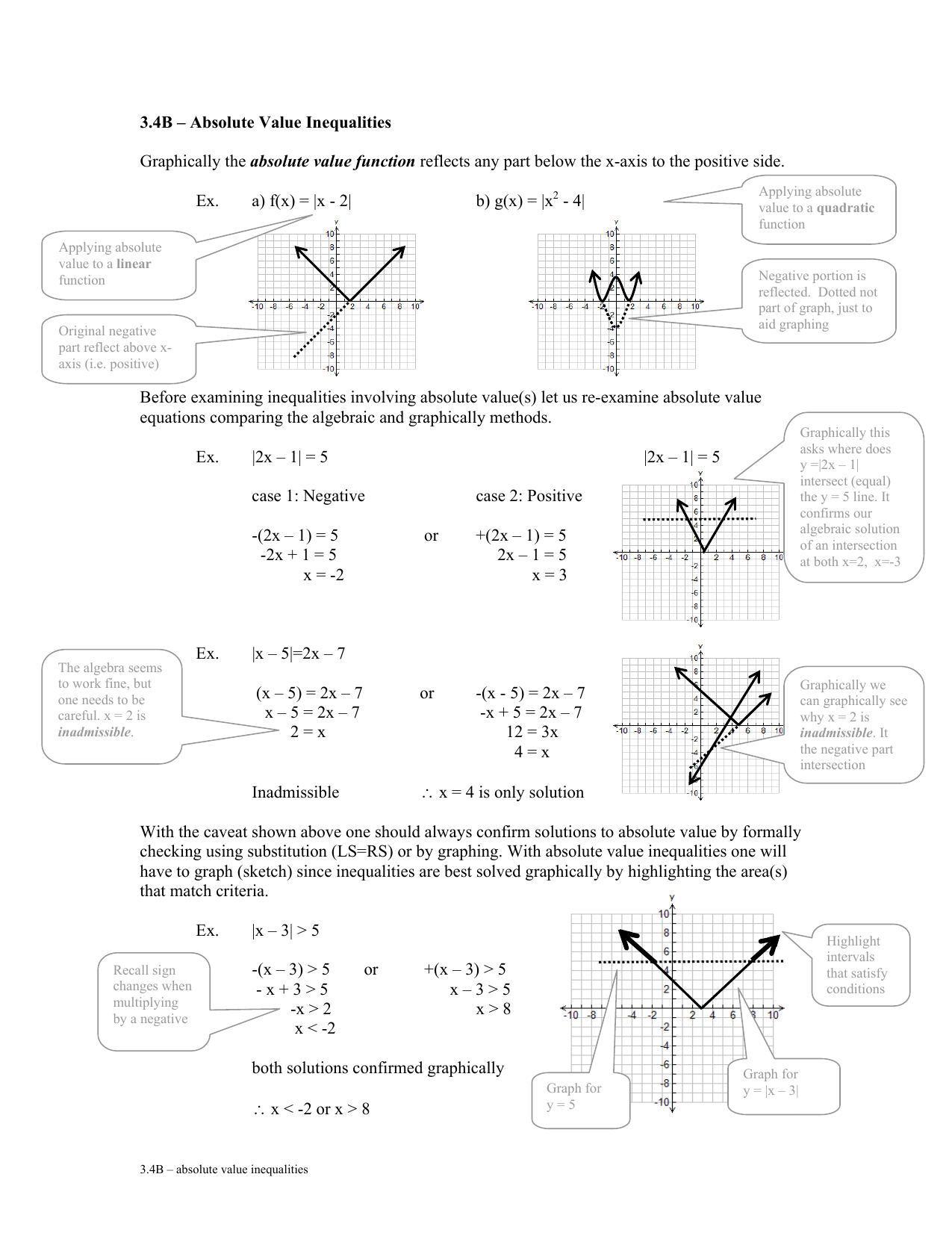
An absolute value equations worksheet serves as a vital pedagogical tool for students and educators, bridging the gap between theoretical algebraic definitions and practical problem-solving. By providing structured practice, these materials enable learners to isolate variables, handle dual-case scenarios, and verify solutions for equations involving absolute value functions, which are fundamental to understanding distance and magnitude in mathematics.
The Mathematical Foundation of Absolute Value
Before diving into worksheets, one must understand the core definition of absolute value. Mathematically, the absolute value of a number $x$, denoted as $|x|$, represents the distance of $x$ from zero on the number line, regardless of direction. Because distance is always non-negative, the absolute value of any real number is either positive or zero.
When dealing with equations such as $|ax + b| = c$, the absolute value symbol creates a two-case scenario. If the distance from zero is $c$, then the expression inside the bars must equal either $c$ or $-c$. This is the "split" principle that serves as the basis for almost every exercise found in an effective absolute value equations worksheet. If a student ignores this principle, they inevitably lose half of the potential solutions to the equation.
Why Structured Worksheets are Effective
Educational researchers have long identified that mastery of algebraic expressions requires repetitive, scaffolded practice. A well-designed worksheet allows a student to move from simple, single-step equations to complex, multi-layered problems.
The Progression of Complexity
A high-quality worksheet is organized by increasing difficulty, ensuring that learners build confidence before tackling advanced constraints. The typical progression looks like this:
- Isolation of the Absolute Value Term: Teaching the learner that $|x| + a = b$ must be rewritten as $|x| = b - a$ before proceeding.
- The Basic Split: Solving simple equations like $|x| = 5$.
- Multi-Step Equations: Dealing with linear expressions inside the bars, such as $|2x - 4| = 10$.
- No-Solution and Extraneous Scenarios: Identifying instances where an equation is impossible (e.g., $|x| = -3$) or contains extraneous roots that do not satisfy the original equality.
Essential Components of a Quality Worksheet
For a worksheet to be truly effective in 2026, it must contain more than just rows of problems. Educators and students should look for resources that incorporate specific structural elements.
- Instructional Summaries: A brief review section at the top of the page reinforces the rules of operations.
- Worked Examples: Providing one or two solved examples allows students to model their methodology after a correct process.
- Mixed Problem Sets: Including a variety of equation types—ranging from simple to complex—helps prevent rote memorization and encourages cognitive flexibility.
- Answer Keys: A detailed answer key, ideally showing the intermediate steps rather than just the final numerical result, is essential for self-correction.
Comparing Worksheet Formats
Different learning environments require different styles of worksheets. The following table provides a comparison of common formats and their best use cases.
| Format Type | Best For | Key Characteristic |
|---|---|---|
| Drill-Based | Fluency building | Large volume of similar, repetitive problems. |
| Concept-Check | Formative assessment | Fewer problems, but requires explaining the "why." |
| Scaffolded | Remedial support | Guided steps with empty boxes to fill in the process. |
| Application-Focused | Real-world context | Uses word problems to test algebraic translation skills. |
Common Pitfalls and Troubleshooting
When solving absolute value equations, students often fall into a few predictable traps. Recognizing these early is crucial for long-term success.
The "Negative Absolute Value" Trap
A common error occurs when a student sees an equation like $|3x - 1| = -5$ and attempts to solve it by splitting it into two equations: $3x - 1 = -5$ and $3x - 1 = 5$. Since an absolute value cannot return a negative result, this equation has no solution. A good worksheet will intentionally include at least one "no solution" case to see if the student checks the validity of the result.
The Failure to Isolate
Students often rush to split the equation before isolating the absolute value expression. For example, in the equation $2|x - 3| + 4 = 10$, a student might incorrectly distribute the 2 or attempt to split the absolute value while the $+4$ is still present. The rule is absolute: isolate the absolute value term entirely on one side of the equation before applying the split.
Forgetting Extraneous Solutions
When an absolute value equation involves variables on both sides (e.g., $|2x - 1| = x + 3$), it is possible to generate solutions that satisfy the algebraic algebra but fail when substituted back into the original absolute value expression. Verification is not just a suggestion; it is a mandatory part of the process.
Pedagogical Benefits of Paper-Based Practice
While digital tools have become ubiquitous in 2026, paper-based worksheets remain highly effective for mathematics. The physical act of writing out the two cases of an absolute value equation engages muscle memory and slows the student down, forcing a more deliberate thought process. This is particularly important for students who struggle with the abstract nature of algebraic variables. By physically separating the page into two columns—one for the positive case and one for the negative case—students create a visual heuristic that aids in long-term retention.
Incorporating Real-World Applications
To increase student engagement, high-quality worksheets often include word problems that rely on absolute value. In engineering, manufacturing, and data science, absolute value is used to define "tolerance ranges."
For example, a machine might be calibrated to cut metal rods to a length of 50 centimeters, with an allowable error of 0.2 centimeters. This can be expressed as an absolute value inequality, but the foundational equations are essential for finding the "worst-case" scenarios. By solving $|x - 50| = 0.2$, students calculate the exact bounds of the tolerance range. This context transforms abstract math into a tool for quality control and error analysis.
Expert Recommendations for Effective Study
To maximize the benefits of an absolute value equations worksheet, follow this structured study routine:
- Theory First: Review the definition of absolute value and the "split" procedure.
- Guided Practice: Complete the provided worked examples without looking at the solutions.
- Independent Work: Use a timer to complete 5–10 problems from the worksheet.
- Verification: Always plug your final answers back into the original equation. If you get an equality (e.g., $7 = 7$), the answer is correct. If you get a contradiction (e.g., $7 = -2$), the answer must be discarded as extraneous.
- Analyze Errors: When an answer is incorrect, identify where the error happened. Was it a sign error during the split? Was it a failure to isolate the absolute value? Pinpointing the breakdown in logic is more valuable than finding the correct number.
Frequently Asked Questions
What is the first step in solving any absolute value equation? The first step is always to isolate the absolute value term by itself on one side of the equation. Any constants outside the absolute value bars must be moved using inverse operations before you proceed to split the equation into two cases.
Can an absolute value equation have more than two solutions? Generally, a standard linear absolute value equation will have at most two solutions. However, if the expression inside the absolute value is more complex (such as a quadratic), the resulting equations could yield more, depending on the constraints.
Why do some solutions "not work" when checked? These are known as extraneous solutions. They appear as a result of the algebraic process but do not satisfy the original equation because they violate the fundamental definition of absolute value (which requires that the result be non-negative).
Are absolute value equations useful outside of school? Yes. They are used in any field involving tolerance or margin of error. This includes manufacturing, quality assurance, programming, and finance, where one must determine how far a result can deviate from a target value.
How do I handle equations where the variable is on both sides? Follow the standard split procedure: create two equations, one where the right-side expression is positive and one where it is negative. Solve both, then substitute your results back into the original equation to ensure they are valid.
Conclusion and Next Steps
The journey to mastering algebraic equations starts with foundational practice. By utilizing a structured absolute value equations worksheet, you develop the muscle memory and conceptual clarity required for higher-level mathematics. Ensure that your study routine emphasizes the isolation of terms and the mandatory verification of all results. For your next practice session, attempt to solve problems that involve both sides of the equation, as these will most effectively test your understanding of the relationship between absolute value and linear functions.