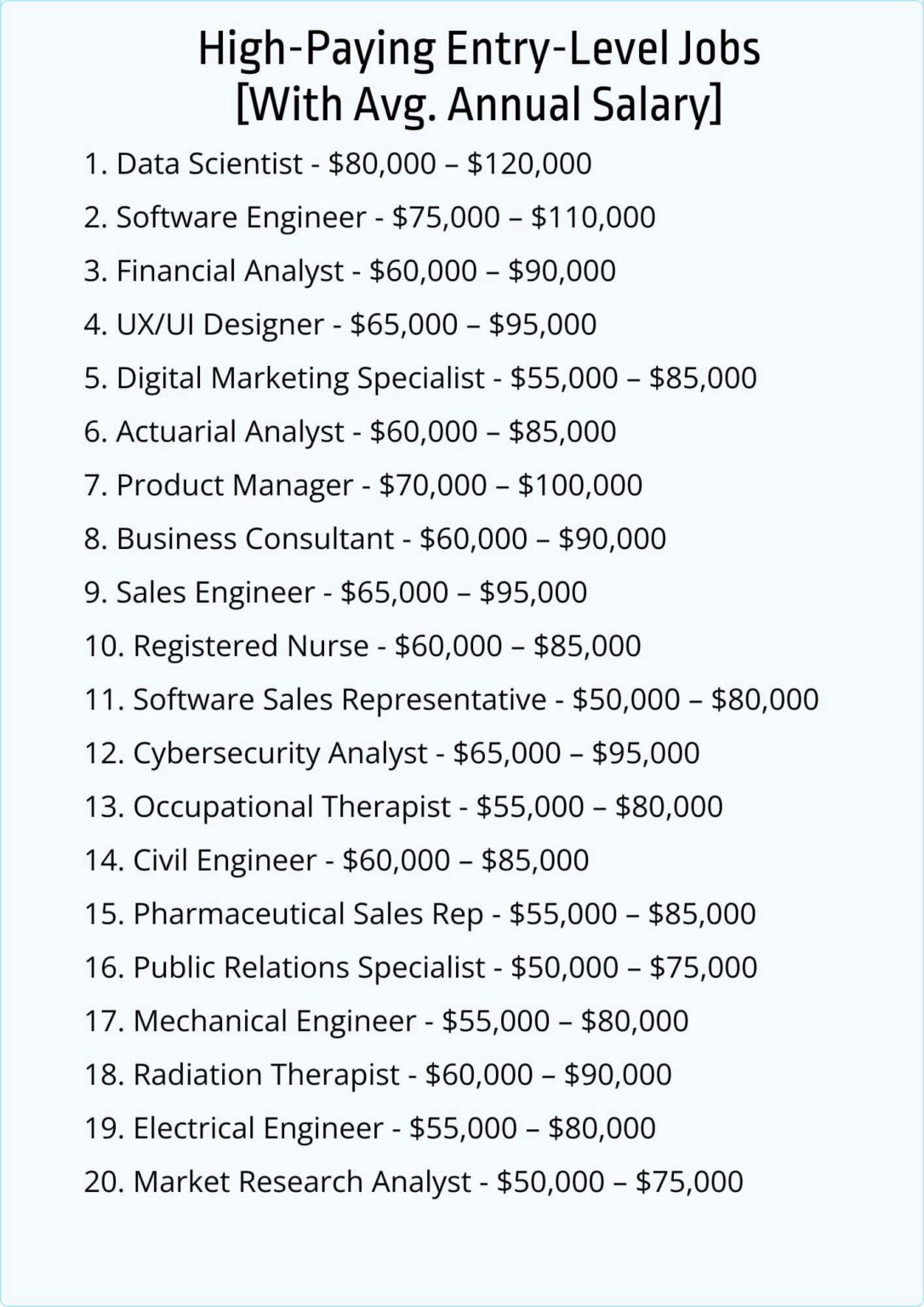
Securing a high-paying entry-level job requires balancing your natural strengths, educational background, and technical aptitude with career paths that offer strong starting salaries and rapid growth potential. This comprehensive guide explores the top seven lucrative entry-level positions, outlining their core requirements, earning potentials, daily responsibilities, and the specific personality types or skill sets they suit best.
1. Software Engineer or Junior Developer
Software engineering remains one of the most accessible yet lucrative career paths for individuals entering the workforce. Because the technology sector values demonstrable coding skills and problem-solving abilities over traditional degrees, junior developers can command high starting salaries right out of a coding bootcamp, university, or self-taught program.
Core Responsibilities and Daily Work
Junior software engineers spend their days writing, testing, and debugging code for applications, websites, or internal systems. They typically work under the mentorship of senior engineers, participating in code reviews, writing unit tests, and fixing software bugs. Common languages and frameworks include Python, JavaScript, Java, and SQL.
Earning Potential and Career Trajectory
Starting salaries for junior software engineers often range from $70,000 to over $100,000 annually, depending on geographic location, industry, and company size. The trajectory is exceptionally steep; developers frequently transition to mid-level and senior roles within three to five years, significantly increasing their compensation.
Who This Role Suits Best
- Logical Thinkers: Individuals who enjoy breaking complex problems down into smaller, manageable logical components.
- Continuous Learners: Technology evolves rapidly; this role suits people who genuinely enjoy reading documentation, learning new frameworks, and staying updated on tech trends.
- Independent Problem Solvers: While teamwork is essential, developers must often spend hours independently researching and troubleshooting code errors.
2. Sales Development Representative (SDR)
For outgoing individuals who prefer human interaction over coding behind a screen, a Sales Development Representative (SDR) role offers a high-earning entry-level path driven by performance-based compensation structures.
Core Responsibilities and Daily Work
An SDR focuses on the top of the sales funnel. Their primary objective is outbound prospecting, which involves identifying potential business clients (B2B), cold calling, sending targeted emails, and qualifying inbound leads. Once a lead shows genuine interest and fits the ideal customer profile, the SDR schedules a meeting for an Account Executive.
Earning Potential and Career Trajectory
Base salaries for SDRs typically range from $45,000 to $65,000, but uncapped commissions and bonuses frequently push total first-year earnings well past $75,000 to $90,000 for top performers. Successful SDRs are usually promoted to Account Executives within 12 to 24 months, where earning potential multiplies.
Who This Role Suits Best
- Resilient Communicators: People who do not take rejection personally and can maintain high energy after multiple declined calls or unanswered emails.
- Goal-Oriented Competitors: Individuals who thrive in metrics-driven environments where daily quotas, leaderboards, and financial incentives drive motivation.
- Persuasive Speakers: Those with high emotional intelligence who can quickly build rapport, ask probing questions, and articulate value propositions clearly.
3. Data Analyst
Data is often called the currency of modern business, and organizations across every industry need professionals who can interpret raw data to guide executive decision-making.
Core Responsibilities and Daily Work
Data analysts collect, clean, and interpret complex data sets. They write SQL queries to extract data from databases, build interactive dashboards using tools like Tableau or Power BI, and present their findings to non-technical stakeholders. Their insights help companies optimize marketing campaigns, streamline supply chains, or improve customer retention.
Earning Potential and Career Trajectory
Entry-level data analysts typically earn between $65,000 and $85,000 per year. With experience in advanced analytics, machine learning, or data engineering, professionals easily transition into senior analyst or data scientist positions with six-figure salaries.
Who This Role Suits Best
- Detail-Oriented Analysts: Individuals with a meticulous eye for detail who can spot anomalies, outliers, and errors in massive spreadsheets.
- Visual Storytellers: People who enjoy taking dry numbers and transforming them into clear, compelling charts and dashboards that tell a coherent business story.
- Curious Investigators: Those who love asking "why" and digging deeper into operational metrics to uncover hidden trends.
4. Digital Marketing Specialist
Digital marketing blends creativity with analytical rigor. Companies rely heavily on digital channels to acquire customers, making entry-level marketing professionals with specialized technical skills highly valuable.
Core Responsibilities and Daily Work
Depending on the specific focus, a digital marketing specialist manages paid advertising campaigns (Google Ads, Meta Ads), optimizes website content for search engines (SEO), executes email marketing sequences, or manages social media channels. They track key performance indicators (KPIs) such as cost-per-acquisition (CPA) and return on ad spend (ROAS) to refine ongoing campaigns.
Earning Potential and Career Trajectory
Entry-level digital marketing roles generally offer starting salaries between $45,000 and $65,000. Specialists who master high-value skills like paid media optimization or technical SEO can rapidly advance to marketing managers or directors, scaling their compensation accordingly.
Who This Role Suits Best
- Creative Strategists: Individuals who enjoy writing persuasive ad copy, brainstorming visual concepts, and understanding consumer psychology.
- Data-Minded Marketers: Unlike traditional advertising, digital marketing requires tracking constant metrics; it suits creative minds who also appreciate numbers and analytics.
- Adaptable Experimenters: People who are comfortable with constant platform algorithm updates and enjoy A/B testing different strategies to find what works.
5. Actuarial Analyst
For those with a deep affinity for mathematics and statistics, becoming an actuarial analyst is one of the most reliable and lucrative professional tracks available immediately after college graduation.
Core Responsibilities and Daily Work
Actuarial analysts work primarily in the insurance, finance, and consulting sectors. They assess financial risks using complex mathematical, statistical, and financial models. Their work helps insurance companies determine appropriate pricing for policies, calculate reserve funds, and evaluate the financial impact of uncertain future events.
Earning Potential and Career Trajectory
Entry-level actuarial positions often start between $70,000 and $90,000. A defining characteristic of this career is the actuarial exam process; as analysts pass professional exams administered by societies like the SOA or CAS, employers typically grant substantial salary bumps and bonuses. Fully credentialed actuaries routinely earn well over six figures.
Who This Role Suits Best
- Advanced Mathematicians: Individuals who excelled in college-level calculus, linear algebra, probability, and mathematical statistics.
- Disciplined Studiers: The career requires passing a rigorous series of professional exams while working full-time, demanding immense personal discipline and study habits.
- Risk-Aware Planners: People who naturally think in terms of probabilities, contingencies, and long-term financial forecasting.
6. Supply Chain or Logistics Analyst
Global commerce depends on the efficient movement of goods from manufacturers to consumers. Supply chain analysts ensure these complex webs operate smoothly and cost-effectively.
Core Responsibilities and Daily Work
Logistics analysts examine transportation routes, inventory levels, warehousing operations, and supplier contracts. They identify bottlenecks, negotiate with freight vendors, and implement optimization software to reduce shipping costs and delivery times. Daily tasks involve heavy use of enterprise resource planning (ERP) software and advanced spreadsheet modeling.
Earning Potential and Career Trajectory
Starting salaries for supply chain analysts range from $55,000 to $75,000. As global supply chains face increasing complexity, experienced logisticians and supply chain managers are in high demand, offering clear pathways to executive leadership roles like VP of Operations.
Who This Role Suits Best
- Systems Thinkers: Individuals who can visualize an entire operational process from end to end and understand how a change in one link affects the entire chain.
- Calm Under Pressure: People who can manage crisis situations, such as shipping delays or sudden inventory shortages, with composure and pragmatic problem-solving.
- Negotiators: Those who enjoy analytical bargaining, vendor management, and finding mutually beneficial financial agreements.
7. Medical Device or B2B Technical Sales Representative
While general sales is lucrative, technical and medical device sales represents the pinnacle of high-paying entry-level sales careers due to the specialized knowledge required to sell complex products to professionals.
Core Responsibilities and Daily Work
Medical device or technical sales representatives sell specialized surgical tools, diagnostic equipment, or enterprise software to hospitals, clinics, or engineering firms. They must understand the underlying science or engineering of their products, conduct product demonstrations for physicians or chief technology officers, and provide operational support during procedures or implementations.
Earning Potential and Career Trajectory
While base salaries typically hover between $50,000 and $70,000, commissions and bonuses frequently push total first-year compensation past $90,000 to $120,000 for top performers. Long-term career progression leads to regional sales director positions managing large enterprise accounts.
Who This Role Suits Best
- Science and Tech Enthusiasts: Individuals with a background in biology, chemistry, engineering, or IT who want to apply their technical knowledge in a commercial environment.
- Relentless Go-Getters: High-energy professionals who are comfortable walking into demanding professional environments, such as operating rooms or corporate boardrooms, with supreme confidence.
- Relationship Builders: People who excel at building long-term, trust-based partnerships with high-value clients where credibility is paramount.
Comparison of Entry-Level High-Paying Careers
| Job Title | Estimated Starting Salary Range | Primary Skill Focus | Key Work Environment |
|---|---|---|---|
| Software Engineer | $70,000 – $100,000+ | Coding, Logic, Frameworks | Remote / Office |
| Sales Development Rep | $45,000 – $75,000+ (With Commission) | Prospecting, Communication | Office / Hybrid |
| Data Analyst | $65,000 – $85,000 | SQL, Visualization, Statistics | Office / Remote |
| Digital Marketing Specialist | $45,000 – $65,000 | Paid Media, SEO, Analytics | Agency / Corporate |
| Actuarial Analyst | $70,000 – $90,000 | Probability, Risk Modeling | Corporate Office |
| Supply Chain Analyst | $55,000 – $75,000 | Logistics, ERP, Modeling | Corporate / Warehouse |
| Technical / Medical Sales Rep | $50,000 – $120,000+ (With Commission) | Product Knowledge, Closing | Field / Hospital / Corporate |
Frequently Asked Questions
What makes an entry-level job "high paying"?
Generally, an entry-level job is considered high-paying if its starting compensation exceeds the national median starting salary for recent graduates by a significant margin—typically starting at $60,000 to $70,000 or higher. These roles often require specialized technical skills, rigorous certifications, or performance-based commission structures that reward high output.
Do I need a specific degree for these high-paying entry-level roles?
It depends heavily on the role. Software engineering, data analysis, and digital marketing often prioritize portfolios, bootcamps, and demonstrated skill over specific college majors. Conversely, actuarial analysis demands strong quantitative coursework, and medical device sales often requires a degree in a life science or business discipline.
How can I land a high-paying entry-level job without prior experience?
To compensate for a lack of formal work history, candidates should build a strong portfolio of personal projects, complete industry-recognized certifications (such as Google Data Analytics or AWS certifications), complete targeted internships, and network extensively with professionals currently working in their desired niche.
Are sales-based entry-level jobs worth the high commission volatility?
Sales roles like SDRs or technical sales reps offer uncapped earning potential that salaried roles lack. While base salaries provide a stable floor, top performers can outearn their peers in traditional salaried roles within their very first year, making them ideal for motivated individuals willing to embrace performance risk.
Final Recommendations and Next Actions
To successfully secure one of these top-tier entry-level positions, begin by auditing your personal strengths: do you lean toward quantitative analysis, creative problem-solving, or interpersonal persuasion? Once you identify the best-suited path, commit to acquiring one or two concrete credentials or portfolio projects that prove your competency. Tailor your resume to highlight relevant coursework, projects, or transferable skills, and leverage professional networking platforms to connect with hiring managers directly.