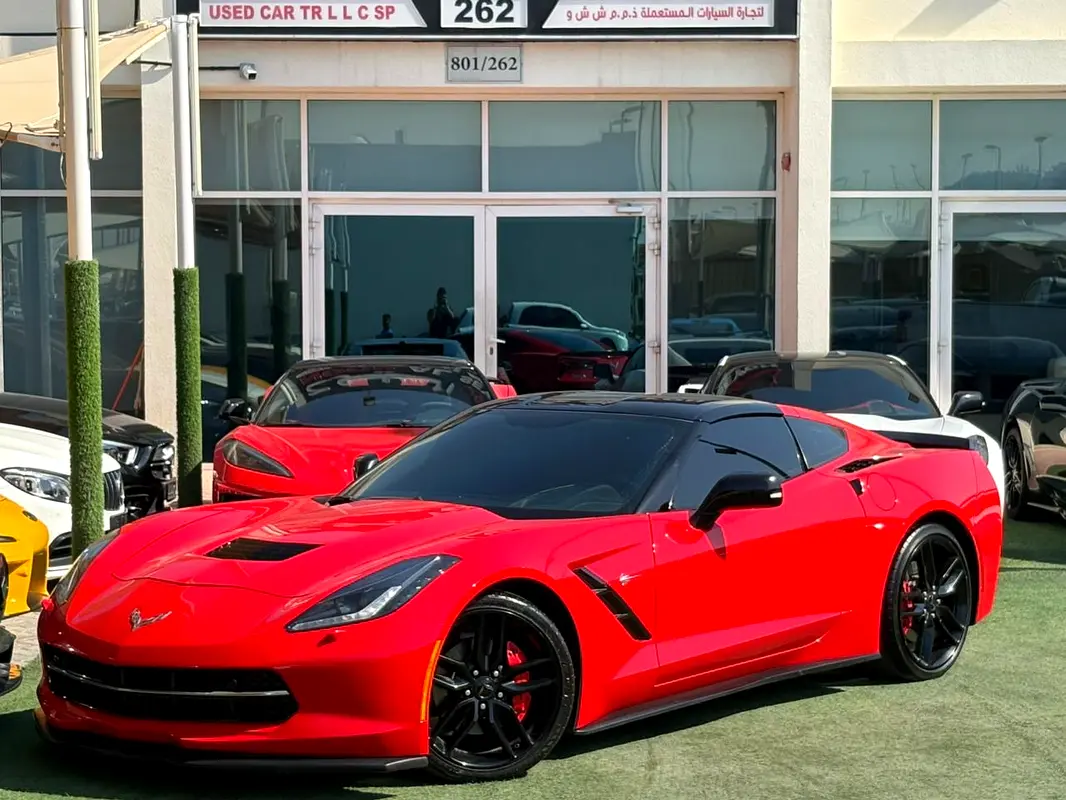
The 2017 Chevrolet Corvette Stingray features a 6.2-liter LT1 naturally aspirated V8 engine producing 455 horsepower and 460 lb-ft of torque in standard trim, increasing to 460 horsepower and 465 lb-ft with the optional performance exhaust. Available in coupe and convertible body styles with a 7-speed manual or 8-speed automatic transmission, it accelerates from 0 to 60 mph in 3.7 seconds.
Overview of the 2017 C7 Corvette Stingray
The 2017 model year represents the fourth year of the seventh-generation (C7) Chevrolet Corvette platform. Built on an aluminum spaceframe architecture with a front-midship engine layout, the C7 Stingray balances near 50/50 front-to-rear weight distribution with rear-wheel drive dynamics. Chevrolet designed the C7 to deliver world-class sports car metrics through advanced powertrain engineering, lightweight composite body panels, and driver-focused chassis technologies.
Buyers in 2017 could select between three distinct interior trim tiers—1LT, 2LT, and 3LT—across both coupe (featuring a removable carbon-fiber roof panel) and convertible body configurations. Furthermore, Chevrolet offered the Z51 Performance Package for drivers seeking track-ready cooling, braking, aerodynamic, and suspension enhancements.
Whether evaluating the 2017 Corvette Stingray on the secondary market today or reviewing its engineering benchmarks, understanding its mechanical specifications, option codes, and physical dimensions is key to understanding its capabilities.
Engine Specifications: The 6.2L LT1 Small-Block V8
At the heart of the 2017 Corvette Stingray is General Motors' 6.2-liter LT1 Small-Block V8 engine. Built entirely from cast aluminum, this naturally aspirated overhead valve (OHV) power plant combines traditional American muscle pushrod architecture with advanced powertrain engineering.
- 6.2L LT1 V8 ENGINE
- 455 HP / 460 LB-FT (Standard Exhaust)
- 460 HP / 465 LB-FT (NPP Dual-Mode Exhaust / Z51)
- Direct Fuel Injection
- Variable Valve Timing (VVT)
- Active Fuel Mgmt (V4 Cylinder Cut)
- Dry-Sump Oil Sump (Z51 Trim Only)
Core Engine Parameters
- Engine Type: 90-degree V8, aluminum block and cylinder heads
- Displacement: 6.2 Liters (376 cubic inches / 6,162 cc)
- Bore and Stroke: 4.06 in x 3.62 in (103.25 mm x 92.0 mm)
- Compression Ratio: 11.5:1
- Valvetrain: Overhead valve, 2 valves per cylinder, Variable Valve Timing (VVT)
- Fuel Delivery: Direct high-pressure fuel injection (up to 2,175 psi / 150 bar)
- Max Engine Speed (Redline): 6,600 RPM
Horsepower and Torque Ratings
The LT1 engine's output varies slightly based on the exhaust system configuration installed from the factory:
- Standard Exhaust System:
- Peak Horsepower: 455 hp @ 6,000 RPM
- Peak Torque: 460 lb-ft @ 4,600 RPM
- Dual-Mode Performance Exhaust (NPP):
- Peak Horsepower: 460 hp @ 6,000 RPM
- Peak Torque: 465 lb-ft @ 4,600 RPM
The dual-mode exhaust system utilizes electronically controlled valves that open under aggressive acceleration or in sportier driving modes. This reduces backpressure, increases output by 5 horsepower and 5 lb-ft of torque, and delivers a significantly louder, deeper exhaust note. The NPP system was available as a standalone option on base models and came standard with the Z51 package.
Engine Efficiency and Lubrication Technologies
The LT1 utilizes direct fuel injection inside the combustion chamber rather than the intake ports, allowing a higher 11.5:1 compression ratio without knocking. Combined with Continuously Variable Valve Timing (VVT), the engine optimizes torque delivery across the low and middle RPM ranges.
To meet federal emissions and fuel economy guidelines, GM integrated Active Fuel Management (AFM). Under light-load conditions, such as cruising on flat highway terrain, AFM deactivates four of the eight cylinders, operating the car effectively as a 3.1-liter V4.
Standard Stingray models feature a conventional wet-sump lubrication system holding 7.0 quarts of engine oil. However, Stingray models equipped with the Z51 Performance Package use a 9.8-quart dry-sump lubrication system. The dry-sump system utilizes an external oil reservoir and dual-stage scavenge pumps to maintain consistent oil pressure during sustained high-g cornering, preventing engine starvation on road courses.
Drivetrain and Transmission Options
The 2017 Stingray sends power exclusively to the rear wheels via a rear-mounted transaxle layout. Positioning the transmission at the rear axle helps achieve an optimal 50/50 front-to-rear weight balance, reducing understeer and optimizing power delivery exiting turns.
7-Speed Manual Transmission (Tremec TR-6070)
The standard transmission on the 2017 Stingray is a Tremec TR-6070 7-speed manual gearbox. It features gear ratios designed to balance acceleration in 1st through 4th gears with highway cruising efficiency in 5th, 6th, and 7th gear overdrive.
- Active Rev Matching (ARM): Drivers can toggle steering-wheel-mounted paddles to activate ARM. The system monitors gear selection and automatically blips the throttle during downshifts to match engine RPM to wheel speed, eliminating rear-wheel hop during hard braking and aggressive corner entry.
- Dual-Mass Flywheel: Smooths engine pulses to maintain high refinement during street driving.
TR-6070 Gear Ratios:
- 1st Gear: 2.97:1 (Standard) / 2.66:1 (Z51)
- 2nd Gear: 2.07:1 (Standard) / 1.78:1 (Z51)
- 3rd Gear: 1.43:1 (Standard) / 1.30:1 (Z51)
- 4th Gear: 1.00:1 (Standard) / 1.00:1 (Z51)
- 5th Gear: 0.71:1 (Standard) / 0.74:1 (Z51)
- 6th Gear: 0.57:1 (Standard) / 0.50:1 (Z51)
- 7th Gear: 0.48:1 (Standard) / 0.42:1 (Z51)
- Reverse: 3.28:1 (Standard) / 2.90:1 (Z51)
- Final Drive Ratio: 3.42:1
8-Speed Automatic Transmission (GM 8L90)
As an option, buyers could select the GM-built 8L90 8-speed paddle-shift automatic transmission. Developed specifically for high-torque applications, the 8L90 provides rapid manual gear selection using steering-wheel-mounted magnesium shift paddles while delivering smooth automatic shift mapping in Tour mode.
8L90 Gear Ratios:
- 1st Gear: 4.56:1
- 2nd Gear: 2.97:1
- 3rd Gear: 2.08:1
- 4th Gear: 1.69:1
- 5th Gear: 1.27:1
- 6th Gear: 1.00:1
- 7th Gear: 0.85:1
- 8th Gear: 0.65:1
- Reverse: 3.82:1
- Axle Ratio: 2.41:1 (Standard) / 2.73:1 (Z51 Performance Axle)
Differential Specifications
- Standard Stingray: Equipped with a mechanical limited-slip differential (mLSD) with a 2.41:1 (auto) or 3.42:1 (manual) final drive.
- Z51 Performance Package: Upgrades to an Electronic Limited-Slip Differential (eLSD). The eLSD continuously calculates vehicle speed, steering angle, throttle position, and lateral g-forces to adjust clutch pack engagement within milliseconds. This optimizes traction out of corners and improves high-speed directional stability.
Performance Metrics and Speed Data
When equipped with performance options, the 2017 Corvette Stingray produces performance figures that rival mid-engine exotic sports cars of its era.
| STINGRAY Z51 PERFORMANCE PROFILE | Specification |
|---|---|
| 0 - 60 MPH | 3.7 Seconds |
| Quarter-Mile | 11.9 Seconds @ 119 MPH |
| Top Track Speed | 187 MPH (Standard Coupe) |
| Lateral Acceleration | 1.03g (Z51 Package) |
| 60 - 0 MPH Braking | 107 Feet |
Acceleration and Top Speed
- 0 to 60 MPH Acceleration:
- Standard Stingray (Manual): 4.0 seconds
- Standard Stingray (Automatic): 3.9 seconds
- Stingray Z51 (Automatic with Launch Control): 3.7 seconds
- 1/4-Mile Acceleration:
- Stingray Z51: 11.9 seconds @ 119 mph
- Standard Stingray: 12.0 seconds @ 118 mph
- Top Track Speed: 187 mph (Coupe with standard aerodynamics). Installing track-focused Z51 rear spoilers increases rear downforce but slightly decreases top-end velocity due to aerodynamic drag.
Braking and Handling Limits
- Lateral Grip (Skidpad Acceleration):
- Standard Stingray: 0.95g
- Stingray Z51: 1.03g
- 60 to 0 MPH Stopping Distance:
- Standard Stingray: ~115 feet
- Stingray Z51: ~107 feet
Launch Control comes standard across all manual and automatic models. When activated in Track mode, the traction system modulates engine torque to deliver maximum acceleration from a standing start while limiting wheel slip.
Chassis, Suspension, and Braking Systems
The C7 platform relies on a hydroformed aluminum chassis frame that is 99 pounds lighter and 57% stiffer than the steel frame used on the previous-generation C6 Corvette.
- HYDROFORMED ALUMINUM FRAME
- FRONT SUSPENSION
- Dual Equal-Length Short/Long Arm
- Composite Leaf
- REAR SUSPENSION
- Dual Equal-Length Short/Long Arm
- Composite Leaf
- OPTIONAL MAGNETIC RIDE CONTROL
- Magnetorheological Damping (MSRC)
- FRONT SUSPENSION
Suspension Architecture
- Front Suspension: Independent short/long arm (SLA) double-wishbone design with cast aluminum upper and lower control arms, transverse composite leaf spring, and monolithic stabilizer bar.
- Rear Suspension: Independent short/long arm (SLA) double-wishbone design with aluminum control arms, transverse composite leaf spring, and stabilizer bar.
- Magnetic Selective Ride Control (MSRC): Available as an option (FE4 suspension code), MSRC utilizes magnetorheological fluid within the shock absorbers. Electrical currents instantly alter the fluid viscosity every 10 to 15 milliseconds, adapting real-time damping performance to road imperfections or aggressive cornering inputs.
Steering System
- Type: Speed-sensitive electric power steering (EPS) with a rack-and-pinion design.
- Ratio: Variable ratio from 12.0:1 to 16.4:1.
- Turns Lock-to-Lock: 2.53 turns.
- Turning Circle (Wall-to-Wall): 37.7 feet.
Braking Components
All 2017 Stingrays feature four-wheel disc brakes engineered by Brembo:
- Standard Brakes (FE1 / FE2 Suspension):
- Front Rotors: 12.6-inch (320 mm) ventilated steel rotors with 4-piston fixed aluminum calipers.
- Rear Rotors: 13.3-inch (338 mm) ventilated steel rotors with 4-piston fixed aluminum calipers.
- Z51 Brakes (FE3 / FE4 Suspension):
- Front Rotors: 13.6-inch (345 mm) dual-cast, slotted steel rotors with 4-piston fixed aluminum calipers and functional brake cooling ducts.
- Rear Rotors: 13.3-inch (338 mm) slotted steel rotors with 4-piston fixed calipers.
Dimensions, Weight, and Capacities
The 2017 Corvette Stingray offers low-slung, wide proportions that optimize high-speed balance while keeping the center of gravity low.
| DIMENSIONS OVERVIEW | Measurement |
|---|---|
| Overall Length | 176.9 inches (4,493 mm) |
| Overall Width | 73.9 inches (1,877 mm) |
| Overall Height | 48.6 inches (1,234 mm) Coupe / 48.7 inches Convertible |
| Wheelbase | 106.7 inches (2,710 mm) |
| Front Track | 63.0 inches (1,600 mm) |
| Rear Track | 61.7 inches (1,567 mm) |
Weight and Weight Distribution
- Curb Weight (Coupe, Manual): 3,298 lbs (1,496 kg)
- Curb Weight (Coupe, Automatic): ~3,347 lbs (1,518 kg)
- Curb Weight (Convertible, Manual): 3,362 lbs (1,525 kg)
- Curb Weight (Convertible, Automatic): ~3,410 lbs (1,547 kg)
- Weight Distribution: 50/50 Front/Rear
Interior Dimensions and Cargo Capacities
- Seating Capacity: 2 Passengers
- Headroom: 37.9 inches (962 mm)
- Legroom: 43.0 inches (1,092 mm)
- Shoulder Room: 55.2 inches (1,402 mm)
- Hip Room: 53.7 inches (1,364 mm)
- Cargo Volume (Coupe): 15.0 cubic feet (425 Liters)
- Cargo Volume (Convertible): 10.0 cubic feet (283 Liters)
- Fuel Tank Capacity: 18.5 US gallons (70 Liters)
Wheels, Tires, and Option Packages
Chevrolet customized the Stingray’s physical footprint based on whether the buyer selected the base chassis setup or the Z51 package.
Wheel and Tire Sizes
- Standard Stingray Wheels:
- Front: 18-inch x 8.5-inch aluminum wheels
- Rear: 19-inch x 10.0-inch aluminum wheels
- Standard Tires:
- Front: P245/40R18 Michelin Pilot Super Sport ZP (Zero Pressure / Run-Flat)
- Rear: P285/35R19 Michelin Pilot Super Sport ZP
- Z51 Package Wheels:
- Front: 19-inch x 8.5-inch aluminum wheels
- Rear: 20-inch x 10.0-inch aluminum wheels
- Z51 Tires:
- Front: 245/35ZR19 Michelin Pilot Super Sport ZP
- Rear: 285/30ZR20 Michelin Pilot Super Sport ZP
Z51 Performance Package Equipment (Option Code Z51)
The Z51 package transformed the baseline Stingray into a track-capable machine by bundling hardware upgrades:
- Performance suspension tuning (revised springs, shocks, and stabilizer bars)
- Electronic Limited-Slip Differential (eLSD) with differential cooler
- Dry-sump engine oiling system
- Larger slotted Brembo brake rotors with dedicated cooling ducts
- 19-inch front and 20-inch rear forged/cast alloy wheels with performance compound tires
- Upgraded transmission fluid cooler and heavy-duty engine cooling system
- Unique exterior aero package (front splitter and rear decklid spoiler)
- Shorter gear ratios on manual models; 2.73 performance axle on automatics
Interior Trim Levels and Features
The 2017 Stingray was sold in three main trim levels for both the Coupe and Convertible.
1LT (Base Trim)
The entry trim offers performance equipment alongside convenience features:
- 8-way power GT bucket seats wrapped in perforated Mulan leather
- Keyless Open and Start with proximity key
- Chevrolet MyLink 8-inch high-resolution touchscreen display
- Apple CarPlay and Android Auto compatibility
- 9-speaker Bose premium audio system
- Rear Vision Camera
- Dual-zone automatic climate control
- Power tilt/telescoping steering column
2LT (Mid-Level Trim)
The 2LT trim adds comfort, safety, and interior technology:
- Bose 10-speaker surround-sound audio system with subwoofer
- Heated and ventilated front seats with power lumbar and side bolster adjustments
- Head-Up Display (HUD) projecting speed, RPM, and gear selection onto the windshield
- Memory Package for driver seat, mirror, and steering wheel positions
- Front Curb-View Parking Cameras
- Auto-dimming driver side mirror and rear-view mirror
- Cargo shade and net (Coupe)
- Universal Home Remote garage door opener
3LT (Premium Trim)
The top-tier 3LT trim upgrades cabin materials and standard electronics:
- Custom leather-wrapped interior trim (instrument panel, door panels, and console cover wrapped in Nappa leather)
- Sueded Microfiber upper interior trim package (A-pillars, visor, and headliner)
- Performance Data Recorder (PDR) with integrated navigation system
- Premium Napa leather seat inserts
Notable Standalone Options in 2017
- Competition Sport Bucket Seats: Features aggressive side bolsters for high-g cornering support.
- Performance Data Recorder (PDR): Records 720p HD video overlaid with telemetry data (speed, gear, acceleration, steering angle, and braking force) to an SD card.
- Magnetic Selective Ride Control: Available separately or bundled on Z51 trims.
- Watkins Glen Gray Metallic: Added as a exterior paint option for the 2017 model year.
Detailed Specification Comparison: Base Stingray vs. Stingray Z51
The table below contrasts factory performance specifications between the base 2017 Stingray Coupe and the Stingray Coupe equipped with the Z51 Performance Package:
| Mechanical / Performance Metric | 2017 Base Corvette Stingray | 2017 Corvette Stingray Z51 |
|---|---|---|
| Engine Displacement | 6.2L (376 cu in) LT1 V8 | 6.2L (376 cu in) LT1 V8 |
| Standard Horsepower | 455 hp @ 6,000 RPM | 460 hp @ 6,000 RPM (Standard NPP) |
| Standard Torque | 460 lb-ft @ 4,600 RPM | 465 lb-ft @ 4,600 RPM (Standard NPP) |
| Engine Oiling System | Wet-Sump (7.0 qt capacity) | Dry-Sump (9.8 qt capacity) |
| Differential | Mechanical Limited-Slip | Electronic Limited-Slip (eLSD) |
| Front Wheel / Tire Size | 18" x 8.5" / 245/40R18 | 19" x 8.5" / 245/35ZR19 |
| Rear Wheel / Tire Size | 19" x 10.0" / 285/35R19 | 20" x 10.0" / 285/30ZR20 |
| Front Brake Rotors | 12.6-in (320 mm) Smooth Ventilated | 13.6-in (345 mm) Slotted Dual-Cast |
| Rear Brake Rotors | 13.3-in (338 mm) Smooth Ventilated | 13.3-in (338 mm) Slotted Ventilated |
| 0-60 MPH Time (Automatic) | ~3.9 Seconds | 3.7 Seconds |
| 1/4-Mile Acceleration | 12.0 sec @ 118 mph | 11.9 sec @ 119 mph |
| Lateral Cornering Grip | 0.95g | 1.03g |
| Curb Weight (Manual Coupe) | 3,298 lbs | 3,362 lbs |
Fuel Economy Ratings and Real-World Consumption
The EPA rated the 2017 Chevrolet Corvette Stingray as surprisingly fuel-efficient for a 450+ horsepower V8 sports car, largely due to its lightweight aluminum construction, tall overdrive gears, and Active Fuel Management (cylinder deactivation).
For official testing guidelines and fuel economy details, consult the U.S. Department of Energy Fuel Economy Database.
EPA Fuel Economy Estimates
- 7-Speed Manual Transmission:
- City: 16 MPG
- Highway: 25 MPG
- Combined: 19 MPG
- 8-Speed Automatic Transmission:
- City: 15 MPG
- Highway: 26 MPG
- Combined: 19 MPG
In real-world highway driving, manual and automatic models often exceed 27-28 MPG when operated in Eco mode, which activates Active Fuel Management (V4 mode) more aggressively. Conversely, aggressive track or spirited driving drops fuel efficiency down into the single digits (8–11 MPG).
The 18.5-gallon fuel tank delivers a highway cruising range of roughly 450 to 480 miles per tankful. Chevrolet requires premium unleaded gasoline (91 octane or higher) to achieve rated power and torque figures without engine timing rollback.
Secondary Market Inspection Points
For buyers evaluating a pre-owned 2017 Corvette Stingray, specific technical components warrant careful inspection:
PRE-OWNED STINGRAY CHECKLIST
Transmission Shudder (8L90 Auto): Verify torque converter fluid flush service bulletin (18-NA-355) was performed with Mobil 1 LV ATF HP.
Wheel Cracking/Bending: Inspect inner barrels of Z51 19"/20" wheels.
LT1 Engine Oil Level (Dry-Sump Z51): Check oil ONLY when engine is warm (175°F+) and allowed to sit 5 to 10 minutes after shutdown.
AFM Valve Actuators: Listen for exhaust rattles or check engine codes related to cylinder deactivation exhaust flow valves.
8L90 Transmission Torque Converter Operation: Early 8L90 8-speed automatic transmissions suffered from torque converter clutch torque slip causing vehicle shudder. GM issued technical service bulletins (such as TSB 18-NA-355) specifying a flush with upgraded Mobil 1 Synthetic LV ATF HP fluid. Verify this service history on automatic models.
Dry-Sump Engine Oil Level Checking: On Z51 models, checking the oil incorrectly when cold leads to overfilling. The oil level must be checked 5 to 10 minutes after shutting off a fully warmed-up engine (oil temperature at 175°F or higher).
Wheel Structural Integrity: The OEM Z51 19-inch front and 20-inch rear cast alloy wheels can be susceptible to inner barrel bending or hairline cracks if subjected to severe pothole impacts. Inspect wheel inner rims thoroughly.
Dashboard Leather Shrinkage (3LT Trims): The 3LT option includes a custom leather-wrapped dash top. In hot climates, sun exposure can cause the leather to pull away from the defrost vents or warp near the instrument cluster.
Frequently Asked Questions
What is the difference between a base Stingray and a Z51 model?
The Z51 Performance Package adds track-focused mechanical components, including a dry-sump oiling system, Electronic Limited-Slip Differential (eLSD), larger slotted Brembo brakes, functional differential/transmission cooling loops, altered gear ratios, larger 19-inch front and 20-inch rear wheels, and front splitter/rear spoiler aerodynamics.
Does the 2017 Corvette Stingray have Apple CarPlay and Android Auto?
Yes. Chevrolet integrated Apple CarPlay and Android Auto as standard features into the 8-inch Chevrolet MyLink infotainment system for the 2017 model year.
Is the 2017 Corvette Stingray reliable?
The naturally aspirated 6.2L LT1 V8 and Tremec 7-speed manual gearbox are structurally robust, often running well past 100,000 miles with basic routine maintenance. The main points of concern center on 8-speed automatic transmission shudder issues (often resolved via fluid flushes) and minor interior electrical or cosmetic wear on 3LT leather dashboards.
What is the 0 to 60 time for a 2017 Corvette Stingray?
When equipped with the Z51 package and 8-speed automatic transmission, the 2017 Stingray achieves a 0 to 60 mph acceleration time of 3.7 seconds. Standard Stingray models clock 0 to 60 mph in 3.9 to 4.0 seconds.
How much cargo space does the 2017 Corvette Stingray coupe offer?
The Stingray Coupe provides 15.0 cubic feet of rear hatch cargo volume, which is enough room to hold two full-sized golf bags or multiple carry-on suitcases—even with the removable carbon-fiber roof panel stowed in its floor brackets.
Can you tow with a 2017 Corvette Stingray?
General Motors explicitly recommends against towing any trailer with the 2017 Corvette Stingray. The vehicle lacks official tow weight ratings, and attaching a hitch can void structural and drivetrain warranty coverage.
Practical Recommendation for Buyers and Enthusiasts
When shopping for or restoring a 2017 Chevrolet Corvette Stingray, prioritize options that match your primary driving intent:
- For Daily Driving and Touring: A standard 1LT or 2LT non-Z51 Coupe equipped with Magnetic Ride Control offers a smoother ride quality on poor pavement, lower tire replacement costs due to smaller wheel dimensions (18"/19"), and low mechanical maintenance due to its conventional wet-sump oil system.
- For Track Days and Spirited Driving: Seek out a Z51-equipped model (preferably with option code FE4 Magnetic Selective Ride Control). The eLSD differential, upgraded dry-sump oil system, and dual-mode NPP exhaust allow the car to endure continuous track sessions without thermal degradation or oil starvation.
- Service Verification: If purchasing an 8-speed automatic, request service records proving the transmission fluid flush TSB was performed. For manual models, test the Active Rev Match system to ensure seamless throttle blips during aggressive downshifts.