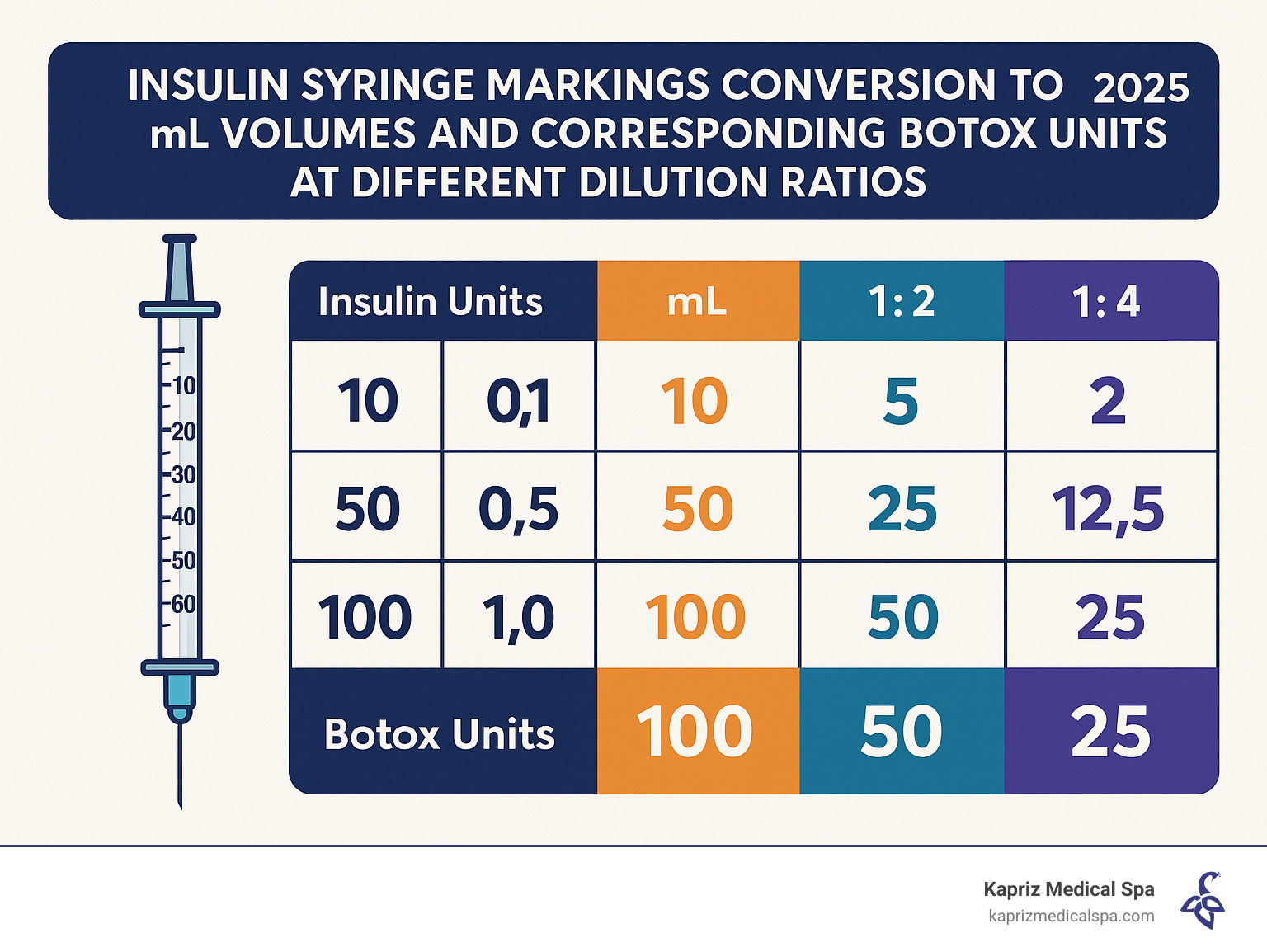
One hundred units of standard U-100 insulin equals exactly 1 milliliter (ml). In medical and diabetes management contexts, understanding insulin concentration and converting units to volume is essential for accurate dosing, safe administration, and proper equipment selection.
Navigating diabetes management requires precise measurements, clear communication with healthcare providers, and a thorough understanding of how insulin is formulated. While standard U-100 insulin makes unit-to-milliliter conversions straightforward, variations in insulin concentrations, syringe types, and delivery devices introduce complexities that require careful attention. This guide examines the relationship between insulin units and milliliters, explores standard concentrations, and provides practical insights for patients, caregivers, and healthcare professionals.
Understanding Insulin Concentrations and the U-100 Standard
Insulin is not measured in standard volume metrics like milligrams or grams in everyday clinical practice; instead, it is measured in "units" of biological activity. These units standardize the blood-glucose-lowering effect of the hormone regardless of the specific formulation or manufacturer. To translate these biological units into a physical liquid volume that can be drawn into a syringe or loaded into a pump cartridge, pharmacists and manufacturers use concentration standards denoted by the letter "U" followed by a number.
The most common concentration worldwide is U-100. The designation "U-100" means that there are 100 units of insulin dissolved in every 1 milliliter (ml) of solution. Because of this specific ratio, calculating volume from units or units from volume becomes a straightforward mathematical relationship:
$$\text{Volume in ml} = \frac{\text{Number of Units}}{\text{Concentration (Units per ml)}}$$
Therefore, for U-100 insulin:
$$\text{Volume in ml} = \frac{100 \text{ units}}{100 \text{ units/ml}} = 1.0 \text{ ml}$$
This ratio forms the baseline for nearly all modern insulin therapy, whether delivered via disposable syringes, insulin pens, or continuous subcutaneous insulin infusion pumps. However, recognizing that U-100 is a standard rather than a universal constant is critical for patient safety.
Historical Context and Alternative Insulin Concentrations
While U-100 is ubiquitous today, historical and specialized clinical scenarios involve other concentrations. Understanding these variations prevents catastrophic dosing errors, particularly for patients requiring high-dose insulin therapy or those transitioning between different care settings.
Historically, insulin was available in U-40 and U-80 concentrations. U-40 insulin contained 40 units per milliliter, meaning 100 units of U-40 insulin occupied 2.5 ml of fluid ($100 \div 40 = 2.5$). Although U-40 insulin is largely obsolete in human medicine in many parts of the world, it remains standard in veterinary medicine for diabetic cats and dogs, requiring specialized U-40 syringes to match the concentration.
Conversely, individuals with severe insulin resistance—often characterized by profound type 2 diabetes requiring massive daily doses—may utilize concentrated insulins. The most common modern concentrated formulations include:
- U-200 Insulin: Contains 200 units per milliliter. For this concentration, 100 units of insulin equals $0.5 \text{ ml}$ ($100 \div 200 = 0.5$).
- U-300 Insulin: Contains 300 units per milliliter (such as Toujeo). Here, 100 units equals approximately $0.33 \text{ ml}$ ($100 \div 300 \approx 0.33$).
- U-500 Insulin: Contains 500 units per milliliter (Regular U-500). In this specialized formulation, 100 units equals $0.2 \text{ ml}$ ($100 \div 500 = 0.2$). U-500 is five times as concentrated as U-100 and is reserved for patients requiring more than 200 units of insulin per day.
| Insulin Concentration | Units per Milliliter | Volume for 100 Units | Common Clinical Use |
|---|---|---|---|
| U-40 | 40 units/ml | 2.5 ml | Veterinary medicine (pets) |
| U-100 | 100 units/ml | 1.0 ml | Standard human diabetes care |
| U-200 | 200 units/ml | 0.5 ml | High-dose basal insulin therapy |
| U-300 | 300 units/ml | 0.33 ml | Long-acting basal insulin therapy |
| U-500 | 500 units/ml | 0.2 ml | Severe insulin resistance |
Conversion Mathematics: Units to Milliliters and Back
For healthcare professionals, pharmacists, and researchers, converting between units and milliliters for various insulin concentrations requires a firm grasp of proportional math. While patients using modern delivery devices rarely need to perform these calculations manually—because insulin pens and specialized syringes are pre-calibrated to the specific concentration—understanding the underlying formula ensures safety and cross-verification.
The general formula for finding the volume ($V$) in milliliters is:
$$V = \frac{U}{C}$$
Where $U$ represents the desired number of insulin units, and $C$ represents the concentration in units per milliliter.
Conversely, if a liquid volume in milliliters is known and the user needs to determine the number of insulin units, the formula is:
$$U = V \times C$$
Practical Calculation Examples
- Standard U-100 Calculation:
- Question: How many milliliters are in 50 units of U-100 insulin?
- Calculation: $50 \text{ units} \div 100 \text{ units/ml} = 0.5 \text{ ml}$.
- Concentrated U-300 Calculation:
- Question: A patient injects 75 units of U-300 insulin. What is the physical volume injected?
- Calculation: $75 \text{ units} \div 300 \text{ units/ml} = 0.25 \text{ ml}$.
- High-Resistance U-500 Calculation:
- Question: If a clinical protocol calls for 0.4 ml of U-500 insulin, how many units is the patient receiving?
- Calculation: $0.4 \text{ ml} \times 500 \text{ units/ml} = 200 \text{ units}$.
Attempting to measure concentrated insulins (like U-500) using standard U-100 syringes without accounting for the concentration factor will result in a fivefold overdose, highlighting why mathematical awareness is vital in clinical settings.
Insulin Delivery Devices and Calibration
The physical device used to administer insulin dictates how conversions are experienced by the end user. Modern insulin delivery systems are engineered to eliminate manual math, reducing the risk of human error.
Insulin Syringes
Traditional vial-and-syringe methods rely on syringes explicitly matched to the insulin concentration. U-100 syringes feature barrel markings calibrated directly in units of U-100 insulin, not in milliliters or cubic centimeters (cc).
- A 0.3 ml syringe typically holds up to 30 units of U-100 insulin.
- A 0.5 ml syringe holds up to 50 units of U-100 insulin.
- A 1.0 ml syringe holds up to 100 units of U-100 insulin.
Because the syringe barrel is pre-calibrated for U-100, drawing fluid to the "100 unit" line automatically draws 1.0 ml of liquid, regardless of the user's awareness of the milliliter volume. Using a U-100 syringe with U-40 or U-500 insulin without a conversion factor is a critical medication error.
Insulin Pens
Pre-filled and reusable insulin pens bypass liquid measurement entirely. The user dials the desired number of units on a mechanical or digital counter, and an internal mechanism dispenses the corresponding micro-volume of liquid. Whether the pen contains U-100, U-200, or U-300 insulin, the dial displays units, shielding the user from calculating milliliters. For example, dialing "100 units" on a U-300 pen delivers 0.33 ml of liquid through the pen's internal gearing.
Insulin Pumps
Continuous subcutaneous insulin infusion (CSII) pumps are programmed in units per hour (basal rates) and units per bolus. The pump reservoir is filled using standard U-100 insulin (or specialized rapid-acting formulations depending on pump model clearances). The pump's internal stepper motor translates programmed unit doses into exact mechanical displacements of the syringe plunger inside the pump housing, injecting microscopic aliquots of fluid.
Clinical Safety, Risks, and Error Prevention
Dosing errors involving insulin are among the most frequently reported medication mistakes in healthcare settings. Because insulin is classified as a high-alert medication by organizations such as the Institute for Safe Medication Practices (ISMP), rigorous safety protocols govern its dispensing, administration, and calculation.
The Dangers of Concentration Mismatches
The most severe errors occur when clinicians or patients confuse insulin concentrations—most commonly mixing up U-100 and U-500 insulin, or utilizing standard U-100 syringes to draw up U-500 insulin.
- Under-dosing scenario: If a patient prescribed U-500 insulin draws their dose using a U-100 conversion assumption incorrectly, they may receive a fraction of their intended dose, leading to severe hyperglycemia and potential diabetic ketoacidosis (DKA).
- Over-dosing scenario: Conversely, if a patient draws U-500 insulin into a standard U-100 syringe assuming a 1:1 unit-to-volume ratio, they will administer five times the intended dose, resulting in profound, life-threatening hypoglycemia.
Best Practices for Error Prevention
To mitigate these risks, healthcare providers and patients should adhere to established safety guidelines:
- Always check the label: Verify the concentration printed on the insulin vial or pen cartridge (e.g., U-100, U-300, U-500) before every administration.
- Match the device to the drug: Ensure that U-500 insulin is administered using dedicated U-500 syringes (which are color-coded and marked in actual units of U-500) or the designated U-500 pen device.
- Avoid volume conversions when possible: Rely on the unit markings on pens and dedicated syringes rather than attempting to measure milliliters with standard medical syringes, unless directed by a clinical protocol under pharmacist supervision.
- Consult professionals: For any questions regarding complex dosing regimens, transitional care, or unfamiliar concentrations, consult a certified diabetes care and education specialist (CDCES) or an endocrinologist.
Disclaimer: This article is for informational and educational purposes only and does not constitute medical, pharmacological, or clinical advice. Always follow the specific instructions provided by your healthcare team, endocrinologist, or pharmacist regarding insulin dosing and administration.
Frequently Asked Questions
Is 100 units of U-100 insulin always equal to 1 ml?
Yes. By definition, U-100 insulin contains 100 units of insulin per 1 milliliter of fluid. Therefore, 100 units of U-100 insulin has a physical volume of exactly 1 ml. This ratio remains constant for all standard U-100 rapid-acting, short-acting, intermediate-acting, and long-acting insulins.
How do I convert units to milliliters for U-300 insulin?
To find the volume in milliliters for U-300 insulin, divide the number of units by 300 (since there are 300 units in 1 ml). For example, 100 units of U-300 insulin equals approximately 0.33 ml ($100 \div 300$), and 300 units equals 1.0 ml.
Can I use a standard 1 ml syringe to measure insulin?
Standard medical 1 ml syringes (such as tuberculin syringes calibrated in cc or milliliters) should generally not be used to measure insulin unless specifically instructed by a healthcare professional in a controlled clinical setting. Insulin syringes are specifically calibrated in insulin units for U-100 formulations, and using standard volumetric syringes increases the risk of calculation errors, particularly with concentrated insulins.
What happens if I inject the wrong volume of insulin?
Injecting an incorrect volume of insulin can lead to dangerous blood glucose fluctuations. Administering too much insulin can cause severe hypoglycemia (dangerously low blood sugar), which can result in dizziness, confusion, seizures, or loss of consciousness. Administering too little insulin can cause hyperglycemia (high blood sugar), potentially leading to ketoacidosis over time. Seek immediate medical attention if a dosing error occurs.
Why are there different concentrations of insulin?
Different concentrations—such as U-200, U-300, and U-500—are designed for individuals with high insulin resistance who require large daily doses of insulin. Using concentrated formulations reduces the physical volume of fluid that must be injected subcutaneously under the skin, minimizing discomfort, leakage, and injection site irritation.