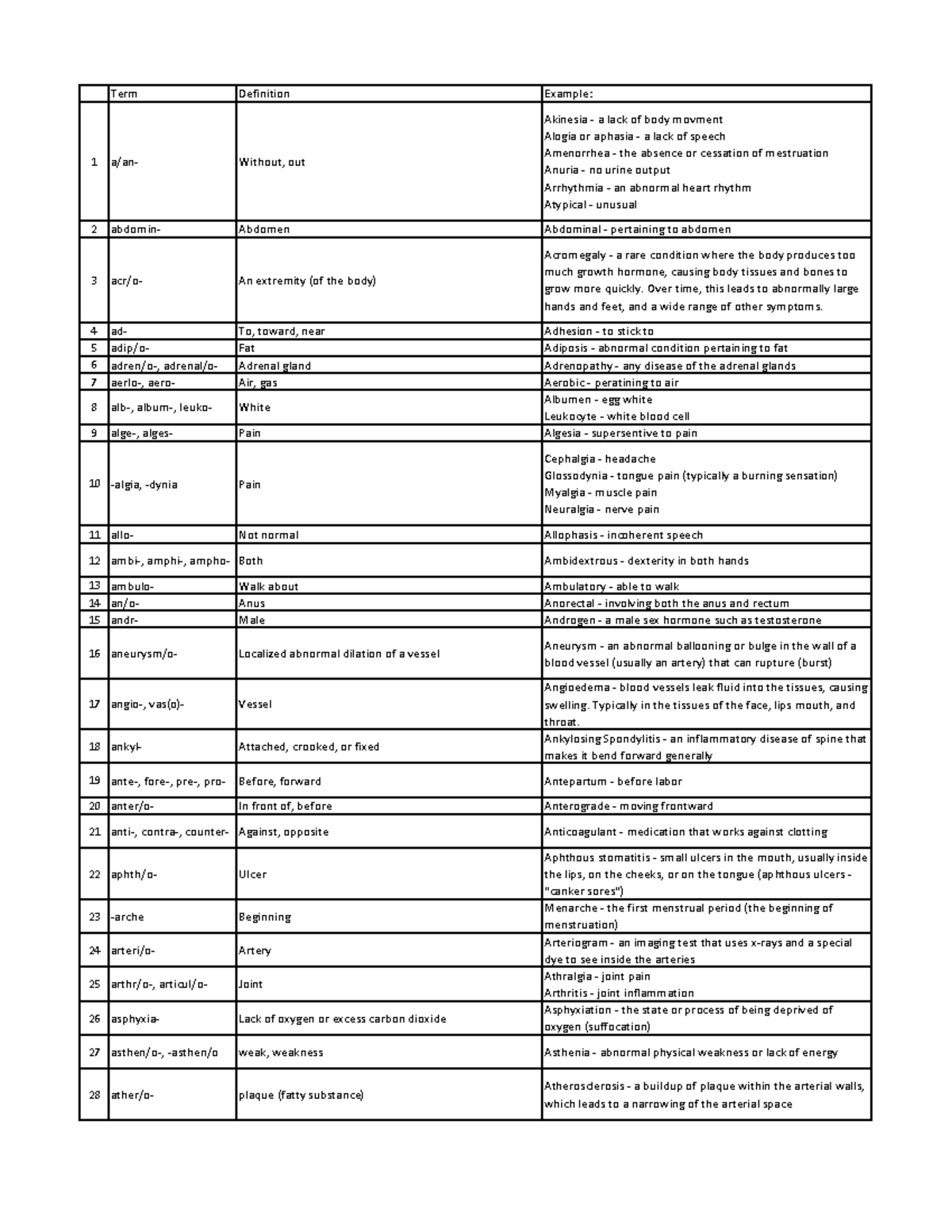
Navigating the language of medicine is essential for patient advocacy, informed decision-making, and effective communication with healthcare providers. Medical terminology is a standardized system derived primarily from Greek and Latin roots, designed to describe anatomy, physiology, pathology, and procedural interventions with precise accuracy. Understanding these terms helps bridge the gap between complex diagnostic reports and personal health management.
The Foundation of Medical Language
Medical terminology is not a random collection of words; it is a structured language based on a system of word building. By mastering a few basic principles—specifically prefixes, suffixes, and roots—you can decode even the most complex clinical jargon without memorizing an entire dictionary.
- Word Roots: These are the foundation of the term, usually indicating the body part or organ involved (e.g., cardio- for heart, gastro- for stomach, hepa- for liver).
- Prefixes: Added to the beginning of a word root to modify its meaning, often indicating direction, number, or time (e.g., hyper- meaning high or excessive, hypo- meaning low or deficient).
- Suffixes: Added to the end of a word root to describe a condition, disease, or procedure (e.g., -itis for inflammation, -ectomy for surgical removal).
By learning these components, you can decipher that "gastritis" is an inflammation (-itis) of the stomach (gastro-), or that "tachycardia" refers to a fast (tachy-) heart (-cardia) rate. This structural approach is the most effective way to gain literacy in clinical environments.
Categorizing Common Medical Terminology
To make sense of the vast landscape of medical language, it is helpful to group terms by their clinical context. Whether you are reviewing a diagnostic report, preparing for surgery, or managing a chronic condition, the following categories provide a framework for organizing the terminology you are most likely to encounter.
1. Diagnostic and Lab Terms
When blood work or imaging results are returned, they often contain technical abbreviations and acronyms. Understanding these is key to discussing results with your physician.
- CBC (Complete Blood Count): A common blood test used to evaluate overall health and detect disorders such as anemia or infection.
- Biopsy: The removal of a small piece of tissue for laboratory examination, usually to determine the presence or nature of a disease.
- Pathology: The study of the causes and effects of diseases, often focusing on laboratory samples.
2. Procedural and Surgical Terms
Surgical reports are dense with Latinate terminology that describes the specific intervention performed.
- Laparoscopy: A minimally invasive surgery where a camera and thin tools are inserted through small incisions.
- Prophylactic: An action or medication taken to prevent a disease rather than treat an existing one.
- Anastomosis: A surgical connection between two vessels, ducts, or bowel segments.
3. Symptom and Condition Descriptors
Terms describing how a patient feels or the nature of a condition are often used to define the severity and progression of a health issue.
- Acute: Describes a condition that is sudden, severe, and typically short-lived.
- Chronic: Refers to a condition that persists over a long period, usually three months or more.
- Asymptomatic: The presence of a disease or condition without any outward signs or symptoms.
Quick Reference: Common Medical Prefixes and Suffixes
The following table serves as a decoder for common medical terminology, allowing you to synthesize meanings when reading clinical notes or informational pamphlets.
| Component | Type | Meaning | Example |
|---|---|---|---|
| Brady- | Prefix | Slow | Bradycardia (Slow heart rate) |
| Dys- | Prefix | Difficult or painful | Dysphagia (Difficulty swallowing) |
| Hyper- | Prefix | Excessive or above normal | Hypertension (High blood pressure) |
| -algia | Suffix | Pain | Myalgia (Muscle pain) |
| -pathy | Suffix | Disease or suffering | Neuropathy (Nerve disease) |
| -plasty | Suffix | Surgical repair | Rhinoplasty (Nose surgery) |
| -scopy | Suffix | Visual examination | Colonoscopy (Exam of the colon) |
Communicating with Healthcare Providers
Understanding medical terminology is not intended to replace the expertise of your physician. Instead, it is a tool for better collaboration. When you receive a report with unfamiliar terms, follow these professional-grade steps to ensure you remain in control of your health decisions:
- Request Definitions: Never feel embarrassed to ask a provider to translate a technical term into plain language. Phrases like, "Could you explain what that diagnosis means in terms of my daily activities?" are highly effective.
- Verify via Reliable Sources: Use portals such as the National Library of Medicine (MedlinePlus) to look up specific conditions. Avoid relying solely on general search engine results, which may contain outdated or unverified information.
- Prepare a Glossary: If you are managing a chronic condition, keep a simple notebook or digital document where you list terms the doctor uses repeatedly. This helps you track the progression of your treatment and ensures you don't miss important details.
- Confirm the Context: A term can mean different things depending on the specialty. A "block" in cardiology refers to electrical signaling, whereas a "block" in anesthesiology refers to nerve numbing. Always ask for context.
Limitations and Professional Advice
It is critical to remember that medicine is a dynamic field where the interpretation of symptoms is highly personalized. While you can learn to read a medical report, you should never attempt to self-diagnose or alter your prescribed treatment plan based on your own interpretation of medical literature. Any decision regarding changes to medication, surgical options, or lifestyle interventions must be made in consultation with a licensed healthcare professional. Medical guides are for educational purposes and do not constitute formal medical advice, diagnosis, or treatment.
Frequently Asked Questions
What is the difference between an "acute" and a "chronic" condition? An acute condition appears suddenly and lasts for a short duration, such as a broken bone or an infection. A chronic condition is a long-term health issue that requires ongoing medical management, such as diabetes or hypertension.
Why do doctors use Latin and Greek terms instead of common language? These languages provide a universal, standardized vocabulary that transcends national borders. This allows medical professionals worldwide to communicate with high precision, ensuring that the description of an anatomical location or a physiological process is understood exactly the same way regardless of the speaker's native language.
How can I verify if a medical term I read online is legitimate? Always check the source of the information. Legitimate medical terms are typically documented by academic institutions, government health agencies, or professional medical boards. If you find a term on a commercial or blog-style website, cross-reference it with a trusted resource like the U.S. National Library of Medicine.
If I don't understand my discharge papers, what should I do? Contact the office of the physician who performed the procedure or diagnosis. Most clinics have nurses or patient coordinators who can walk you through the discharge summary, explain the medications listed, and clarify the necessary follow-up steps.
Are all medical abbreviations standardized? No. While many are common, some abbreviations can be misinterpreted or lead to errors. For example, some abbreviations for "daily" or specific units of measurement have been flagged by safety organizations like the Joint Commission for their potential to be confused. Always ask for clarification if an abbreviation seems ambiguous.
Next Steps for Health Literacy
Start your journey toward better health literacy by identifying the five most frequent terms in your own medical records. Research these specifically using the root-word method outlined in this guide. By taking an active role in deciphering your personal health history, you become a more effective partner in your own care. In 2026, with the rise of patient portals, you have more access to your data than ever before; use this access to build a clear, terminology-informed understanding of your wellbeing.